Loading…


Shonen TCG · Guides
Union Arena Tokyo Ghoul Deck Guide: Purple Kaneki 2026
8 min readBy Ryu Nakamura
Reviewing
Union Arena
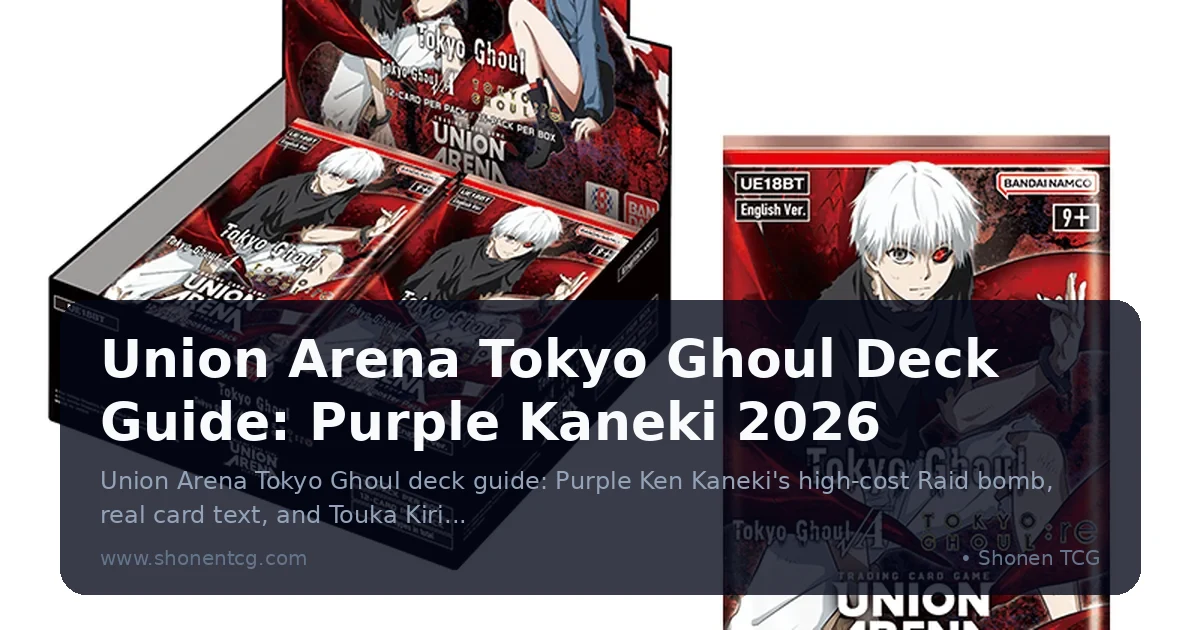
Union Arena Tokyo Ghoul deck guide time: while newer franchises have grabbed recent tournament headlines, Ken Kaneki's Purple build has quietly stayed a real, currently-competitive archetype since UE18BT launched. This guide covers the actual printed card text behind Kaneki's variable-cost Raid engine, Touka Kirishima's synergy role, and where the honest gaps in tournament data currently sit.
TL;DR: Purple Tokyo Ghoul runs on Ken Kaneki (UE18BT/TKG-1-042, 12-cost, 5000 BP), a Raid Character whose Raid cost drops by 1 for every differently-costed card in your sideline, making a full sideline the difference between an unplayable bomb and a genuine mid-game threat. Touka Kirishima (UE18BT/TKG-1-047) is the deck's flexible early piece, reactivating cheap characters or drawing cards, and later resting an active Kaneki to grant herself Double Attack. Bandai's official results archive credits Tokyo Ghoul with a handful of top-placing finishes in the 3-4 range since December 2025.
What does the Union Arena Tokyo Ghoul deck actually do? (quick answer)
Fill your sideline with a spread of differently-costed cards to bring Ken Kaneki's steep 12-cost Raid down to something actually castable, then use his attack trigger to force a bad choice on your opponent. It's a sideline-management deck first and a beatdown deck second, since Kaneki's whole plan depends on what's already sitting in that zone by the time you want to Raid him in.
Overview: Kaneki's variable-cost Raid engine
Ken Kaneki (UE18BT/TKG-1-042, SR) is a 12-cost Purple Raid Character with 5000 BP, and that base cost is a wall on its own. His printed text turns that wall into a real plan, though: when he performs Raid, his required energy drops by 1 for each card with a different required-energy value already in your sideline. A sideline stocked with a genuine spread of costs, rather than a pile of identical cheap cards, is what actually makes him playable at a reasonable point in the game.
That distinction matters for deckbuilding. A sideline full of 1-cost cards only ever counts as one distinct value toward the discount. Deliberately varying what ends up sidelined, rather than dumping whatever's cheapest, is the real skill behind casting Kaneki on curve instead of on turn nine or later.
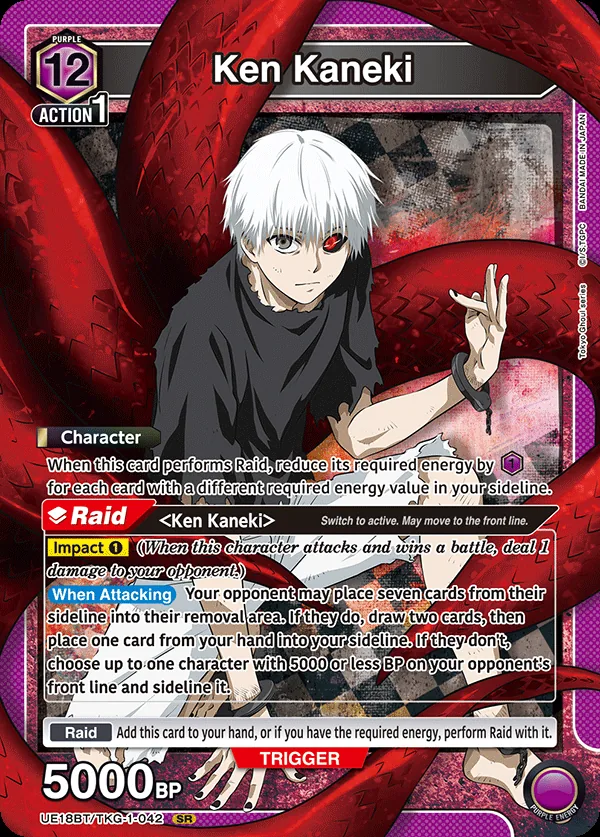 Ken Kaneki's Raid cost reduction: 1 less required energy for every differently-costed card already in your sideline.
Once he's in, Kaneki carries Impact (bonus damage on a won battle) and a genuinely nasty When Attacking trigger: the opponent may remove seven of their own sideline cards to their removal area, and if they do, you draw two cards and sideline one from your hand. If they refuse, you instead choose an opponent front-line character with 5000 or less BP and sideline it directly. Either branch is bad for the opponent, which is exactly the point.
GODEEPER: New to Union Arena's Raid mechanic entirely? The full rules breakdown covers how Raid Characters work across every color, not just this one. Union Arena Raid Mechanic Explained →
Touka Kirishima: the flexible early piece
Ken Kaneki isn't a turn-one play, so the deck needs a way to function before he's castable. Touka Kirishima (UE18BT/TKG-1-047, SR) is a 4-cost Purple Raid Character with 4000 BP that fills exactly that role.
Her When Played ability gives a real choice: either reactivate a character with 3 or less required energy already on your field, or simply draw a card. Both options are useful in different situations, reactivating a body that already traded keeps pressure on, while drawing digs toward whatever piece you're missing. Once Kaneki is actually on the field, her Activate: Main ability (usable once per turn while she's on the front line) rests an active Ken Kaneki with 4 or less required energy to grant herself Double Attack for the turn, a real payoff for having both pieces out together.
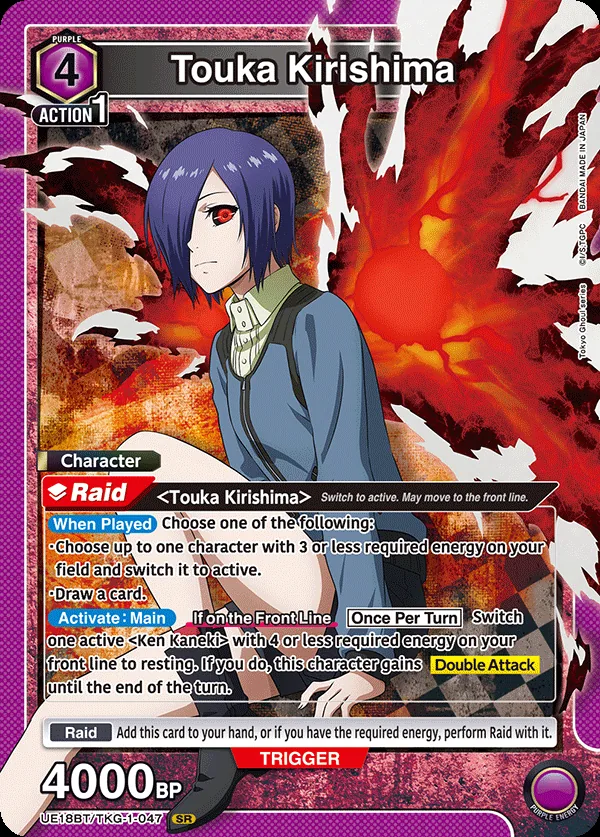 Touka Kirishima's Activate: Main ability rests a cheap active Ken Kaneki to grant herself Double Attack, a direct synergy line between the deck's two named leads.
Step-by-Step: piloting Purple Tokyo Ghoul
1. Sideline for variety, not just for cost. Every differently-costed card in your sideline reduces Kaneki's Raid cost by 1, so a spread of values gets him online faster than a stack of identical cheap cards ever will.
2. Play Touka early regardless of your Kaneki timing. Her When Played choice is useful on curve whether or not Kaneki is anywhere close to castable, so there's rarely a reason to hold her back.
3. Track your actual Raid cost for Kaneki every turn, not just at the start of the game. Since it changes as your sideline grows, recheck it before committing to a plan that assumes last turn's number.
4. Use Kaneki's When Attacking trigger as a genuine threat, not a coin flip. Both branches benefit you, so attacking with him is close to a free choice for your opponent to make worse, not a gamble on their part.
Tips
Read Kaneki's cost-reduction text carefully before assuming it's a flat discount. It counts distinct required-energy values in your sideline, not raw card count, so a sideline of five identical 1-cost cards only counts once.
Community deck-tech coverage has generally treated this build as a real mid-pack contender rather than a top-tier deck, useful context if you're weighing it against a franchise with a bigger recent headline result. It rewards patient sideline management over a fast, low-decision plan.
If you're building around Touka specifically, hold a spare 4-or-less-cost Kaneki in mind as a target for her Double Attack synergy before committing her Activate: Main ability to a turn where no such target exists.
Where Tokyo Ghoul actually stands right now
Bandai's official top-placing decks archive shows Tokyo Ghoul with a handful of cumulative finishes in the 3 to 4 range since December 2025, a real mid-pack presence in a currently open field rather than a deck that's fallen off since launch. It hasn't posted the headline regional result that Bleach or Rurouni Kenshin have recently, but it's stayed a genuine, currently-playable option through the format's ongoing rotation of hot decks.
GODEEPER: Curious how Tokyo Ghoul's placements stack up against the rest of the current Union Arena field? Union Arena Current Meta: Which Deck Is Strongest Right Now →
Key Takeaways
- Ken Kaneki (UE18BT/TKG-1-042, SR, Purple, 12-cost) is the deck's core engine: his Raid cost drops by 1 for each differently-costed card in your sideline
- Touka Kirishima (UE18BT/TKG-1-047, SR, Purple, 4-cost) is the flexible early piece, reactivating a cheap character or drawing a card, then later resting Kaneki for her own Double Attack
- The UE18BT set spans both Tokyo Ghoul and Tokyo Ghoul:re, giving the deck a wider character pool than a single-arc release
- Tokyo Ghoul has a handful of cumulative official top-placing finishes in the 3-4 range since December 2025, a genuine mid-pack presence
- Kaneki's When Attacking trigger forces a real choice on the opponent, both branches favor the Kaneki player
Frequently Asked Questions
Is Purple Kaneki a good deck in Union Arena? Yes. It's a real, currently-competitive archetype: Bandai's official results archive credits Tokyo Ghoul with a handful of top-placing finishes in the 3-4 range since December 2025, a genuine mid-pack presence rather than a launch deck that's since fallen off.
What does the Ken Kaneki card actually do? Ken Kaneki (UE18BT/TKG-1-042, SR, 12-cost, 5000 BP) is a Raid Character whose Raid cost drops by 1 for each differently-costed card in your sideline. He carries Impact, and When Attacking, forces the opponent to choose between removing 7 of their own sideline cards or letting you sideline their character.
What is Touka Kirishima's role in the deck? Touka Kirishima (UE18BT/TKG-1-047, SR, 4-cost, 4000 BP) is the deck's early-game piece. Her When Played ability either reactivates a cheap character or draws a card, and her Activate: Main ability rests an active Ken Kaneki to grant herself Double Attack.
Does this set only cover the original Tokyo Ghoul anime? No. The official UE18BT booster art and card pool span both Tokyo Ghoul and its sequel Tokyo Ghoul:re, giving the deck a wider character pool than a single-arc set would.
Is this a good deck for new Union Arena players? It's playable but not the easiest on-ramp. Ken Kaneki's variable Raid cost takes real sideline-tracking to use efficiently, and his When Attacking trigger asks the opponent to make a choice that a new pilot may not immediately read correctly. A simpler top-tier deck is generally friendlier for a first Union Arena deck.
Related Reading
- Union Arena Fullmetal Alchemist Deck Guide: Blue 2026: Another mid-pack franchise with its own resource-management core.
- Union Arena Card Rarities Explained: Every Tier in 2026: What SR rarity actually means for cards like Kaneki's and Touka's prints.
- Union Arena TCG Beginner Guide: How to Start (2026): The sideline and energy basics behind every card in this guide.
- Union Arena Deck Building Guide: Build a 50-Card Deck: The legal deck-construction rules to apply once you've picked this archetype.
References
- UNION ARENA BOOSTER PACK Tokyo Ghoul series [UE18BT] official product page: Bandai's official set listing and release details
- UNION ARENA Card List, official card database: Source for Ken Kaneki's and Touka Kirishima's verified card text used in this guide
- TCGPlayer Union Arena: Tokyo Ghoul: Card pricing reference
Was this guide helpful?
About the author
RN
Beginner Guides & Crossover Writer
Anime fan turned TCG content creator. Bridges the gap between anime fandom and card game strategy. Covers beginner guides, anime-to-TCG crossover content, and Union Arena.
- TCG content creator since 2022
- Specializes in onboarding new players
- Covers Union Arena multi-IP content
- Bridge between anime fandom and TCG community
Disclaimer
This article is published for informational and entertainment purposes. It does not constitute professional financial, legal, or technical advice. Game performance, online services, patch schedules, and store listings change. Verify critical details (pricing, system requirements, regional availability) with publishers and storefronts before you buy. Affiliate links, where present, help support our editorial work and are labelled in our affiliate disclosure.