

Shonen TCG · Guides
Union Arena Evangelion Deck Guide: Yellow A+-Tier 2026
This Union Arena Evangelion deck guide covers a Yellow deck with documented regional results and several distinct public tracker variants. Below is what the deck actually does, how the current Standard tracker separates those variants, and where the English deck stands after newer sets expanded the field.
TL;DR: Yellow Evangelion uses strong energy generation and high unit density to apply pressure early while keeping late-game options open. TCG Contender's current Standard page lists Evangelion Test Type-01 Pseudo DMS Phase in Tier 1, with Rei Ayanami and Evangelion Proto Type-00 in Tier 2. Official results also show Yellow Evangelion in 3rd at GENCON on August 21 and 1st at Carta Magica in May. A Japan-to-English Asuka cut is not verified by the allowed sources, so it is not used as a causal claim here.
Updated October 2, 2026: TCG Contender's current Standard page, updated September 29, splits Evangelion into named variants instead of one A+ family label: Test Type-01 Pseudo DMS Phase is Tier 1, while Rei Ayanami and Proto Type-00 are Tier 2. The official GENCON and Carta Magica results remain unchanged.
What does the Yellow Evangelion deck actually do? (quick answer)
Apply consistent mid-game pressure while banking enough staying power to survive into the late game, using Yellow's strong energy generation and the set's dense character count to threaten multiple attacks per turn without over-committing. It's a tempo deck, not a pure aggro or pure control deck, and that flexibility is exactly why it held the top of the format for so long.
Overview: pressure and staying power together
Most Union Arena decks lean hard into one plan: race with aggression, or grind with control. Yellow Evangelion's actual strength is refusing to fully commit to either. Yellow's energy generation keeps the board consistently active turn over turn, and the Evangelion cast's unit density (a large pool of playable characters at every cost point) means the deck rarely runs out of bodies to threaten with, while still holding back enough to defend when it needs to.
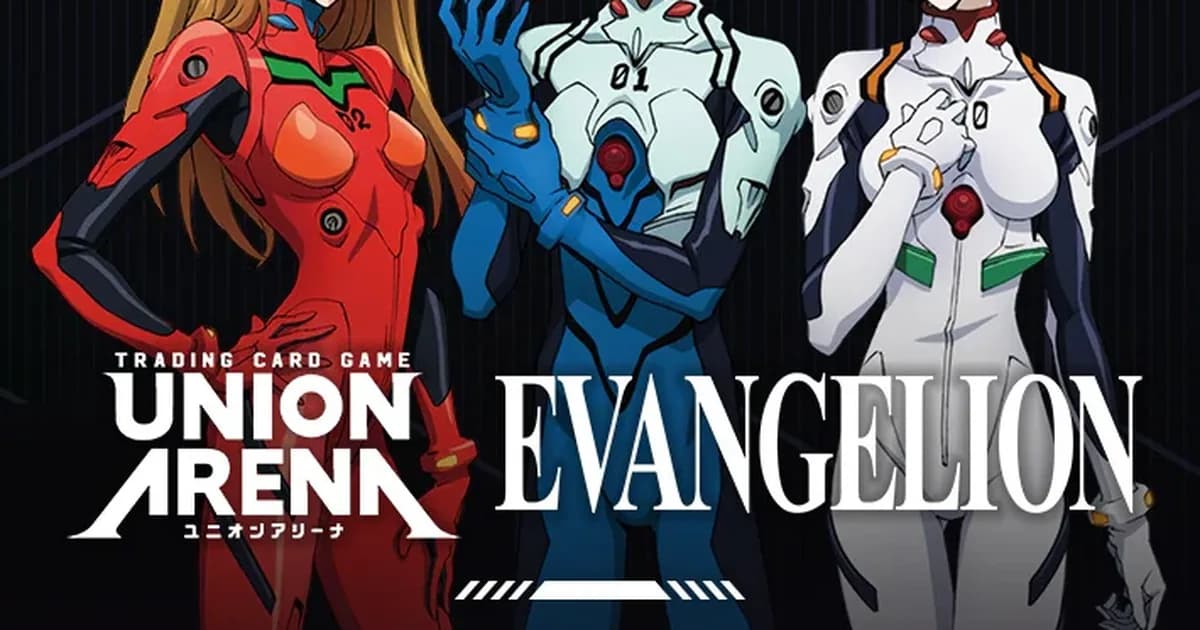
 Rei Ayanami and her EVA unit, part of the official Evangelion: New Theatrical Edition set art.
Part of the deck's toolkit runs through energy-recycling effects rather than direct combat tricks. Misato Katsuragi (UE15BT/EVA-1-006), a 0-cost Yellow Character, is a clean example: her Activate:Main ability switches herself to resting and sidelines herself to choose one yellow character on your field and switch it to active. That's a real tempo tool, letting you reuse a character's ability or get an attacker back up a turn earlier than it would otherwise be available, at the cost of Misato herself leaving the field.
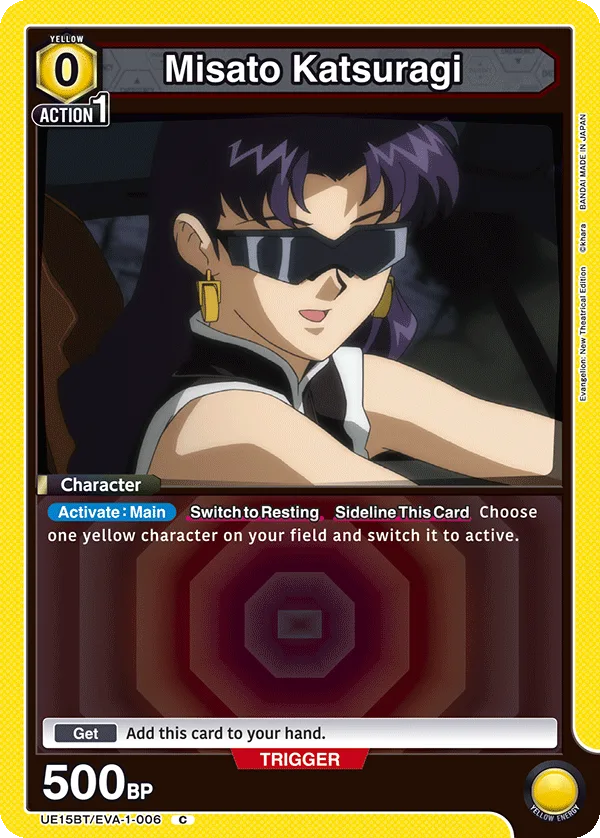 Misato Katsuragi's Activate:Main ability: sideline her to switch another yellow character on your field back to active.
GODEEPER: Curious how Evangelion compares to the decks currently ahead of it? Union Arena EN Meta Tier List 2026 →
The card that got cut between Japan and English
The earlier version of this guide attributed the English deck's ceiling to a zero-cost Asuka card allegedly cut during localization. The official Union Arena product and card pages, plus TCG Contender's public tracker, do not establish that claim, so it should not be presented as fact. If you copy a Japanese list, compare every entry against the official English card list before buying or registering it.
Step-by-Step: Playing the Tempo Plan
1. Develop board width in the early turns, not just power. The deck's strength comes from having enough characters in play to threaten multiple angles, not from committing everything to one big threat.
2. Use energy-recycling pieces like Misato proactively, not reactively. Sidelining her to reset a key character to active is strongest when it sets up your next attack, not as a last-resort save.
3. Hold back genuine defensive options as the game develops. Because the deck doesn't have to choose between offense and defense the way a pure aggro list does, resist the urge to dump your whole hand early just because you can.
4. Re-evaluate the matchup before committing to an all-in turn. Check whether you're playing into a mirror-adjacent grind, a BP-reduction deck, or an aggressive discard finisher, since the right amount of pressure versus defense shifts by opponent.
Tips for playing Evangelion in the current meta
Respect the format has changed around you. Evangelion's own kit hasn't gotten weaker since spring, but SAKAMOTO DAYS' free-play engine and Reze's BP-reduction plan both generate more raw value per turn on paper. Winning with Evangelion now means leaning harder into the flexibility that made it strong in the first place, not trying to out-value decks built specifically to do that better.
Don't assume every online decklist uses the EN card pool. Double-check any Japanese list against the official English card list before you buy singles or register it, because a source can use a different release and legality context.
Evangelion remains a strong choice if you already have the cards or want a deck that rewards adaptable play over a single fixed game plan, it's just no longer the automatic first pick it was through the spring.
Matchup notes
Against Yellow SAKAMOTO DAYS, expect a close mirror-adjacent grind, both decks apply steady pressure rather than an explosive one-turn kill, so whoever manages tempo more efficiently over several turns tends to pull ahead. Against Purple Reze, Evangelion's high unit density is a real asset, Reze's BP-reduction effects have to spread across more bodies than a narrower deck would present, which blunts the value of any single reduction. Against Red Kagurabachi, respect Chihiro Rokuhira's Double Attack threat specifically, Evangelion's defensive options need to be online before Kagurabachi assembles its discard-fueled finisher, not after.
Where Evangelion actually stands right now
Yellow Evangelion placed 3rd at GENCON 2026 on August 21, 2026, and earlier took 1st place (Yellow) and 2nd place (Purple) at Carta Magica Regionals in May. Those are real results, but they do not justify carrying one old A+ label across every Evangelion variant. TCG Contender's current Standard page lists Test Type-01 Pseudo DMS Phase in Tier 1, while Rei Ayanami and Proto Type-00 are in Tier 2. The tracker therefore supports variant-level evaluation rather than one blanket family ranking.
Key Takeaways
- Yellow Evangelion applies mid-game pressure while keeping late-game staying power, driven by strong energy generation and high unit density
- Japanese and English lists should be compared against the official English card list; the earlier zero-cost Asuka localization claim is not verified by the allowed sources
- Misato Katsuragi (EVA-1-006) is a real example of the deck's energy-recycling toolkit: sideline her to switch another yellow character back to active
- The deck placed 3rd at GENCON 2026 (August 21) and took 1st (Yellow) at Carta Magica Regionals in May
- TCG Contender's current Standard page lists Test Type-01 Pseudo DMS Phase in Tier 1, with Rei Ayanami and Proto Type-00 in Tier 2
Frequently Asked Questions
Is Yellow Evangelion still a good deck in Union Arena? Yes, but use the current variant labels rather than one A+ family label. TCG Contender lists Evangelion Test Type-01 Pseudo DMS Phase in Tier 1, and Rei Ayanami plus Proto Type-00 in Tier 2. Yellow Evangelion placed 3rd at GENCON 2026 on August 21 and took 1st at Carta Magica Regionals in May.
Why did Yellow Evangelion fall from S-tier to A+? A+ is the older shorthand used by this article, not the current TCG Contender label. The tracker separates Evangelion into named variants, so evaluate Test Type-01 Pseudo DMS Phase, Rei Ayanami, and Proto Type-00 by their individual rows rather than applying one family tier.
What card was cut from the English version of Yellow Evangelion? I could not verify a zero-cost Asuka localization cut from the allowed official Union Arena and TCG Contender sources checked for this update. Check the official English card list before treating a Japanese list as legal or complete.
What does the Yellow Evangelion deck actually do? It applies mid-game pressure while keeping late-game staying power, backed by Yellow's energy generation and the set's high unit density. That combination lets the deck threaten multiple attacks per turn while still holding defensive options, rather than committing fully to one game plan.
Is Evangelion a good deck for new Union Arena players? It's a reasonable second deck, not the easiest first one. The energy-recycling toolkit (cards like Misato Katsuragi switching characters between active and resting) rewards understanding tempo, which takes a few games to click. Red Kagurabachi is generally a more straightforward starting point.
Related Reading
- Union Arena SAKAMOTO DAYS Deck Guide: Compare Evangelion's flexible Yellow plan with another current Union Arena tempo shell.
- Union Arena Chainsaw Man Reze Deck Guide: A different removal and tempo plan to test against Evangelion.
- Union Arena Red Kagurabachi Deck Guide: A more beginner-friendly top-tier deck for comparison.
- Union Arena Current Meta Tier List: The official tournament results archive Evangelion's placement data draws from.
References
- UNION ARENA official Evangelion: New Theatrical Edition product page: official card images and set details for UE15BT, source for the Misato Katsuragi card text quoted above
- UNION ARENA official card list: English card-pool reference; it does not confirm a localization-cut claim
- UNION ARENA official top-placing decks archive: GENCON 2026 and Carta Magica Regionals placement results
- TCG Contender Union Arena Standard meta: current variant-level tier labels and scores
Was this guide helpful?
About the author
Beginner guides and anime crossover
Pen name for the Shonen TCG desk's beginner guides, starter decks and anime-to-card-game explainers.
- Rules checked against the official rulebook and card text
- Every claim traced to a cited source
- Opinions marked as ours, with the reason
Keep reading

Union Arena Chainsaw Man Reze Deck Guide: Purple 2026
Guides · 7 min
Union Arena SAKAMOTO DAYS Deck Guide: Yellow Free-Play
Guides · 9 min
Union Arena Purple Todo Deck Guide: JJK Regional Winner
Guides · 7 min
Union Arena Bleach Ichigo Deck Guide: Purple Build 2026
Guides · 8 min

Union Arena Madoka Magica Set Announced: UE29BT 2027
News · 5 min
Union Arena Rurouni Kenshin Deck Guide: Red Build 2026
Guides · 9 min

Union Arena Re:ZERO Prerelease: What to Expect (2026)
Guides · 9 min
Union Arena Attack on Titan Vol.2: New Yellow Color
Guides · 8 min
Disclaimer
This article is published for informational and entertainment purposes. It does not constitute professional financial, legal, or technical advice. Game performance, online services, patch schedules, and store listings change. Verify critical details (pricing, system requirements, regional availability) with publishers and storefronts before you buy. Affiliate links, where present, help support our editorial work and are labelled in our affiliate disclosure.