Loading…


Shonen TCG · Guides
Union Arena Attack on Titan Vol.2 EN Tier List: Snapshot
Union Arena Attack on Titan Vol.2 EN tier list: separate public list volume from official recommended shells, with Yellow's launch evidence clearly labeled.
15 min readBy Alex Chen
Reviewing
Union Arena
This Union Arena Attack on Titan Vol.2 EN tier list is a launch snapshot researched on September 18, 2026. Attack on Titan Vol.2 is now an English release, but a responsible ranking needs to separate Bandai's recommended recipes, public decklist volume, and verified tournament results. They are not interchangeable.
The English set released on September 18, while the public list hub checked for this article showed lists through September 10. That means the list volume is an early signal from prerelease and launch testing, not a post-launch regional win-rate table.
TL;DR: Red has the deepest public list footprint, with Armin Arlelt and Eren Jaeger at 78 lists each and Mikasa Ackermann at 74 on the cited Attack on Titan hub. Blue and Green also have established pools, led by Eren Jaeger (Attack Titan) at 47, Levi at 44, Reiner Braun at 36, Historia Reiss at 34, and Ymir (Jaw Titan) at 33. Yellow is the important new Vol.2 watchlist: Bandai recommends both Eren and Zeke Rumbling and a Mikasa, Levi, Armin, and Falco shell, but no verified Attack on Titan placement was visible in the official top-placing archive at this snapshot.
Last checked: Bandai's Attack on Titan Vol.2 product page, recommended recipes, top-placing archive, and Union Arena Decklists were checked on September 18, 2026. The public list snapshot is dated through September 10, so revisit the tiers when post-release event lists appear.
Union Arena Attack on Titan Vol.2 EN tier list: quick answer
The safest early read is Red first for evidence, Blue and Green next for established depth, and Yellow as the high-interest unproven lane. That is not a claim that Red has the best win rate. It is a ranking of how much public deck activity and supporting recipe information we can actually verify today.
| Evidence tier | Color or build family | Public list signal | What the evidence supports |
|---|---|---|---|
| A, volume signal | Red 104th Cadet Corps and Attack Titan | Armin 78, Eren 78, Mikasa 74, Eren Attack Titan 47 | The deepest existing pool, with Vol.2 cards already appearing in public and official recipes |
| B, established pool | Blue Levi, Historia, and Ymir | Levi 44, Historia 34, Ymir Jaw Titan 33 | A mature UE10BT foundation that has started absorbing Vol.2 cards |
| B, established pool | Green Titan families | Reiner 36, Annie Female Titan 30, Reiner Armored Titan 27, Zeke Beast Titan 26 | Multiple proven title shells, with separate Vol.2 packages rather than one single build |
| C, lower volume | Green and Blue secondary families | Bertholdt Colossal 17, Rod Titan 14, Erwin 3, Armored Titan 2 | Real deck activity, but a smaller public sample than the leading hubs |
| Watchlist | New Yellow Vol.2 builds | No separated public Yellow hub count found | Two official recipes and several high-impact cards, but not enough verified result data for a letter tier |
The counts are not unique deck totals. A single public list can contain more than one named character and therefore be represented on more than one hub. Read the table as a comparison of visible activity, not as a metagame share chart.
How this Attack on Titan Vol.2 tier list was built
The evidence comes from two live sources and one important negative check.
First, Bandai's official Recommended Decks by Title page showed eight Attack on Titan recipes dated September 10, 2026: two Yellow, two Blue, two Green, and two Red. Those are useful starting shells and confirm which Vol.2 packages Bandai expects players to test. They are not event standings.
Second, Union Arena Decklists' Attack on Titan hub showed public 50-card Standard lists through September 10. Its character pages report the list counts used above and identify each page's color and card family. It is a fan site, not an official Bandai results database, so it provides a public-interest signal rather than a tournament rating.
Finally, Bandai's official Top-Placing Decks archive did not show an Attack on Titan entry in the current page snapshot. No verified regional result or official win rate is used here. If a regional posts results after this article's scheduled September 22 publication, the Yellow watchlist and the volume tiers should be revisited rather than treated as permanent rankings.
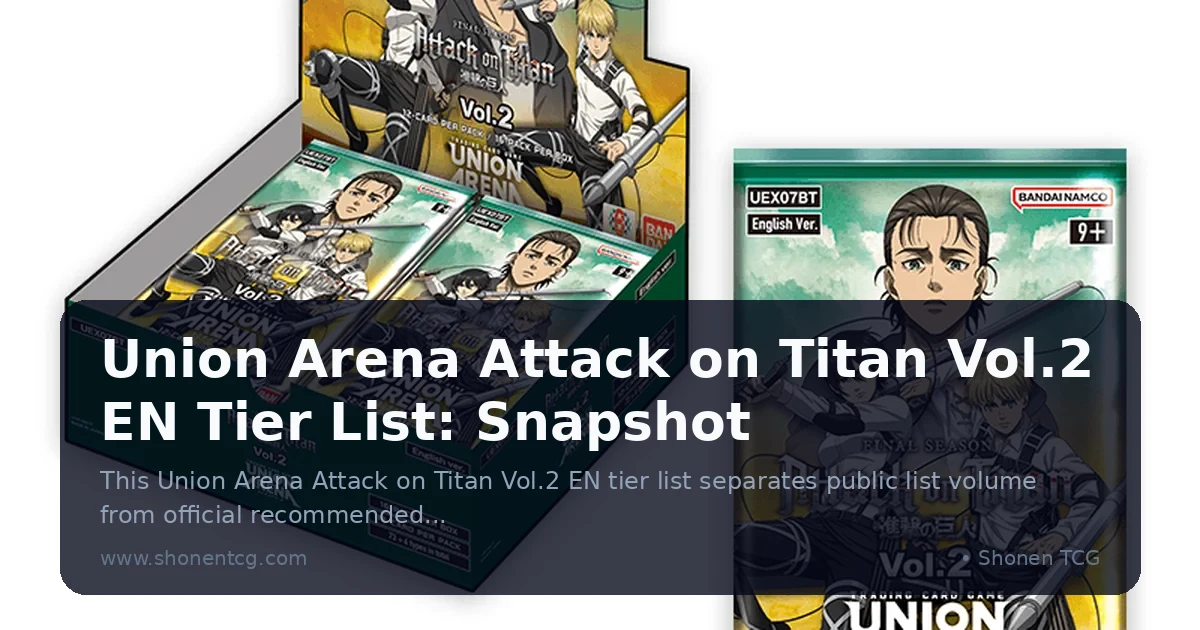
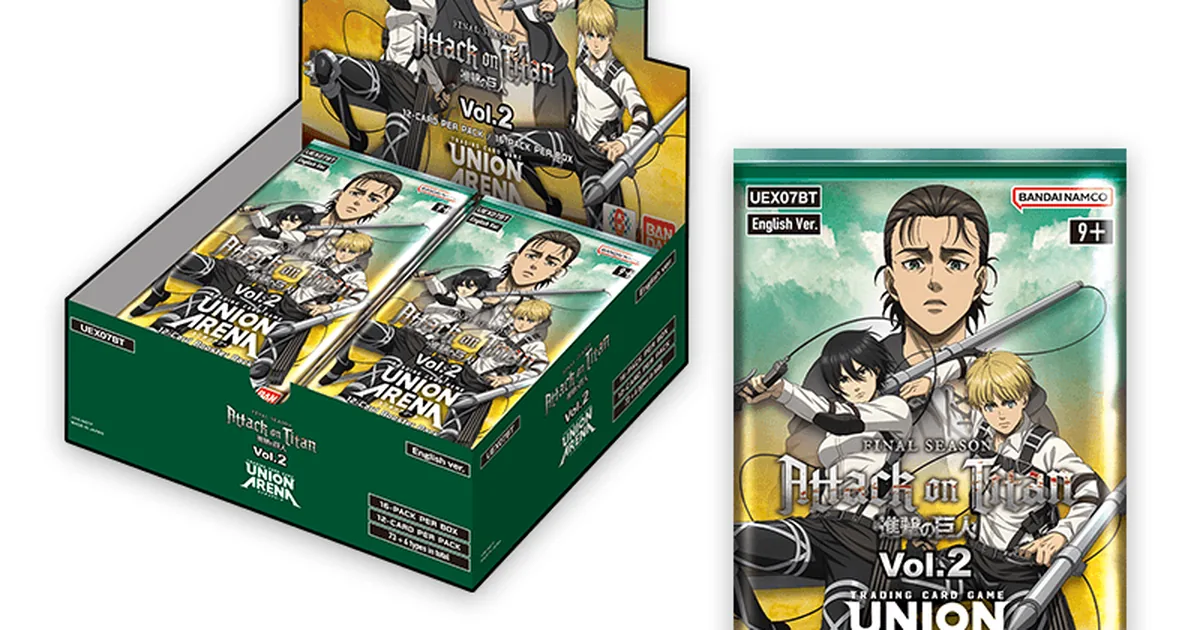 The official UEX07BT product image shows the booster box and pack art used for the Vol.2 English release.
Tier A evidence: Red 104th Cadet Corps and Attack Titan
Red has the strongest case for an early top tier because it has the largest visible public footprint and two distinct official recipes. Armin Arlelt and Eren Jaeger each appear on 78 public list hubs, while Mikasa Ackermann appears on 74. The Eren Jaeger (Attack Titan) hub adds another 47-list package.
That does not mean the four numbers should be added together. Red lists often include several of these characters in the same 50 cards, and the hub counts overlap by design. The useful conclusion is narrower: players are testing the established Red shell more often than any other Attack on Titan family currently visible in the public data.
The official Red recipes show two recognizable directions. One uses the Vol.2 Mikasa and Eren cards inside a 104th Cadet Corps shell. The other uses the Vol.2 Eren cards, including the Attack Titan package, alongside the older red core. That makes Red the easiest place to start if you want a deck with an existing card pool and new-set upgrades to test immediately.
The strategic identity is also easy to verify from the card text. The existing red Eren and Mikasa cards are Raid characters, and their effects reward a front-line attack sequence built around 104th Cadet Corps cards. Vol.2 does not replace that identity. It gives the shell more ways to convert attacks into pressure and lets players test whether the new red cards improve the established curve.
The caution is important: public list volume can reflect familiarity, card availability, or prerelease enthusiasm. It is not a substitute for win-loss data. Red earns the A label in this article because it has the most visible evidence, not because a verified event has already proven it superior.
Tier B evidence: Blue Levi, Historia, and Ymir
Blue has three substantial public hubs: Levi at 44 lists, Historia Reiss at 34, and Ymir (Jaw Titan) at 33. Those figures put Blue behind the leading Red families but ahead of the lower-volume groups. More importantly, the official recipes show that Blue is not being treated as a single narrow list.
Bandai's Blue recipes split between a Levi package and a Historia package supported by the existing Ymir cards. The Vol.2 contribution is visible in the recommended lists: one recipe uses new Levi cards, while the other uses new Historia cards and the Sweet Candy event. That is a real upgrade path even before tournament results exist.
The new Yellow Levi is a separate card from the established Blue Levi family, so do not treat the two colors as one deck. The official Vol.2 card page identifies Yellow Levi as a five-energy, 4000-plus BP Character with an Activate: Main ability that can switch him active or give him Double Attack after meeting a Yellow board condition. That card belongs to the Yellow watchlist, not this Blue tier.
Blue therefore earns a B label for depth and continuity. It has enough public deck history to be a serious testing option, but the available sources do not justify calling it a tournament-proven answer to the new Yellow cards.
Tier B evidence: Green Titan families
Green is more spread out than Red or Blue. Reiner Braun leads the public hub at 36 lists, followed by Annie Leonhart (Female Titan) at 30, Reiner Braun (Armored Titan) at 27, and Zeke Jaeger (Beast Titan) at 26. Bertholdt Hoover (Colossal Titan) at 17 and Rod Reiss (Titan) at 14 show additional, smaller lines.
The official Green recommendations confirm that this is not one uniform list. One recipe adds the Vol.2 Pieck Finger and Armored Titan package to the older Annie and Reiner shell. The other adds the Vol.2 Zeke and Beast Titan package to the existing Pure Titan plan. Both are credible starting points, but they answer different deck-building questions.
Green's B placement reflects the number of established shells, not a claim that every one of them is equally strong. If you already own the first Attack on Titan set, Green offers a clear way to expand into Vol.2 without abandoning the cards you have. If you are buying from zero, wait for the first real event results before assuming the larger family has the best conversion rate.
C tier evidence: smaller established families
The lower-volume group still contains real deck activity. Bertholdt Hoover (Colossal Titan) has 17 public lists and Rod Reiss (Titan) has 14. Erwin Smith, Armored Titan, Bertholdt Hoover, and Kenny Ackermann appear in much smaller samples on the same title hub.
These families are not automatically bad. Small samples can mean a more specialized play pattern, fewer public deck pilots, or a card that is harder to acquire. The reason they sit in C for this snapshot is simply that the public evidence is thinner and the official recipes do not give them the same new-set emphasis as the leading Red, Blue, Green, and Yellow packages.
Use these as testing projects rather than buying decisions. A strong local result or a better-supported list can move one of them quickly, especially this early in the English release window.
Yellow watchlist: the real Vol.2 question
Yellow is the headline addition to Attack on Titan Vol.2. Bandai's product page explicitly calls Yellow a new color for the franchise, and the official card list shows the set's new Yellow characters and Rumbling cards. It is also the part of the release where the available evidence is easiest to overstate.
Bandai's two Yellow recommended recipes point in different directions:
- Eren and Zeke Rumbling: the recipe includes Eren Jaeger (Doomsday Titan), Zeke Jaeger (Beast Titan), Jaw Titan, Beast Titan, Ymir, Our Founder, and Rumbling support.
- Mikasa, Levi, Armin, and Falco: the second recipe builds a Yellow character board around the new Mikasa, Levi, Armin, and Falco cards, with a different curve and support package.
The featured Eren card is not a vague chase-card label. Bandai's card page identifies Eren Jaeger (Doomsday Titan) as a Yellow 13-energy, 8000 BP Character with Raid, Impact 1, and a cost reduction while a Zeke card is on the field. Its When Played effect can play a Nine Titans card from hand or sideline. Those are meaningful build-around hooks, but they still need actual games and tournament lists behind them.
The new Yellow Mikasa also has a clear role. The official card page gives her 4000 BP at four energy, a block restriction against characters at 5000 BP or more, and a conditional ability that becomes more threatening when the opponent is at one Life. Yellow Levi similarly asks for a board of unique Yellow characters before its AP ability can produce extra attacks. The cards have an identity. What they do not have yet is a verified placement record in the sources checked.
That is why Yellow stays on the watchlist instead of receiving an invented S or A label. A new color can have a high ceiling and still be the wrong deck to buy before the first event data arrives.
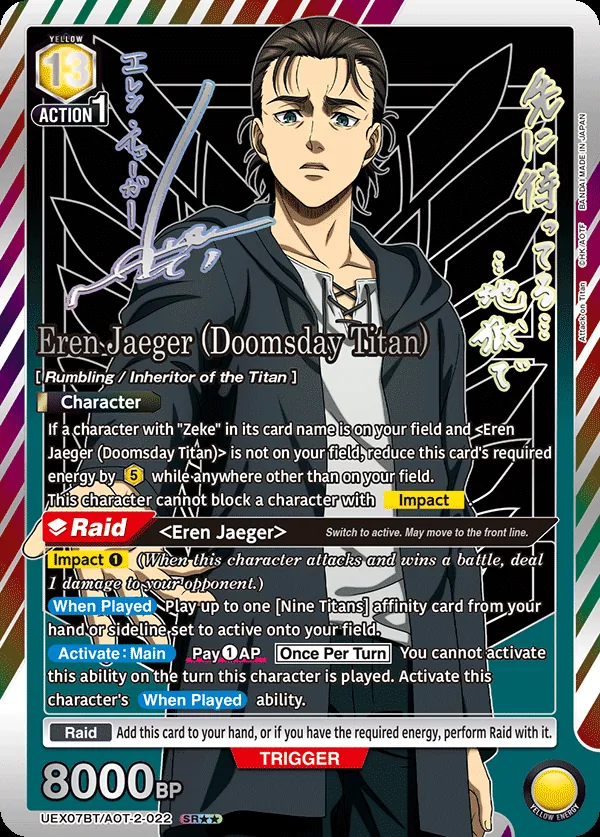 Eren Jaeger (Doomsday Titan) is the clearest Yellow build-around in Vol.2, but a strong card is not the same as a verified tier placement.
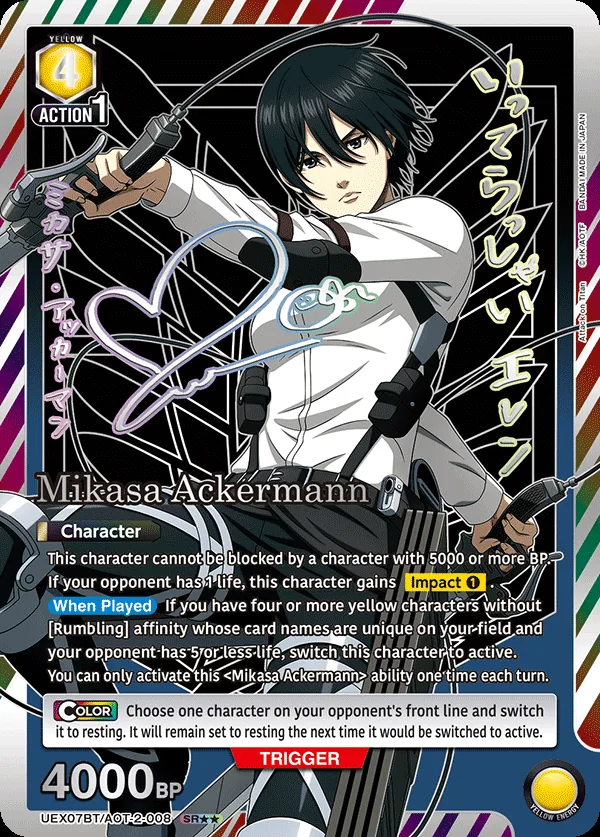 Yellow Mikasa shows the second major Vol.2 direction: a board of unique Yellow characters and a late-game pressure payoff.
What to play first after the English release
Choose based on the kind of evidence you want to act on:
- Want the safest starting pool? Start with Red. It has the largest public list footprint, two official recipe directions, and a deep UE10BT foundation.
- Already own the first set? Blue and Green both have clear Vol.2 upgrade paths. Blue adds new Levi or Historia cards, while Green can branch into Pieck, Armored Titan, or Zeke packages.
- Want the new-set experiment? Test Yellow, but proxy or borrow before committing to sealed product. The official recipes are real, while the competitive ranking is still unconfirmed.
- Want a less common project? Try Bertholdt or Rod with a deliberate plan and track your games. Their lower public volume means less solved information, not an automatic loss.
The first useful update to this article should come from actual event results, not another round of spoiler reading. Once Bandai's top-placing archive or a transparent event report records Attack on Titan Vol.2, the evidence can move from recipe and list volume to performance.
Key takeaways
- Red has the strongest current evidence by public list volume, with Armin and Eren at 78 lists each and Mikasa at 74.
- Blue and Green have established pools, but each contains several overlapping families rather than one proven best deck.
- Yellow is the major Vol.2 addition, with official Eren and Zeke and Mikasa, Levi, Armin, and Falco recipes.
- The official top-placing archive did not show a verified Attack on Titan result in the snapshot checked on September 18, 2026.
- Public list counts overlap and are not win rates, unique deck counts, or market share.
- Recheck this ranking after the first English events instead of treating launch-day evidence as settled meta.
GODEEPER: Re:ZERO released on the same English date. Union Arena Re:ZERO EN Tier List: 7-Leader Snapshot uses the same evidence-first method for that set.
Related Reading
- Union Arena Attack on Titan Vol.2: New Yellow Color: Set facts, Yellow's arrival, and the confirmed Vol.2 card highlights.
- Union Arena Attack on Titan Vol.2 Armin Deck Guide: Red Vol.2: A dated Red 104th Cadet Corps framework with Vol.2 card sequencing and mulligan advice.
- Union Arena Attack on Titan Vol.2 Eren Deck Guide: Red Vol.2: A separate Red Eren Jaeger shell with 78 public lists and a hand-return Raid loop.
- Union Arena Attack on Titan Vol.2 Buying Guide: What to Buy: Launch-week sealed prices and singles-versus-display guidance.
- All Union Arena Sets: Complete EN Release Schedule (2026): The release calendar for Vol.2 and the rest of the English line.
- Union Arena Current Meta: Which Deck Is Strongest Right Now: Official cross-IP tournament results and the limits of Union Arena meta data.
- Union Arena Deck Building Guide: A practical starting point for turning a recipe into a legal 50-card list.
- Union Arena TCG Beginner Guide 2026: Rules and format context before choosing a Vol.2 shell.
Frequently Asked Questions
What is the best Attack on Titan Vol.2 deck in Union Arena? Red has the largest public list footprint, led by Armin, Eren, and Mikasa hubs. That is a volume signal, not proof of a tournament win rate, and Yellow is still too new for a result-based ranking.
Is Yellow the strongest color in Attack on Titan Vol.2? It has the clearest new-set identity, including Doomsday Titan Eren, Yellow Levi, and Yellow Mikasa. The current evidence supports testing it, not calling it the strongest before event results exist.
Does Union Arena have an official Attack on Titan Vol.2 tier list? No. Bandai publishes recommended deck recipes and a separate top-placing archive, not a Vol.2 tier list or win-rate table. This article labels its public list signal separately from official recipes.
What do the public list counts mean? They count public 50-card Standard lists on the cited fan hub that contain a named character or leader. A list can appear on multiple character pages, so do not add the counts together as unique decks.
When did Attack on Titan Vol.2 release in English? The official product page lists September 18, 2026. UEX07BT has 73 card types plus 6 Action Point types, with 12 cards per pack and a listed $4.99 MSRP per pack.
References
- Union Arena Attack on Titan Vol.2 official product page: release date, MSRP, rarity breakdown, and the new Yellow color.
- Bandai Recommended Decks by Title: eight Attack on Titan recipes dated September 10, 2026.
- Bandai Top-Placing Decks: official event archive checked for verified Attack on Titan placements.
- Union Arena Decklists Attack on Titan hub: public 50-card list counts and character-family pages, used as a volume signal only.
- Official Eren Jaeger (Doomsday Titan) card page: Yellow card text and stats.
- Official Levi Vol.2 card page: Yellow card text and stats.
- Official Mikasa Ackermann Vol.2 card page: Yellow card text and stats.
About the author
AC
Multi-TCG analyst covering the competitive trading card game scene. Tournament coverage, format analysis, and cross-game comparison content.
- Covers multiple TCG formats
- Tournament reporter and analyst
- Cross-game format comparison specialist
- Active in OPTCG, Union Arena, and Lorcana communities
Disclaimer
This article is published for informational and entertainment purposes. It does not constitute professional financial, legal, or technical advice. Game performance, online services, patch schedules, and store listings change. Verify critical details (pricing, system requirements, regional availability) with publishers and storefronts before you buy. Affiliate links, where present, help support our editorial work and are labelled in our affiliate disclosure.