

Shonen TCG · Guides
Union Arena Re:ZERO and Attack on Titan Vol.2 Tier List
Neither new set has an official top-placing result yet, so this tier list ranks what can be checked: how many public lists each build has and which colors Bandai's own recipes cover.
Our callTest Yellow Rem/Ram or Purple Emilia for Re:ZERO and Red Eren, Armin or Mikasa for Attack on Titan Vol.2. None of them has an official result yet, so treat these as testing tiers, not rankings.
This Union Arena Re:ZERO and Attack on Titan Vol.2 tier list is a post-launch evidence refresh, not a made-up S-to-D ladder. Both English products released on September 18, 2026, and both clusters now have far more public decklists than they did at launch. The official results picture hasn't changed: Bandai's Top-Placing archive still shows no Re:ZERO or Attack on Titan Vol.2 placement.
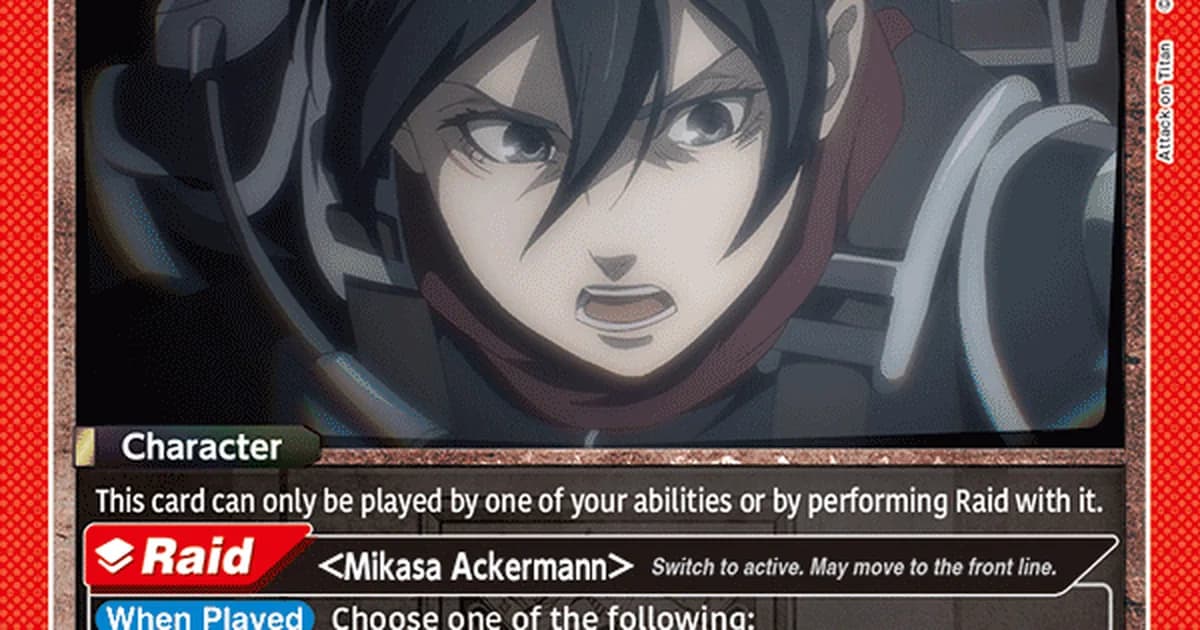
TL;DR: Re:ZERO's clearest test group is the Yellow Rem and Ram family, with Purple Emilia as the other large public lane. Attack on Titan Vol.2 has the deepest public activity in Red Eren, Armin, and Mikasa hubs, while Yellow remains the important new-set watchlist. These are evidence tiers built from dated public lists and official recommended recipes, not tournament win rates. The official archive currently has no visible result for either new cluster.
Updated October 21, 2026: we refreshed every public list count (the Rem, Ram, Eren, Armin and Mikasa pages have all roughly doubled since our last check), added the Emilia count, and re-checked Bandai's Top-Placing archive and recipe page. The tiers didn't change.
Union Arena Re:ZERO and Attack on Titan Vol.2 tier list: quick answer
The honest order is test the repeated Red and Yellow shells first, then use the official recipe pages to expand the field. Rem, Emilia, and the Ram-focused Yellow variant give Re:ZERO the most useful current comparison points. Eren, Armin, and Mikasa give Attack on Titan Vol.2 the deepest Red evidence. Yellow is the new Vol.2 package worth watching, not a proven winner.
No current source supports a numeric win-rate ranking for either cluster. Union Arena Decklists supplies public 50-card lists and focal-character counts. Bandai supplies recommended recipes and official event results. Those sources answer different questions, so this article keeps three labels separate: public list signal, official recipe signal, and verified placement signal.
How the post-launch evidence is ranked
The first tier is repeatable public shell. A character hub with many dated lists gives us enough repeated card choices to write a deck guide and compare variants. It does not tell us how those lists performed.
The second tier is official recipe support. Bandai's Recommended Decks by Title page shows which colors and packages the publisher expects players to try. This helps confirm that a color combination is legal and intended, but a recommended recipe is not an event result.
The third tier is verified placement. Bandai's Top-Placing Decks archive is the hard check. When we rechecked it on October 21, 2026, the newest results had been posted September 18, and none of them was a Re:ZERO or Attack on Titan Vol.2 deck. That absence keeps both clusters provisional even though their public list activity has grown.
The Union Arena current meta article uses the same separation for established IPs. The new clusters should not be promoted above that evidence standard just because a character hub looks busy.
Union Arena Re:ZERO and Attack on Titan Vol.2 tier list: Re:ZERO tiers
Re:ZERO has a more complicated public-list picture than a single leader ranking suggests. On October 21 the Rem page held 258 public lists and the Ram page 240, both with lists as recent as October 16. Those pages overlap because many Yellow lists include both sisters, so the counts cannot be added together. They do show something useful: Ram is not just a card that happens to exist, and Rem remains the most established focal label in the Yellow family.
| Evidence group | Re:ZERO build | Current signal | Read it as |
|---|---|---|---|
| Test first | Yellow Rem and Ram family | Rem page 258 lists, Ram page 240 lists | The deepest repeated Yellow shell, with Ram now distinct enough to test as the focus |
| Test first | Purple Emilia and Echidna | Emilia page 183 lists | A genuine second color lane with a different Event and sideline plan |
| Test next | Beatrice and Crusch families | Visible public hubs, smaller than the main lanes | Real alternatives, but thinner list depth and no verified placement |
| Watchlist | Subaru, Echidna variants, and other small labels | Sparse or mixed focal-character labels | Need more repeated lists before a confident tier call |
The current public Rem hub and Ram hub show the family relationship clearly. The featured Ram list uses a Ram-heavy Yellow package alongside Rem, Demon Sisters, and Demon Power. The featured Rem page is more Rem-centered. That is enough to justify two guides with different sequencing priorities, but not enough to claim two unrelated archetypes.
Bandai's Recommended Decks by Title page currently displays Re:ZERO recipes in Yellow, Blue, and Purple. The public list signal makes Yellow Rem and Ram the most obvious starting point, while the official page confirms that Purple and Blue are intended build directions rather than fan-invented color combinations. The Ram guide explains the Yellow search and Raid plan, and the Emilia guide covers the Purple Event plan.
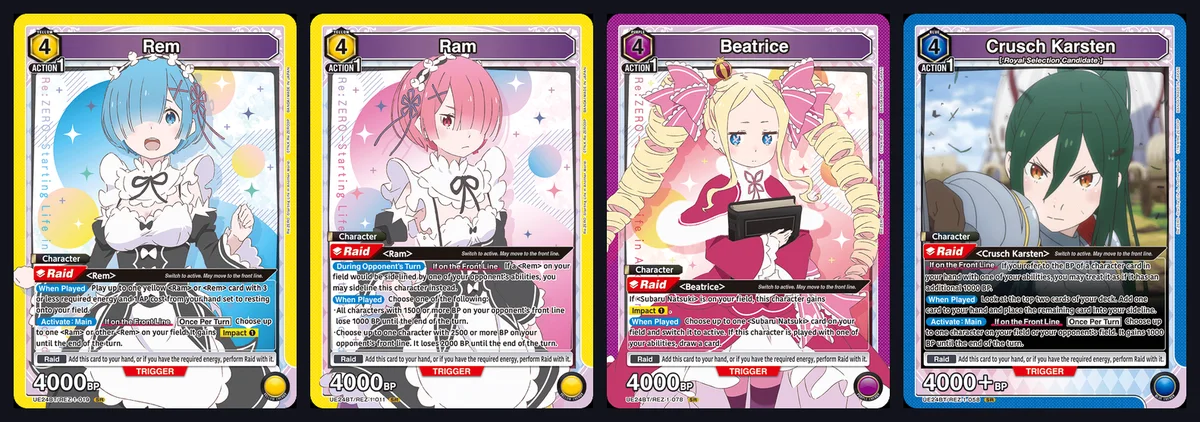 Image: Bandai, UNION ARENA official card list (UE24BT/REZ-1-019, 011, 078, 058). One card from each Re:ZERO family in the table above; the picture isn't a ranking.
For a quick tour of the Re:ZERO builds across colors, Damos posted six deck lists on release day:
The current public tier conclusion for Re:ZERO is therefore modest. Put the Yellow Rem and Ram family and Purple Emilia in the first testing group. Keep Beatrice, Crusch, and smaller labels in the second group until there is more list repetition or a verified event. Do not convert the public site's tier labels into official Bandai rankings.
Attack on Titan Vol.2 provisional tiers after launch
Attack on Titan Vol.2 has a larger Red comparison set because the original UE10BT card pool already gave 104th Cadet Corps decks a foundation. On October 21 the public pages showed Eren Jaeger at 353 lists, Armin Arlelt at 348, and Mikasa Ackermann at 334, all with lists as recent as October 16. These are separate focal-character pages, not unique deck counts. A Red list can appear on more than one page when it contains Eren, Armin, and Mikasa together.
| Evidence group | Attack on Titan build | Current signal | Read it as |
|---|---|---|---|
| Test first | Red Eren and 104th Cadet Corps | Eren page 353 lists | Deepest single focal-character sample and a clear Vol.2 support line |
| Test first | Red Armin and 104th Cadet Corps | Armin page 348 lists | Nearly the same public depth, with a different setup priority |
| Test first | Red Mikasa and 104th Cadet Corps | Mikasa page 334 lists | A real return and sideline variant, not simply an Eren name swap |
| Watchlist | Yellow Vol.2 Rumbling packages | Official Yellow recipes and new cards | Strong product signal, but no verified placement in the archive snapshot |
| Test next | Blue and Green established families | Active public hubs across Levi, Historia, Reiner, Ymir, and others | Mature title shells that need current event results before a strict tier call |
The Mikasa guide is distinct because the repeated cards ask a different question from the Eren guide. Mikasa 066 turns an attack-phase return into a resting body at end phase. Mikasa 067 recovers a small 104th card or pays two hand cards to sideline a 5000-plus Character. Mikasa 088 and 089 add more return and Eren-dependent removal. The deck still shares the Red 104th Cadet Corps pool, but its focal loop is real.
Bandai's official Recommended Decks by Title page displays Attack on Titan Vol.2 recipes in Yellow, Blue, Green, and Red. That breadth matters. It means Yellow is not a spoiler-era guess, but the official recipe page still does not tell us which color has the best match record. The Attack on Titan Vol.2 buying guide covers the product context, while the Eren guide and Armin guide show how the established Red pool is being used.
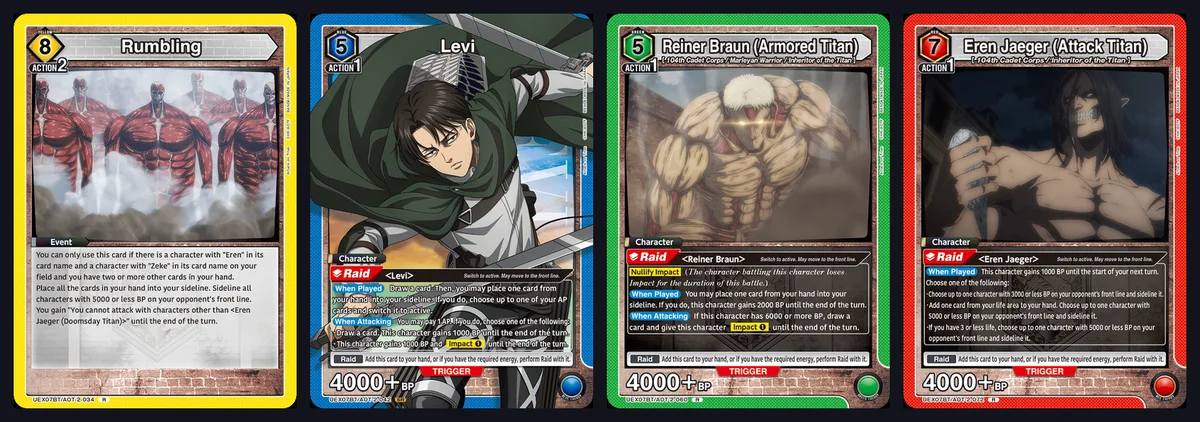 Image: Bandai, UNION ARENA official card list (UEX07BT/AOT-2-034, 042, 060, 072). One Vol.2 card per color Bandai's recipe page covers.
The current Attack on Titan conclusion is therefore Red first for evidence, Yellow first for watchlist interest. Eren, Armin, and Mikasa have enough repeated public activity to justify separate focal-character testing. Yellow has enough official recipe support to monitor closely. None of those statements is a verified win-rate claim.
What would change these tiers
One verified result would change the evidence label, but not automatically crown a deck. A top cut from a large event would establish that the cluster can convert into an official placement. A repeated run of results would justify moving a build from “test first” to a real competitive tier. A single list upload would not.
The next useful update should record the event date, player count, placement, focal list, and whether the deck is a pure or hybrid version. That last detail matters for both clusters. A Ram list can be a Rem and Ram hybrid. A Mikasa list can contain the full Eren and Armin package. Without the actual list, a character label is too coarse to support a matchup claim.
The Union Arena release schedule also matters for timing. New set launches can make public list counts rise before local events have enough time to produce a stable result sample. Refresh this page after the first meaningful regional or major store series rather than treating list volume as a final verdict.
GODEEPER: If you want the rules behind the shared card pool before comparing character hubs, use the Union Arena deck building guide for 50-card construction, source material, and energy fundamentals.
Our take
If you're picking one deck from each set, play Yellow Rem/Ram for Re:ZERO and Red Eren for Attack on Titan Vol.2. They have the most public lists to learn from, so you'll spend less time guessing at the 50. Keep Purple Emilia and Red Armin as the second picks. Yellow Vol.2 is the one to watch, but nobody has shown a result with it yet, so don't buy into it first.
Key Takeaways
- Re:ZERO's Yellow Rem and Ram family is the deepest current public shell, with meaningful overlap that should not be counted twice.
- Purple Emilia is the clearest alternate Re:ZERO lane, with a different sideline and Event plan.
- Attack on Titan Vol.2's Red Eren, Armin, and Mikasa hubs all have substantial public activity, with Eren and Armin slightly ahead by current hub count.
- Mikasa is distinct enough to receive a guide because its return and sideline loop changes the Red sequencing plan.
- Yellow Attack on Titan Vol.2 is the most important watchlist color, backed by official recipes but not yet by a verified placement in the archive snapshot.
- Bandai's recommended recipes, public list counts, and official event results must remain separate evidence categories.
Frequently Asked Questions
What is the best Union Arena Re:ZERO deck after launch? There is no verified post-launch winner. Start with the Yellow Rem and Ram family or Purple Emilia because those lanes have enough repeated public construction to test, then recheck official results before calling one the best. The current evidence supports testing, not a settled winner.
What is the best Attack on Titan Vol.2 deck after launch? Red has the deepest public focal-character hubs, with Eren and Armin ahead of Mikasa by current count. That makes Red the strongest evidence tier for testing, not a confirmed tournament ranking. Yellow is the major watchlist lane. The live archive is still the deciding check.
Did Re:ZERO or Attack on Titan Vol.2 place in an official event? The Bandai top-placing archive checked for this refresh shows no visible result for either cluster. The archive changes as events are posted, so check the live page before making a later competitive claim. That is why this article uses watchlist language.
Are the public Union Arena decklist counts unique decks? No. Lists can appear under several focal-character hubs when they share a source material. Use the numbers to identify repeated shells, not to calculate exact metagame share. Treat each number as a hub signal, then inspect the actual list before drawing conclusions.
Is Ram a separate Re:ZERO archetype from Rem? Ram is distinct enough as a focal-character variant because the public hub and featured lists center a Ram-heavy search and Raid package. It still overlaps heavily with Rem, so do not describe it as a completely separate color identity.
Is Mikasa a separate Attack on Titan Vol.2 archetype from Eren and Armin? Yes, as a focal-character build. The Red pool overlaps, but Mikasa's return, sideline, and Vol.2 Raid priorities create a separate sequencing plan. The shared card pool creates overlap, but the return timing and sideline costs change the pilot plan.
How should I use this tier list? Use it to choose what to test first. Confirm card legality and official recipes, study repeated public lists, and only upgrade a tier claim when dated event results support it. Revisit the page when a dated regional list or repeat result adds new evidence.
Related Reading
- Union Arena Re:ZERO EN Tier List: the earlier launch snapshot, useful for seeing how the public evidence changed.
- Union Arena Attack on Titan Vol.2 EN Tier List: the earlier Vol.2 launch snapshot and its evidence labels.
- Union Arena Re:ZERO Rem Deck Guide: the closest Yellow comparison for the Ram-focused variant.
- Union Arena Re:ZERO Beatrice Deck Guide: Purple Build 2026: a Purple sideline shell that broadens the Re:ZERO testing set.
- Union Arena Historia Deck Guide: Blue AoT Build 2026: a Blue Event-threshold shell for the Vol.2 comparison.
- Union Arena TCG Beginner Guide 2026: the rules and terminology baseline before comparing post-launch deck evidence.
- Union Arena Re:ZERO Buying Guide: dated product context for entering the Yellow or Purple cluster.
References
- Union Arena official Recommended Decks by Title: Bandai's current recipe signal for Re:ZERO and Attack on Titan Vol.2.
- Union Arena official Top-Placing Decks archive: official event results checked October 21, 2026.
- Union Arena Decklists Ram page: public Re:ZERO list volume checked October 21, 2026.
- Union Arena Decklists Rem page: public Re:ZERO comparison list volume checked October 21, 2026.
- Union Arena Decklists Emilia page: public Purple Re:ZERO list volume checked October 21, 2026.
- Union Arena Decklists Mikasa Ackermann page: public Attack on Titan list volume checked October 21, 2026.
- Union Arena Decklists Eren Jaeger page: public Red comparison list volume checked October 21, 2026.
- Union Arena Decklists Armin Arlelt page: public Red comparison list volume checked October 21, 2026.
- Bandai Mikasa Ackermann UEX07BT/AOT-2-067 card entry: the 5000-plus sideline mode.
About the author
Card values and pull rates
Pen name for the Shonen TCG desk's card value, pull rate and collector market coverage.
- Prices read from TCGplayer and Cardmarket listings, dated
- Pull rates tied to a stated sample
- Opinions marked as ours, with the reason
Keep reading
Union Arena Mikasa Deck Guide: Red AoT Vol.2 Build 2026
Guides · 14 min
Union Arena Beatrice Deck Guide: Purple Re:ZERO Build 2026
Guides · 7 min
Union Arena Historia Deck Guide: Blue AoT Build 2026
Guides · 7 min
Union Arena Re:ZERO Ram Deck Guide: Yellow Build 2026
Guides · 8 min
Union Arena NIKKE Precious Booster: Price and Contents
Guides · 6 min
Union Arena Attack on Titan Eren Deck Guide: Red Vol.2
Guides · 8 min
Union Arena Re:ZERO Emilia Deck Guide: Purple Build 2026
Guides · 6 min
Union Arena Attack on Titan Vol.2 Buying Guide: What to Buy
Guides · 14 min
Disclaimer
This article is published for informational and entertainment purposes. It does not constitute professional financial, legal, or technical advice. Game performance, online services, patch schedules, and store listings change. Verify critical details (pricing, system requirements, regional availability) with publishers and storefronts before you buy. Affiliate links, where present, help support our editorial work and are labelled in our affiliate disclosure.