

Shonen TCG · Guides
Union Arena Mikasa Deck Guide: Red AoT Vol.2 Build 2026
Union Arena Mikasa deck guide starts with one important rules clarification: this is a focal-character label, not a leader-zone deck. Union Arena has no leader zone. The public decklist data still gives Mikasa enough of her own Red package to study, with 158 lists on the current Mikasa hub and several Mikasa-heavy builds dated September 18 and 19, 2026.
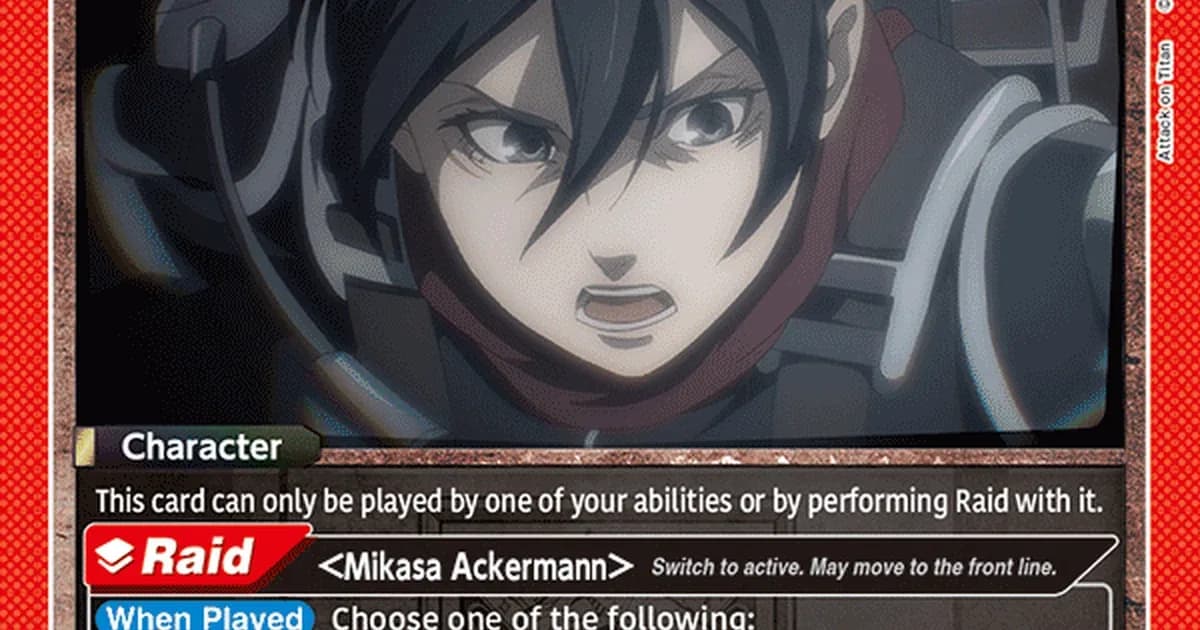
TL;DR: Build around the Red 104th Cadet Corps return loop.
UEX07BT-066
UEX07BT-066Shop on TCGplayer can play itself from hand at the end of your turn after a red 104th card returned during the attack phase, while
UEX07BT-067
UEX07BT-067Shop on TCGplayer is a 3-cost Raid that either recovers a small 104th body or trades two hand cards for a 5000-plus opposing front-line Character. The UE10BT Mikasa package adds more return, sideline, and Eren-dependent removal. Public list volume confirms a real Mikasa-focused lane, but the official results archive has not verified a Vol.2 placement in the snapshot used here.
Union Arena Mikasa deck guide: what makes the Red shell different
The current Mikasa decklist hub shows 158 public 50-card Standard lists, with the newest entries dated September 19, 2026. That is a substantial construction signal only when you read the lists, not just the number. The featured build contains a dense Mikasa package from both the original Attack on Titan set and Vol.2: Mikasa 085, 087, 088, 089, UEX07BT-066, and UEX07BT-067, plus the Red Eren and Armin cards that make the 104th Cadet Corps pool function.
The difference from the existing Eren guide is the job each card is asked to do. Eren 092 is a major hand-return Raid payoff in that guide. A Mikasa-focused list uses the same source material, but it treats returning Red 104th cards as a way to turn on Mikasa 066, refill the sideline with Mikasa 088, and make the next Raid turn more flexible. The Armin guide is a different focal plan again, with Armin's setup and recovery priorities leading the curve.
The public data also shows more than one Mikasa flavor. A September 19 list titled around “AOT scouts v2” is packed with Mikasa 085, 087, 088, 089, Vol.2 066 and Vol.2 067, while another September 18 Sasha and Mikasa list reduces the Eren 092 count and leans into a wider 104th and Sasha board. Those lists overlap, but they are not just an Eren list with one Mikasa card substituted. The return and sideline engine is the part that gives Mikasa the right to her own focal-character guide.
The evidence boundary still matters. Bandai's official top-placing archive is the source for verified event placements, and its current visible archive does not show a Re:ZERO or Attack on Titan Vol.2 result. The Mikasa hub is useful for repeated player construction, not proof that this build has already beaten a regional field.
Key Takeaways
- Mikasa has a current Red public hub with 158 Standard lists through September 19, 2026.
- The deck shares the 104th Cadet Corps card pool with Eren and Armin, but its return-to-hand and sideline loops give it a distinct focal plan.
- Mikasa 066 rewards returning a red 104th card during the attack phase, then plays itself resting at the end of the turn.
- Mikasa 067 is a flexible Raid: recover a small non-Raid 104th card or trade two hand cards for large-character removal.
- Mikasa 088 turns its own return into a sideline card and gains BP when your field is wide with 104th Cadet Corps cards.
- Mikasa 089 is the Eren-enabled Raid finisher that sidelines an opposing front-line Character at 3500 BP or less.
- Public list volume is real, but no official Vol.2 placement was verified in the current Bandai archive snapshot.
Union Arena Mikasa deck guide: the Red return engine
The deck's early turns are about making a return-to-hand event happen without losing the whole board. The most direct payoff is UEX07BT-066UEX07BT-066Shop on TCGplayer Mikasa Ackermann from Vol.2. It costs one energy, has 2500 BP, and checks at the start of your end phase whether one of your red 104th Cadet Corps cards returned from the field to your hand during the attack phase. If it did, you may play Mikasa from hand resting on your front line. The trigger can activate once each turn, and the official Q&A confirms that a card returned by an opponent's effect can also satisfy the condition.
That timing changes how you sequence attacks. You want the return to happen during the attack phase, not after combat or during an unrelated setup action. If Mikasa 066 is already in hand, the returned card becomes the switch that converts an attack-phase bounce into another body. If Mikasa is on the field, the return can still matter because other Red cards use hand and sideline movement as part of their own effects.
The second anchor is UEX07BT-067UEX07BT-067Shop on TCGplayer Mikasa Ackermann. At three energy and 4000 BP, it is a Raid Character with two very different When Played modes. The first returns a non-Raid 104th Cadet Corps Character with required energy 3 or less from your sideline to hand. That mode rebuilds your hand and gives you a card to deploy again. The second checks for an opposing front-line Character at 5000 BP or more, then asks you to place two cards from hand into your sideline to sideline that Character. Do not treat the removal mode as free. It is a deliberate hand-to-board exchange for games where a large blocker is worth the cost.
The older Red package gives the new cards more ways to matter.  UE10BT-085
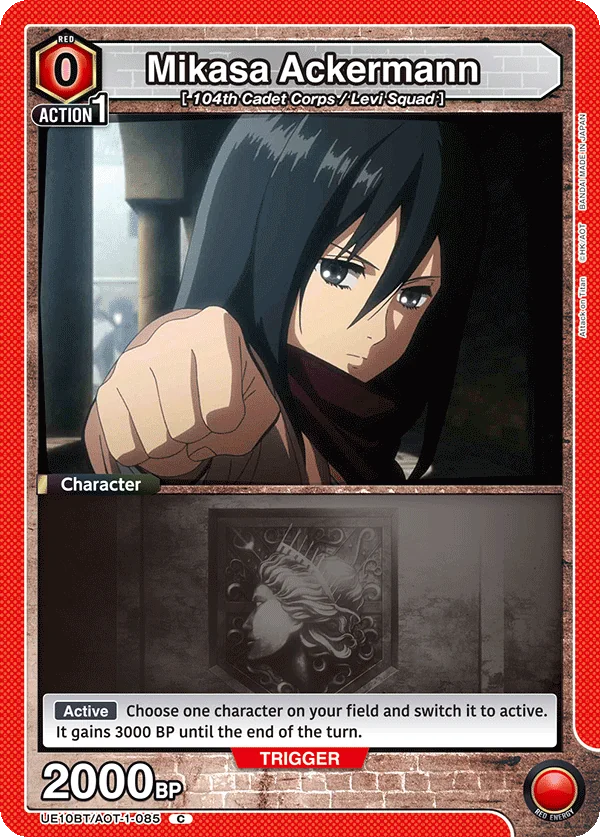 UE10BT-085Shop on TCGplayer Mikasa is a 0-cost, 2000 BP 104th Cadet Corps and Levi Squad Character with no main effect, but its Active trigger can switch one of your active Characters and give it 3000 BP.
 UE10BT-088
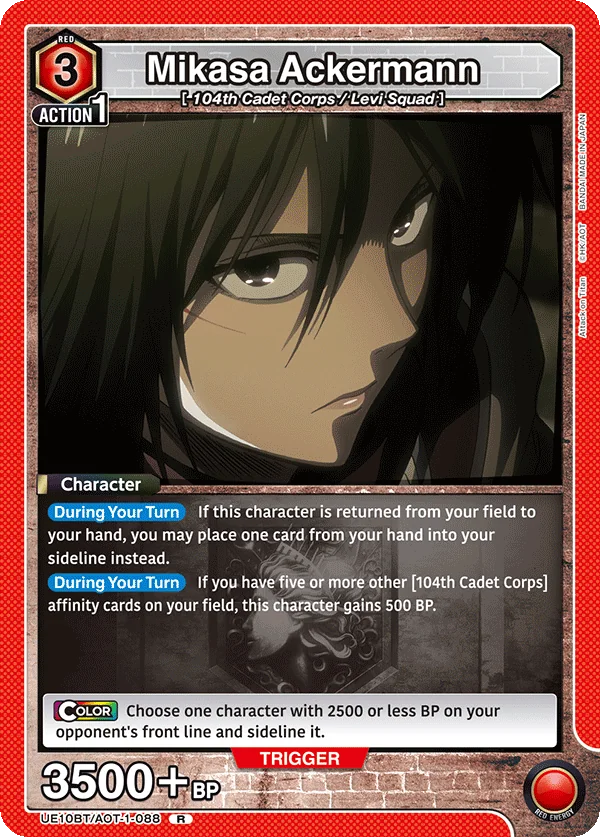 UE10BT-088Shop on TCGplayer Mikasa is the three-cost body that places a hand card into the sideline after it returns from your field during your turn. It also gains 500 BP when you have five or more other 104th Cadet Corps cards on the field. Finally,
 UE10BT-089
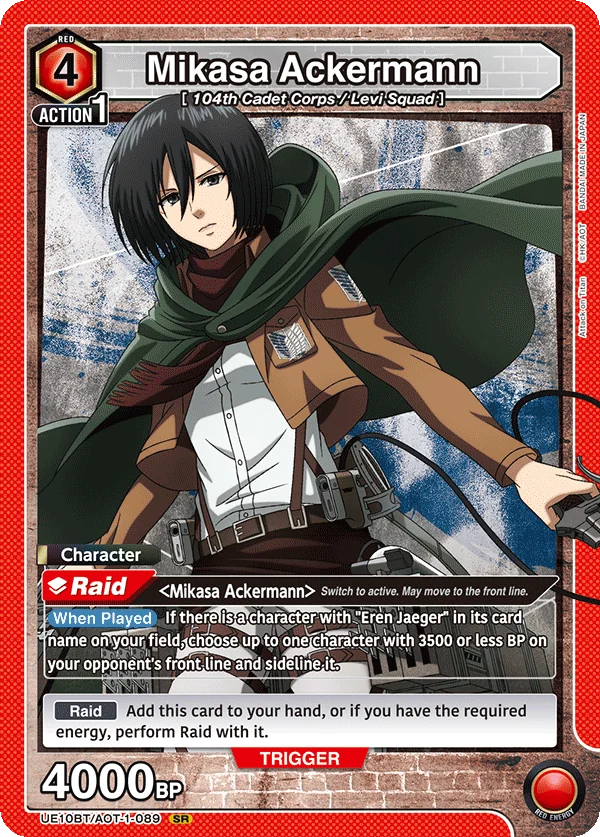 UE10BT-089Shop on TCGplayer is the four-cost 4000 BP Raid. If Eren is on your field when it is played, it can sideline an opposing front-line Character with 3500 BP or less.
Together, these cards create a loop with three decisions: which card returns, which card becomes sideline material, and whether the next Mikasa Raid should recover or remove. You are not trying to bounce everything immediately. You are using movement to keep the hand stocked while making the opponent's front line increasingly awkward to block.
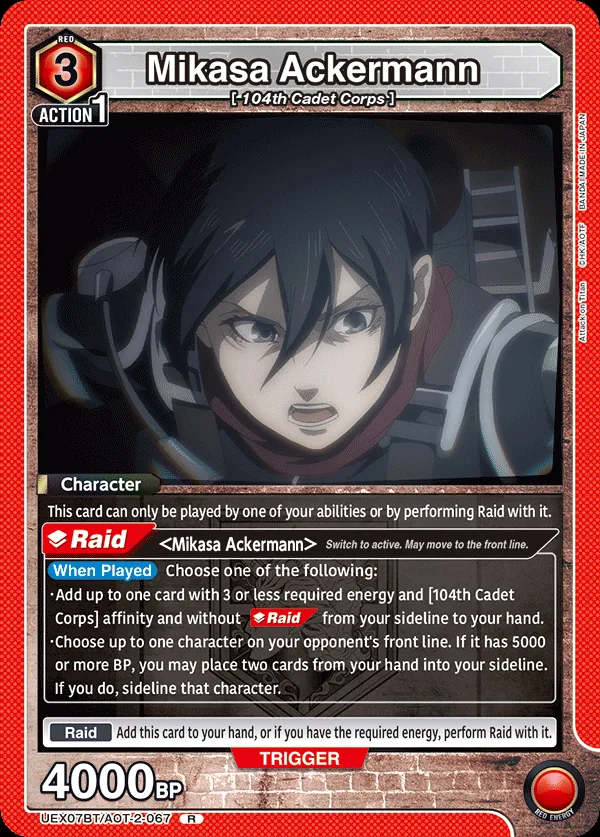 Mikasa UEX07BT-067 is the flexible three-cost Raid: recover a small non-Raid 104th card or pay two hand cards to remove a large opposing front-line Character.
GODEEPER: The Attack on Titan Vol.2 set article covers the booster release and the new Yellow package. This guide stays on the post-launch Red cards that the public Mikasa lists actually repeat.
Step-by-Step
1. Mulligan for a cheap 104th body and a return path. A good opening hand has an early Character, one way to return a red 104th card, and one payoff such as Mikasa 066, Mikasa 067, or Mikasa 089. A hand made entirely of four-cost Raid cards cannot start the movement loop and should usually go back.
2. Put the return event inside the attack phase. Before attacking, identify which card will return and what that opens. The Mikasa 066 check happens at the start of your end phase, so a return that occurs during the attack phase can become another resting Character without spending a second main-phase play.
3. Use Mikasa 066 as a tempo body, not as your only win condition. Playing it from hand resting is valuable because it adds a body after the return, but it does not replace the need for a strong attack. Protect the turn's important attacker first, then let 066 fill the board if the return condition is satisfied.
4. Choose Mikasa 067's mode from the board state. Use the recovery mode when your sideline contains a cheap 104th card that will matter again. Use the removal mode only when the opposing 5000-plus Character is blocking a meaningful attack or represents an ability you cannot answer another way. Paying two hand cards for a target that you could ignore is a losing exchange.
5. Turn Mikasa 088's return into future material. When 088 returns during your turn, its effect places one hand card into the sideline. Choose a card that is genuinely better as future recovery or payment than as an immediate play. This is how the deck keeps movement from becoming pure card disadvantage.
6. Pair Mikasa 089 with Eren only when the removal is live. The four-cost Raid needs an Eren on your field to sideline a front-line Character at 3500 BP or less. If you have no Eren, it is still a Raid body, but do not spend your turn expecting removal that the board cannot provide.
7. Close with a wide 104th board and flexible hand. The deck is strongest when it has several 104th Cadet Corps cards on the field, a card in the sideline that Mikasa 067 can recover, and enough hand left to defend. Do not empty the hand just to use every movement effect. The best end state is a board that can attack again while still holding the next return or counter.
Tips: avoiding the Red shell's common traps
Do not copy Eren's curve and rename it Mikasa. The public Eren hub is larger at 171 lists and the Armin hub is close behind at 169. Their volume makes them useful comparison points, but Mikasa's 158-list hub repeats a different set of priorities. Count return enablers, sideline effects, and Mikasa payoffs before deciding whether a list is really Mikasa-focused.
Keep the attack-phase timing visible. If a card returns after the attack phase, it may not satisfy Mikasa 066. Say the timing out loud while testing: attack, resolve the return, finish attacks, reach the end phase. That habit prevents a lot of false “the card did not work” conclusions.
Do not treat the sideline as a second hand. Mikasa 067 can recover a non-Raid 104th card with required energy 3 or less, but the card has to be there first. Mikasa 088 and related effects ask you to put cards there, so plan the cost before you use the effect. A sideline full of cards you cannot recover is not an engine.
Respect the two-card removal cost. The 067 removal mode is powerful against a 5000-plus Character, but you pay two cards from hand. Prefer it when the removed Character prevents multiple attacks, carries the opponent's win condition, or would otherwise force you to spend even more cards. Use the recovery mode when the opponent's board does not justify that price.
Use 088's BP boost as a board-count reward. The 500 BP gain requires five or more other 104th Cadet Corps cards on your field. It is a reason to go wide, not a reason to play 088 into an empty board. The card's return-to-sideline effect still matters when the board is smaller, so do not force a bad attack just to turn on the bonus.
Separate public list volume from event results. The Mikasa hub tells you that players are building and iterating. Bandai's top-placing archive tells you whether a verified official result exists. Keep those two statements separate in testing notes and in any future tier update.
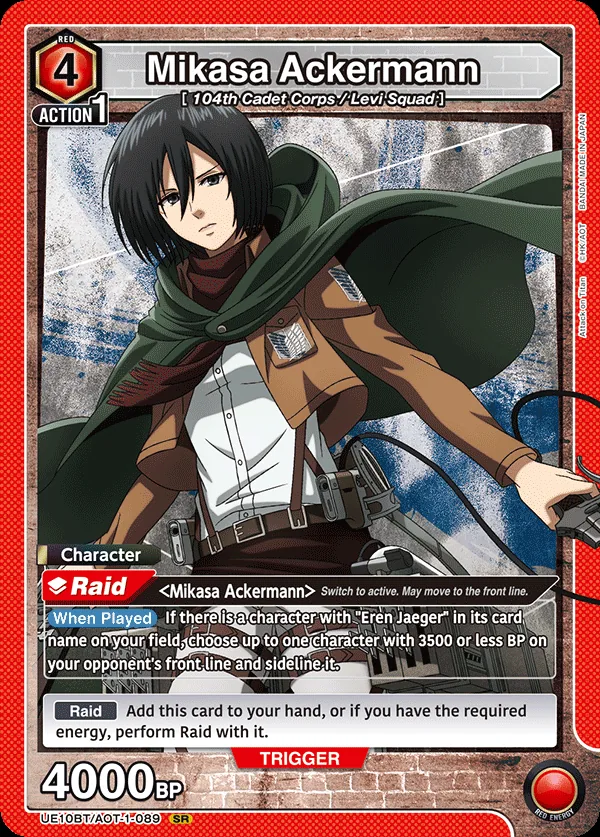 Mikasa UE10BT-089 is the four-cost Raid that turns an Eren on your field into targeted removal against a small opposing front-line Character.
Where Mikasa fits beside Eren and Armin
The published Eren and Armin guides are not made obsolete by this one. Eren's Red plan is the best comparison for the shared cards, especially the Eren 092 hand-return line. If your games are mostly about setting up Eren 092 and attacking with that card as the central Raid, you are playing the Eren plan even if four Mikasa cards are in the list.
Mikasa becomes the focal plan when returning Red 104th bodies creates more than one payoff: Mikasa 066 joins the field at end phase, Mikasa 088 converts its own return into a sideline card, and Mikasa 067 turns that sideline into either recovery or a large-character answer. The Vol.2 cards do not replace the UE10BT package. They give the Red shell more reasons to make movement happen on time.
Armin's list is another useful contrast. Armin supports the same 104th Cadet Corps title, but its public hub and sample builds are not centered on Mikasa's repeated return triggers. A Mikasa list can still play  UE10BT-075
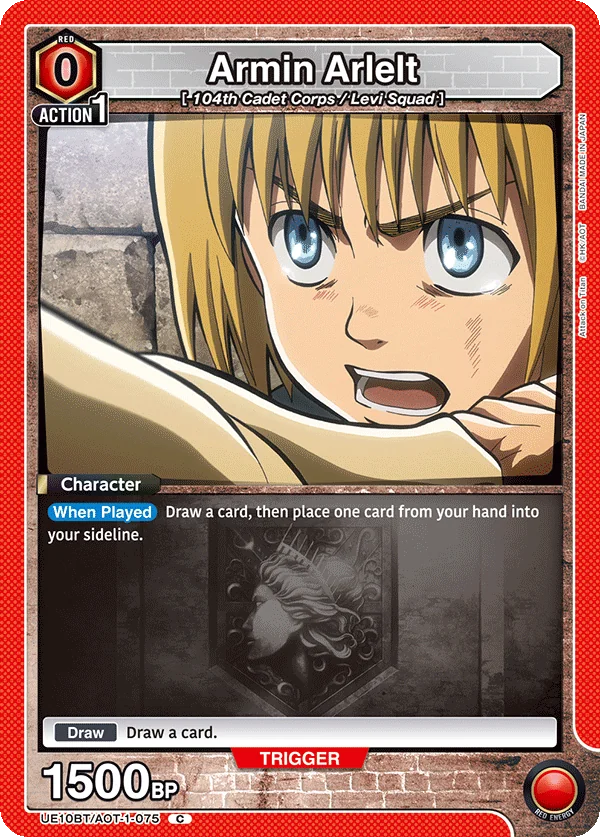 UE10BT-075Shop on TCGplayer Armin and
 UE10BT-077
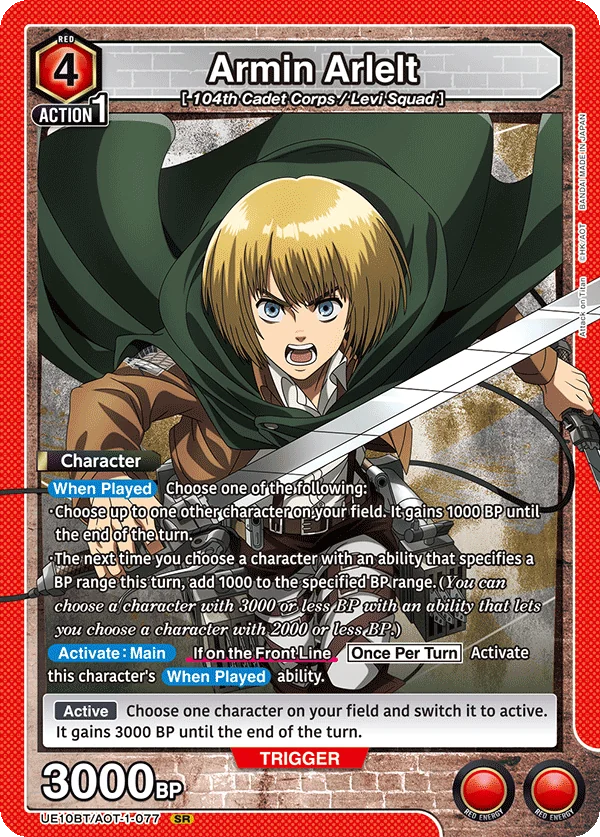 UE10BT-077Shop on TCGplayer Armin as support bodies, just as it can play
 UE10BT-090
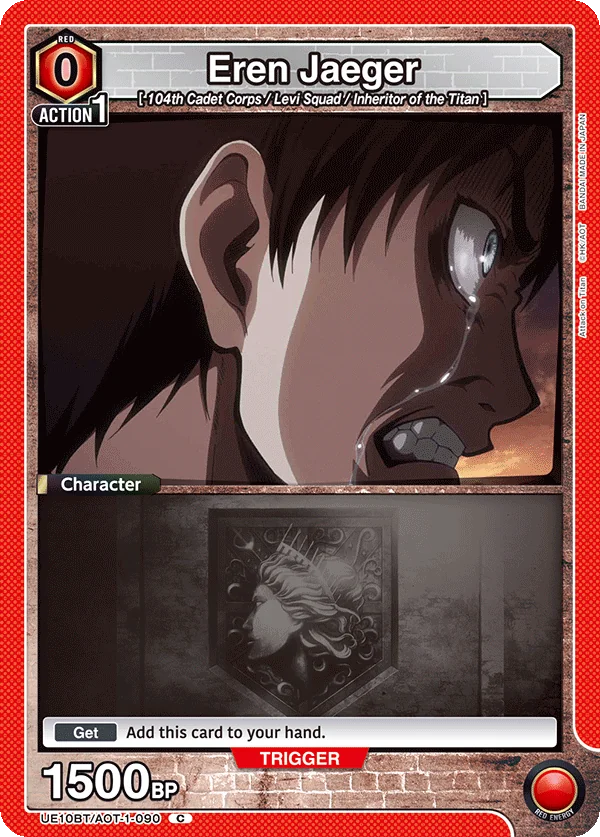 UE10BT-090Shop on TCGplayer Eren and
 UE10BT-092
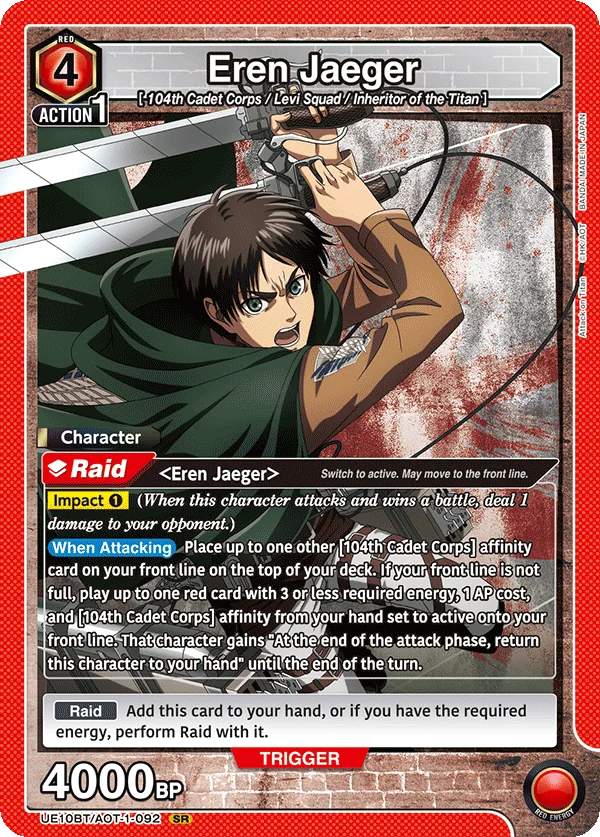 UE10BT-092Shop on TCGplayer Eren. The focal-character label describes what your sequencing prioritizes, not a rule that bans every other character.
The Attack on Titan Vol.2 tier snapshot is the right place to compare public list volume with official recipes and tournament evidence. The honest competitive conclusion today is narrow: Mikasa is a distinct, actively built Red lane, but it still needs verified post-launch placements before anyone should call it a top tier.
GODEEPER: The Union Arena deck building guide covers the 50-card and single-source-material rules that keep this shared 104th Cadet Corps pool legal.
Frequently Asked Questions
Is Mikasa a distinct Union Arena deck from Eren and Armin? Yes, at the level needed for a focal-character guide. The Mikasa hub has 158 lists and includes Mikasa-heavy and Sasha plus Mikasa variants. It shares cards with Eren and Armin, but the return and sideline loop changes the sequencing priorities.
What does Mikasa UEX07BT-066 do? It is a 1-cost, 2500 BP Red Character that can play itself resting from hand at the start of your end phase after a red 104th Cadet Corps card returned from the field during the attack phase. The effect is once per turn.
What does Mikasa UEX07BT-067 do? It is a 3-cost, 4000 BP Red Raid Character. It either recovers a small non-Raid 104th Character from the sideline or, against a 5000-plus opposing front-line Character, trades two hand cards for a sideline removal. That choice is the card's key swing turn.
Does Union Arena have a leader zone? No. Mikasa is the public decklist focal character, not a leader card in a separate zone. The deck still uses the normal 50-card main deck, three AP cards, and single-source-material rules. The focal name describes your sequencing priority, not a special deck size.
Which Mikasa cards are the core? Start with Vol.2 Mikasa 066 and 067, then test UE10BT Mikasa 085, 088, and 089. The best counts are not settled, so track which version you are testing. The Vol.2 pair supplies the new-set anchors, while the UE10BT cards add older return and Raid texture.
Is the Mikasa build competitive? It has meaningful public list volume, but the official archive snapshot used here has no verified Attack on Titan Vol.2 placement. That makes it a real testing lane, not a proven tournament tier. The live archive remains the deciding check as more events are posted.
What should I mulligan for? Keep a cheap 104th body, a return path, and one Mikasa payoff. Send back hands that contain only expensive Raid cards or that cannot put a red 104th card back into hand during the attack phase. A powerful-looking top end cannot start the loop by itself.
Related Reading
- Union Arena Re:ZERO EN Tier List: a parallel post-launch snapshot for the other September 18 Union Arena release.
- Union Arena Attack on Titan Vol.2 EN Buying Guide: sealed and singles context for the UEX07BT release.
- Union Arena Historia Deck Guide: Blue AoT Build 2026: compare the Blue Event engine with Mikasa's Red return loop.
- All Union Arena Sets: EN Release Schedule: where Attack on Titan Vol.2 sits in the English product calendar.
- Union Arena Current Meta: cross-IP official-result context for a new deck's evidence level.
References
- Attack on Titan Vol.2 official product page: Bandai's UEX07BT release and product information.
- Mikasa UEX07BT-066 official card page: official card text and the timing rule for the return trigger.
- Mikasa UEX07BT-067 official card page: official Raid, recovery, and removal text.
- Mikasa UE10BT-085 official card page: official starter-package card text.
- Mikasa UE10BT-088 official card page: official return, BP, and Color trigger text.
- Mikasa UE10BT-089 official card page: official Raid and Eren-dependent removal text.
- Union Arena Decklists Mikasa Ackermann hub: public list count and dated Mikasa-focused builds checked September 19, 2026.
- Union Arena official top-placing decks archive: official result source checked September 25, 2026.
Was this guide helpful?
Cards in this article
About the author
Pen name for the Shonen TCG desk's tournament coverage, format analysis and cross-game comparisons.
- Results taken from event pages and standings
- Other games checked against their own official rules
- Opinions marked as ours, with the reason
Keep reading
Union Arena Re:ZERO and Attack on Titan Vol.2 Tier List
Guides · 12 min
Union Arena Re:ZERO Ram Deck Guide: Yellow Build 2026
Guides · 8 min
Union Arena Beatrice Deck Guide: Purple Re:ZERO Build 2026
Guides · 7 min
Union Arena Attack on Titan Eren Deck Guide: Red Vol.2
Guides · 8 min
Union Arena Historia Deck Guide: Blue AoT Build 2026
Guides · 7 min
Union Arena Re:ZERO Emilia Deck Guide: Purple Build 2026
Guides · 6 min
Union Arena Attack on Titan Vol.2 Buying Guide: What to Buy
Guides · 14 min
Union Arena NIKKE Precious Booster: Price and Contents
Guides · 6 min
Disclaimer
This article is published for informational and entertainment purposes. It does not constitute professional financial, legal, or technical advice. Game performance, online services, patch schedules, and store listings change. Verify critical details (pricing, system requirements, regional availability) with publishers and storefronts before you buy. Affiliate links, where present, help support our editorial work and are labelled in our affiliate disclosure.