

Shonen TCG · Guides
One Piece TCG Red Deck Guide: Full Aggro Strategy 2026
Reviewing
One Piece TCG
One Piece TCG Red deck guide: Red is the game's clearest pressure color. It wants to attack before the opponent has a stable board, use Rush or power changes to make those attacks awkward to answer, and turn a small lead into a closed game before the hand runs out.
The important correction to the old version is that Red is not defined by a universal burn engine. Portgas.D.Ace from OP-16 does not deal automatic Life damage. Its Leader text gives a qualifying high-power Luffy or Whitebeard Pirates Character Rush for the turn. That is a tempo effect, and the deck should be built around it as one.
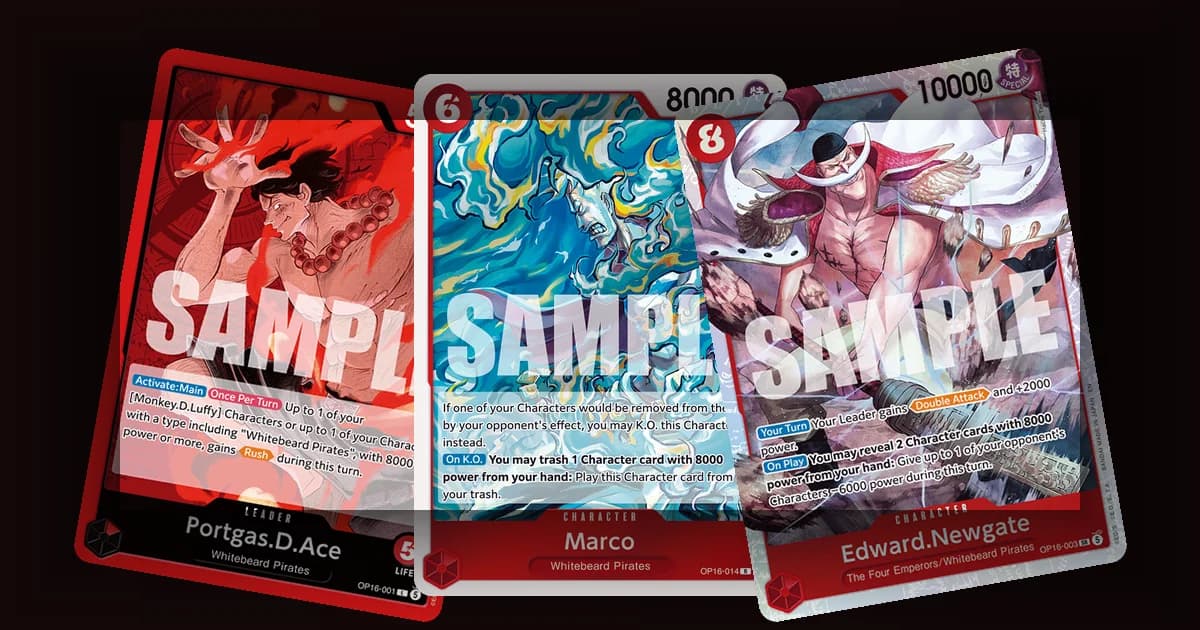
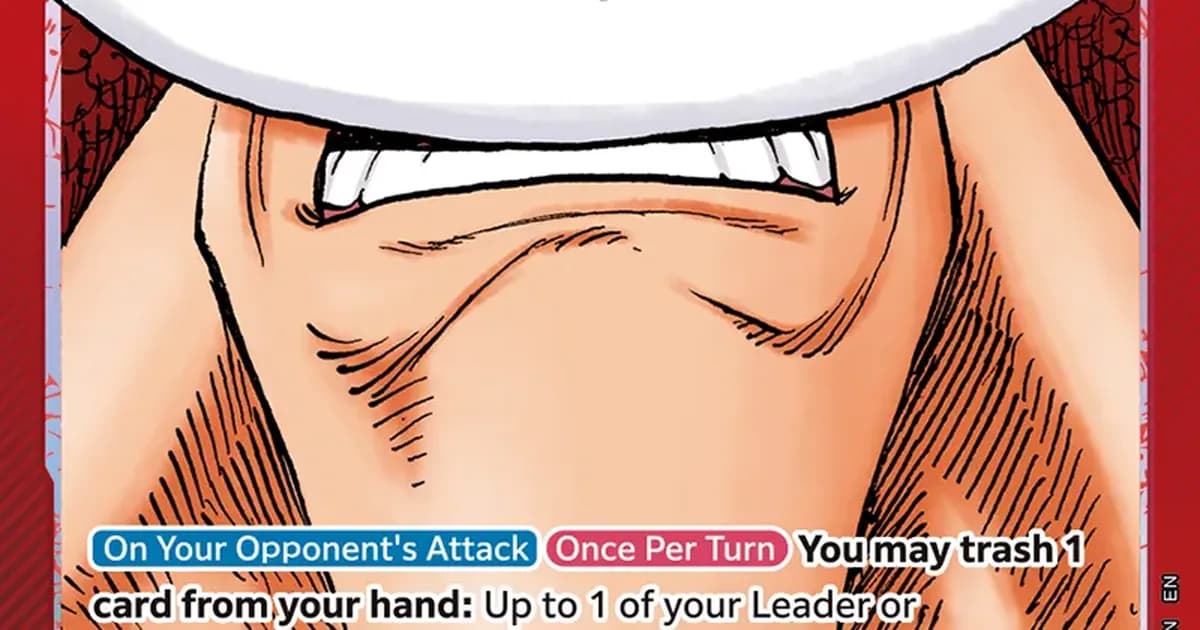
Featured image note: This real sample collage shows three OP-16 Red cards from the Whitebeard Pirates package. It is representative card art, not proof of a complete list or a current ranking.
TL;DR: Red wins by making the opponent answer attacks before their engine is ready. Rush is the core keyword, but DON!! timing, Counter preservation, and the Leader's exact condition matter more than simply filling a list with aggressive Characters. OP16-001 Ace is a Whitebeard Pirates Rush Leader, while current OP-17 data also shows Red Luffy and Red/Black Sabo as separate competitive paths.
Updated October 2, 2026: OPMetagame's current OP-17 snapshot labels Red/Black Sabo, Red/Green Luffy & Ace, and Red/Green Luffy as S tier, while Red Ace and Red Whitebeard are A tier. The page does not provide win-rate figures for these entries, so this guide no longer repeats unsupported percentages or the older Red Luffy and Red Enel labels.
One Piece TCG Red deck guide: quick answer
Choose a Red Leader, build a curve that can attack early, and make every DON!! attachment serve a clear purpose. Red is at its best when the opponent has to spend a Counter or accept damage on several consecutive turns. It loses momentum when it empties its hand for one large attack and cannot rebuild after a bounce, K.O., or defensive turn.
Key takeaways
- Rush lets a Character attack on the turn it is played, according to the official comprehensive rules.
- Red pressure comes from attack frequency, power manipulation, and Leader-specific payoffs. Do not assume every Red list deals direct Life damage.
- OP16-001 Portgas.D.Ace gives Rush to a qualifying 8000-power Luffy or Whitebeard Pirates Character once per turn.
- OP16-118 Portgas.D.Ace is a separate Red Secret Rare Character with a top-five search effect. It is support for a Whitebeard shell, not the Leader.
- In the current OPMetagame snapshot, Red/Black Sabo, Red/Green Luffy & Ace, and Red/Green Luffy are S tier; Red Ace and Red Whitebeard are A tier. The page supplies no win-rate figures for these rows.
- Standard legality follows the Block Icon on the printing. Older leader names are not enough to establish legality.
Red color identity in One Piece TCG
Red asks a straightforward question: can you make the opponent spend cards before they have enough resources to stabilize? The answer usually involves a low-cost Character, an attack that is just large enough to demand a Counter, and a second threat that arrives before the opponent can recover.
Rush and attack timing
The official rules define [Rush] as the ability for a Character to attack during the same turn it is played. That makes Rush the cleanest way to convert DON!! into immediate pressure. It does not mean every Rush Character is automatically good. A small Rush attack may trade for a Counter, while a larger body may be better saved for a turn when the opponent cannot answer it.
Red also uses effects that change power, reduce opposing power, or make a specific Character harder to ignore. Read the exact text before assigning a card a role. The same 6000-power body can be an attacker, a Counter, or a setup piece depending on its Leader and conditions.
Direct Life pressure is not the whole plan
Some Red cards and Leaders can create extra reach against Life, but describing all Red Events as burn is misleading. Many Red games are won through ordinary attacks backed by Rush and DON!! attachments. If a card removes Life without an attack, check whether the effect has a cost, a target restriction, or a condition that makes it weaker than a normal swing.
This distinction matters for deck building. A list that spends too many slots on narrow direct-damage effects can run out of Characters and Counters. A list that never threatens Life gives the opponent time to develop. The useful middle ground is enough reach to punish a low-Life opponent while keeping a board that can attack again next turn.
DON!! is your clock and your defense
Red often wants to attach DON!! to create an attack that crosses a Counter threshold. That is only half of the calculation. Ask what the opponent can attack back with and whether your hand has a Counter for it. Spending every DON!! on the final attack can make a winning board suddenly fragile.
Use the One Piece TCG DON!! system guide for the general resource rules, then adapt the advice to the Leader. A Red Leader with a built-in power or Rush condition may want a different attachment pattern from a Leader that wants to keep Characters wide.
Red leaders in the OP-17 field
The word "best" needs a date. OPMetagame's current OP-17 snapshot lists Red/Black Sabo, Red/Green Luffy & Ace, and Red/Green Luffy in S tier. It lists Red Ace and Red Whitebeard in A tier. The page does not publish win-rate figures for these entries, and the snapshot does not place the older generic Red Luffy or Red Enel labels in those S or A rows. These are live third-party labels, not Bandai rankings, and they can change quickly.
Limitless' archived OP-16 table tells a different story. Its format-filtered page lists Red Ace at 0.87% of points share, behind Red/Blue Lucy and several non-Red leaders. That does not prove the Ace Leader is weak. It proves that OP-16 archive share and the current OP-17 tracker are different questions. Keep the format label attached to every meta claim.
Portgas.D.Ace OP16-001
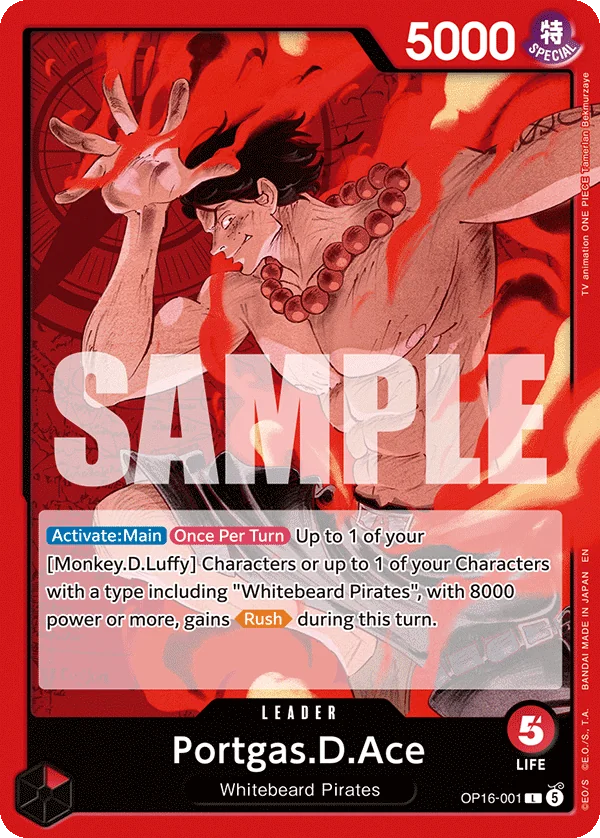 OP16-001OP16-001Shop on TCGplayer Portgas.D.Ace is a Red Leader with 5 Life and 5000 power. Its once-per-turn Activate: Main effect gives Rush to up to one Monkey.D.Luffy Character or up to one Character with a type including Whitebeard Pirates, as long as that Character has 8000 power or more.
That condition shapes the list. You want large Whitebeard Pirates or Luffy bodies that are worth giving immediate access to the attack step, plus enough early plays to avoid passing turns while you wait for the condition. Ace does not provide automatic burn damage, so the deck wins by making its high-power cards attack at the right moment.
Red Luffy and other current branches
Red/Black Sabo uses a different two-color resource and removal plan from OP16-001 Ace. Red/Green Luffy & Ace and Red/Green Luffy are also separate Leader-specific decks, not generic lists that can be copied card for card into Ace. Red Enel is not in the current OPMetagame S or A rows, while Red Whitebeard is listed in A, so do not carry forward the older tier labels without a fresh snapshot.
If you are choosing a Leader for a tournament, compare the recent lists by Leader and ask three questions: how often does the list present an attack by turn three, what does it do after the opponent stabilizes, and which cards are legal in the event's Standard or Extra Regulation? Those questions are more reliable than a color-wide tier label.
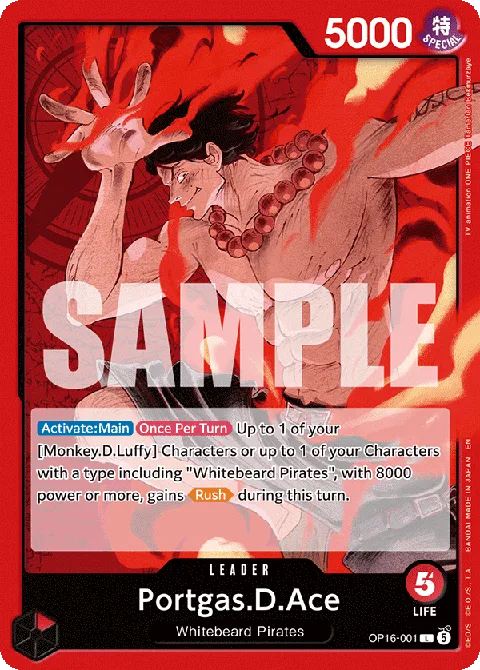 Portgas.D.Ace OP16-001OP16-001Shop on TCGplayer is the OP-16 Red Leader. The printed effect grants Rush to a qualifying 8000-power Luffy or Whitebeard Pirates Character; it does not deal automatic burn damage.
Building a Red deck
The exact cards depend on the Leader, but the construction problem is consistent: keep enough early pressure on the table without losing the hand needed to survive the opponent's reply.
A useful first draft
Start with a 50-card main deck and the separate 10-card DON!! deck. Then test the following jobs rather than chasing a fixed ratio:
- Early bodies: Characters that can attack, search, add power, or set up the next turn.
- Rush threats: Enough same-turn attackers that a slow opening hand does not leave you passing repeatedly.
- Large payoffs: Characters that become better when the Leader grants Rush or changes their power.
- Counters: A real defensive package. Red cannot win every game by attacking first, so do not cut all Counter value for more damage.
- Interaction: Power reduction, K.O. effects, or other answers to the opposing board. The right mix changes with the Leader.
For Ace, begin with Whitebeard Pirates cards that satisfy the 8000-power condition and add Luffy cards only when their effect supports the same plan. OP16-118 Portgas.D.Ace is a 5-cost, 6000-power Red Character with a +1000 Counter. On Play or On K.O., it looks at five cards and can add a Monkey.D.Luffy or a card with a type including Whitebeard Pirates to hand. It also changes the Counter of your 8000-power Characters in hand to +2000. That is a search and hand-quality tool, not a Life-burn effect.
The OP-16 complete guide has the historical set context. Use the One Piece TCG Standard format guide to check legality before treating an older Red list as tournament ready.
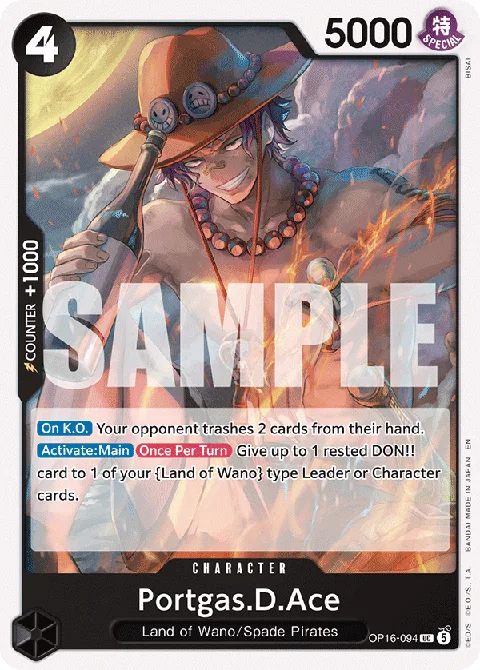
This real OP16-094 Portgas.D.Ace Character is Black, costs 4, and belongs to the Land of Wano/Spade Pirates package. It is retained as a clearly labeled card-identity example, not as a Red deck recommendation.
Matchup planning without fake percentages
Exact matchup percentages need a named dataset, date, Leader, and sample size. The old version of this article presented numbers such as 45-55 and 52-48 without a reproducible source, so they have been removed.
Into fast decks
The first few attacks matter more than a late-game finisher. Keep a playable curve, protect the Character that can attack again, and do not spend every Counter on an attack that does not change the race. A small early hit can be correct if it makes the opponent spend a card before their engine starts.
Into bounce and control
Do not put every threat on the board at once. Bounce rewards the opponent when you have no card in hand to replay. Keep one attacker or search piece back, and make them choose between answering the board and protecting Life.
Into Life and Trigger decks
Read the opposing Life plan before deciding whether to attack. A Trigger can be more valuable to the opponent than the Life card itself, but refusing to attack forever gives them time to build. Use power thresholds and a wider attack sequence so a single reveal does not erase the whole turn.
Into large Characters
Red needs to decide whether the opposing body must be removed or can be ignored. Power reduction and a DON!!-boosted attack may open a route, but trading two cards for one Character is not always correct. If the Leader can attack Life directly, sometimes the better answer is to keep the board and race.
Step-by-Step: playing a Red turn
1. Count DON!! before you play a Character. Decide which cards must be paid for, which DON!! can be attached, and whether you still have enough resource for a Counter on the opponent's turn.
2. Identify the attack that changes the game. It may be a small Leader swing that forces a Counter, a Rush Character attacking immediately, or a large attack that makes the opponent give up a card. Do not assume the biggest number is automatically the best line.
3. Sequence search and pressure together. If a search effect finds the card needed for next turn, play it before committing to an attack that consumes your only remaining DON!!. Red needs a next turn, not just a good current turn.
4. Turn on Ace only when the target is worth exposing. Ace's once-per-turn effect is strongest when an 8000-power Luffy or Whitebeard Pirates Character can attack immediately and force a meaningful response. Do not spend the effect on a weak attack just because the condition is available.
5. Preserve one defensive card when the board is ahead. An extra attack is less valuable if the opponent can return the pressure and remove your last Character. Treat the opponent's next attack as part of your current DON!! calculation.
6. Recount the race after every Life change. Once either Leader is at low Life, a Counter, a Trigger, or a single large swing can change the correct line. Red rewards decisiveness, but it still needs a current board count.
Key takeaways
- Rush is Red's clearest tool, but attack sequencing and Counter preservation decide whether the pressure lasts.
- OP16-001 Ace grants Rush to a qualifying high-power Luffy or Whitebeard Pirates Character. It is not a burn Leader.
- OP16-118 Ace is a separate Red Secret Rare Character that searches the top five and improves 8000-power Character Counters.
- The current OPMetagame snapshot places Red/Black Sabo, Red/Green Luffy & Ace, and Red/Green Luffy in S tier, with Red Ace and Red Whitebeard in A tier; use a dated source rather than one color-wide ranking.
- Standard legality follows the Block Icon on the exact printing. Extra Regulation is broader, but tournament rules still matter.
- Keep enough Counter value and replayable threats that one bounced or K.O.'d Character does not end your turn cycle.
Related reading
- OP-16 Ace Deck Guide: a focused list and sequence guide for the OP16-001 shell.
- OP-17 Meta Tier List: current leader context after the OP-17 launch.
- OP-16 All 6 Leaders Explained: historical OP-16 leader text and color comparison.
- One Piece TCG Luffy Deck Guide: another Red-centered pressure shell to compare against Ace.
Frequently asked questions
What does Red do in One Piece TCG? Red is associated with early attacks, Rush Characters, power changes, and direct pressure. Some Red cards can remove Life or create extra reach, but the Leader and set decide how much of that plan a deck actually uses.
Who are the best Red leaders in One Piece TCG in 2026? OPMetagame's current OP-17 snapshot lists Red/Black Sabo, Red/Green Luffy & Ace, and Red/Green Luffy in S tier, with Red Ace and Red Whitebeard in A tier. It is a third-party live snapshot, not a permanent ranking or an official Bandai tier list, and it does not publish win rates for these entries.
What is Rush in One Piece TCG? Rush lets a Character attack during the same turn it is played. You still need to pay the card's cost, choose a legal attack, and keep enough DON!! for the rest of the turn.
Is Portgas.D.Ace OP16-001 a burn Leader? No. Its once-per-turn Activate: Main effect gives Rush to up to one Monkey.D.Luffy Character or Whitebeard Pirates Character with 8000 power or more. The deck creates pressure through that extra attack, not automatic Life damage from the Leader.
Is Red a good color for beginners? It is easy to understand and harder to sequence well. New players can learn the basic attack plan quickly, then improve by tracking DON!!, hand size, Counter thresholds, and which Character must survive for the next turn.
How does Standard affect older Red leaders? Bandai's 2026 season notice says Standard permits cards with Block Icon 2 or higher, while Extra Regulation uses the broader card pool subject to the ban list. Check the icon on the exact card printing before using an older leader.
References
Was this guide helpful?
Cards in this article
About the author

Competitive TCG Writer
Competitive One Piece TCG player who topped at regional level. Has strong opinions about leader tier lists and when the meta is being over-hyped.
- Regional One Piece TCG top-8 finisher
- Competitive meta analyst
- Matchup and deck-building specialist
Keep reading
One Piece TCG Green Deck Guide: Rest and Tempo Denial 2026
Guides · 17 min

One Piece TCG Blue Yellow Guide: Pairing and Nami Strategy
Guides · 14 min
One Piece TCG Purple Deck Guide: DON Ramp and Control
Guides · 12 min
One Piece TCG Black Deck Guide: Removal and Trash Mastery
Guides · 9 min
One Piece TCG OP-16 meta report: July 2026 snapshot
Guides · 9 min
OP-17 Leaders Preview: All 6 Confirmed, Xebec Is Blue
News · 6 min
One Piece TCG Nami Counter Guide: Beat Blue Yellow 2026
Guides · 10 min
OP-16 Nami Tech Cards: 7 Verified Picks by Color (2026)
Guides · 16 min
Disclaimer
This article is published for informational and entertainment purposes. It does not constitute professional financial, legal, or technical advice. Game performance, online services, patch schedules, and store listings change. Verify critical details (pricing, system requirements, regional availability) with publishers and storefronts before you buy. Affiliate links, where present, help support our editorial work and are labelled in our affiliate disclosure.