Loading…


Shonen TCG · Guides
One Piece TCG Black Deck Guide: Removal and Trash Mastery
Reviewing
One Piece TCG
One Piece TCG Black deck guide: of all six colors, Black has the clearest identity. You destroy what your opponent plays and replay what you discard. Every card in a Black deck either clears the board or fills the graveyard for a payoff later. Knowing when to remove versus when to hold removal is what separates a Black player who wins from one who runs dry at the worst moment.
TL;DR: One Piece TCG Black deck guide: Black is the removal and trash color. It destroys opponent's Characters efficiently and replays your own cards from the discard pile. Top Black leaders in 2026: Yamato (OP16-079, mono-Black Wano recursion) and Blackbeard (OP16-080, Black/Yellow Trigger-redirect control). Yamato is more approachable; Blackbeard is the higher skill ceiling. Both were among OP-16's top-performing leaders at launch; in the current OP-17-blended meta (Sep 6), Blackbeard sits at 7.8% share, the format's #4 deck, while Yamato has climbed back to 3.4% after a summer dip.
One Piece TCG Black deck guide: what does Black do?
Black is the removal and trash color. That's the full identity, and every mechanical decision flows from it. Where Red attacks fast and Green ramps early, Black trades, removes, and waits for the recursion window that makes late-game Black decks feel nearly impossible to exhaust.
The color has a specific spot relative to every other color:
- Red is aggro and burn, going wide and fast
- Blue is tempo and card draw, bouncing characters and refilling hand
- Green is Don!! acceleration, ramping into oversized threats
- Yellow is Life manipulation and Trigger effects, playing defense then swinging late
- Purple is cost reduction and board bouncing, grinding through value
- Black removes Characters by cost threshold and rebuilds from the trash
The core loop: remove threats to stay alive, send your own cards to trash intentionally, then replay those cards with buffs or at reduced cost. Black doesn't win fast. It wins by being impossible to clean up.
What Black Does: Removal and Trash
K.O. Removal
Black's signature is cost-based K.O. removal. Events and character abilities that read "K.O. a character with cost 5 or less" are the backbone of every Black list. This removal is unconditional within the cost range: no attack requirement, no life trade, just destruction.
Typical Black removal covers cost 3 through 7, depending on the Don!! investment. Paying 2 Don!! on a removal event usually handles cost 4-5 targets. Going up to 3 Don!! often clears cost 6-7. That efficiency is why Black matches up well against wide boards and against decks that commit expensive characters before having protection online.
One thing to understand clearly: removal isn't a tempo play in isolation. It's board control that keeps your leader alive long enough for the recursion engine to matter. Black decks that fire removal too early on small threats often run dry against decks that keep refilling.
Trash Filling (Self-Mill)
Black has effects that deliberately send cards from your deck or hand to your own trash. It's intentional self-mill, and it fuels everything that comes after. Cards with abilities that say "send the top X cards from your deck to your trash" or "discard a character to gain an effect" build the resource base that Black leaders then exploit.
Running 8-10 cards that fill the trash is standard. The mix usually includes character abilities that trigger when entering the field (send 2 from deck), events that mill as part of a cost (pay 2 Don!!, send 3 from deck, do the effect), and leader abilities that self-mill on attack, which is common in mono-Black variants.
The mental model that matters: the trash is a second hand. Cards there aren't lost; they're staged for recursion. Treating self-mill as card loss is the most common mistake players new to Black make.
Trash Recursion
Recursion turns the trash from a pile into an engine. Black has multiple ways to play Characters from the trash rather than the hand: replaying characters with Rush (immediate attack ability), discounting the cost of trash plays, or triggering bonus effects when specific character types come back.
The recursion type varies by leader. Yamato uses Wano Country characters specifically. GY Law uses a different character pool. Blackbeard leans on the trash less directly but operates in the same color space because Yellow supplements what Black builds.
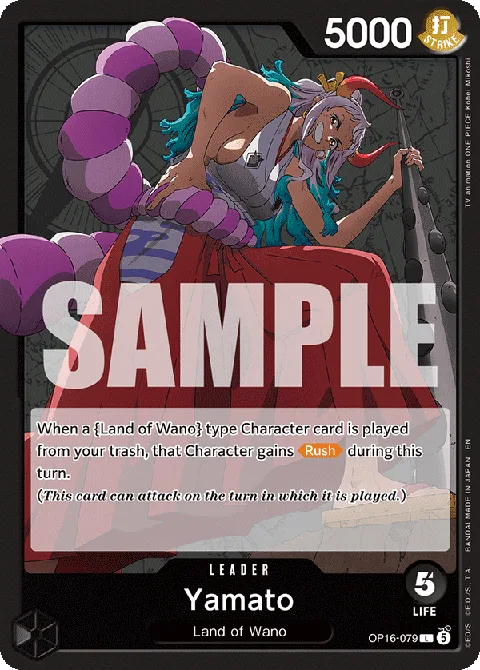 Yamato (OP16-079) is the flagship Black leader in OP-16, running Wano Country recursion with Rush to generate board swings that Ace and Nami struggle to answer.
How K.O. Removal Works in Black
Black removal is cost-threshold based. Knowing the thresholds before you sit down matters. You want to answer "can I remove that?" in real time, not mid-calculation.
Most Black removal falls into three buckets.
At 2 Don!!, you're handling the cost 3-5 range. These are efficient and the right answer to Red's early bodies that need to stay off the board.
At 3 Don!!, you're clearing cost 5-7. The investment is real, but the effect is often a 1-for-1 that removes a character worth 2-3 Don!! more than you paid. These are your answers to the win conditions your opponent was building toward.
Character-attached removal is the third type. Some Black characters enter the field and immediately K.O. an opponent's character as their activation effect. They're slightly less mana-efficient than pure events, but they leave a body behind for blocking after the trade.
Running the right mix depends on your expected metagame. Against Red and Green, lean toward low-cost removal that catches their early bodies. Against Blue and Purple, you want the high-cost answers that handle their big finishers.
GODEEPER: Yamato is the flagship Black leader in OP-16, and her Wano recursion plan requires knowing exactly which characters to prioritize in the trash. Yamato OP-16 Deck Guide: Wano Recursion Build →
The Trash Engine Explained
The trash engine has three phases: fill, select, replay.
Fill. Your first 3-4 turns are about sending the right cards to trash. Not every card in your deck belongs there early. You want your recursion targets in the trash, specifically the high-value characters that gain Rush or cost reduction when replayed. Lower-cost utility characters should stay in hand for blocking and early tempo.
Select. Once your trash has 6+ relevant characters, you start making decisions about what to replay. This is where Black gets complex. The trash is visible to both players. Your opponent knows what threats you have available. Experienced Black players use that visibility to bait removal before replaying real threats.
Replay. The payoff. Playing a cost-7 character from trash for the recursion cost (often 3-4 Don!!) while it gains Rush is a swing that closes games. Black's recursion plays are typically worth 2-3x the Don!! investment because of the Rush or cost reduction attached.
The timing rule: don't start replaying until you have at least one removal event in hand to protect the returned character. A replayed threat that gets bounced before attacking wastes the recursion slot, and that's a brutal tempo loss at the stage of the game when Black should be taking over.
Top Black Leaders in 2026
Yamato (OP16-079)
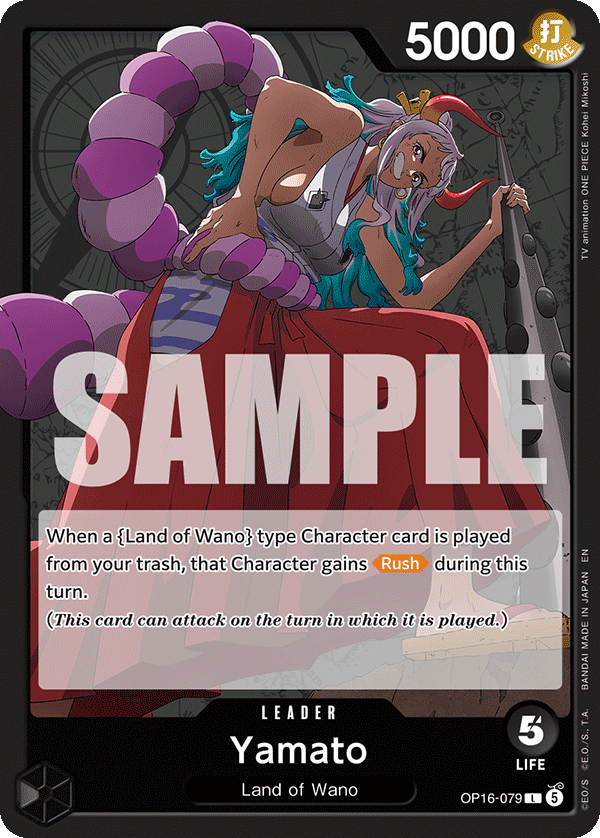 OP16-079OP16-079Shop on TCGplayer Yamato is the mono-Black flagship leader in OP-16, one of the format's top performers at launch and still a strong choice into July. Her leader ability: when a Wano Country character is played from your trash, that character gains Rush this turn. She can also attack the turn she's played, which is unusual for a leader and creates immediate pressure your opponent wasn't expecting.
The game plan is linear but requires execution. Fill trash with Wano characters turns 1-3. Use removal to survive turns 2-5. Begin the recursion engine from turn 5 onward. Replaying Wano characters with Rush while holding removal creates board states where the opponent's perpetually behind on both characters and Life.
Yamato's the most approachable Black leader for players new to the color. The win condition is direct. The caveat: trash management, knowing which Wano characters to prioritize in the pile, takes several games to develop. You'll make the wrong call early and that's fine.
Blackbeard (OP16-080)
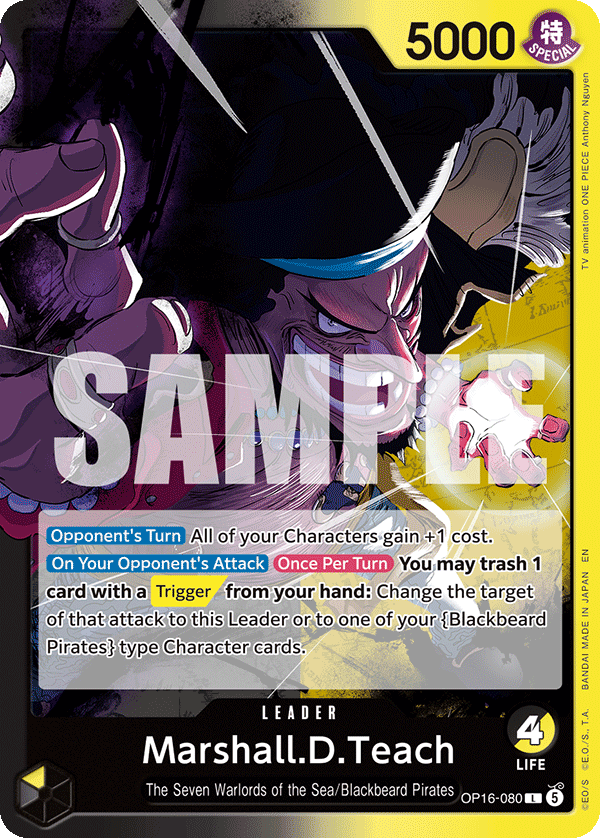 OP16-080OP16-080Shop on TCGplayer Marshall D. Teach runs Black/Yellow. His leader ability is a once-per-turn redirect: on your opponent's attack, you may trash 1 card with a [Trigger] from your hand to change the target of that attack to Blackbeard himself or to one of your {Blackbeard Pirates} type Characters. He also makes your own Characters cost 1 more to play during the opponent's turn, a smaller tax that mostly limits how greedy you can be with reactive plays. Against a board where your Leader is the real target, the redirect is a genuine save, turning a Life-losing attack into a trade you chose.
Blackbeard pairs this with Yellow's Trigger package, giving the deck defensive burst effects that Black alone doesn't have. Every Trigger card in your hand does double duty: it can redirect an attack away from your board, or it can flip normally off the top of your Life area as a Trigger. Deciding which job a given Trigger should do is the core tension of piloting the deck.
That's also the problem. Spending a Trigger on the redirect means it's gone from your hand, and it's no longer protecting your Life cards either. That requires tracking exactly how many Triggers you're holding, what each one does, and whether this specific attack is worth burning one to redirect. Blackbeard is an advanced leader, and I don't think that's overstated. It rewards players who've put in the format reps.
GY Law (OP-15)
Law's Black/Blue variant from OP-15 remains a popular choice in EN. It uses a trash recursion plan similar to Yamato but supplements it with Blue's card draw and tempo tools. The draw package finds recursion targets faster; the bounce effects from Blue add a second removal axis.
GY Law is intermediate-to-advanced. Dual-color balance requires more deckbuilding precision, and managing two color requirements across Don!! payments adds real complexity. But if you enjoy grinding through value rather than committing to one plan, it's the most flexible of the Black archetypes.
GODEEPER: The GY Law build has its own distinct recursion plan and character targets. OP-16 GY Law Deck Guide: Trash Engine Breakdown →
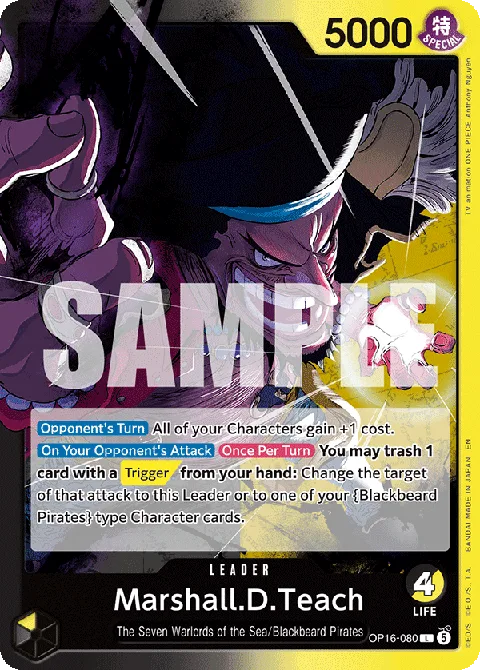 Marshall D. Teach Blackbeard (OP16-080) runs the Black/Yellow Trigger-redirect strategy, spending Trigger cards from hand to send attacks onto his Leader or Blackbeard Pirates Characters.
Which Black Archetype Suits Your Playstyle
There are three distinct Black archetypes in the current meta, and they suit very different types of players.
Mono-Black Recursion (Yamato): start here if you want a clear game plan and you're willing to learn trash management. The deck wins through a specific engine. Mistakes are readable, which matters when you're still getting reps in.
Dual-Color Control (Blackbeard): pick this if you're comfortable managing a hand where every Trigger card has two jobs, normal defense or a leader-ability redirect, and can decide correctly under pressure. Blackbeard rewards players who track exactly which attacks are worth burning a Trigger to send onto his Leader or a Blackbeard Pirates Character instead. High skill ceiling, and the results back it up: a 67.1% win rate over 70+ tracked games back at OP-16 launch, and he's still one of the format's stronger decks now, sitting at 7.8% meta share, the #4 spot, in the current OP-17-blended standings.
Dual-Color Tempo (GY Law): pick this if you already understand Blue's tempo tools and want to add trash recursion as a secondary angle. GY Law bridges the two most technical colors in OPTCG. The learning curve is steep.
If you're new to Black, start with Yamato. Ten to fifteen games and the trash management starts to feel natural. If you've already got reps with Black and you're ready for something harder, Blackbeard is the format's most complex and rewarding option.
Building a Black Deck: Card Counts and Ratios
A working Black deck follows these rough ratios.
Removal sits at 8-12 cards: K.O. events and character abilities covering cost 3-7. Mix at least two different cost thresholds. A removal suite that only handles one range will leave you stranded in specific matchups.
Trash fill runs 8-10 cards: self-mill characters and events. The target is 6+ relevant cards in trash by turn 5. Under-running trash fill is the most common deckbuilding mistake in Black, and it's an easy one to make when you're trying to fit everything.
Recursion payoffs are leader-specific, landing somewhere in the 6-10 range. Yamato runs Wano characters with strong Rush value when replayed; Blackbeard leans on a smaller recursion package because Yellow Triggers fill the defensive role.
Counter package: 8-14 cards, with 10 as a reasonable standard. Under-countering in Black is punishing because the trash engine takes several turns to come online and you need to survive the early game to see it.
High-cost finishers run 4-6 cards, targeting the 6-8 cost range. Black runs these at lower counts than other colors because recursion replays them, so you don't need 4 copies to see them consistently.
The curve ends up deliberately top-heavy compared to aggro decks. Don!! from turns 1-4 goes to removal and blockers. From turn 5 onward, it goes to recursion plays.
SHOP: Building a Black One Piece deck? Compare current One Piece Card Game singles for the leader and removal package. Shop TCGplayer →
Step-by-Step: Piloting a Black Deck Turn by Turn
Once your deck is built, the turn-by-turn plan for any Black archetype follows the same broad arc: survive, fill, recur, close.
1. Hold removal early instead of firing it blind. Turns 1-2, play cheap blockers and utility characters. Save K.O. removal for a target that actually threatens your board or Leader rather than the first body your opponent plays.
2. Fill the trash with real recursion targets. Turns 1-3, prioritize self-mill effects that put your leader's specific recursion targets (Wano characters for Yamato, Blue tempo pieces for GY Law) into the trash rather than random cards.
3. Spend removal to survive turns 2-5. As the opponent develops, spend your 2 Don!! and 3 Don!! removal events on the biggest threats in their cost range. This is the window where Black looks the most reactive.
4. Check your trash count before turn 5. You want 6+ relevant characters in trash by turn 5. If you're short, keep milling before you start replaying; a thin trash makes the recursion plan unreliable.
5. Begin recursion plays once you're holding backup removal. From turn 5 onward, replay your best trash target (with Rush or a reduced cost, depending on leader) only when you have a removal event in hand to protect it from being traded off immediately.
6. Close with protected recursion swings. Keep alternating removal and recursion each turn: clear what threatens your board, then replay another trash target. Black wins by outlasting the opponent's ability to keep answering, not by racing.
Matchup Tendencies
Red (aggro) is a favorable matchup. This is where Black removal feels the best: Red floods the board fast, and Black's designed to clear that board efficiently. The matchup comes down to whether Red can pile on enough Life damage before your removal stabilizes. When it does stabilize, the game's usually yours.
Blue (tempo) is closer to even. Blue bounces characters back to hand; Black removes them permanently. Blue's bounce disrupts Black's recursion targets temporarily, which is annoying. The player who controls board resources by the midgame tends to win.
Yellow (Triggers) plays out differently depending on your leader. Blackbeard's positioned well here because his own deck runs the same Trigger cards a Yellow opponent does, so he understands the matchup's rhythm and can spend his redirect on exactly the attack a Yellow opponent is counting on landing. Yamato vs pure Yellow is more of a race: does Yellow's Trigger burst outpace Yamato's recursion damage before the recursion engine takes over? Often it doesn't.
Green (ramp) is favorable. Green's ramp relies on keeping characters alive to activate Don!! abilities. Black's removal kills those characters before Green can use them, which short-circuits the whole plan. Removal-heavy Black lists are among the strongest Green counters in the format.
Purple (control) is the slowest and most mentally taxing matchup. Both sides generate value slowly. Purple grinds through cost reduction and bounce; Black grinds through removal and recursion. Over 8-10 turns, the player who built the larger resource advantage wins. It's a technical exercise and not always the most fun one, but Black has real tools for it.
For a full breakdown of where Black sits in the current OP-16 metagame, the OP-16 meta tier list covers every leader's performance across the first week of JP results.
Key Takeaways
- Black's identity is removal and trash recursion. Every card either destroys an opponent's character or fuels the discard pile for a payoff.
- The trash is a second hand. Self-mill isn't card loss; it's staging future plays.
- 8-12 removal cards is the baseline. Running below 8 leaves you vulnerable to boards you can't clear.
- Yamato (OP16-079) is the entry point for Black. Clear game plan, learnable trash management.
- Blackbeard (OP16-080, Black/Yellow) redirects attacks by spending Trigger cards from hand, a constant resource-management puzzle. Advanced players only.
- GY Law (OP-15) bridges Black and Blue for players who want tempo alongside recursion.
- Match the archetype to your playstyle, not to what's topping the meta. All three Black archetypes are competitive in OP-16.
Understanding which Black archetype fits your style is half the battle. For more on One Piece TCG mechanics, the counter mechanic guide and the OP-16 complete guide cover the foundations you need to run any Black list effectively.
Related Reading
- OP-16 Blackbeard Deck Guide: Black/Yellow Life information and Trigger package breakdown.
- One Piece TCG Red Deck Guide: Full Aggro and Burn 2026: Red's aggro identity, a sharp contrast to Black's removal-and-grind game plan.
- One Piece TCG Green Deck Guide: Mill and Disruption 2026: Green's mill and bounce approach, which shares Black's love of opponent's deck as a resource.
- One Piece TCG Blue/Yellow Color Guide: another dual-color pairing to compare against Black/Yellow Blackbeard.
- One Piece TCG Standard Format Guide 2026: which sets are currently legal, useful context before committing to a Black archetype.
- OP-16 Budget Deck Post-Launch: how to build a competitive Black list without chasing expensive singles.
- One Piece TCG How to Play: Rules and Mechanics: the core turn structure Black's removal and recursion plan operates within.
Frequently Asked Questions
What does Black do in One Piece TCG? Black is the removal and trash color. It has the best K.O. effects in the game, destroying opponent's Characters by cost threshold, and has self-mill effects to intentionally fill your own discard pile. Recursion abilities then replay Characters from the trash, often with Rush or at reduced cost. Black controls the board through efficient removal and rewards players who treat the trash as a second hand.
Who are the best Black leaders in One Piece TCG in 2026? Yamato (OP16-079, mono-Black) and Blackbeard/Teach (OP16-080, Black/Yellow) were among OP-16's top-performing leaders at launch. In the current OP-17-blended meta (opdecks.xyz, Sep 6), Blackbeard sits at 7.8% share, the format's #4 deck behind Enel, Mihawk, and Luffy, while Yamato has climbed back to 3.4% after a summer dip. GY Law (OP-15, Black/Blue) is a strong alternative in EN. Yamato uses Wano Country trash recursion with Rush; Blackbeard spends Trigger cards from hand to redirect attacks onto his Leader or Blackbeard Pirates Characters, with Yellow Triggers covering defense the rest of the time.
What is trash recursion in One Piece TCG? Trash recursion means playing Characters from your discard pile rather than your hand or deck. Black deliberately sends cards to the trash through self-mill effects, then replays those cards with bonuses. Yamato's leader ability gives replayed Wano characters Rush, making them attack immediately. The trash becomes a staging area for future plays, not a pile of lost resources.
Is Yamato or Blackbeard better for beginners? Yamato is more approachable. Her plan is clear: fill the trash with Wano characters, use removal to survive, then replay Wano characters with Rush from turn 5. Blackbeard's redirect ability spends a Trigger card from hand to move an attack onto his Leader or a Blackbeard Pirates Character, which requires knowing what every common Trigger does and deciding, attack by attack, whether redirecting is worth losing that card as a normal counter. That is an advanced skill set that takes significant metagame knowledge to use well.
How many removal cards should I run in a Black deck? 8-12 K.O. events or character abilities is the standard range. Cover at least two cost thresholds: low (cost 3-5) and high (cost 5-7). Running below 8 removal cards leaves you exposed to boards you cannot clear, particularly in the critical turns 3-5 before your recursion comes online.
Can Black pair with other colors in One Piece TCG? Yes. Black/Yellow (Blackbeard) is the format's top dual-color pairing, with Yellow adding Trigger effects and Life information. Black/Blue (GY Law) adds card draw and bounce tempo. Mono-Black (Yamato) gives the cleanest recursion focus without needing to balance two color requirements. The choice depends on whether you want information/Triggers, draw/tempo, or pure recursion.
References
Was this guide helpful?
Cards in this article
About the author

TCG Deck Analyst
Former card game tournament organiser turned analyst. Covers One Piece TCG meta, deck efficiency, and card valuation. Builds spreadsheets for decks most people just play.
- Regional TCG tournament organiser
- One Piece TCG meta specialist
- Competitive deck analysis

Disclaimer
This article is published for informational and entertainment purposes. It does not constitute professional financial, legal, or technical advice. Game performance, online services, patch schedules, and store listings change. Verify critical details (pricing, system requirements, regional availability) with publishers and storefronts before you buy. Affiliate links, where present, help support our editorial work and are labelled in our affiliate disclosure.