

Shonen TCG · Guides
One Piece TCG Trade Guide: How to Trade Cards Fairly
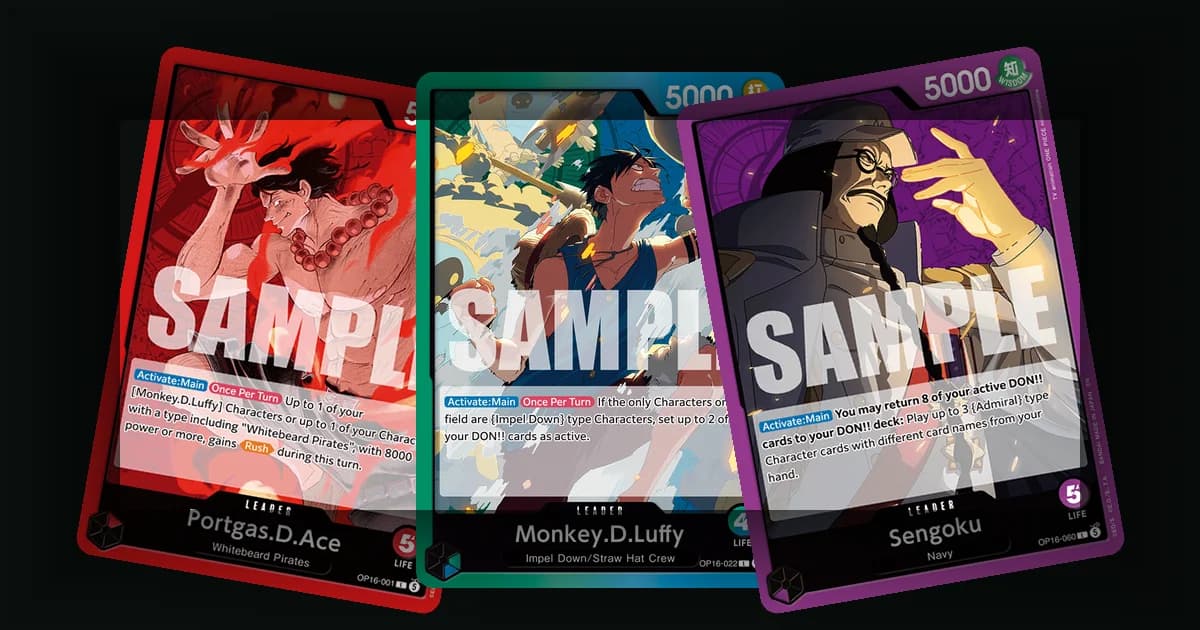
TL;DR: This One Piece TCG trade guide is about comparing the exact card, version, condition, language, and current market evidence on both sides. There is no universal 10% fairness rule and no guaranteed “hold” category. Trade in a public venue when possible, use protection or a middleman online, and confirm current legality because Block rotation and restrictions can change a card's buyer pool.
Note: The rules, Block Number, restriction, and card-record details in this guide were checked on September 18, 2026. Prices, fees, supply, and demand change by region and platform. Treat every market value as a dated reference, not a promise.
One Piece TCG trade guide: quick answer
A fair trade starts with shared information, not with a slogan about a percentage. Before you compare numbers, write down the card number, set, language, treatment, condition, and quantity. Two cards with the same character name can have different effects, colors, printings, or collector premiums.
Then choose one valuation method for both sides. A marketplace listing can show what sellers are asking, while a market-price field or recent completed sale can show a different view. Use the same source and version for both cards, record the date, and discuss any uncertainty before handing anything over.
The practical rules are:
- Compare identical card numbers and treatments whenever possible
- Separate regular play copies from alternate art, Super Parallel Rare, and graded copies
- Adjust for condition, language, centering, surface, and visible defects
- Check current Standard and Extra Regulation legality before valuing competitive demand
- Do not assume a popular character or a high rarity will protect the price
- Use a public venue, simultaneous exchange, or platform protection for safety
If both traders understand the references and accept the condition, a small difference can be a convenience choice. If the other person hides the version, rushes the decision, or refuses to agree on a source, walk away.
GODEEPER: Before trading away an older staple, check the One Piece TCG meta rotation guide for Block and restriction risk.
One Piece TCG trade guide: valuing a card correctly
Identify the exact card first
Start with the card number printed on the card, not only the character name. Record the set code, number, rarity, color, card type, language, and treatment. For a parallel, confirm the number and rules text rather than treating a different illustration as a different effect.
As a concrete database check, the OP-16 records for 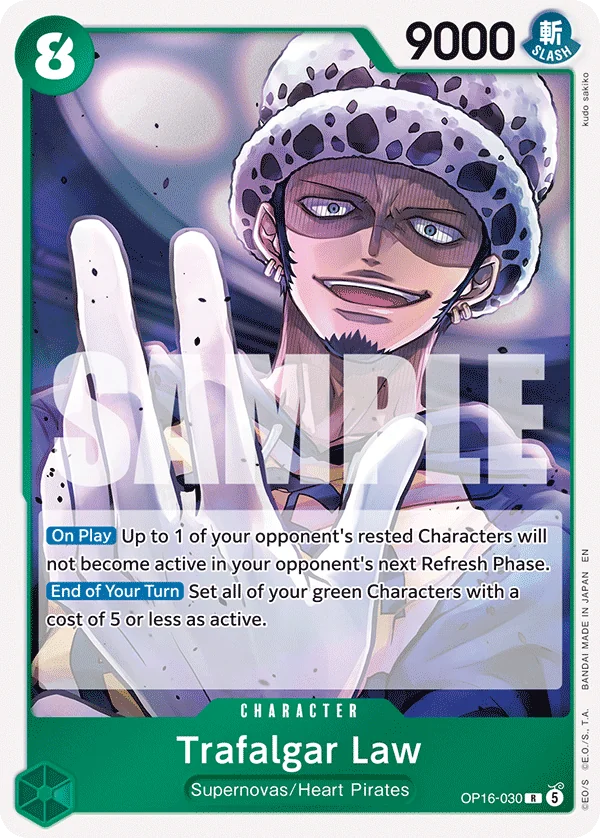 OP16-030OP16-030Shop on TCGplayer and
 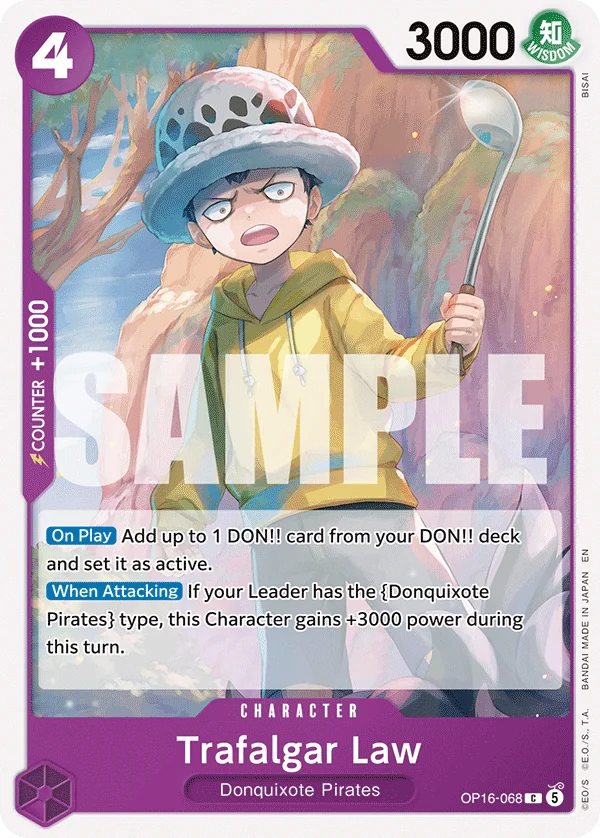 OP16-068OP16-068Shop on TCGplayer both use the name Trafalgar Law but describe different Character cards. OP16-030 is a Green Rare Character, while OP16-068 is a Purple Common Character. A name-only search would be an unsafe shortcut when building a trade value.
Match condition and language
Near Mint, Lightly Played, and damaged cards are not interchangeable. Look at corners, edges, surface, centering, bends, dents, and whitening under good light. If a flaw is visible, show it in the photos and write it in the trade message.
Language also affects the buyer pool. A Japanese, English, or other-language copy can have different availability and tournament-use rules in the region where the trade happens. Verify the event rules if the recipient intends to play the card rather than collect it.
Match the valuation source
Use the same marketplace or sale-history method for both sides. A current listing is evidence of an asking price, not proof that a buyer paid it. A market-price field can be useful, but it has a timestamp and may combine different transaction conditions. Recent completed sales are stronger context when enough comparable sales exist.
For a graded card, compare the exact grading company, grade, label, and card version. A population report tells you how many items a company has recorded at each grade. It does not tell you the market price or guarantee that the next copy sells at a particular number.
Record the time and net value
Prices can move after a tournament result, restriction notice, new set, reprint, or rotation announcement. Save a screenshot or link, write down the date, and state whether shipping and fees are included. A trade does not need to use cash, but both parties still need to know what they are comparing.
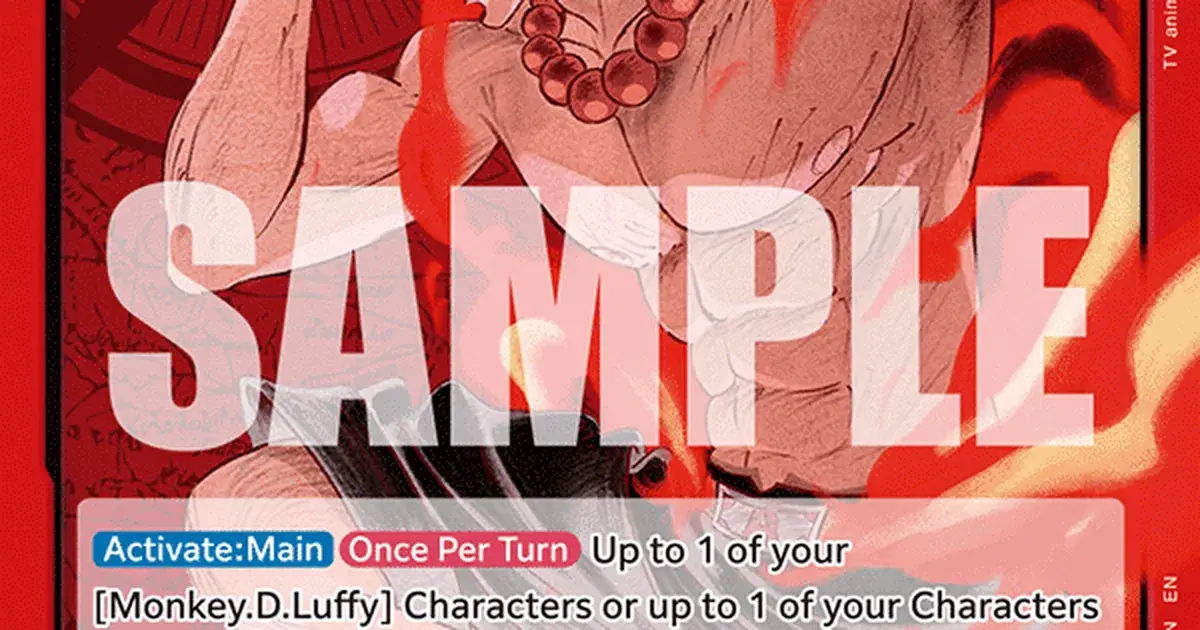
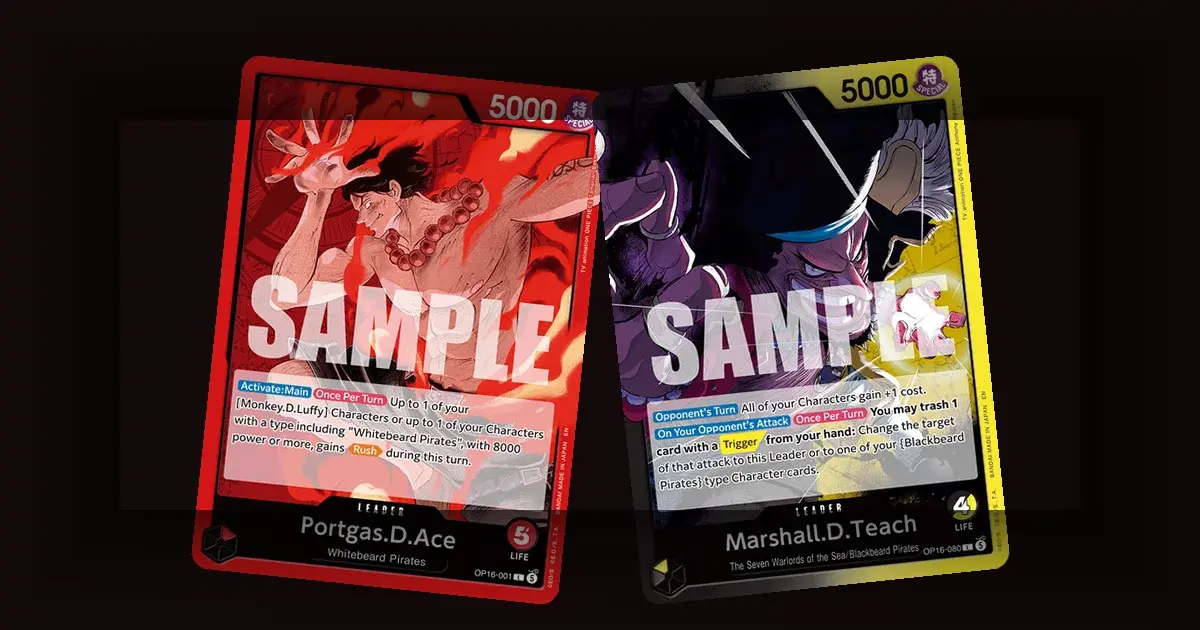
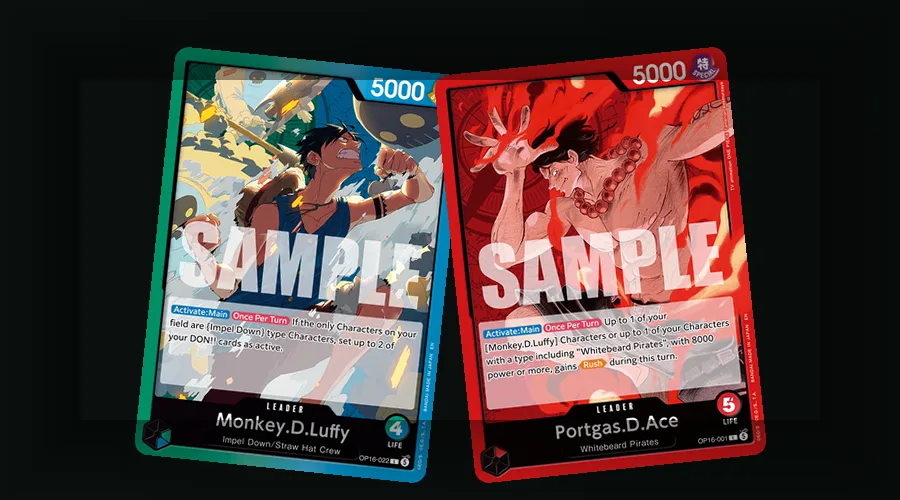 These real OP-16 sample Leaders show Monkey.D.Luffy and Portgas.D.Ace. They illustrate card artwork only, not current prices or a recommended trade ratio.
What to keep, trade, or review
Avoid universal “hold” lists. Use demand and purpose instead.
Keep or review before trading
- Cards you currently need for a legal deck
- Flexible staples that fit more than one Leader or archetype
- Copies with collector interest and active play demand, if you accept the price risk
- Cards affected by a recent reveal, tournament result, reprint, restriction, or Block update
- Cards that would cost more to replace than the value you receive
Dual demand can make a card more resilient because players and collectors are different buyer groups, but it is not a guarantee. Collector demand can fade, supply can grow, and a competitive card can be power-crept.
Trade or sell after review
- Duplicates outside the decks and collections you actually plan to keep
- Cards tied to a list you have permanently stopped playing
- Premium treatments you do not value as a collector
- Speculative copies whose current demand is based mainly on an unconfirmed prediction
- Cards with a shrinking buyer pool after rotation or a restriction
“Trade” does not automatically mean “sell at the top.” A trade can exchange one risk for another. Compare the card you receive with the card you give away using the same standard.
Block rotation and restriction risk
One Piece Card Game Standard is no longer a no-rotation format. Bandai's Block Number system began April 1, 2026. The official schedule describes an approximately three-year Standard pool, with Blocks 2 through 5 used from April 2026 through March 2027 and Blocks 3 through 6 used from April 2027 through March 2028.
Extra Regulation is the broader official format, but the exact event announcement still controls. A card leaving Standard can retain play demand in Extra Regulation, casual play, or collection, but it may become harder to trade if most people at your venue only play Standard.
Bandai also says that certain card numbers can receive Block updates and that past Super Parallel Rare cards and matching card numbers generally receive special Standard treatment. Check the printed Block number and the official Block update page instead of guessing from the set code.
The official restriction notice uses banned cards, banned pairs, and restricted cards. It says the list may change as the environment changes and that revisions are typically considered after Championship Season 1 in Japan and after the World Championship, while earlier action remains possible. A card's competitive demand can change quickly after one of these notices.
Trading safely in person and online
In person
Meet at a public card shop, convention, or organized event when possible. Put both sides on the table, inspect them under the same light, confirm the card numbers and condition, and exchange at the same time. If either person needs a second opinion, ask a store employee or judge before the cards leave the table.
Do not let a crowd or a time limit force a decision. You can pause, look up a card, or decline. A fair trade remains fair after a five-minute check.
Remote trade
For an online trade, agree in writing on card number, version, condition, language, quantity, shipping method, tracking, and what happens if the package is damaged or lost. Use a platform with buyer or trade protection when available. For higher-value transactions, use a trusted middleman whose identity and process both parties can verify.
Photograph the cards, packaging, and tracking receipt. Do not rely on a screenshot of a social profile as proof of identity. Check references for completed trades, not only comments copied into a new account.
Red flags include pressure to ship immediately, refusal to show the back or surface, a version mismatch, an offer that depends on an unverified price spike, a request to move payment outside protection, and an unwillingness to use tracking for an expensive card.
Trade versus sell
Choose the route that matches your goal.
Trade when: you want a specific card, the other person has a version you would actually buy, and both sides can agree on condition and source. A trade can avoid some cash-sale friction, but it still has shipping, time, and mismatch risk.
Sell when: you need cash, want to reduce a collection, or cannot find the card you want in a fair trade. Compare the expected net proceeds after the platform's current fee schedule, shipping, taxes, and return risk. Never insert a generic fee percentage into every marketplace calculation.
Keep when: you need the card for a current list, the replacement cost is high, or you have not resolved the card's legality and demand. Waiting for better information is a valid decision.
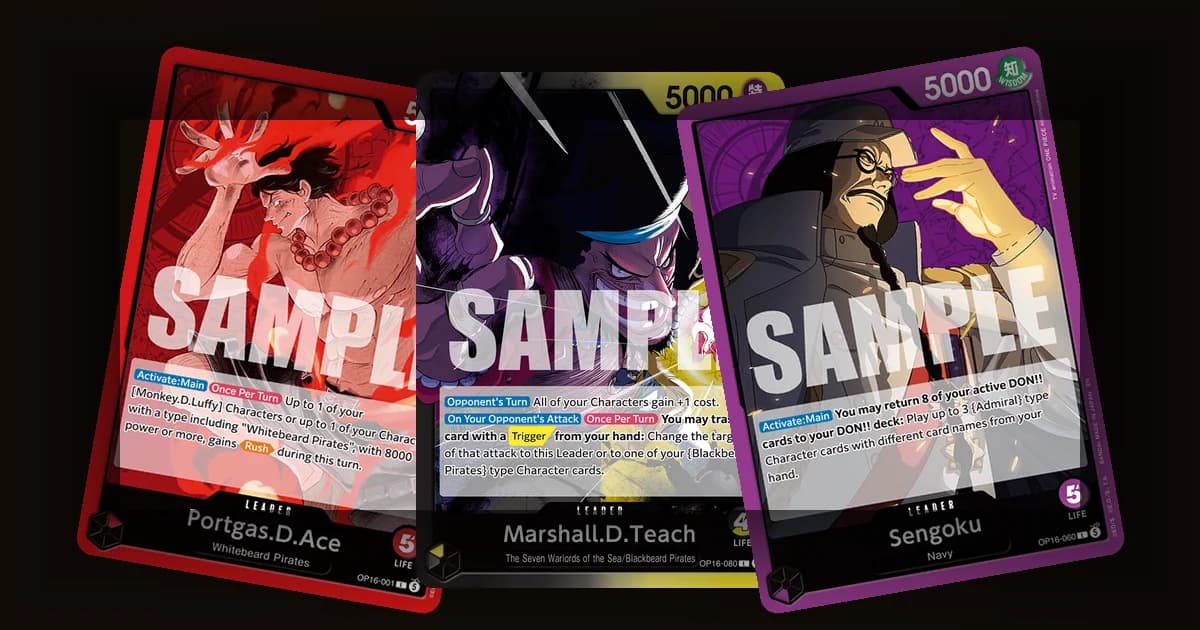
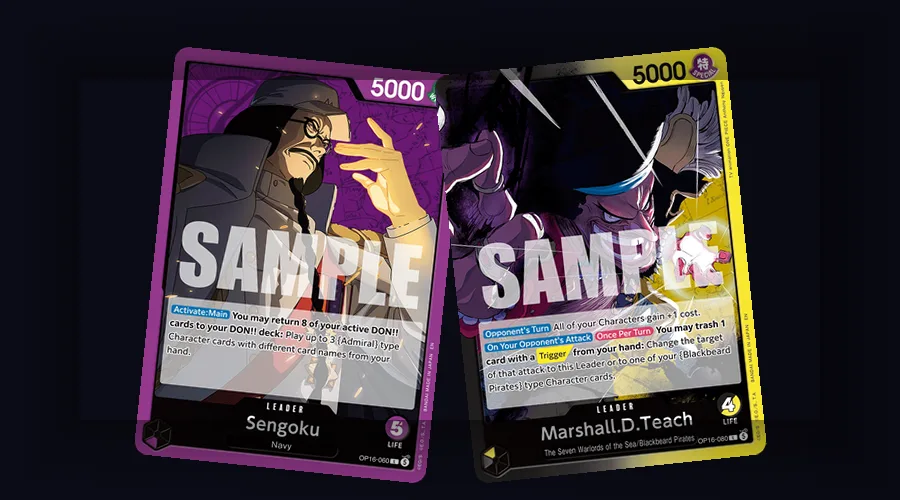 These real OP-16 sample Leaders show Sengoku and Marshall.D.Teach. They are representative sample assets, not evidence of a current tournament ranking or trade value.
Building a trade that helps your collection
Trade toward a defined list. Write down the card numbers you need before browsing binders. This keeps a nice-looking card from becoming an expensive detour.
Separate playable copies from display copies. If you want the effect, buy the regular printing. If you want the art, label the premium as a collection choice. Mixing those goals makes a trade look unfair when the two traders simply value different things.
Use duplicates deliberately. A duplicate can become a missing staple, but do not empty the only cards that keep more than one deck functional. Track your deck cores separately from trade inventory.
Trade hype with caution. A recent result can create attention, but one result is not a durable price floor. If you trade into a hyped card, accept that the value can fall when the next set, restriction notice, or tournament result arrives.
Trade etiquette and reputation
State the condition and version before agreeing. If a card has whitening, a bend, a language difference, or a treatment mismatch, disclose it before the other person makes a decision. Do not change the offer after the other trader has accepted because you found a better listing.
If a new player is using the wrong card number or source, explain the difference rather than exploiting the mistake. You can decline a trade without embarrassing anyone. A clear “I value these differently, so I will pass” protects both people and leaves the door open for a later exchange.
For repeated online trades, keep a record of tracking and feedback. Reputation is useful only when it comes from completed, verifiable transactions. For in-store conduct, the One Piece TCG locals etiquette guide covers the broader event norms.
When to walk away
Do not trade when the card identity, version, or condition is unclear. Do not trade under pressure, without a source both parties accept, or when the other person refuses reasonable photos or verification.
Pause when you are trading away a card you may need again. Price the replacement copy first. A trade that looks even on paper can be expensive if you immediately need to rebuy the same staple.
Pause when the only evidence is a viral post, a single listing, a spoiler, or an unconfirmed ban prediction. Save the link and review it after there is reliable market or official information.
Step-by-Step: Final trade checklist
1. Write the exact card numbers. Include set, number, treatment, language, quantity, and whether any card is graded.
2. Inspect condition together. Use the same light and disclose corners, edges, surface, centering, dents, bends, and whitening.
3. Choose a shared reference. Use the same marketplace, comparable sale history, or local source for both sides. Record the date and whether fees or shipping are included.
4. Check legality and demand. Look at the current Block Number, restrictions, format, recent results, and whether each card has play or collector demand.
5. Agree on the details in writing. For remote trades, confirm addresses, tracking, packaging, insurance or protection, and what happens if something goes wrong.
6. Exchange only when both sides are comfortable. A fair trade can be declined at any time. Do not let urgency replace verification.
Key takeaways
- Identify the exact card number, treatment, language, and condition before discussing value
- Use the same dated source and method for both sides, and distinguish listings from completed sales
- Dual demand may help, but no rarity, character, or archetype guarantees future value
- Standard rotation and restriction changes can reduce a card's competitive buyer pool
- Public simultaneous exchanges are safer in person; use protection or a verified middleman online
- Do not rely on a universal 10% fairness rule or fixed marketplace fee percentage
- Keep deck cores separate from duplicates and cards you truly want to trade
Related Reading
- One Piece TCG Card Grading Guide: condition and grading decisions.
- OP-16 Price Guide: Post-Launch Card Values: set-specific market context.
- One Piece TCG Most Expensive Cards 2026: high-end card context.
- One Piece TCG Standard Format Guide 2026: current legality and deck rules.
- One Piece TCG Deck Building Guide: building toward a specific list.
- OP-16 Law Deck Guide: examples using verified OP-16 Trafalgar Law cards.
Frequently Asked Questions
Q: How do I value a card for trade? A: Verify the exact card number, printing, treatment, language, and condition. Then use the same current marketplace or comparable sale method for both sides and record the date.
Q: What should I hold versus trade? A: Keep cards you need, flexible staples, and items whose legality and demand you have checked. Trade duplicates or cards you no longer want after comparing replacement cost. No category is guaranteed to hold value.
Q: How do I avoid scams? A: Meet publicly, inspect cards, exchange simultaneously, and use platform protection or a verified middleman for remote high-value trades. Confirm tracking and condition in writing.
Q: Trade or sell? A: Trade when you want a specific card and agree on comparable versions. Sell when you need cash or cannot find a fair trade. Use the platform's current fees instead of a fixed percentage.
Q: What is a fair trade? A: Both traders should agree on source, version, condition, date, and any convenience difference before confirming. There is no universal percentage that settles every trade.
Q: Should I trade competitive deck cards? A: Trade duplicates or cards you no longer need after checking legality and replacement cost. Keep the core of a deck you may return to.
Q: How do I track prices? A: Use current marketplace context and comparable sales where available. For graded cards, a population report describes recorded supply, not a guaranteed value.
References
- TCGplayer One Piece Card Game listings: current marketplace context.
- One Piece Card Game official rules: rules and format references.
- Introduction of the Block Number System: Standard and Extra Regulation schedule.
- Overview of Cards Subject to Block Number Updates: current Block updates and Super Parallel Rare treatment.
- Official Banned/Restricted Card Notice: restriction categories and revision policy.
- OP16-030 Trafalgar Law card record: card number, type, and list context.
- OP16-068 Trafalgar Law card record: card number, type, and list context.
Was this guide helpful?
Cards in this article
About the author
Card values and pull rates
Pen name for the Shonen TCG desk's card value, pull rate and collector market coverage.
- Prices read from TCGplayer and Cardmarket listings, dated
- Pull rates tied to a stated sample
- Opinions marked as ours, with the reason
Keep reading
One Piece TCG Standard Format Guide 2026: Legal Sets
Guides · 12 min
One Piece TCG Budget Competitive Guide 2026 Under $100
Guides · 13 min

One Piece TCG Deck Building Guide: Build From Scratch
Guides · 12 min
One Piece TCG Meta Rotation Guide: When to Sell Cards
Guides · 15 min
OP-16 Ace Deck Guide: Whitebeard Pirates Rush Build
Guides · 12 min
OP-16 Collectors Guide: SEC, Manga Rare, Alt-Art Cards
Guides · 11 min
OP-16 Box Opening Strategy: How Many Boxes to Open
Guides · 10 min

OP-16 vs OP-15 power level comparison: what changed?
Guides · 11 min
Disclaimer
This article is published for informational and entertainment purposes. It does not constitute professional financial, legal, or technical advice. Game performance, online services, patch schedules, and store listings change. Verify critical details (pricing, system requirements, regional availability) with publishers and storefronts before you buy. Affiliate links, where present, help support our editorial work and are labelled in our affiliate disclosure.