Loading…


Shonen TCG · Guides
OP-16 Ace Deck Tech Week 1: Whitebeard Rush EN Results
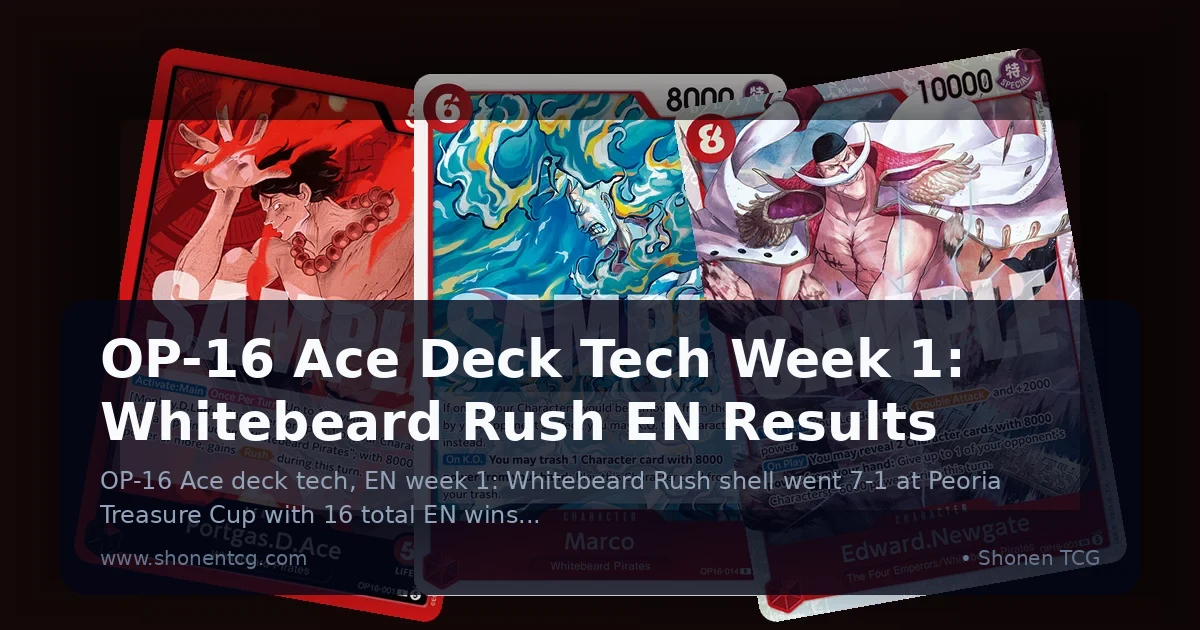
Portgas D. Ace returned as an OP-16 leader. This OP-16 Ace deck tech covers the historical Whitebeard Pirates Rush shell that went 7-1 at the Peoria Treasure Cup on June 20, 2026.
TL;DR: OP-16 Ace (OP16-001) is a Red Rush leader built around granting surprise attacks to Whitebeard Pirates bodies with 8000+ power or to Monkey D. Luffy. The shell uses Moby Dick for a top-three search and DON!! transfer, Thatch for cheap tempo, and Little Oars Jr. as a conditional Rush target. Player Long placed 3rd at the Peoria Treasure Cup on June 20, 2026 with a 7-1 record. This is a historical deck tech, not a current tier verdict.
OP-16 Ace deck tech: quick answer
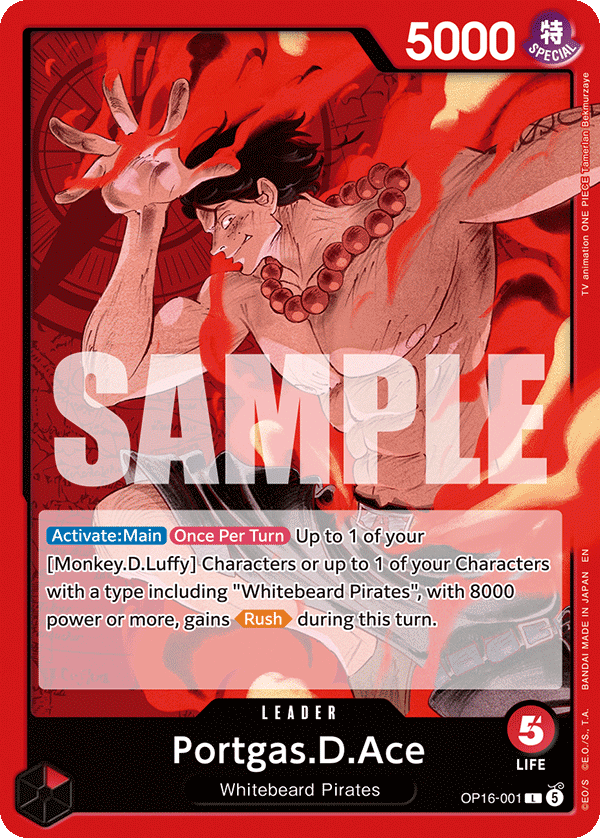 OP16-001OP16-001Shop on TCGplayer Ace is a 5000-power, 5-life Red leader who grants Rush to a qualifying Whitebeard Pirates character or Luffy once per turn during your Main phase. The deck wins by building a Whitebeard board around Moby Dick's top-three search, playing Thatch at a cost discount, and closing with Rush attacks from Newgate, Little Oars Jr. after its condition is live, or Luffy.
GODEEPER: Want the full card-by-card breakdown of what makes the Red Ace shell tick since launch? OP-16 Ace Deck Guide: Whitebeard Pirates Rush Build →
How Ace's Leader Ability Works
The leader ability reads: [Activate: Main] [Once Per Turn]. Give Rush this turn to 1 Monkey D. Luffy character you control OR 1 Whitebeard Pirates character you control with 8000 or more power.
A few things to understand about this effect:
It triggers on demand. You choose when to use it during your Main phase, which means you can develop your board first and then grant Rush to the character that benefits most from the attack right now. This is different from characters that have Rush printed on the card, which the opponent can see and play around on the previous turn.
The 8000 threshold gates the ability. Not every Whitebeard Pirates body qualifies. Thatch at his base stats does not reach 8000, so he is not a Rush target. Edward Newgate and Little Oars Jr. do clear the threshold. This creates a natural tension: you want bodies on board early to enable Thatch's cost reduction, but you specifically want high-power bodies to be Rush targets later.
Luffy bypasses the power threshold. 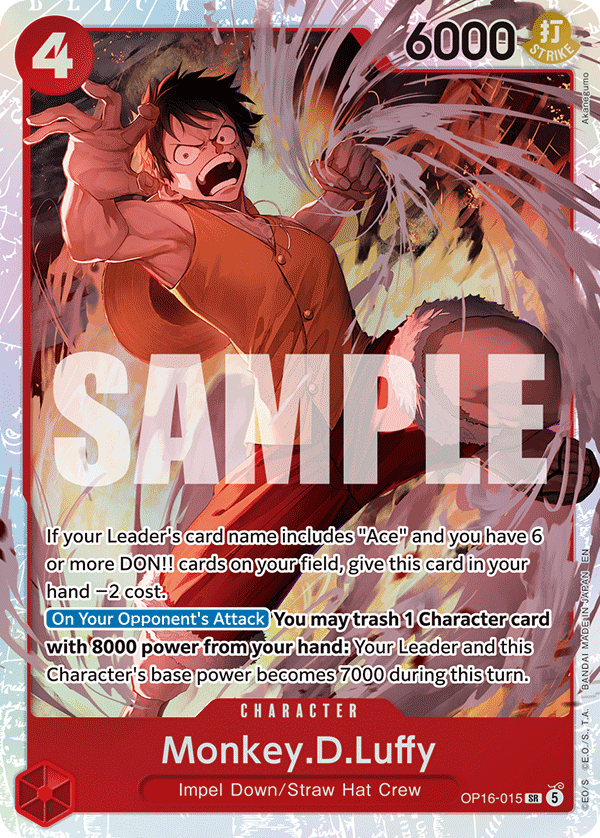 OP16-015OP16-015Shop on TCGplayer Monkey D. Luffy (the OP-16 version) qualifies regardless of power because the ability names him directly. His cost also drops by 2 when you have 6 or more DON!! on field, making him efficient to deploy in the mid-game turns where you want to grant Rush.
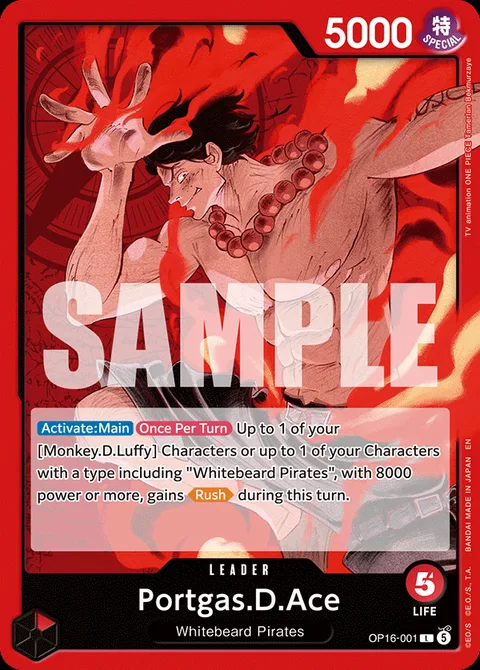 Ace (OP16-001) grants Rush to Whitebeard Pirates, turning fresh plays into immediate attacks for the deck's fast clock.
The Whitebeard Pirates Shell
The core cards in the EN week 1 build reflect the Peoria TC result and the official OP-16 card pool.
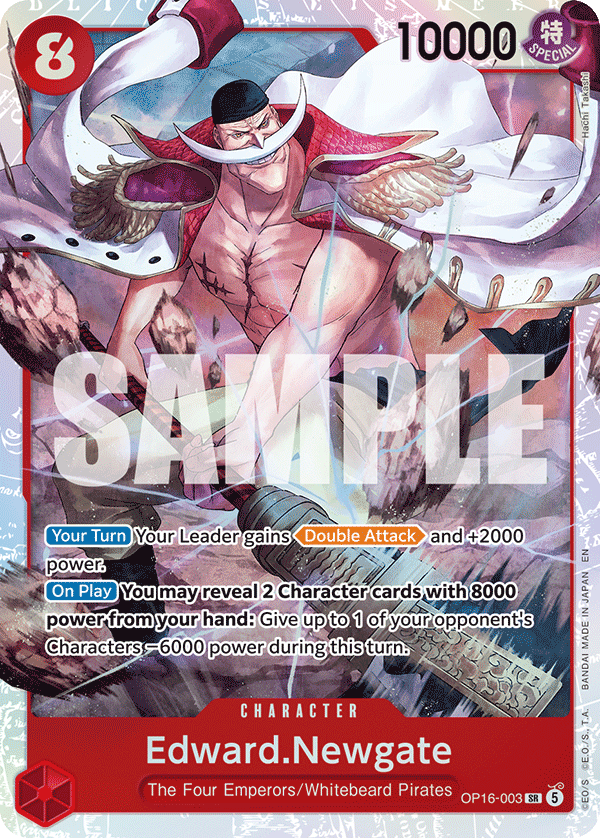 OP16-003OP16-003Shop on TCGplayer Edward Newgate (Whitebeard), 4 copies. The anchor of the board. He clears the 8000 threshold and becomes the primary Rush target when Luffy is not available or when you need a single massive attack to break through a defensive setup. Four copies because the deck cannot afford to miss him in the mid-game.
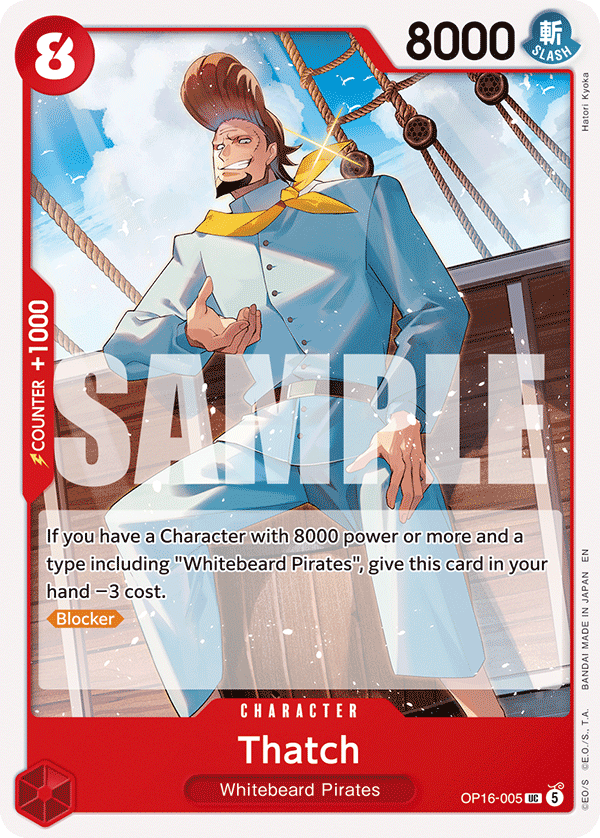 OP16-005OP16-005Shop on TCGplayer Thatch, 4 copies. Thatch's cost drops by 3 when you control an 8000+ Whitebeard Pirates character. That condition becomes live when an 8+ cost Whitebeard Pirates character such as Newgate is on the field. Little Oars Jr. is only 4 cost, so it cannot satisfy this requirement by itself. At his discounted cost, Thatch provides power-efficient tempo that fills out the board and stacks bodies without stretching your DON!! too thin.
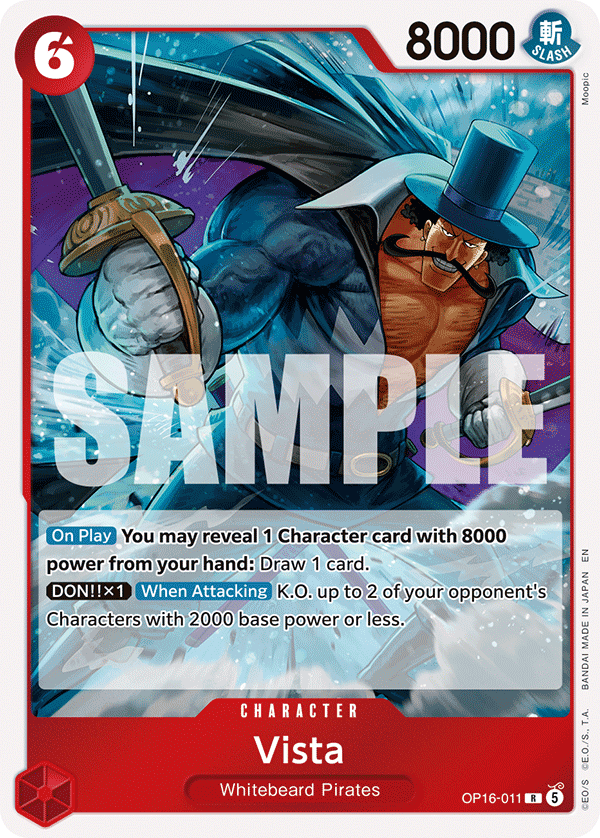 OP16-011OP16-011Shop on TCGplayer Vista, 4 copies. Vista provides a reliable stat line that fits between the low-cost openers and the heavy hitters. He does not need a condition to come into play effectively and handles the DON!! curve on turns where you are not yet ready to deploy Newgate.
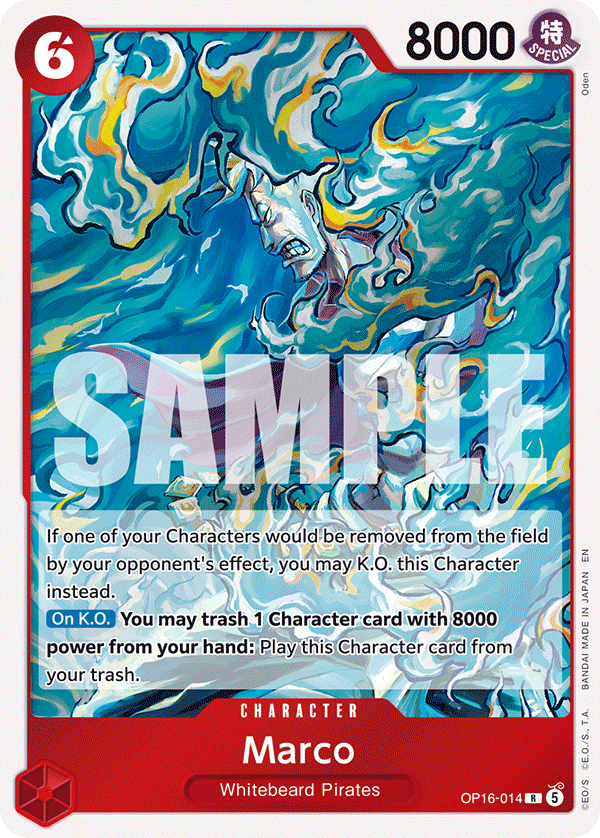 OP16-014OP16-014Shop on TCGplayer Marco, 4 copies. Marco is the defensive resilience piece. If an opponent's effect would remove one of your Characters, Marco can K.O. itself instead, then its On K.O. ability can play Marco from your trash by trashing an 8000-power Character card from hand. That matters against removal-heavy matchups like Blackbeard.
Monkey D. Luffy (OP16-015): situational core. The direct Rush target named by Ace's leader ability. His cost reduction at 6+ DON!! makes him a natural turn-6 play, and granting Rush to him on that same turn creates a high-damage attack that most boards cannot absorb cleanly.
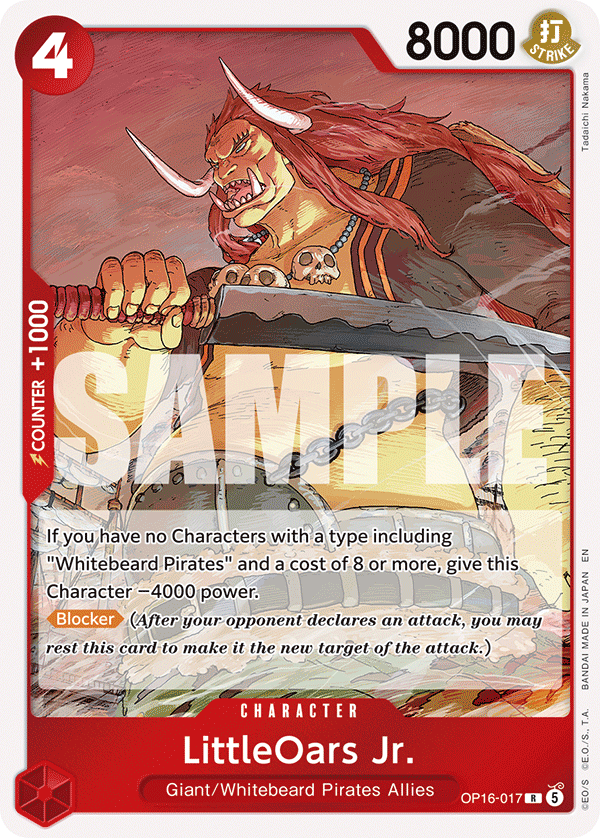 OP16-017OP16-017Shop on TCGplayer Little Oars Jr., 4 copies. Correction: his 8000 base power is conditional, not free. His real card text applies a -4000 power penalty unless you already control a Whitebeard Pirates Character with 8 cost or more, meaning he sits at 4000 power (below Ace's Rush threshold) until Edward Newgate is already down. Sequence Newgate first; Oars Jr. becomes a second legal Rush target once that condition is met, not a standalone one. He also has Blocker, which gives the shell a defensive option while it builds toward its larger bodies.
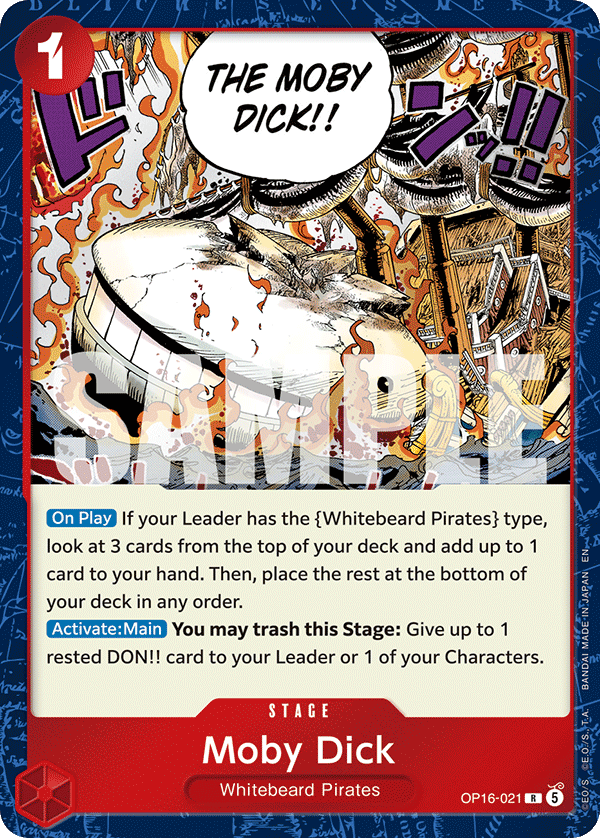 OP16-021OP16-021Shop on TCGplayer Moby Dick (Stage), 4 copies. Correction: this is a one-time [On Play] search, not a repeatable draw engine. If your Leader has the Whitebeard Pirates type (Ace qualifies), look at the top 3 cards of your deck and add up to 1 to hand. It also has a separate [Activate: Main] ability: trash the Stage to give up to 1 rested DON!! card to your Leader or a Character. That transfers a rested DON!! card after the Stage leaves play; it does not untap DON!! or draw cards. Both effects help smooth the route to Newgate and Thatch, but neither is an ongoing card-draw engine.
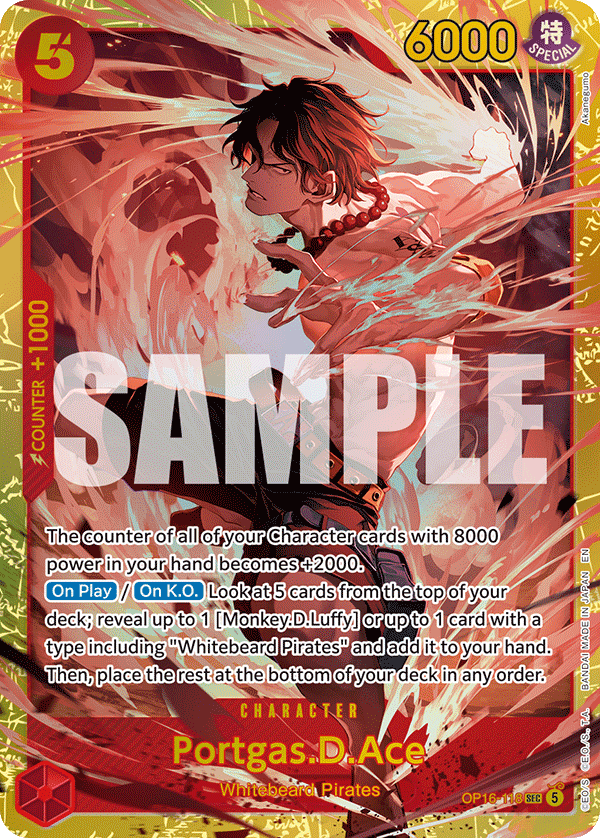 OP16-118OP16-118Shop on TCGplayer Portgas D. Ace (Character version), 4 copies. This character version of Ace gives every 8000-power Character card in your hand +2000 Counter. Its [On Play] and [On K.O.] effects also look at the top 5 cards for a Monkey D. Luffy or Whitebeard Pirates card. It is both a hand-quality tool and a consistency piece, not just an additional attacker.
Sample Decklist (EN Verified)
This framework reflects the Peoria TC placing list for Player Long, who finished 3rd with a 7-1 record on June 20, 2026. Individual counts in the non-core slots vary by local meta preference.
Leader:
- OP16-001OP16-001Shop on TCGplayer Portgas D. Ace x1
Characters:
- OP16-003OP16-003Shop on TCGplayer Edward Newgate x4
- OP16-005OP16-005Shop on TCGplayer Thatch x4
- OP16-011OP16-011Shop on TCGplayer Vista x4
- OP16-014OP16-014Shop on TCGplayer Marco x4
- OP16-015OP16-015Shop on TCGplayer Monkey D. Luffy x2-3
- OP16-017OP16-017Shop on TCGplayer Little Oars Jr. x4
- OP16-118OP16-118Shop on TCGplayer Portgas D. Ace (Character) x4
Stages:
- OP16-021OP16-021Shop on TCGplayer Moby Dick x4
The remaining slots are filled with low-cost Red counter cards and Events depending on local metagame. The sample list used defensive Counter cards to help the shell reach its Rush turns.
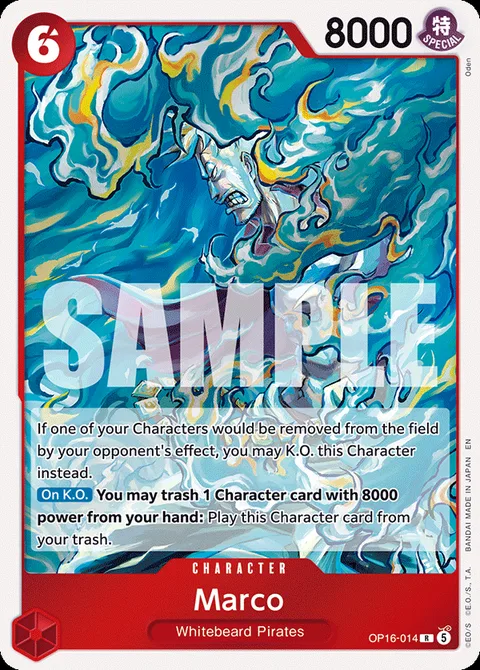 Marco (OP16-014) can K.O. itself instead of letting an opponent's effect remove another character, then return from the trash by trashing an 8000-power Character card from hand.
Turn-by-Turn Play Pattern
Turns 1-3 (early game): Priority is setting up Moby Dick as soon as possible. Use these turns to search for Newgate and identify your optimal mid-game attack line. Vista can come down as an early body to establish presence without committing too much DON!!.
Turns 4-5 (mid-game, critical window): Deploy Edward Newgate first; his 8000+ power isn't conditional. With Newgate on the field, both Thatch's cost reduction and Little Oars Jr.'s own power boost become active, since both check for a Whitebeard Pirates Character at 8+ cost in play. Play Thatch at the discounted cost, then Little Oars Jr. once he can actually hit his printed 8000 power. The board now has multiple real 8000+ targets and the opponent cannot single out a priority threat easily.
Turn 6+ (Rush window): At 6+ DON!!, Luffy's cost reduction kicks in. You can deploy Luffy and use Ace's leader ability on the same turn to grant Rush, creating a back-to-back attack that stacks with existing bodies. If Luffy is not in hand, use the leader ability on Newgate or a now-boosted Little Oars Jr. instead. The goal is to attack for damage that forces the opponent to exhaust their hand countering rather than building their own board.
Closing: The deck does not burn the opponent out. It closes by stacking Rush attacks over multiple turns until the opponent runs out of Counter cards. Moby Dick's one-time search helps find a key piece, while its second ability can attach a rested DON!! card to a Leader or Character after the Stage leaves play. That supports the final attack sequence without pretending the Stage is a repeatable draw engine.
Step-by-Step: Running the Week 1 Ace Rush Line
1. Prioritize Moby Dick on turns 1-3. Get the Stage down as early as possible so its one-time On Play search can find Edward Newgate. Vista can fill the board on these turns without committing too much DON!!.
2. Deploy Newgate first once you hit the mid-game. His 8000+ power is not conditional, and he is what unlocks the other two thresholds: Thatch's cost reduction and Little Oars Jr.'s own power boost both check for a Whitebeard Pirates Character at 8+ cost in play.
3. Follow with Thatch, then Little Oars Jr. Play Thatch at his discounted cost once Newgate is down, then bring in Little Oars Jr. once he can actually hit his printed 8000 power. This gives the opponent multiple real 8000+ targets to answer at once.
4. Grant Rush at 6+ DON!!, ideally onto Luffy. Once Luffy's cost reduction kicks in, deploy him and use Ace's leader ability the same turn to attack immediately. If Luffy is not in hand, point the ability at Newgate or a now-boosted Little Oars Jr. instead.
5. Close by stacking Rush turns, not by racing. Keep attacking with surprise Rush turns until the opponent runs out of counter cards rather than swinging for one big burst; against a resource-heavy opponent like Enel, expect to need more than one or two Rush turns to close it out.
Matchup Direction
These assessments come from community discussion following week 1 EN results. No fabricated win rate numbers are included.
vs Blackbeard (Week 1 read): unfavorable. Blackbeard's attack-redirection effect and cost pressure can blunt Ace's attack turns before the Rush window fully opens. The deck can generate enough early pressure to steal games, but this directional assessment is not a current win-rate claim. See the OP-16 Blackbeard deck guide for how the opposing side approaches the matchup.
vs Yamato (Week 1 read): roughly even. Ace's Rush tempo competes with Yamato's recursion speed. Neither deck had a decisive structural advantage in the early weeks. Outcomes depended on draw quality and whether the Ace player landed Rush before Yamato completed a recursion cycle.
vs Luffy (Week 1 read): slightly favored. Ace's removal efficiency and Rush timing can pressure the Luffy Impel Down flood strategy. Luffy's mid-game commitment creates a window where attacks may land before the board stabilizes. This was a directional early-format read, not a measured matchup rate.
vs Sengoku Purple Control (Week 1 read): favorable. Rush pressure can land before Sengoku ramps to a full Admiral board. If Ace closes by turn 8-9, Sengoku may not assemble the Admiral package in time. The OP-16 Sengoku deck guide outlines the ramp timeline Sengoku needs to survive this aggression.
vs Purple Enel (Week 1 read): very unfavorable. This was the hardest matchup in the historical snapshot. Enel's resource plan could absorb one or two Rush turns before Ace's board became decisive. Without a specific tech card for the matchup, Ace often needed to win before the opponent stabilized.
GODEEPER: The week 1 EN meta picture includes more than Ace. OP-16 Meta Tier List: Week 1 EN Results →
OP-16 Ace deck tech: is it worth studying after launch?
Yes, as a historical shell and testing project. Ace combines a top-three search and DON!! transfer from Moby Dick with a surprise Rush grant that can turn an established board into immediate pressure.
September 18, 2026 context: the live Limitless OP-16 dashboard lists Red Ace at 0.87% of tracked deck share, with Red/Blue Ace listed separately at 0.71%. Its Red Ace card page shows four listed OP-16 placings. That is real evidence of continued play, but the sample is too small to support an S-tier label or a guaranteed matchup spread. Use the current database and event date before treating this Week 1 list as a tournament recommendation.
The Peoria third-place finish from Player Long shows that the shell could produce a 7-1 result in a single Treasure Cup. It is useful tournament evidence, but it does not prove a format-wide ranking or an EN advantage over JP testing.
Cost note: The Whitebeard Pirates shell draws heavily from OP-16 in-set cards, but current lists can include cross-set slots and prices change. Compare the dated Peoria list with the current Red Ace card breakdown before buying a full playset. For set-level market context, the OP-16 best cards to pull guide covers current high-value pieces.
The deck does not reinvent the Red Rush archetype. It is a valid parallel shell to OP-13 Ace, suited to players who want to run native OP-16 support and capitalize on Moby Dick's search and DON!! transfer.
Key Takeaways
- OP-16 Ace is Red, 5000 power, 5 life, Whitebeard Pirates type
- Leader ability grants Rush once per turn to Luffy or any 8000+ Whitebeard Pirates body
- Moby Dick (Stage) is a one-time on-play search plus a rested DON!! transfer, not a repeatable draw engine; the sampled list used 4 copies
- Thatch's 3-cost discount and Little Oars Jr.'s own 8000 power both require an 8+cost Whitebeard Pirates Character already in play, which in practice means Newgate first
- Edward Newgate is the reliable Rush target; Little Oars Jr. becomes a second one after Newgate lands; Luffy is the DON!!-discounted option at 6+ DON!!
- The live archive preserves the verified Peoria result: 3rd place with a 7-1 record; no comparable EN-wide total is claimed here
- Ace's Week 1 matchup notes were directional, with Purple Enel marked hardest and Sengoku Purple Control most favorable
Related Reading
- OP-16 Yamato Deck Guide: How the Black leader in this historical matchup note builds its recursion clock.
- Purple Enel Deck Guide, OP-16 Format: A close look at the matchup marked hardest in this Week 1 snapshot.
- OP-16 Luffy Deck Guide: How the Blue/Green leader's board plan compares with Ace's Rush clock.
- One Piece TCG OP-16 One Month Meta Report: A wider view of how the OP-16 field shifted after this Week 1 snapshot.
- One Piece TCG OP-16 Complete Guide: Full set overview covering all leaders, key cards, and the overall OP-16 power level.
Frequently Asked Questions
What color is the OP-16 Ace leader? Portgas D. Ace (OP16-001) is Red with 5000 power and 5 life. His leader type is Whitebeard Pirates and he operates entirely within the Red color identity, requiring no splash.
How does Ace's leader ability work in OP-16? Once per turn during your Main phase, you activate the ability to give Rush to one Monkey D. Luffy character you control OR one Whitebeard Pirates character you control with 8000 or more power. Rush lasts until end of turn. You choose the timing during your Main phase, so you develop your board first and then decide which body benefits from the surprise attack.
What is the best Rush target for OP-16 Ace? Edward Newgate (OP16-003), since his 8000+ power isn't conditional. Little Oars Jr. (OP16-017) looks like the obvious target on paper, but his real card text applies -4000 power unless you already control a Whitebeard Pirates Character at 8+ cost, so he only becomes a second legal target after Newgate is already down. Monkey D. Luffy (OP16-015) is the other core target, especially effective at 6+ DON!! when his cost reduction makes him efficient to deploy and immediately Rush on the same turn.
Is OP-16 Ace better than OP-13 Ace? Both can be viable depending on the format and list. OP-16 Ace has more native in-set support via the Whitebeard Pirates package, while OP-13 Ace runs a different ability. This Week 1 article does not establish a current winner between them.
How does Thatch work in the Ace deck? Thatch (OP16-005) gets a 3-cost reduction when you control a Whitebeard Pirates character with 8000 or more power in play. Edward Newgate reliably clears this threshold on his own; Little Oars Jr. cannot satisfy the 8+ cost requirement because it is a 4-cost character. Once a real 8000+ body is on the board, Thatch drops to an efficient cost for his power level and can be played the same turn without spending all your DON!!.
What are Ace's hardest matchups in OP-16? In the historical Week 1 read, Purple Enel was the hardest matchup and Blackbeard was also difficult. These are directional notes, not current win-rate data.
Did OP-16 Ace place in any EN tournaments week 1? Yes. Player Long placed 3rd at the Peoria Treasure Cup on June 20, 2026 with a 7-1 record. The live archives do not preserve a directly comparable EN-wide total for the original tracking window, so this event result is the verified performance claim here.
References
- Official OP-16 card list: official Bandai card database for OP-16 card text and stats
- Current Limitless OP-16 deck database: current OP-16 deck share and event-result context
- Limitless Red Ace card breakdown: current Red Ace OP-16 list sample and placing count
- Peoria Treasure Cup, June 20 2026 result via One Piece Top Decks: source for Player Long's 3rd place 7-1 finish and published list
- Peoria OP16 decklists via Pankurecords: independent event archive for the same Red Ace result
Was this guide helpful?
Cards in this article
About the author
KT
Competitive TCG Analyst
Competitive One Piece TCG player and deck builder with 3 years of tournament experience. Covers meta analysis, tier lists, and leader builds.
- 3 years competitive OPTCG tournament experience
- Regional top 8 finisher
- Deck builder and meta analyst
- Covers every set since OP-01
Disclaimer
This article is published for informational and entertainment purposes. It does not constitute professional financial, legal, or technical advice. Game performance, online services, patch schedules, and store listings change. Verify critical details (pricing, system requirements, regional availability) with publishers and storefronts before you buy. Affiliate links, where present, help support our editorial work and are labelled in our affiliate disclosure.