

Shonen TCG · Guides
OP-16 Akainu deck guide: Sakazuki in Sengoku Navy 2026
This OP-16 Akainu deck guide is about 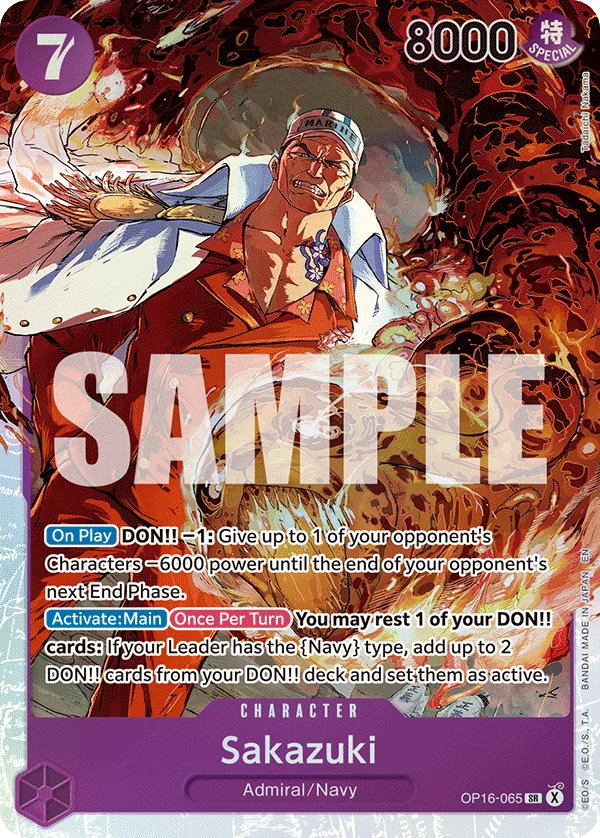 OP16-065OP16-065Shop on TCGplayer Sakazuki, the Purple Character printed for Akainu, and
 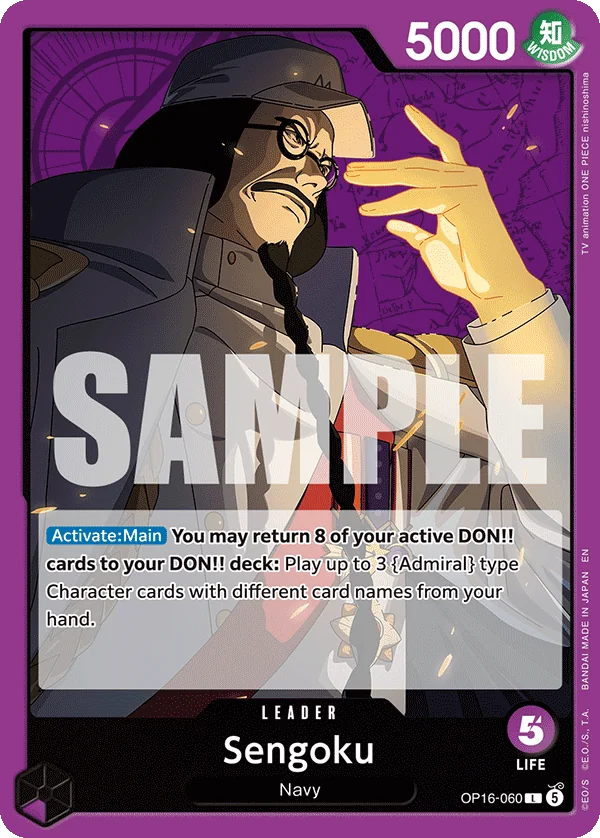 OP16-060OP16-060Shop on TCGplayer Sengoku, the Navy Leader that gives the shell its identity. The central plan is not a board wipe: use early Navy bodies and counters to reach your ramp turns, then use Sakazuki's -6000 effect and the Admiral package to control one important threat at a time.
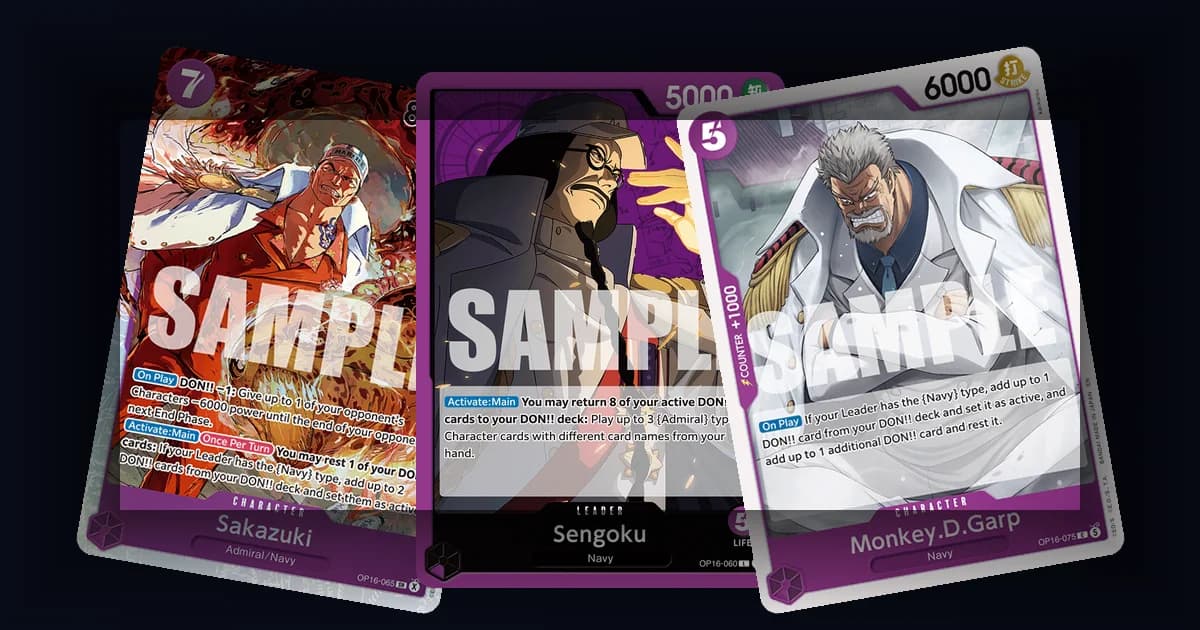
TL;DR: Sakazuki OP16-065 is a 7-cost, 8000-power Purple Character, not a Leader. His On Play effect gives one opposing Character -6000 power until the end of the opponent's next End Phase for DON!!-1. His once-per-turn Activate: Main can add up to 2 active DON!! cards when your Leader has the Navy type. Play him in mono-Purple Sengoku Navy, not with Green Smoker.
OP-16 Akainu deck guide? (quick answer)
Build around Sengoku OP16-060 and treat Sakazuki as an Admiral Character. Sengoku's Activate: Main returns 8 active DON!! cards to the DON!! deck and can play up to 3 Admiral Characters with different card names from your hand. Sakazuki then supplies targeted power reduction and another DON!! engine, while the rest of the Navy package keeps the board stable.
OP-17 is already in the English card pool, so the old launch-week claim that Sengoku was a Tier 2 leader is no longer a useful current description. The deck is still a coherent OP-16 control framework, but current data places it in the fringe tier rather than among the leading tournament choices.
GODEEPER: Want the full shell around this Character? The OP-16 Sengoku Deck Guide covers the Leader plan and Admiral sequencing in more detail.
Why Sakazuki is the key Navy Character
Sakazuki's On Play effect is precise removal: pay DON!!-1 to give up to one opposing Character -6000 power until the end of the opponent's next End Phase. It does not banish a Character, and it does not touch a second target. A 6000-power Character can become easy to finish in combat, while a larger Character may require an attack or another effect after the reduction.
His second ability is easy to overlook. Once during your turn, you may rest 1 of your DON!! cards if your Leader has the Navy type, then add up to 2 DON!! cards from the DON!! deck and set them active. This makes Sakazuki both a removal piece and a ramp tool. The effect is legal with Sengoku because Sengoku is Navy, and it is also a reason to sequence your DON!! carefully instead of spending every active card before playing him.
Sakazuki costs 7 and has 8000 power, so he is not an early-game answer. The deck's cheap Navy Characters, counter Events, and DON!! planning have to buy enough time for him to matter. When he arrives, choose the target whose power reduction changes the next combat or removes the opponent's best blocker, rather than firing at the first Character you see.
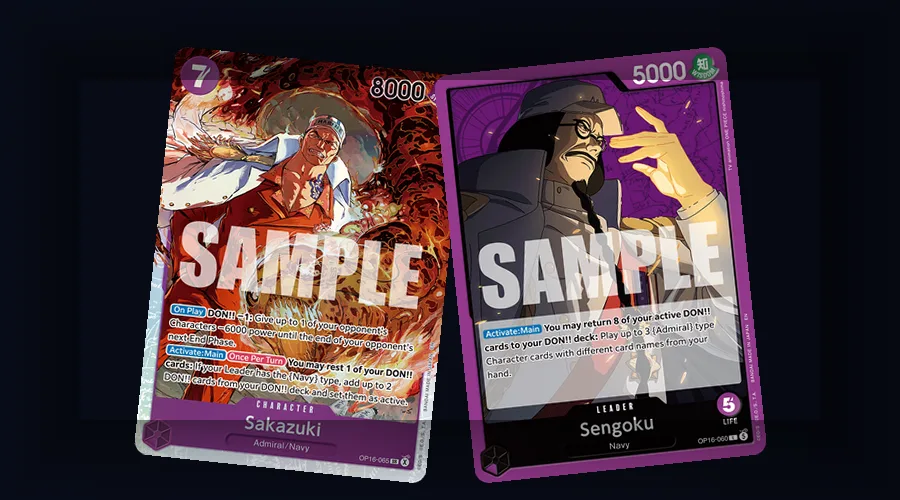 Sakazuki OP16-065 is the removal and ramp anchor of Sengoku's Navy deck, while Sengoku supplies the large Admiral deployment effect.
Building the Sengoku Navy shell around Akainu
This is a mono-Purple Navy framework. The exact 50-card list can change with the format, but the roles below stay stable.
- Leader: Sengoku OP16-060, Purple and Navy, with an Activate: Main that can deploy up to 3 different Admirals after returning 8 active DON!! cards.
- Removal and ramp: Sakazuki OP16-065, the 7-cost Character with -6000 power and the Navy-linked DON!! ability.
- Admiral package:
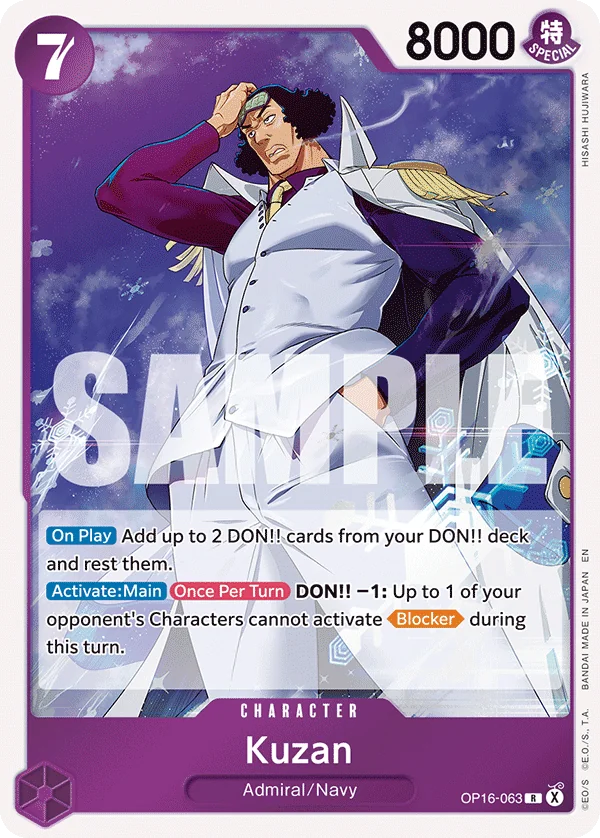 OP16-063OP16-063Shop on TCGplayer Kuzan and
 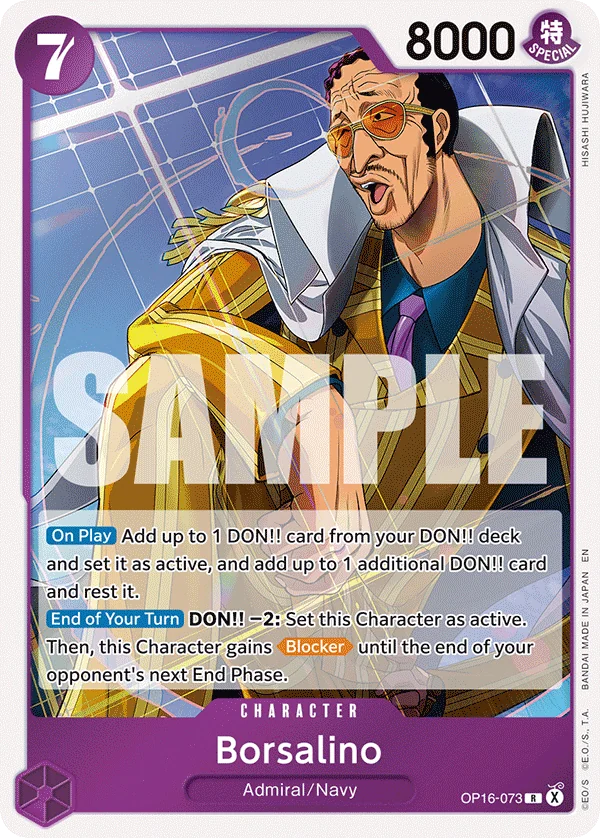 OP16-073OP16-073Shop on TCGplayer Borsalino are Purple Admiral/Navy Characters with their own DON!! effects. These are the official card names, even though players may still call them Aokiji and Kizaru.
 - Navy support:
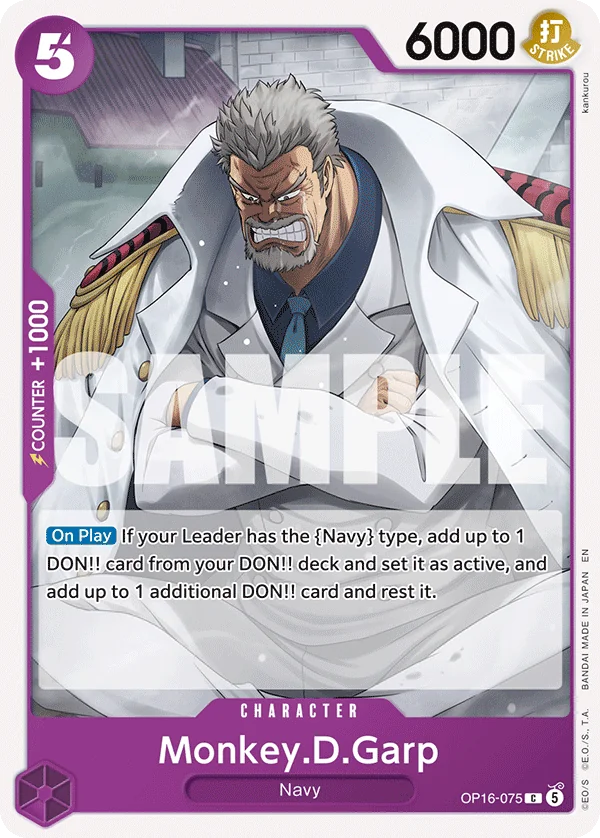 OP16-075OP16-075Shop on TCGplayer Monkey.D.Garp is a 5-cost Purple Navy Character that adds one active and one rested DON!! when your Leader has the Navy type.
 - Early defense: cheap Purple Navy Characters and counter Events that keep your hand and board intact until the 7-cost turns.
Do not add 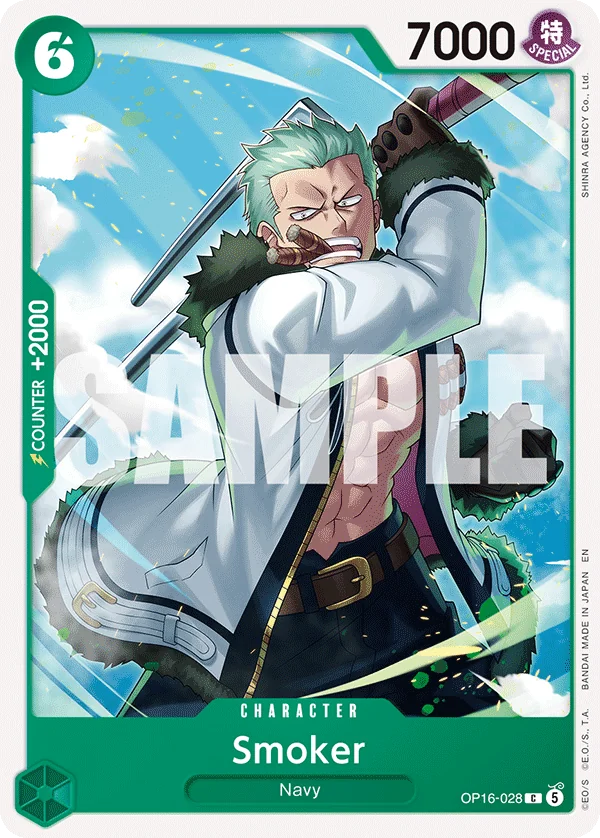 OP16-028OP16-028Shop on TCGplayer Smoker to this mono-Purple list just because he has the Navy trait. OP16-028 is Green, so it fails the Leader's color restriction. The same check applies to every off-color Navy card you consider.
The list has two resource problems to solve. First, several Admirals cost 7, so a hand full of payoffs can do nothing while the opponent develops. Second, Sengoku's Leader effect requires 8 active DON!! cards and different Admiral names in hand. Mulligans and early plays should therefore protect your hand quality, not just maximize board presence.
The official card text also changes how you think about the top end. Sakazuki can create DON!! after he enters, Garp can accelerate earlier, Borsalino brings a mixed active and rested DON!! package, and Sengoku converts a large DON!! bank into multiple Admirals. The deck wins by arranging those effects in sequence, not by relying on one Character to clear everything.
How a game flows
Early turns: Develop a cheap Purple Navy body when it protects your life or creates a useful search line. Keep enough counter value in hand to avoid losing before the Admiral turn. Do not spend all your DON!! on a low-impact Character if that delays a needed ramp line.
Middle turns: Use Garp, Borsalino, and Sakazuki to change the DON!! curve. If one opposing Character is the obstacle to stabilizing, Sakazuki's -6000 effect can set up the attack that removes it. If the opponent has a wide board, do not pretend one target is a reset button. Pair the reduction with combat, a blocker-denial effect, or Sengoku's multi-Admiral deployment.
The Admiral turn: Sengoku needs 8 active DON!! cards and three different Admiral names if you want to use the full Leader effect. Count the Admirals in hand before returning DON!! to the deck. If the hand only supports one weak deployment, a normal Character turn may be safer.
After Sakazuki: His once-per-turn ramp ability can help rebuild the DON!! bank, but it still costs a rested DON!! card to activate. Preserve enough active DON!! for the effect you actually need, then use the remaining cards for attacks or counters.
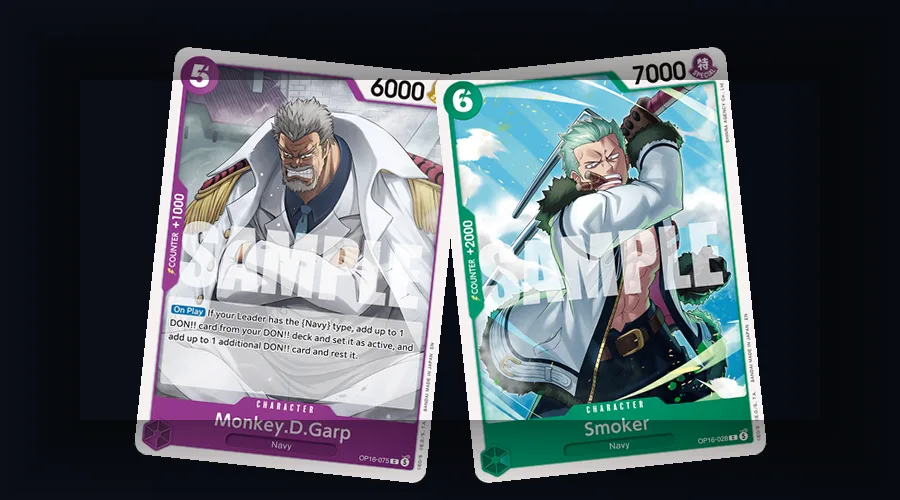 Monkey.D.Garp is Purple Navy support; the Green Smoker card shown beside him is not legal under mono-Purple Sengoku.
Step-by-Step: piloting the Sengoku Navy shell
1. Mulligan for a curve, not a pile of Admirals. Keep an early Navy body, a useful counter, or a line that protects your hand. A hand containing only 7-cost Characters is not a plan.
2. Track active DON!! before every play. Sengoku's ability needs 8 active DON!! cards, while Sakazuki, Borsalino, Kuzan, and Garp each interact with the DON!! deck differently. Write the next threshold down if necessary.
3. Choose Sakazuki's target for the next combat. His -6000 effect lasts until the end of the opponent's next End Phase. Use it on the Character whose reduced power changes an attack, removes a blocker, or stops the opponent's best line.
4. Decide between a normal Admiral turn and Sengoku's deployment. Returning 8 active DON!! cards is a large commitment. Use the Leader effect when you can play different Admiral names that produce a meaningful swing, not merely because the cost is available.
5. Convert the advantage before the opponent resets. Attack reduced Characters, protect the Admirals with counters, and use Sakazuki's ramp only when the extra DON!! improves the next turn. The deck's advantage disappears if it spends every resource on a single oversized Character and leaves no defense.
Current OP-16 and OP-17 context
The original version of this guide used a July 2026 tier label and an August OP-17 forecast. Both are stale now. Limitless' OP-16 deck filter currently shows Purple Sengoku at 21 points and 0.36% share, while OPTCG Apps' ranked-game snapshot dated September 14 lists Sengoku at a 40.4% win rate and 0.1% play rate. Those are different datasets and formats, but they tell the same story: Sengoku is a fringe choice, not a current Tier 2 leader.
That does not make the shell unplayable. It means the deck guide should sell the control puzzle, Navy ramp interactions, and pilot skill rather than promising a current tournament position. OP-17's English release on August 28 also means OP-16 matchup advice should be checked against the event's legal card pool before an event.
Matchup direction by board problem
Wide low-cost boards
Sakazuki answers one Character. Against a wide board, reduce the target that blocks your cleanest attack, then use combat and other effects to remove the remaining bodies. Spending Sakazuki on a small Character just because it is available can leave the real board intact.
One large Character
The -6000 effect is strongest when it moves a Character into range of your existing power values. It is not automatic removal against a high-power target. Plan the follow-up attack before you spend the DON!! so the opponent cannot simply keep the reduced Character alive with a counter.
Blocker-heavy turns
Power reduction and blocker denial solve different problems. If the opponent's blocker is the actual obstacle, use the rest of the Navy package or a relevant effect to deal with the blocker. Do not assume Sakazuki's reduction alone removes the defensive text.
Recursion and long control games
One-for-one removal is less impressive when the opponent can replay the same engine. Preserve your hand, prioritize the Character that enables the next recursion chain, and use Sengoku's multi-Admiral turn only when it creates a lasting board advantage.
Sakazuki's collector and competitive value
The old claim that the standard OP16-065 copy settled around $29 was a printing error in the context of current prices. A September market snapshot from Foilr put the English standard copy around $0.34, while a TCGplayer product page showed a market price around $0.45. The expensive versions are the alternate art and Manga Rare printings, not the regular Super Rare copy.
InkSight's September 10 OP-16 snapshot listed the Sakazuki Manga Rare around $1,127. Treat that as a dated market reference, not a permanent valuation. When buying, confirm whether the listing is standard, alternate art, or Manga Rare before comparing prices.
For the deck itself, the low standard-card price makes the Sengoku shell relatively accessible compared with its chase printings. The real cost is testing the list and acquiring the other Admirals or staple pieces that fit the current format.
SHOP: Compare the exact OP-16 printing before buying. The standard Sakazuki, alternate art, and Manga Rare use the same card number but have very different market values. Shop TCGplayer →
Common mistakes with Akainu
Treating Sakazuki as a Leader. He is a Character. Sengoku is the Purple Navy Leader.
Calling -6000 a banish effect. The On Play ability changes power until the opponent's next End Phase. It does not remove the Character by itself.
Forgetting the ramp ability. Sakazuki can add up to 2 active DON!! cards once per turn when your Leader has the Navy type. This is part of his value, not optional flavor text.
Using the wrong English card names. OP16-063 is Kuzan and OP16-073 is Borsalino. Aokiji and Kizaru are familiar aliases, but the deck list and card database use the printed names.
Adding Green Smoker to a Purple Leader deck. Navy is a trait, not a color override. The Leader's color restriction still applies.
How Akainu compares to other removal
Sakazuki is best understood as a power-reduction and ramp Character, not as a generic removal spell. The -6000 window can set up combat, while the DON!! ability raises the ceiling of a Navy turn. That combination is why Sengoku wants him even when another Character has more raw board impact.
The tradeoff is timing. A seven-cost Character that only reduces one target can be awkward when the opponent has a wide board or when your hand is already low. The supporting Navy cards have to create the active DON!! and defensive buffer that let Sakazuki do both jobs.
Key takeaways
- Sakazuki OP16-065 is a Purple 7-cost, 8000-power Character, not the Leader.
- His On Play ability gives one opposing Character -6000 power until the end of the opponent's next End Phase for DON!!-1.
- His once-per-turn Activate: Main can add up to 2 active DON!! cards when your Leader has the Navy type.
- Sengoku OP16-060 is the mono-Purple Navy Leader and can deploy up to 3 different Admiral Characters after returning 8 active DON!! cards.
- Kuzan, Borsalino, and Monkey.D.Garp are the OP-16 Purple Navy pieces that support the Admiral plan; Green Smoker does not fit.
- Current OP-16 and ranked data puts Sengoku at low representation, so treat this as a technical control guide rather than a current Tier 2 promise.
GODEEPER: Compare this ramp-and-control plan with the other OP-16 leaders in the One Piece TCG OP-16 complete guide.
Related Reading
- OP-16 All 6 Leaders Explained: Why Sengoku is the Leader and Sakazuki is a Character.
- OP-16 Three Admirals Guide: How Sakazuki, Kuzan, and Borsalino fit the deck.
- OP-16 Format July 2026 Meta Update: Historical OP-16 context, useful for separating launch-era advice from current data.
- OP-16 Pre-Launch Buying Guide: Historical sealed and singles advice for the set's launch window.
- One Piece TCG Counter Mechanic Explained: How to preserve your hand while waiting for the Admiral turn.
- One Piece TCG DON!! System Explained: The resource rules behind Sengoku's and Sakazuki's ramp effects.
Frequently Asked Questions
Is Akainu a leader in OP-16? No. Sakazuki, also known as Akainu, is the OP16-065 Purple Character. Sengoku OP16-060 is the Purple Navy Leader.
How do you use Akainu? Play Sakazuki in a mono-Purple Sengoku Navy shell. Use DON!!-1 to give one opposing Character -6000 power, then use the combat step or another effect to convert that reduction into a real removal.
What deck does Akainu go in? Sengoku's Three Admirals Navy deck, with Kuzan, Borsalino, and Monkey.D.Garp as the core OP-16 support pieces. Green Smoker is not legal under the Purple Leader.
Is Akainu expensive? The standard copy is currently inexpensive, with recent market snapshots around $0.34 to $0.45. Alternate-art and Manga Rare versions are much more expensive, so check the printing before buying.
When does Akainu come online? He costs 7, but Garp, Borsalino, Sakazuki, and Sengoku can change the DON!! curve. Plan around turns 4 or 5, then deploy him when the -6000 effect changes the board rather than on a fixed turn.
Is the Sengoku Akainu deck good for beginners? It can teach useful resource-management skills, but it is less forgiving than a simple curve deck. Start with the early-game plan and DON!! thresholds before trying the full multi-Admiral line.
References
- OP-16 The Time of Battle official product page: Official product and set information
- Official One Piece Card Game rules: Leader, Character, DON!!, and deck-construction rules
- Sakazuki OP16-065 on Limitless: Card text, legal formats, and printing data
- Sengoku OP16-060 on Limitless: Leader text and legal formats
- Kuzan OP16-063 on Limitless: Card text and Purple Admiral details
- Borsalino OP16-073 on Limitless: Card text and Purple Admiral details
- Monkey.D.Garp OP16-075 on Limitless: Card text and Navy ramp details
- Limitless OP-16 deck results: Current OP-16 format representation, including Purple Sengoku
- OPTCG Apps current ranked meta: September 14, 2026 win-rate and play-rate snapshot
- InkSight OP-16 price snapshot: September 10 market snapshot for standard, alternate, and Manga Rare printings
- Foilr Sakazuki OP16-065 price page: Recent standard-copy market snapshot
- Official OP-17 release announcement: English release date and prerelease timing
Was this guide helpful?
Cards in this article
About the author
Beginner guides and anime crossover
Pen name for the Shonen TCG desk's beginner guides, starter decks and anime-to-card-game explainers.
- Rules checked against the official rulebook and card text
- Every claim traced to a cited source
- Opinions marked as ours, with the reason
Keep reading

All One Piece TCG Sets OP-01 to OP-17: Complete List (2026)
Guides · 13 min
Best Anime TCG to Play in 2026: 5 Games Ranked and Compared
Guides · 12 min
OP-16 Garp Deck Guide: Sengoku Navy Build and Meta
Guides · 11 min
One Piece TCG Tournament Guide: How to Compete (2026)
Guides · 11 min
OP-16 is it worth buying? Box, singles, or sealed?
Guides · 9 min
OP-16 Pre-Launch Buying Guide: Post-Launch Update 2026
Guides · 11 min
One Piece TCG card rarities explained: C to Manga Rare
Guides · 12 min

OP-15 Meta Tier List 2026: Archived Format Snapshot
Guides · 9 min
Disclaimer
This article is published for informational and entertainment purposes. It does not constitute professional financial, legal, or technical advice. Game performance, online services, patch schedules, and store listings change. Verify critical details (pricing, system requirements, regional availability) with publishers and storefronts before you buy. Affiliate links, where present, help support our editorial work and are labelled in our affiliate disclosure.