

Shonen TCG · Guides
OP-16 Price Guide: What Every Card Is Worth (2026)
OP-16 price guide with a September 12 TCGplayer snapshot for the three Admiral Manga Rares, standard-card context, and a safer buy-or-wait framework.
Reviewing
One Piece TCG
This OP-16 price guide uses a dated market snapshot, not a live quote. InkSight's September 12, 2026 set page reports TCGplayer Market Prices of $1,127 for Sakazuki, $1,109 for Kuzan, and $1,043 for Borsalino in their premium treatments. The numbers can move with condition, language, seller inventory, and sales depth.
Bandai's official OP-16 product page lists June 12, 2026 as the English release date, a $4.99 per-pack MSRP, and a Three Admirals Super Alt-Art feature. Price trackers and marketplaces commonly call those premium treatments Manga or Comic parallels. This article uses that collector shorthand while keeping the official product wording clear.
For the verified OP-16 release window, event formats, and regional legality notes, see the OP-16 launch guide retrospective.
Last checked: September 18, 2026. Dollar figures below are dated TCGplayer Market Price snapshots, not guaranteed purchase prices. Check the exact listing, printing, condition, shipping, tax, and seller history before paying.
TL;DR: In the September 12 InkSight snapshot of TCGplayer Market Prices, the premium Sakazuki, Kuzan, and Borsalino treatments were $1,127, $1,109, and $1,043. Those are market observations, not live asks or an investment thesis. The set-wide median moved down 7.2% over the prior 30 days, while the three chase cards were comparatively steady in a separate 50-day comparison. If you need an OP-16 card for play, start with the standard printing; buy the premium treatment because you want the collectible.
OP-16 price guide? (quick answer)
The September 12 set snapshot ranks the three Admiral treatments above every other OP-16 printing. The official card list identifies OP16-065 as a Super Rare Sakazuki, OP16-063 as a Rare Kuzan, and OP16-073 as a Rare Borsalino. The premium versions retain those card numbers and names, but their collector treatment is what drives the price gap.
| Premium treatment | Card number | Standard rarity | TCGplayer Market Price, Sep. 12, 2026 |
|---|---|---|---|
| Sakazuki | OP16-065 | Super Rare | $1,127 |
| Kuzan | OP16-063 | Rare | $1,109 |
| Borsalino | OP16-073 | Rare | $1,043 |
These figures are not the cheapest listings. They are Market Price observations collected by InkSight, with outlier listings excluded from its set summary. A thin market can move quickly when a few high-value copies sell, so use the table as a dated reference point rather than a promise of what every seller will accept.
The wider set is much cheaper. InkSight reports September 12 median Market Prices of $31.13 for Secret Rares, $5.82 for Leaders, $5.67 for Super Rares, and $0.19 for Rares. Medians describe a rarity tier; they do not tell you what every playable or alternate-art card costs. That distinction is why a broad claim such as "$10 to $60 for standard SRs and Rs" is not a useful OP-16 baseline.
The Three Admiral Manga Rares
Sakazuki / Akainu (OP16-065)
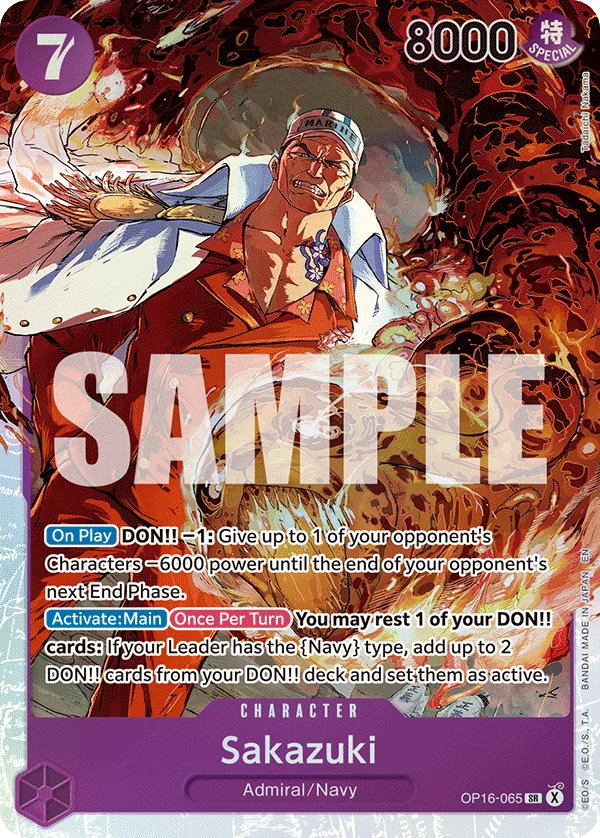 OP16-065OP16-065Shop on TCGplayer Sakazuki is a Purple Super Rare with the Admiral/Navy trait in the official list. Its premium treatment was the highest-priced OP-16 printing in the September 12 snapshot at $1,127. The same card number also has a much cheaper standard printing, so do not confuse a normal OP16-065 copy with the premium version when comparing listings.
The Japanese benchmark is older and should be labeled that way. SNKRDUNK's July 13 report listed an average market figure around 500,000 JPY and a store price around 390,000 JPY. That report is useful historical context, not a September Japanese quote. The English and Japanese markets can diverge because they have different supply, language demand, and selling fees.
Kuzan / Aokiji (OP16-063)
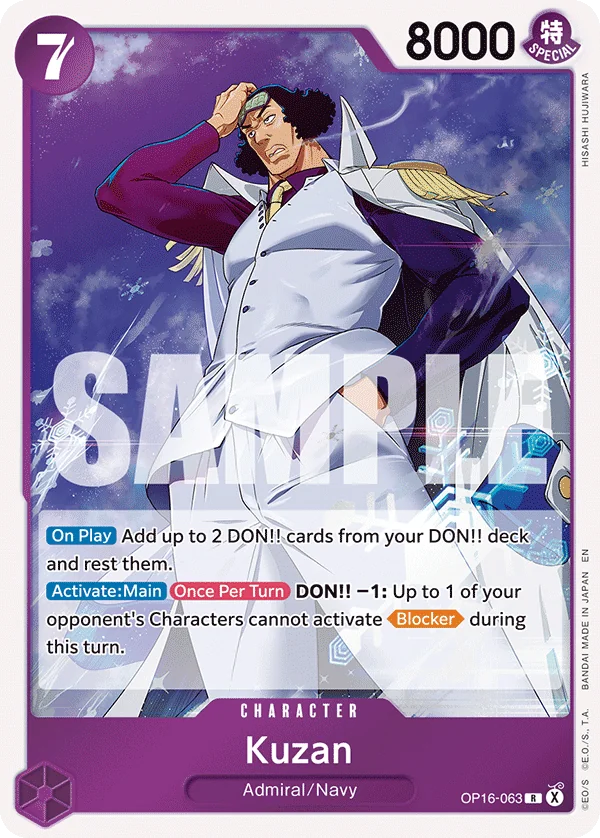 OP16-063OP16-063Shop on TCGplayer Kuzan is a Purple Rare with the Admiral/Navy trait. Its premium treatment was $1,109 in the September 12 Market Price snapshot, only $18 below Sakazuki. That narrow gap is an observation from one dated market, not proof that the two cards will track each other in the future.
SNKRDUNK's July 13 Japanese report placed Kuzan around 400,000 JPY on average, with a listed price around 330,000 JPY. It also attributed demand to collectors building the Three Admirals display. That is a reasonable explanation for collector interest, but it does not create a guaranteed price floor.
Borsalino / Kizaru (OP16-073)
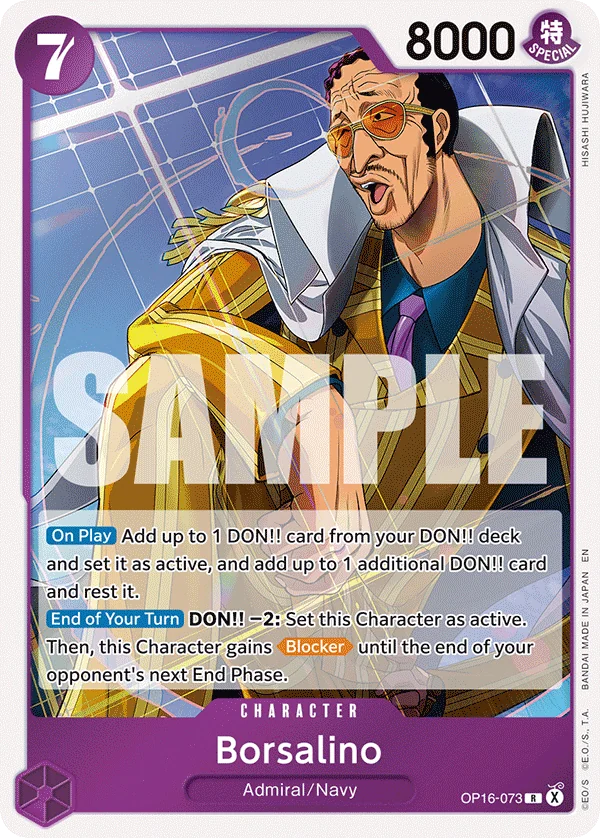 OP16-073OP16-073Shop on TCGplayer Borsalino is the third Purple Admiral/Navy card in the chase group. Its premium treatment was $1,043 in the September 12 snapshot, the lowest of the three but still within the same four-figure band.
SNKRDUNK's July 13 Japanese report showed an average around 400,000 JPY and a listed price around 319,999 JPY. The report is useful for comparing the early JP market, but it should not be presented as the current value of a Japanese copy. Condition and exact treatment still matter.
What the Current Snapshot Says About the Market
The latest set page reports a 0.0% seven-day median change and a 7.2% decline over 30 days across the priced OP-16 cards. Those are set-wide medians across many printings, not a direct forecast for the three premium Admirals.
A separate 50-day report using September 5 data gives a more focused comparison. From June 18 to August 6, Borsalino rose 4.8%, Sakazuki rose 1.6%, and Kuzan fell 2.2%. The report describes Kuzan as effectively flat and notes that the cards below the chase tier absorbed larger losses. That is evidence of relative resilience during that window, not evidence that the cards cannot fall.
The practical conclusion is simple: the market is highly concentrated. InkSight says the top five printings held 81.2% of tracked OP-16 value in its September 12 snapshot, with the three Admirals alone accounting for 66.7%. A few premium sales can therefore dominate the headline set value while most common, uncommon, and ordinary rare cards remain inexpensive.
Japan vs. English Prices
Japan's May 30 release preceded the official English June 12 release by 13 days. That creates a useful historical comparison, but it does not create a fixed conversion rate between languages. Japanese and English copies are separate listings with different availability, buyer pools, shipping costs, and tournament-use considerations.
Use the July 13 SNKRDUNK figures as an early Japanese reference and the September 12 InkSight figures as a later English-market reference. Do not compare one country's average with the other's lowest ask and call the difference a premium. Also check whether a listing is the standard card, an alternate art, a Special treatment, or the premium Admiral treatment before doing any arithmetic.
The official card list is the safest way to verify the identity behind a listing. It shows the base cards and their text, while a marketplace page supplies the treatment and price. This matters especially for OP16-065, OP16-063, and OP16-073 because the same card number can appear in both ordinary and premium versions.
GODEEPER: For the full week-1 buy, hold, or sell verdict broken down by rarity and card type, see OP-16 Week 1 Buy Hold Sell: Full Verdict 2026.
OP-16 Price Guide: What to Buy
Buy a standard copy when you need the card for a deck. The official list identifies the ordinary Sakazuki, Kuzan, and Borsalino versions by the same card numbers used by the premium treatments. Paying four figures for the treatment makes sense only if the collection value is part of your goal.
Buy a premium copy for collecting, not because appreciation is guaranteed. The three cards are visually connected and the market currently values them highly, but a thin, high-dollar market can move sharply. Set a budget, compare completed-sale evidence where available, and leave room for taxes, shipping, grading, and seller fees.
Wait when you have no urgency. A player who does not need a card for an upcoming event can watch a price alert and compare several listings. A collector who wants a specific copy may reasonably buy when the condition and price fit the budget. Neither choice is a reliable way to predict the bottom.
Be cautious with sealed product. Bandai's official product page gives the pack MSRP and rarity categories, but it does not publish a per-rarity pull-rate table. InkSight recorded an OP-16 booster box Market Price of $207.85 on September 5, while TCG Spikes recorded $208.46 on that date. Those are dated market observations, not expected returns. Open sealed product for the experience, or buy the exact single you want when certainty matters.
For per-card singles analysis beyond the three Admirals, see the OP-16 singles buying guide. The related reading section also points to the set's broader box-versus-singles analysis.
Key Takeaways
- The September 12, 2026 TCGplayer snapshot recorded $1,127 for Sakazuki, $1,109 for Kuzan, and $1,043 for Borsalino premium treatments.
- The official card list identifies OP16-065 as a Super Rare Sakazuki, OP16-063 as a Rare Kuzan, and OP16-073 as a Rare Borsalino. Confirm the treatment before comparing prices.
- The set-wide median fell 7.2% over 30 days in the latest snapshot, while a separate 50-day comparison showed the three chase cards were comparatively steady through August 6.
- The July 13 Japanese figures are historical benchmarks, not current September quotes.
- Standard printings are the sensible starting point for play. Premium treatments are collector purchases with no guaranteed return.
- Bandai lists a $4.99 English pack MSRP and does not publish per-rarity pull odds on the official product page.
Related Reading
- OP-16 Most Expensive Cards Ranked: Top 6 by Price (2026): the full set value ranking beyond the three Admirals.
- OP-16 Japanese vs English Price Guide: Which to Buy: language, legality, and price tradeoffs between Japanese and English cards.
- OP-16 Is It Worth Buying? Full Verdict & ROI (2026): dated box, pack, and singles comparisons.
- OP-16 Collectors Guide: rarity tiers, long-term collecting considerations, and parallel structure.
- One Piece TCG OP-16 Complete Guide: the reference hub for leaders, deck guides, meta, and collector value.
Frequently Asked Questions
How much are the OP-16 Admiral premium treatments worth? In InkSight's September 12, 2026 snapshot of TCGplayer Market Prices, Sakazuki was $1,127, Kuzan was $1,109, and Borsalino was $1,043. Those figures are dated market observations, not guaranteed sale prices.
How much is the OP-16 Sakazuki premium treatment worth in Japan? SNKRDUNK's July 13 report listed an average around 500,000 JPY and a listed price around 390,000 JPY. That is an early Japanese reference and should not be reused as a current September quote.
Do I need the premium Admiral treatments to play? No. The official card list identifies standard versions of OP16-065, OP16-063, and OP16-073. The premium versions are collector treatments of those cards, so buy the ordinary printing when gameplay is the priority.
Have OP-16 prices stabilized? Not uniformly. The latest set snapshot shows a 0.0% seven-day median change and a 7.2% 30-day decline across the set. The three chase cards were comparatively steady in a separate June 18 to August 6 comparison, but that history is not a guarantee about the next listing.
Are the OP-16 premium Admiral cards a good investment? They are collectible cards, not guaranteed investments. Buy only if the card gives you enough collecting value at the price you can afford, and assume the market can decline.
What is the Boa Hancock parallel in OP-16 worth? SNKRDUNK's July 13 Japanese report listed the OP16-032 parallel around 20,000 JPY on average and around 19,000 JPY on its marketplace. That is a dated Japanese figure, not a current English-market quote.
Should I open OP-16 boxes to chase an Admiral? Only if opening sealed product is part of the fun. Bandai lists the product MSRP and rarity categories but does not publish per-rarity pull odds, so a high card price is not the same thing as a reliable expected return from a box.
References
- Bandai Namco, BOOSTER PACK -THE TIME OF BATTLE- [OP-16]: official release date, MSRP, product contents, and Three Admirals Super Alt-Art feature.
- Bandai Namco, OP-16 card list: official card numbers, names, rarities, colors, and rules text.
- InkSight, The Time of Battle set snapshot: September 12, 2026 TCGplayer Market Price snapshot, tier medians, concentration, and recent movement.
- InkSight, OP-16 50-day market report: dated June 18 to August 6 comparison for the three premium Admiral treatments and other printings.
- InkSight, The Time of Battle box versus singles: September 5 sealed-product snapshot and methodology note about unpublished pull rates.
- TCG Spikes, Is OP-16: The Time of Battle Worth It?: September 5 sealed and chase-price comparison with explicit limits on pull-rate claims.
- SNKRDUNK Magazine, OP-16 Marineford Manga Rare tracker: July 13 Japanese market references for the Admirals and Boa Hancock parallel.
- TCGplayer, The Time of Battle price guide: marketplace reference for checking the exact printing and current listing context.
- Limitless TCG, One Piece card database: set and card reference used to cross-check OP-16 identifiers.
Cards in this article
About the author
TCG Collector & Value Analyst
TCG collector and value analyst covering anime card games since 2021. Specializes in pull rates, card values, and market trends across One Piece TCG and Union Arena.
- TCG collector since 2021
- Tracks card values across TCGPlayer and CardMarket
- Pull rate analysis across 100+ boxes opened
- Covers One Piece TCG and Union Arena collector market
Keep reading
OP-16 Impel Down Buggy Deck Guide: Blue Swarm Build
Guides · 15 min
OP-16 Marco Deck Guide: Phoenix in Whitebeard 2026
Guides · 15 min
OP-16 Singles Buy Hold Sell: September 2026 Snapshot
Guides · 11 min
OP-17 Spoilers: All Confirmed Cards and Leaders 2026
Guides · 12 min
One Piece TCG Nami Counter Guide: Beat Blue Yellow 2026
Guides · 10 min
One Piece TCG OP-16 meta report: July 2026 snapshot
Guides · 9 min
One Piece TCG Blue Yellow Guide: Pairing and Nami Strategy
Guides · 14 min
Purple Enel Deck Guide for One Piece TCG OP-16 2026
Guides · 11 min
Disclaimer
This article is published for informational and entertainment purposes. It does not constitute professional financial, legal, or technical advice. Game performance, online services, patch schedules, and store listings change. Verify critical details (pricing, system requirements, regional availability) with publishers and storefronts before you buy. Affiliate links, where present, help support our editorial work and are labelled in our affiliate disclosure.