

Shonen TCG · Guides
OP-16 Box Opening Strategy: How Many Boxes to Open
OP-16 box opening strategy: compare sealed and singles with a dated EV method, verified product facts, pull-rate limits, and a safer opening budget.
TL;DR: OP-16 box opening strategy should start with your goal and budget, not a promised pull ratio. Bandai lists $4.99 MSRP per pack and no official per-rarity odds. Use a dated sealed price, a transparent singles list, and a conservative EV model. Buy a specific chase card as a single when the opening experience is not the point.
Last checked: Bandai's OP-16 product page, current sealed-market references, and current card records were checked on September 18, 2026. Market prices and third-party EV models can change daily. No official pull-rate table was found.
OP-16 box opening strategy: quick answer
The honest answer is conditional. Opening can be good entertainment, a way to build a broad binder, or a source of trade stock. It is a poor way to guarantee a specific card because every result is random and Bandai does not publish a per-rarity odds table for OP-16.
Bandai's official OP-16 product page gives the English release date as June 12, 2026, pack MSRP as $4.99, 126 plus 1 card types, and the product's rarity categories. It also highlights the Three Admirals Super Alt-Art feature. Those facts do not establish a guaranteed number of SEC, Special, Treasure Rare, or Manga printings per box.
Retail and market-reference listings commonly describe the English booster box as 24 packs, but that configuration is not the same thing as an official pull-rate promise. Verify the sealed product listing in your region before doing the math.
Use this decision rule:
- Open sealed when you value the experience, broad card coverage, or a shared opening with friends.
- Buy singles when you want one exact Leader, SEC, Manga printing, or playset.
- Set a hard cap before opening. A lucky pull should not become a reason to spend past the cap.
- Recalculate with current prices if you are comparing sealed product with singles.
GODEEPER: Need the broader buy-versus-wait decision? The OP-16 pre-launch buying guide explains why launch estimates should not be reused after release.
What box EV means
Expected value is a model, not a promise. A simple version is:
EV per box = sum of (estimated pull probability x net card value) - opening costs
That formula needs more inputs than a headline usually shows:
- The sealed price on the date of the calculation
- The language and market being measured
- Which card printings count as distinct pulls
- The source and date of each card price
- Fees, shipping, taxes, and the discount for bulk cards
- The assumed distribution of rarities or an observed opening sample
If a model silently assumes a guaranteed Manga card, uses an asking price as a sale price, or counts every common at a nonzero value, it can make a box look more profitable than it is. If a model uses only TCGplayer highs and ignores fees, it is not your net return.
Current sealed and singles context
The market moved far beyond the old launch estimates. OP Box Index reported a completed-sale median of about $222 for an English OP-16 box on September 10, 2026, based on 93 eBay sales in its trailing window. That is a dated resale-market observation, not a universal price for every country or store.
The exact EV answer depends on the model. OnePiece Terminal's current set page reported an estimated box EV of about $113 against a sealed market price around $225 in its September 9 snapshot, while other models may count cards and prices differently. Treat that figure as the site's model, not an official Bandai number.
The practical conclusion is more durable than either number: compare the exact sealed price with the exact single prices on the same day, and write down the assumptions. Do not keep using an $80 to $95 launch estimate when the sealed market and chase-card prices have moved.
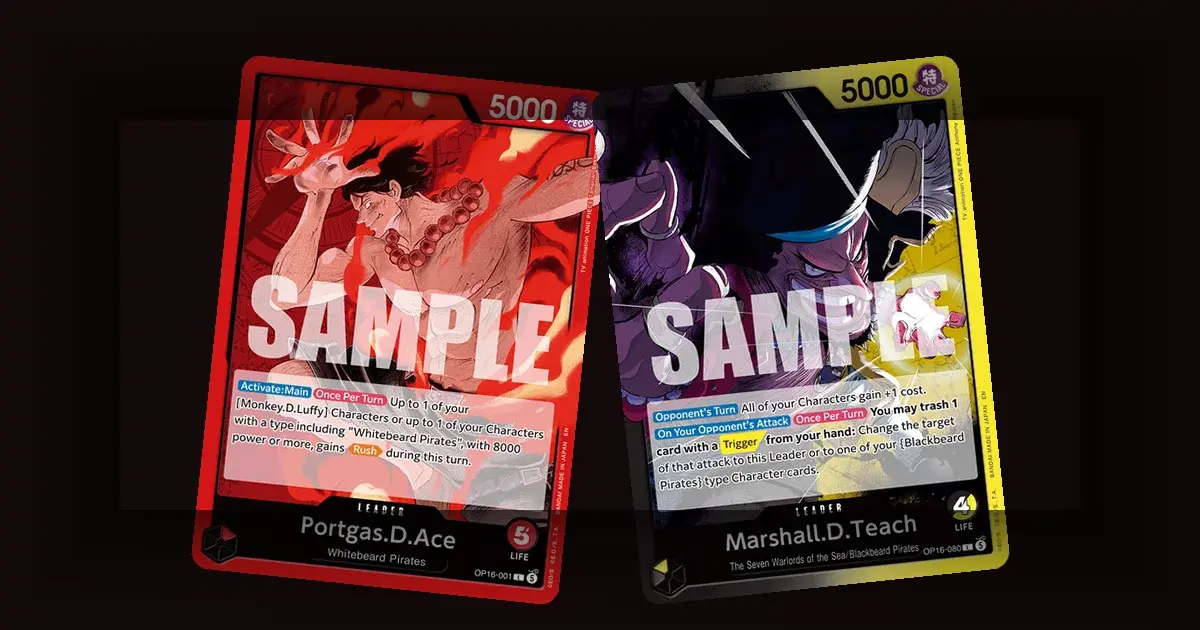
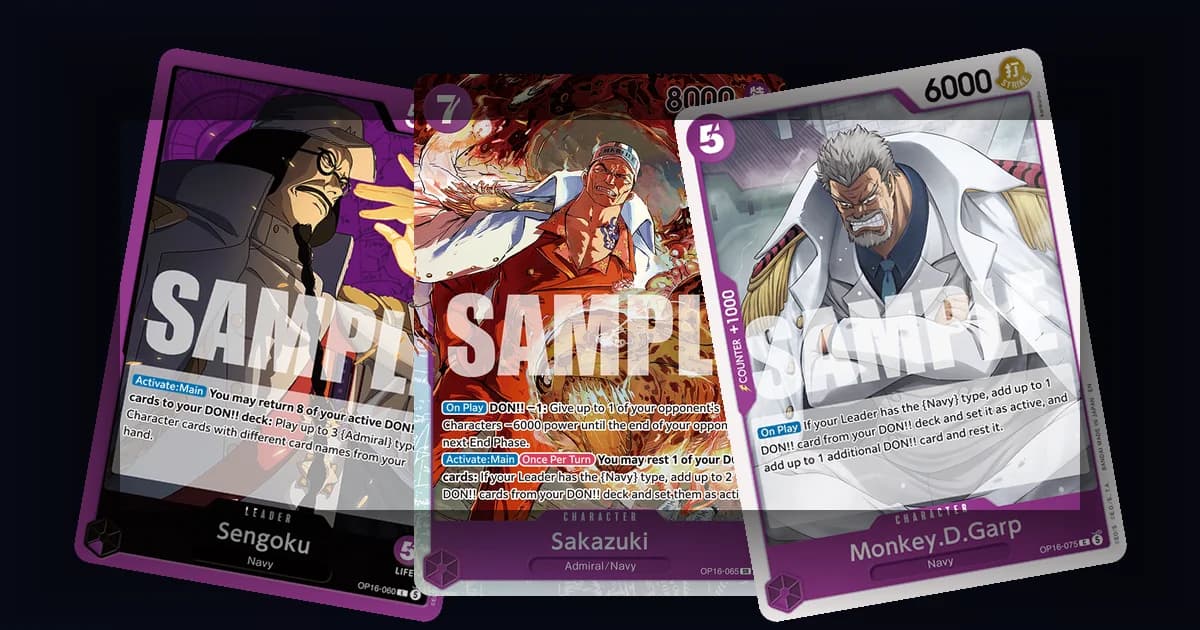
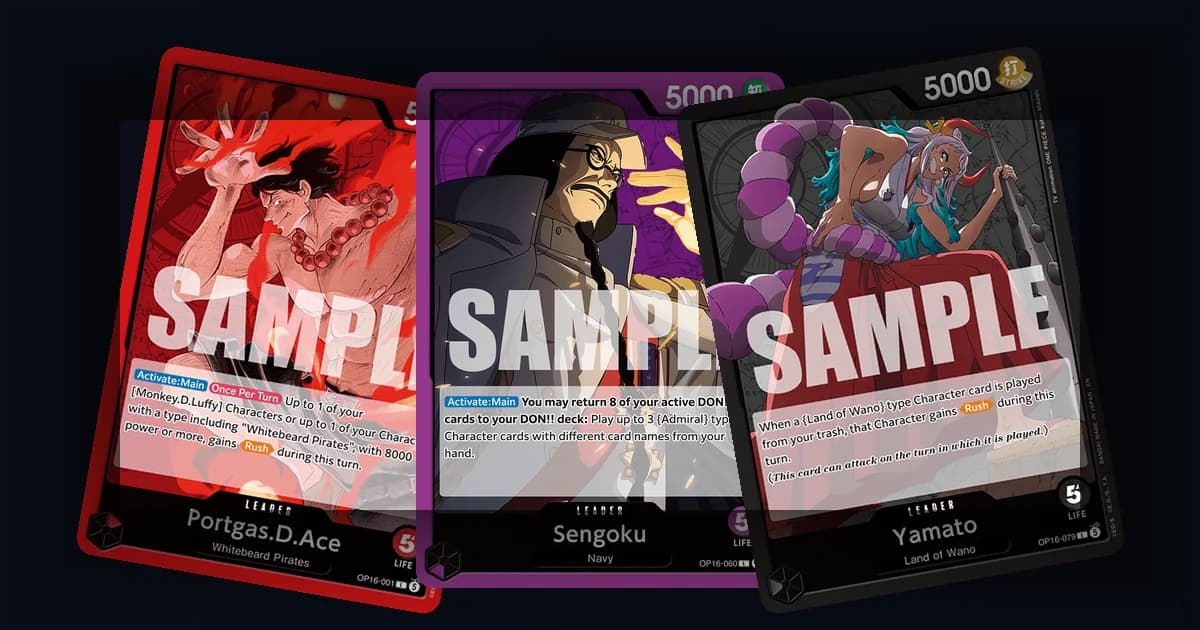
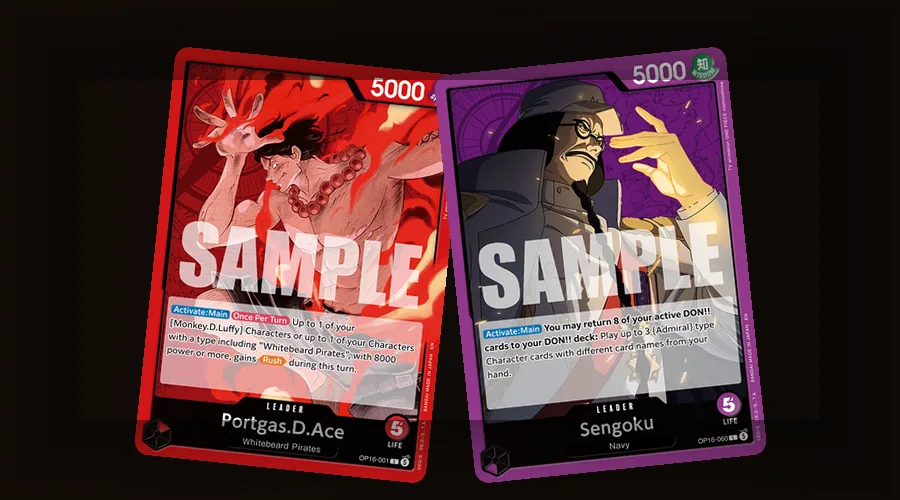 These real OP-16 sample Leaders show Portgas.D.Ace and Sengoku. They illustrate the set's Leader range, not sealed product contents or a guaranteed box result.
Pull rates and what is actually verified
The official product page does not publish a per-rarity pull-rate table. InkSight's OP-16 pull-rate guide explicitly separates facts from estimates: pack and box structure are listed with retailer or market provenance, while no official probability is published.
That means this guide will not repeat the old claim that an SEC appears once every 8 to 12 boxes. It may resemble an opening sample from a particular product run, but it is not a Bandai guarantee and it cannot tell you when your next box will contain Ace or Marshall.D.Teach.
The same warning applies to Manga printings. OP-16 has three Manga market entries for Sakazuki, Kuzan, and Borsalino, but the existence of three chase printings does not tell you the probability of opening one. If a seller or video quotes a pull ratio, ask for the sample size, date, region, product language, and raw per-pack results.
Sealed versus singles by goal
You want a specific card
Buy the single first. For example, 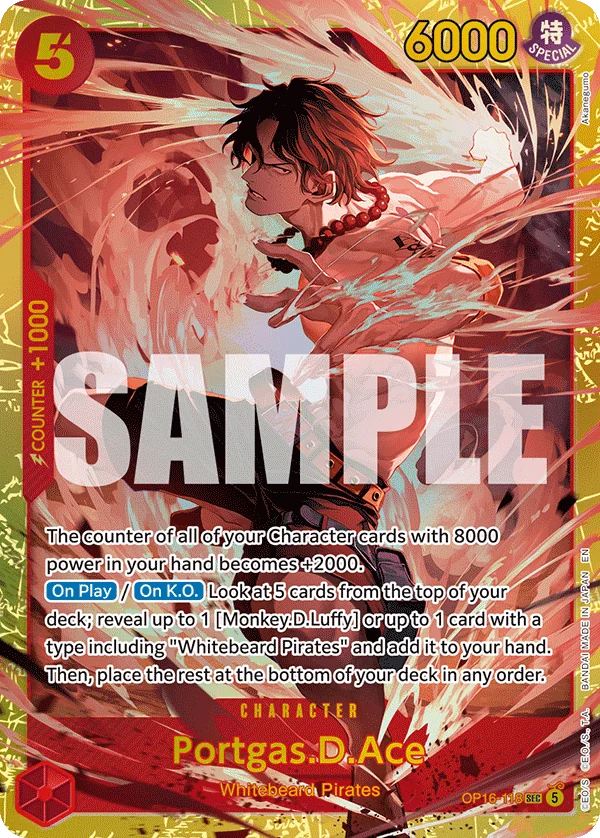 OP16-118OP16-118Shop on TCGplayer Portgas.D.Ace and
 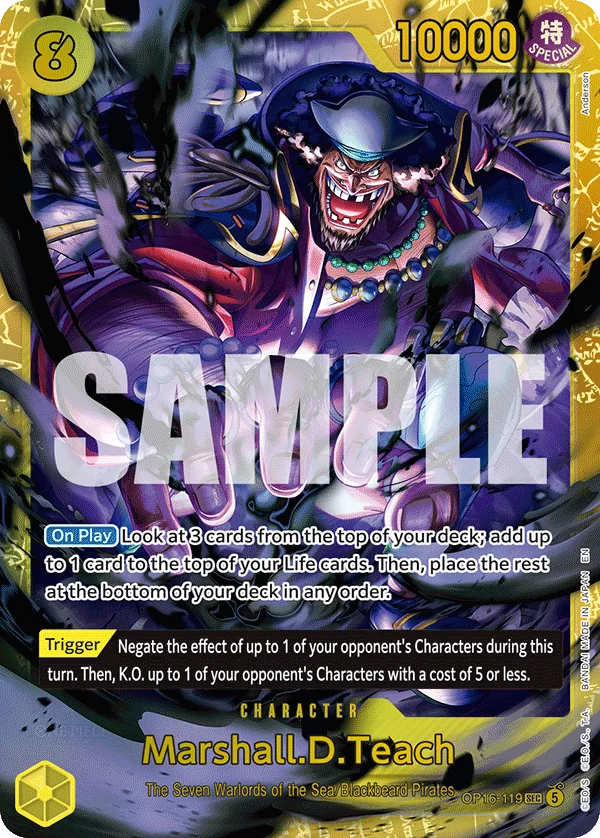 OP16-119OP16-119Shop on TCGplayer Marshall.D.Teach are separate SEC Character cards, and their prices can differ from their Leader versions. If you need a playset or one exact parallel, opening boxes adds duplicate and condition risk without guaranteeing the target.
You want a broad collection
One or two boxes can provide the experience and a spread of base cards, but choose the count from your budget. After opening, make a list of missing cards and compare singles with another sealed purchase. The second decision should use current prices, not the excitement of the first opening.
You want trade stock
A local trading community can make duplicates useful, but bulk is not automatically liquid. Check what people at your store actually want, and value trades by exact printing, condition, language, and current net cost. Do not count a card at its highest active listing just because it is theoretically tradable.
You want an investment
Treat sealed and singles as separate speculative markets. A chase card can fall while sealed prices rise, or a box can become scarce while its ordinary contents lose demand. There is no guaranteed return, and opening removes the sealed condition that another collector may value.
A safer opening budget
Instead of fixed box targets, use three limits:
- Entertainment limit: the amount you can spend and still feel the opening was worth it if the pulls are ordinary.
- Completion limit: the additional amount you will spend after opening before switching to singles.
- Stop limit: the point at which you stop opening even if the chase card has not appeared.
For a single box, write down the all-in cost before purchase. For a group opening or case, agree in advance how cards, duplicates, shipping, and high-value pulls are allocated. A case can spread variance across more boxes, but it cannot remove variance or create an official expected return.
How to compare a sealed offer
Use this checklist before buying:
- Confirm language and product: English and Japanese boxes are different markets.
- Confirm sealed condition: Check factory seals, seller history, and return policy.
- Record the all-in price: Include shipping, taxes, and fees.
- Check current single prices: Use the exact printing and a dated market source.
- Decide the purpose: Entertainment, binder, trade stock, or value comparison.
- Apply the stop limit: Do not increase the budget because the chase has not appeared.
If the goal is an exact card, compare that card's price directly with the sealed price. If the goal is entertainment, do not pretend the entertainment value is an investment return. Both choices can be reasonable when the goal is clear.
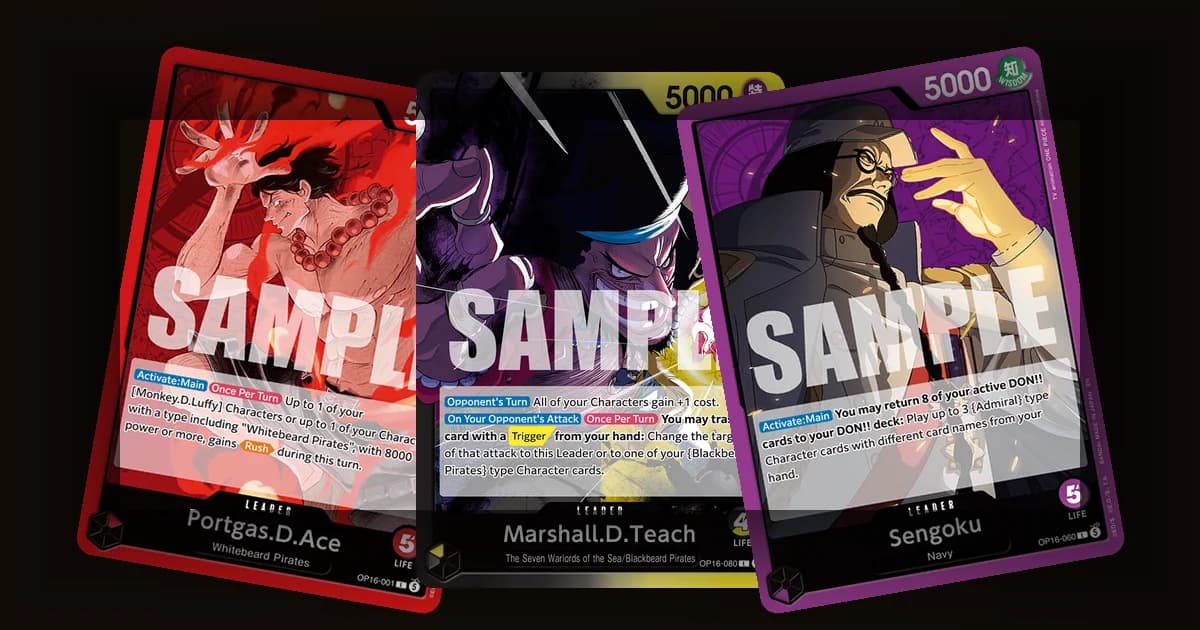
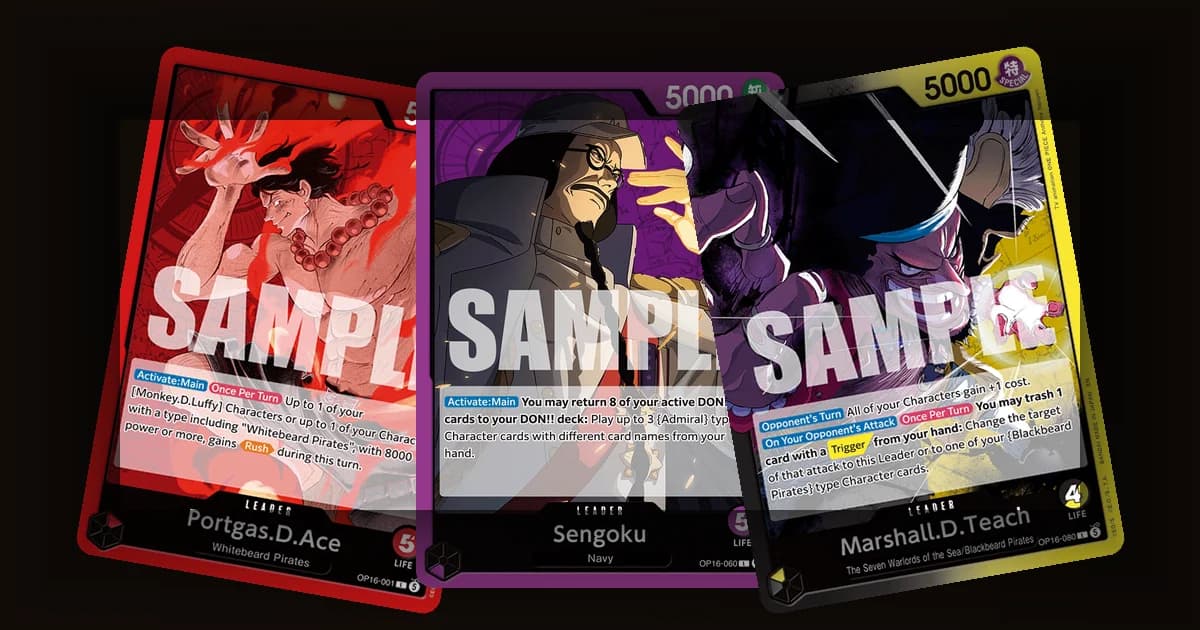
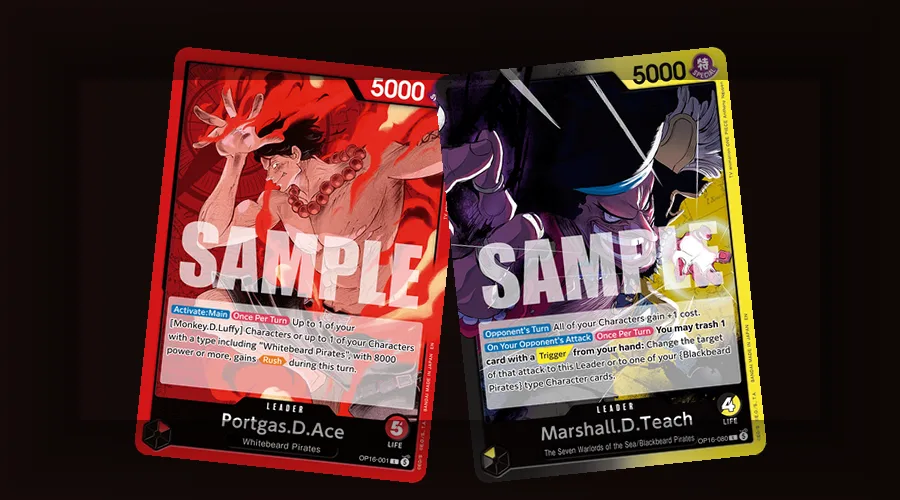 These real OP-16 sample Leaders show Portgas.D.Ace and Marshall.D.Teach. They are card-art examples only, not SEC cards and not evidence of a pull ratio.
What to do with the pulls
Sleeve chase cards immediately. Put valuable pulls into a clean sleeve before sorting or photographing them. Then inspect corners, edges, surface, and centering before deciding whether to play, trade, sell, or grade.
Separate collection copies from play copies. A card in a tournament deck accumulates wear. If you want a clean binder copy, keep it out of active play and record the printing and condition.
Do not treat bulk as guaranteed value. Commons, uncommons, and low-demand Rares may be useful for learning, casual play, or trade bundles, but they should not be counted at a price you cannot realize.
Use current deck demand carefully. A playable card can rise after a tournament result and fall after a reprint or rotation change. Separate collector demand from current playable demand when you calculate value.
Step-by-Step: Making the opening decision
1. Name the goal. Write down whether you want fun, broad coverage, trade stock, a complete set, or one specific chase card.
2. Check the current sealed price. Record the language, seller, date, shipping, taxes, and return terms. Do not use an old launch price as today's cost.
3. Check the exact single price. If one card is the goal, compare its current base, alternate-art, or Manga listing directly with the sealed cost.
4. Set the stop limit. Decide the maximum amount before opening. More boxes improve the number of attempts, not the certainty of a specific pull.
5. Open and protect the cards. Sleeve chase cards immediately, record the contents, and keep collection copies away from play wear.
6. Recalculate after opening. Compare the missing cards and duplicate value with singles. Stop opening when singles solve the remaining goal more efficiently.
Common OP-16 opening mistakes
- Repeating an unofficial pull ratio as fact: Bandai does not publish a per-rarity odds table for the set.
- Using launch-week EV: Sealed and single prices have moved since June. Recalculate with a dated snapshot.
- Confusing MSRP with market price: Bandai lists $4.99 per pack. A sealed box price depends on the product configuration and seller.
- Counting asking prices as realized value: Active listings are not the same as completed sales after fees.
- Using the wrong card printing: SEC, Leader, alternate art, and Manga entries can share a character or card number but have different prices.
- Opening past the budget: More boxes cannot guarantee a target and can create a larger pile of duplicates.
- Ignoring language and condition: English, Japanese, raw, and graded markets should not be mixed in one EV line.
Key takeaways
- Bandai's OP-16 page confirms $4.99 pack MSRP, 126 plus 1 card types, and no guaranteed per-rarity pull table.
- Retail and market references commonly describe the English box as 24 packs, but verify the sealed configuration in your region.
- Current sealed prices and EV models are dated and source-dependent. Record the date and assumptions rather than using a universal number.
- Opening makes the most sense for entertainment, broad collection, or a planned group experience.
- Buying singles is usually the controlled route for one exact SEC, Manga printing, parallel, or playset.
- Set a stop limit before opening and protect every valuable pull immediately.
GODEEPER: Want to compare individual chase cards after opening? Read the One Piece TCG Most Expensive Cards guide and verify each exact printing before using a number.
Related Reading
- OP-16 Collectors Guide: Identify SEC, Manga, and Super Alt-Art printings.
- OP-16 Singles Buying Guide: Compare post-launch singles and timing.
- OP-16 Admiral Manga Rare Guide: Focus on the set's three Admiral Manga printings.
- OP-16 Best Cards to Pull: Rank set cards by collecting and play interest.
- One Piece TCG Card Grading Guide: Inspect and submit high-value pulls carefully.
Frequently Asked Questions
Q: How many OP-16 boxes should I buy? A: Choose from an entertainment budget. One box may be enough to enjoy opening, while more boxes add cost and duplicates. If you want one exact card, check the single first.
Q: What is the official OP-16 box EV? A: There is no official Bandai EV. Third-party models use different price sources and pull assumptions, so record the date, market, and methodology before comparing results.
Q: How many packs are in a box? A: Retail and market listings commonly describe the English booster box as 24 packs. Bandai's official page lists pack MSRP and set contents, so confirm the box configuration for your region.
Q: What are the SEC pull rates? A: Bandai does not publish a guaranteed per-rarity pull rate on the OP-16 product page. Do not treat an opening sample or a community estimate as a promise.
Q: Is opening worth it for value? A: It is risky as a pure value strategy. Open when the experience or broad collection is worth the cost, and buy a single when the target is specific.
Q: Should I buy a case? A: Only when the case fits a store, content, group, or entertainment plan. More boxes spread attempts but do not eliminate random outcomes.
Q: When is the best time to open? A: There is no universal best time. Compare current sealed price, current singles, and your purpose on the same date instead of relying on launch-week projections.
References
- OP-16 The Time of Battle official product page: Release date, $4.99 pack MSRP, set contents, and official rarity categories.
- InkSight OP-16 pull-rate guide: Provenance for box structure and confirmation that no official per-rarity odds are published.
- OP Box Index English OP-16 box page: Dated completed-sale sealed-box snapshot.
- OnePiece Terminal OP16 set page: Dated third-party EV model and market comparison.
- Portgas.D.Ace OP16-118 card record: Current SEC card market reference.
- Marshall.D.Teach OP16-119 card record: Current SEC card market reference.
- One Piece Card Game official rules hub: Current game and organized-play documents.
Cards in this article
About the author
Card values and pull rates
Pen name for the Shonen TCG desk's card value, pull rate and collector market coverage.
- Prices read from TCGplayer and Cardmarket listings, dated
- Pull rates tied to a stated sample
- Opinions marked as ours, with the reason
Keep reading
OP-16 Collectors Guide: SEC, Manga Rare, Alt-Art Cards
Guides · 11 min

OP-16 vs OP-15 power level comparison: what changed?
Guides · 11 min
OP-16 Ace Deck Guide: Whitebeard Pirates Rush Build
Guides · 12 min
OP-16 Sengoku Deck Guide: Purple Marine Admirals Build
Guides · 13 min
One Piece TCG Standard Format Guide 2026: Legal Sets
Guides · 12 min
One Piece TCG Trade Guide: How to Trade Cards Fairly
Guides · 13 min
OP-16 EN Launch Guide: What Happened After Release
Guides · 12 min
One Piece TCG Budget Competitive Guide 2026 Under $100
Guides · 13 min
Disclaimer
This article is published for informational and entertainment purposes. It does not constitute professional financial, legal, or technical advice. Game performance, online services, patch schedules, and store listings change. Verify critical details (pricing, system requirements, regional availability) with publishers and storefronts before you buy. Affiliate links, where present, help support our editorial work and are labelled in our affiliate disclosure.