

Shonen TCG · Guides
One Piece TCG Locals Etiquette Guide: Play Right at Events
Most locals etiquette is already in Bandai's floor rules. Here's what they ask of you, in plain English.
Our callFollow Bandai's floor rules: present your deck for a cut every game, ask before touching your opponent's cards, and call a judge instead of arguing.
Good One Piece TCG locals etiquette is mostly written down. Bandai's Sanctioned Tournaments Floor Rules cover the habits regulars expect from you: greet your opponent, shuffle and hand your deck over for a cut, say what your effects are doing, ask before you touch their trash, and call a judge instead of arguing. Learn those and you'll fit in on your first night.
Updated October 19, 2026: we rewrote this guide against the current Floor Rules (Ver. 1.6.0, last updated October 10, 2025). The old version treated the cut as a courtesy you "offer"; the rules say you must present your shuffled deck for one. We added what the rules say about dice and counters, slow play, time limits and penalties, and removed card images that had nothing to do with the advice.
One Piece TCG locals etiquette: what the floor rules ask at the table
The Floor Rules apply to Sanctioned Tournaments, the events Bandai approves rather than runs itself, and an event's own regulations win if the two disagree. Section 2 is a short behavior list. In the rules' own order:
- Acknowledge your opponent before and after each match.
- Communicate clearly about the timing and declaration of effects, and answer when your opponent asks.
- Keep your cards and belongings neat so your opponent and the judges can see what's happening.
- Handle your opponent's cards with care, and ask permission before checking their field, revealed cards or trash.
- Don't look at your opponent's hand or deck unless a card tells you to.
- Ask your opponent and the judge before you leave your seat mid-match.
- Keep anything that isn't your Leader, deck, DON!! deck or playmat off the table.
That last one surprises people. Dice (20 sides or fewer) and power counters are allowed, but only after your opponent agrees they won't be a distraction. A quick "fine if I use this for power?" covers it.
Shuffling and the cut
This is the rule that's easiest to get slightly wrong. After you shuffle, you must present your deck to your opponent to cut or shuffle. It isn't an optional courtesy. Once they've done that, you can't shuffle or cut your own deck again. Shuffle in full view, in a reasonable amount of time, without looking at the cards, and cut your opponent's deck quickly when they hand it over.
If your opponent can't touch your deck (remote play, for example), the rules give a proxy cut: split it into three roughly even piles and let them name the order you stack them in.
Sleeves are part of this too. Every card in the main deck goes in the same opaque sleeve, same orientation, one card per sleeve. You can double-sleeve, but every card needs the same setup and at least one opaque layer. Your Leader and DON!! need different sleeves from the main deck, or none at all.
Slow play, rude opponents and calling a judge
The floor rules list "deliberately taking more time than is needed" as offensive behavior, next to speaking loudly and talking your opponent down. Their penalty section puts continued slow play that would stop the match finishing on time at the Warning level, and spells out how it's handled: when an opponent reports it, the judge checks the time spent and deals with it. So you don't need to argue with someone who's stalling. Ask once, then call a judge.
The same goes for rules questions. Anyone can call a judge (or staff) when something's unclear, and both players have to follow the ruling. Provoking or insulting an opponent is a Warning in the examples, and spectators can't give advice at all. A friend leaning over to point out a lethal line is a listed violation, and so is asking the crowd for help.
Players and stores on r/OnePieceTCG say the same thing. In an October "Locals Scaries" thread about an unpleasant opponent, a store account, u/BeckettCastleTCG, replied: "As a store, we always tell our players to let an employee know when you have a negative interaction with a player." In an August thread about an opponent misreporting counter values, one of the top answers, from u/thenoblitt, was simpler: "If he cheats. Call the judge."
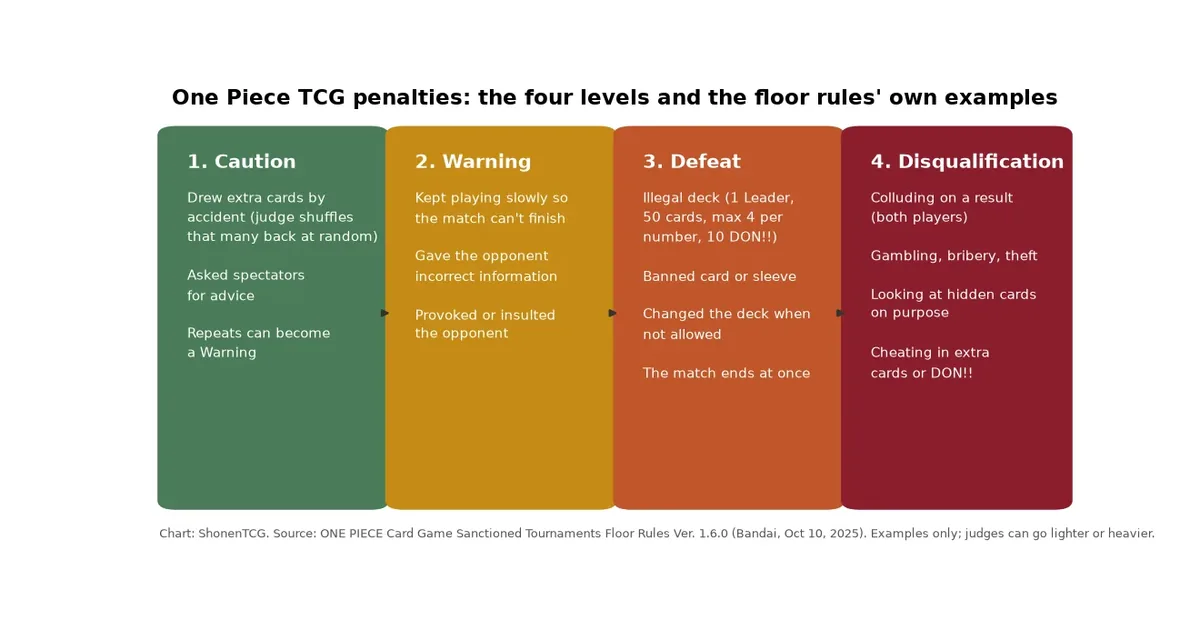 Chart: ShonenTCG. Source: ONE PIECE Card Game Sanctioned Tournaments Floor Rules Ver. 1.6.0, section 12 (Bandai, October 10, 2025).
The examples are guides, not a fixed table. Judges can go lighter or heavier depending on the event and what happened, and repeating a violation can bump it up a level.
When time runs out
Bandai recommends best-of-one matches of 35 minutes with 5 minutes of extra time for sanctioned events, though your store can set its own. If the game isn't over when time is called, you play three more turns, with the current player's turn counted as turn 0. If there's still no winner, the player with more Life cards wins; ties go to cards left in deck, then Characters in play, then whoever drew from their Life area last.
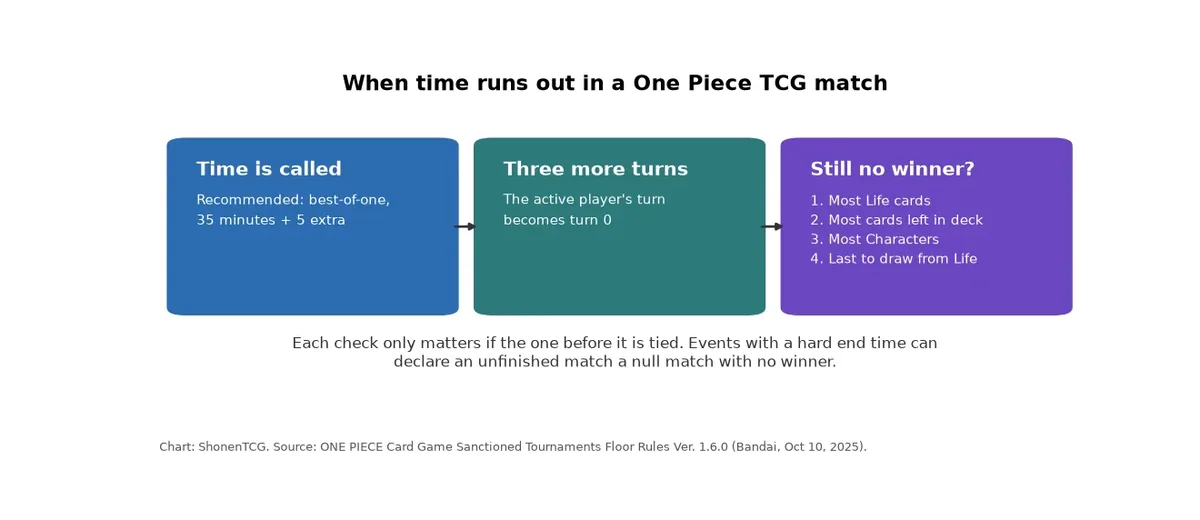 Chart: ShonenTCG. Source: ONE PIECE Card Game Sanctioned Tournaments Floor Rules Ver. 1.6.0, section 8.2 (Bandai, October 10, 2025).
Knowing this is etiquette too: it means nobody has to argue about who won a timed-out game.
One Piece TCG locals etiquette after the match
Acknowledge your opponent, win or lose; the rules ask for it after every match, not just before. Check the result before it goes down: once it's recorded on the match slip or a judge has confirmed it, it can't be changed. If you need to leave early, tell a judge or staff and ask to withdraw. Withdrawing after pairings go up but before your match starts counts as conceding that round.
Our take
Read sections 2 and 8 of the Floor Rules once before your first event. They're short, and they cover almost every awkward moment you'll run into. The one habit we'd drill is the cut: hand your deck over every game without being asked, and take theirs. And when a game gets tense, let the judge do the arguing. That's what they're there for.
How we checked this: on October 19, 2026 we read Bandai's current ONE PIECE Card Game Sanctioned Tournaments Floor Rules (Ver. 1.6.0) and built both diagrams from it.
Related Reading
- One Piece TCG Tournament Guide 2026: event types, formats and how to sign up.
- One Piece TCG Banlist and Restrictions Explained: what makes a deck legal before you register it.
- One Piece TCG How to Play: Rules and Mechanics: the turn structure, if you're still learning it.
- One Piece TCG Common Beginner Mistakes: the in-game errors to avoid once you sit down.
References
- ONE PIECE Card Game Sanctioned Tournaments Floor Rules Ver. 1.6.0 (Bandai, last updated October 10, 2025)
- One Piece Card Game official rules page (Bandai)
About the author
Pen name for the Shonen TCG desk's tournament coverage, format analysis and cross-game comparisons.
- Results taken from event pages and standings
- Other games checked against their own official rules
- Opinions marked as ours, with the reason
Keep reading
One Piece TCG Sleeves and Accessories: What to Buy First
Guides · 6 min
One Piece TCG Common Beginner Mistakes: 9 to Avoid
Guides · 7 min

OP-17 Release Date: Asia English (Philippines), US, Japan
News · 4 min
One Piece TCG Attacking Rules: Targets, Blocks and Ties
Guides · 6 min
One Piece TCG How to Read a Card: 6 Things to Check
Guides · 6 min
One Piece TCG Life Cards: Face-Down, Damage and Triggers
Guides · 6 min
One Piece TCG Keywords Explained: Rush, Blocker & More
Guides · 9 min
One Piece TCG DON Cards: 10 Per Deck, Rest or Attach
Guides · 6 min
Disclaimer
This article is published for informational and entertainment purposes. It does not constitute professional financial, legal, or technical advice. Game performance, online services, patch schedules, and store listings change. Verify critical details (pricing, system requirements, regional availability) with publishers and storefronts before you buy. Affiliate links, where present, help support our editorial work and are labelled in our affiliate disclosure.