

Shonen TCG · Guides
One Piece TCG OP-16 Guide: Set Review & Leaders (2026)
One Piece TCG OP-16 guide to all six leaders, best cards to pull, current meta standings, collector value, and buying advice for The Time of Battle set.
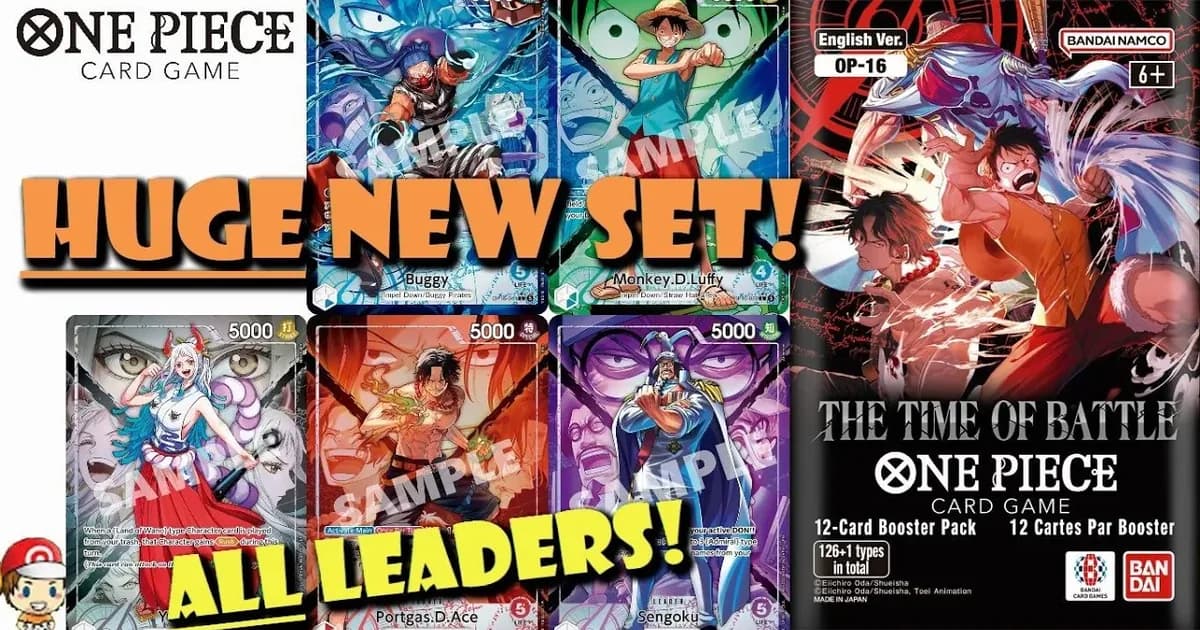
TL;DR: One Piece TCG OP-16 "The Time of Battle" released June 12, 2026 with six new leaders from the Paramount War arc: Ace, Sengoku, Yamato, Blackbeard, Luffy, and Buggy. Ace and Blackbeard each have a Secret Rare Character chase card (OP16-118, OP16-119) alongside their standard leader. Ace grants Rush to qualifying Whitebeard Pirates Characters, while Yamato uses the trash and Blackbeard redirects attacks. Sakazuki (Akainu), Marco, and Garp are Character cards, not leaders. Buy singles for competition and check current event rules before playing.
Updated October 5, 2026: Corrected the deck copy limit to follow card number rather than character name and added Bandai's Block Number Standard framework.
One Piece TCG OP-16: The Set Overview
OP-16 "The Time of Battle" is the sixteenth main expansion for One Piece TCG, continuing the Paramount War storyline. It covers the Marineford battle, the Impel Down breakout, and Whitebeard's final stand, with six new deck-defining leaders.
Bandai lists June 12, 2026 as the OP-16 release date and $4.99 per pack as the MSRP. The official product page lists 126+1 types and the set's rarity families, while current sealed prices vary by region, language, and retailer.
This guide covers the six leaders, the best cards to chase, collector value, deck-building direction, and the current OP-16 standings. Whether you are starting competitive play or expanding a collection, OP-16's Paramount War roster offers distinct strategic identities. If you're brand new to the rules, colors, and deck building, start with the One Piece TCG complete guide instead and come back here once you've picked a set to build around.
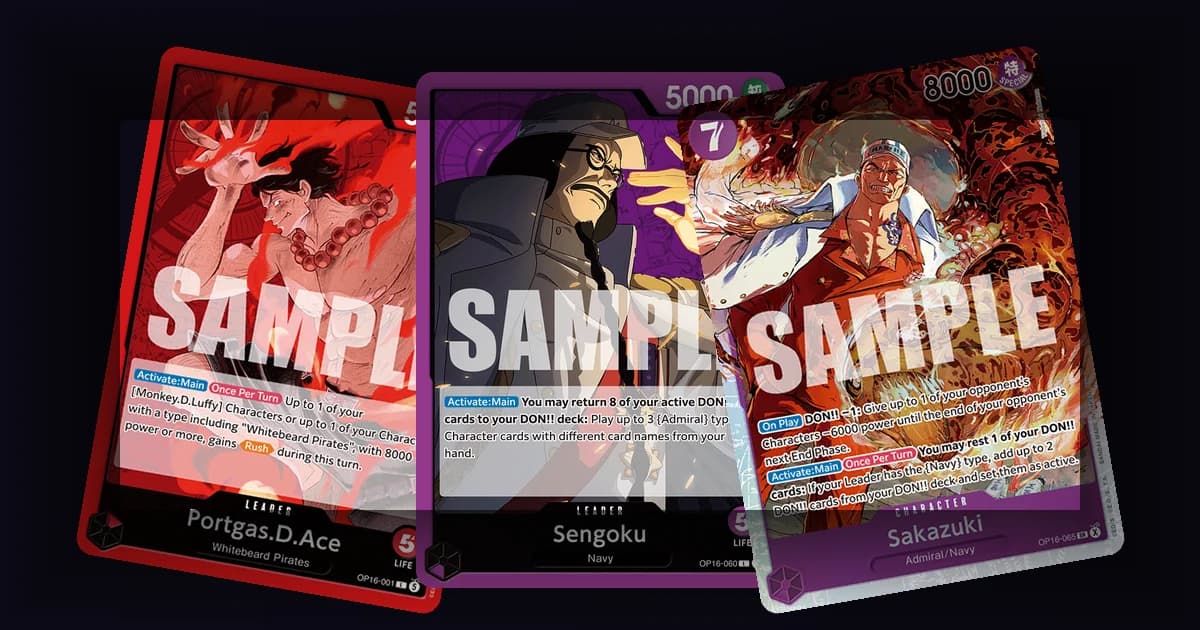
The set's design centers on the factions of the Paramount War: the Navy and its Admirals, the Whitebeard Pirates, the Seven Warlords, and the Impel Down breakout crew. Each faction maps to a leader and color identity. For a card-by-card roster check, see the OP-16 Paramount War leaders and factions guide.
GODEEPER: New to the game? Start with the rules and DON!! system before diving into leaders. One Piece TCG Beginner Guide 2026
The Six OP-16 Leaders
A critical clarification first: the six OP-16 leaders are Ace, Sengoku, Yamato, Blackbeard, Luffy, and Buggy. Akainu, Marco 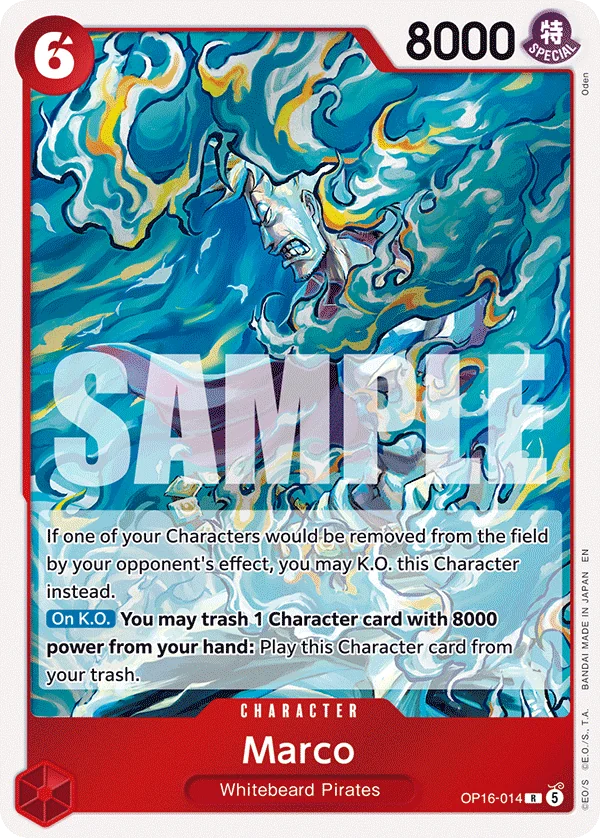 OP16-014OP16-014Shop on TCGplayer, and Garp are powerful Character cards, not leaders. This distinction matters because deck construction is color-locked to your leader.
Ace (Red, Whitebeard Pirates)
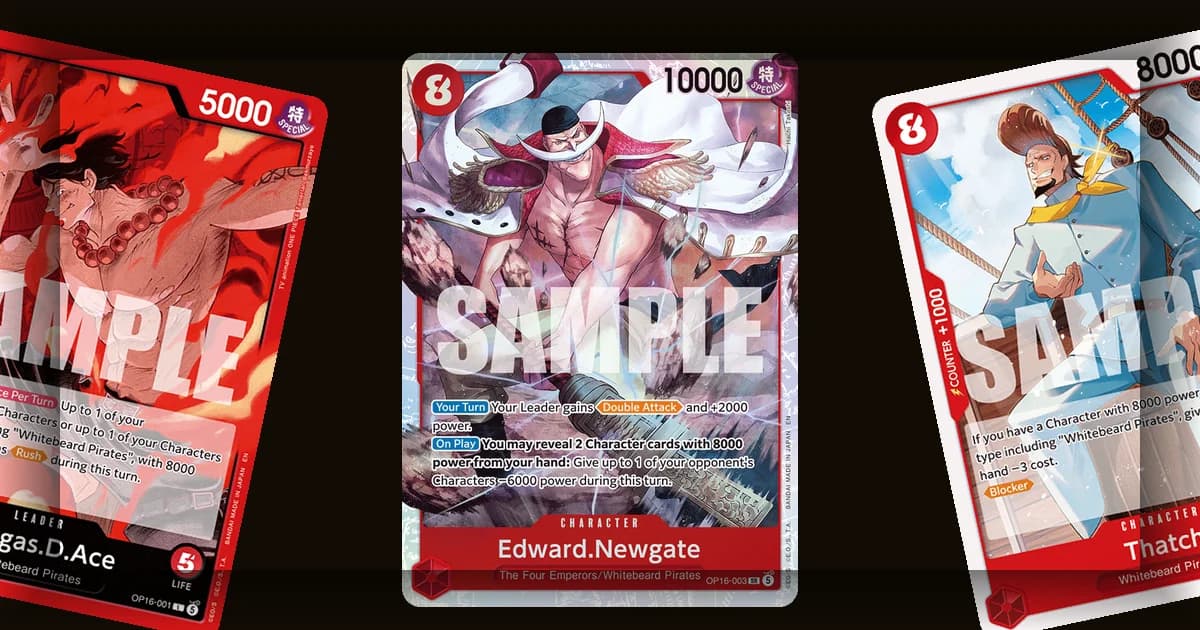
Portgas D. Ace 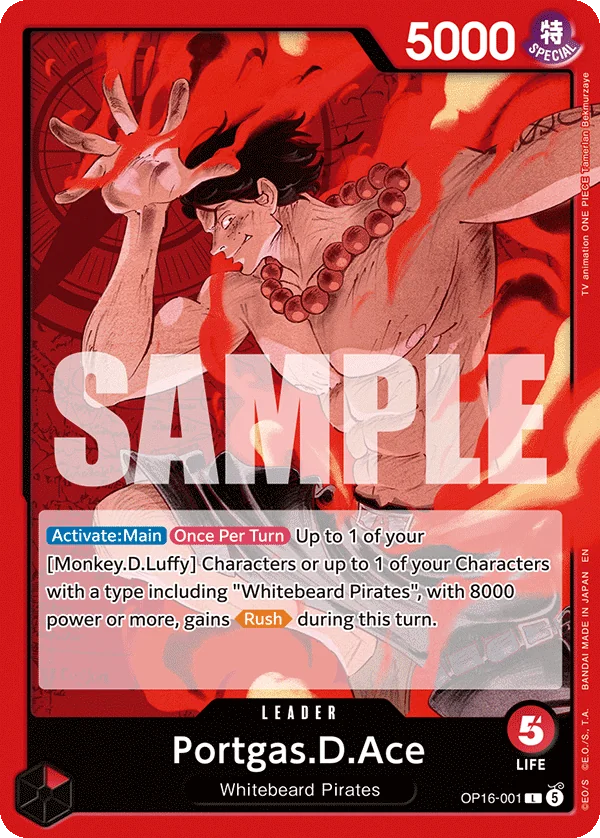 OP16-001OP16-001Shop on TCGplayer is a Red Whitebeard Pirates leader. Once per turn, his effect can give Rush to a Luffy or Whitebeard Pirates Character with 8000 or more power, creating a fast pressure plan. He also has a separate SEC Character card, OP16-118
 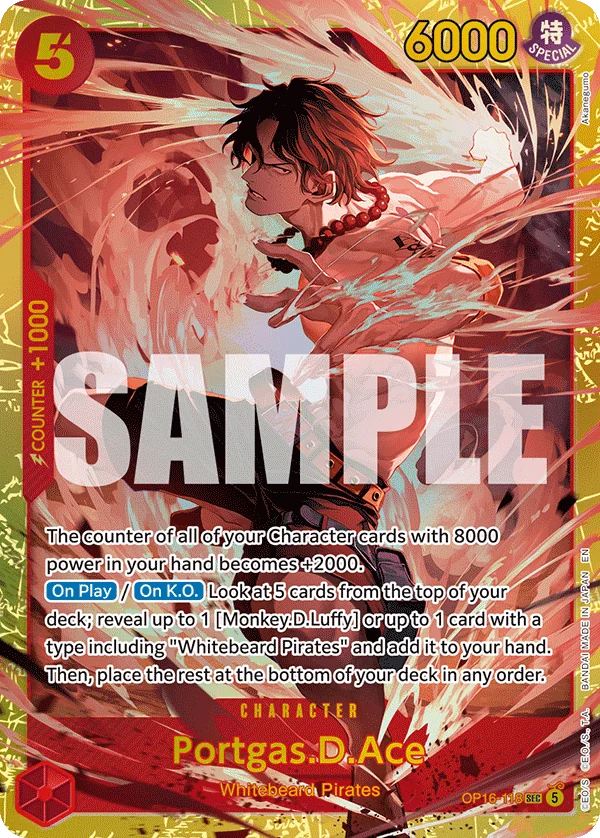 OP16-118OP16-118Shop on TCGplayer, one of two SEC Character cards in the set. Play this if you like aggressive racing. Full breakdown: OP-16 Ace Deck Guide. For week 1 EN tournament results and matchup notes, see the OP-16 Ace deck tech week 1 report.
Sengoku (Purple, Navy) - Marine ramp into the Three Admirals
Sengoku 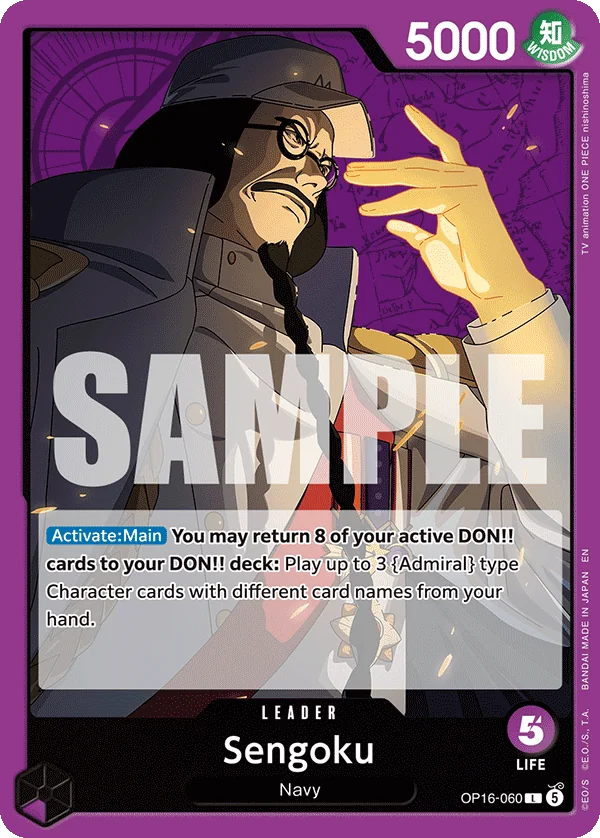 OP16-060OP16-060Shop on TCGplayer is the Purple Navy leader who can return 8 active DON!! cards to the DON!! deck to play up to three different Admiral Characters from hand: Sakazuki, also known as Akainu
 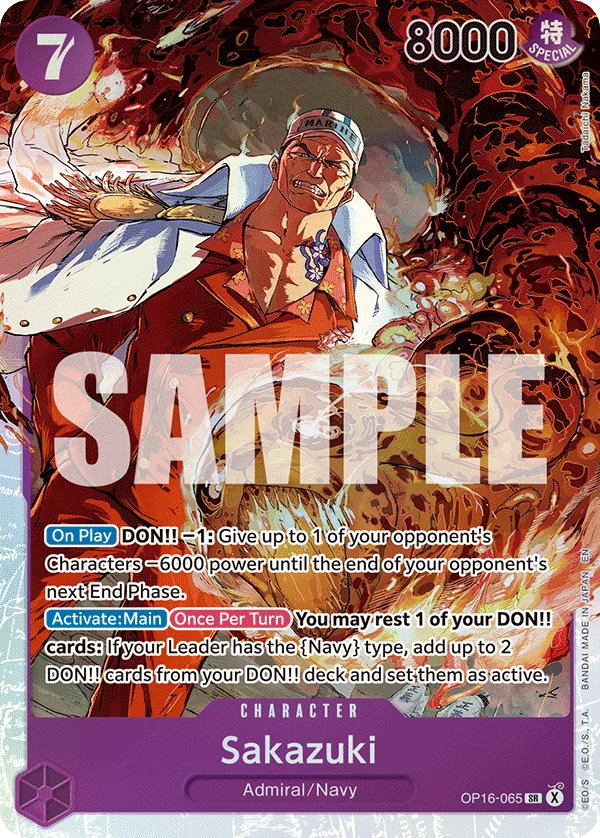 OP16-065OP16-065Shop on TCGplayer, Borsalino, also known as Kizaru
 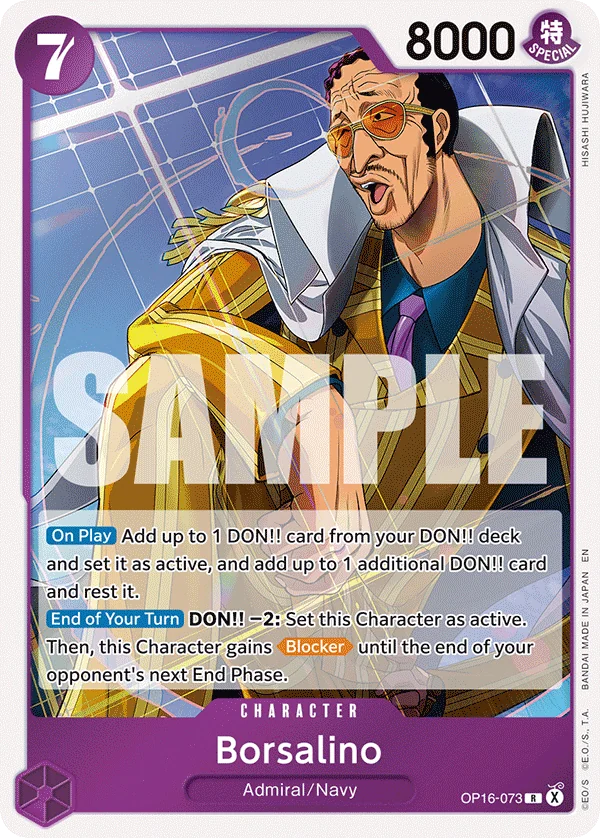 OP16-073OP16-073Shop on TCGplayer, and Kuzan, also known as Aokiji
 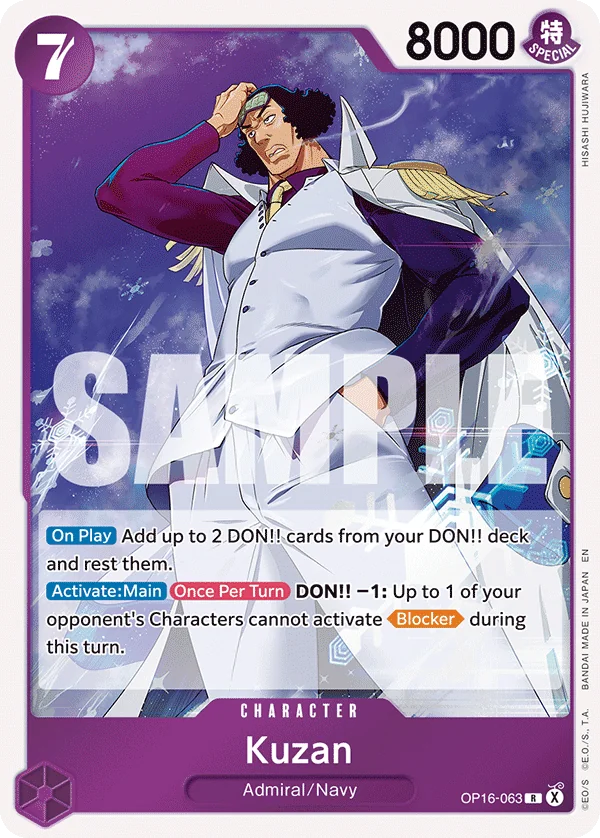 OP16-063OP16-063Shop on TCGplayer. The official product page highlights the Three Admirals in OP-16's Super Alt-Art feature. Play this if you like high-cost Purple ramp control. Full breakdown: OP-16 Sengoku Deck Guide.
Yamato (Black, Wano) - trash recursion
Yamato 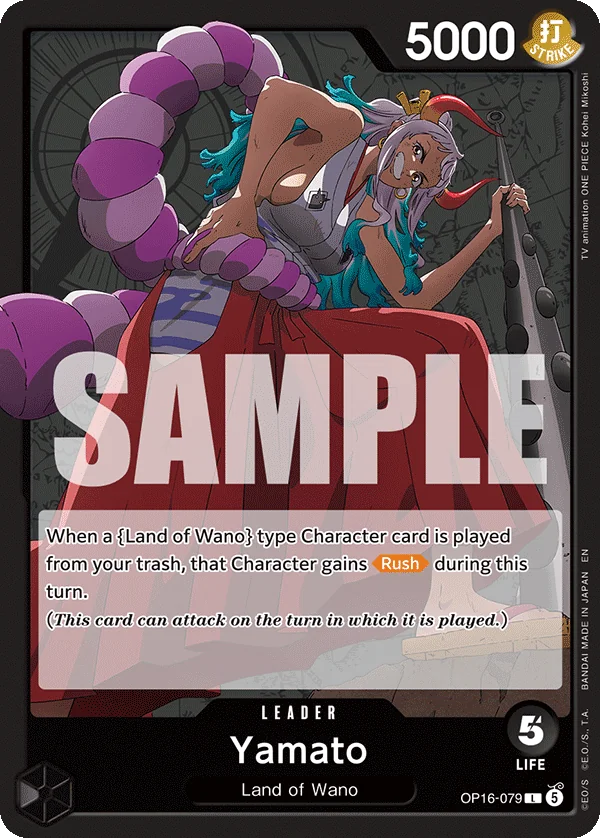 OP16-079OP16-079Shop on TCGplayer is the mono-Black Land of Wano leader whose ability gives Rush to Land of Wano Characters played from your trash, enabling surprise recursion attacks. Play this if you enjoy resilient recursion aggro. Full breakdown: OP-16 Yamato Deck Guide.
Blackbeard (Black/Yellow) - redirect control
Marshall D. Teach / Blackbeard 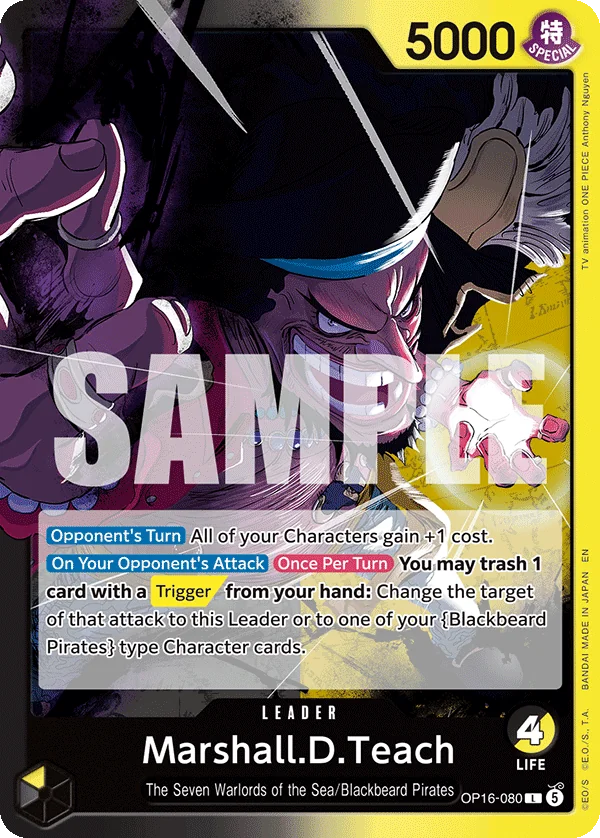 OP16-080OP16-080Shop on TCGplayer is the Black/Yellow leader whose once-per-turn opponent-turn effect lets you trash a card with a Trigger to redirect an attack to the leader or a Blackbeard Pirates Character. His static effect also raises the cost of your Characters during the opponent's turn. He has a separate SEC Character card, OP16-119
 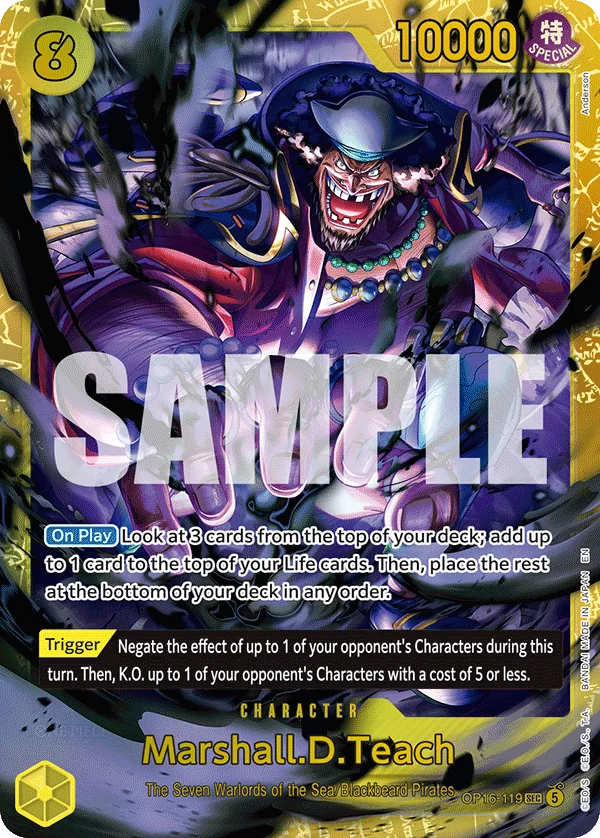 OP16-119OP16-119Shop on TCGplayer. Play this if you want an unconventional, demanding leader. Full breakdown: OP-16 Blackbeard Deck Guide.
Luffy (Green/Blue, Impel Down / Straw Hat Crew) - tempo
Monkey D. Luffy 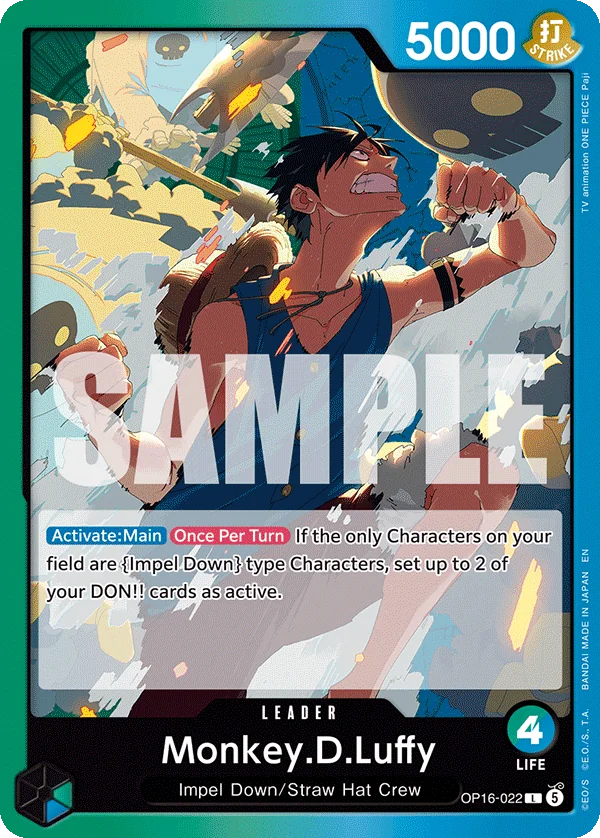 OP16-022OP16-022Shop on TCGplayer is a Green/Blue leader built around Impel Down and Straw Hat Crew support. Once per turn, if every Character you control is Impel Down, the leader can set up to two DON!! cards as active. Beginner-friendly. Full breakdown: OP-16 Luffy Deck Guide.
Buggy (Blue) - Impel Down swarm
Buggy 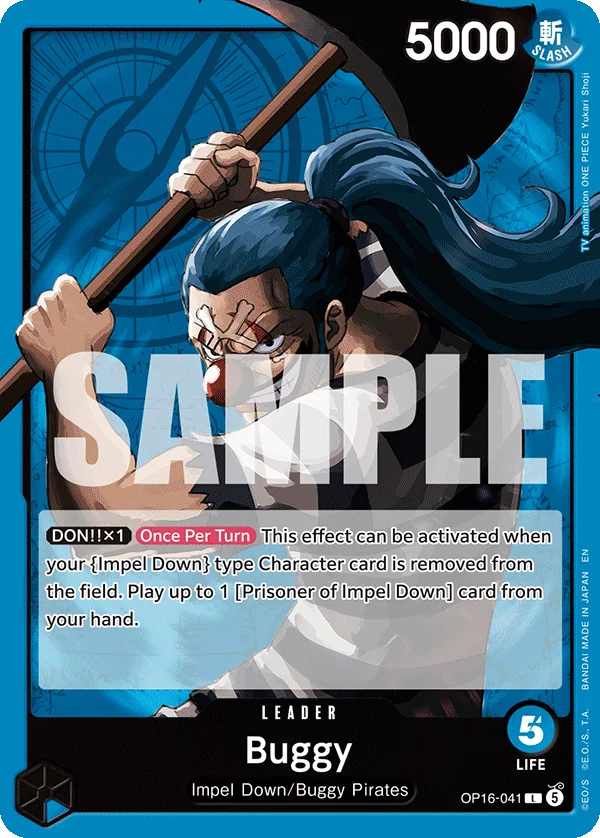 OP16-041OP16-041Shop on TCGplayer is the Blue Impel Down and Buggy Pirates leader. With a DON!! attached, his once-per-turn ability can play a Prisoner of Impel Down
 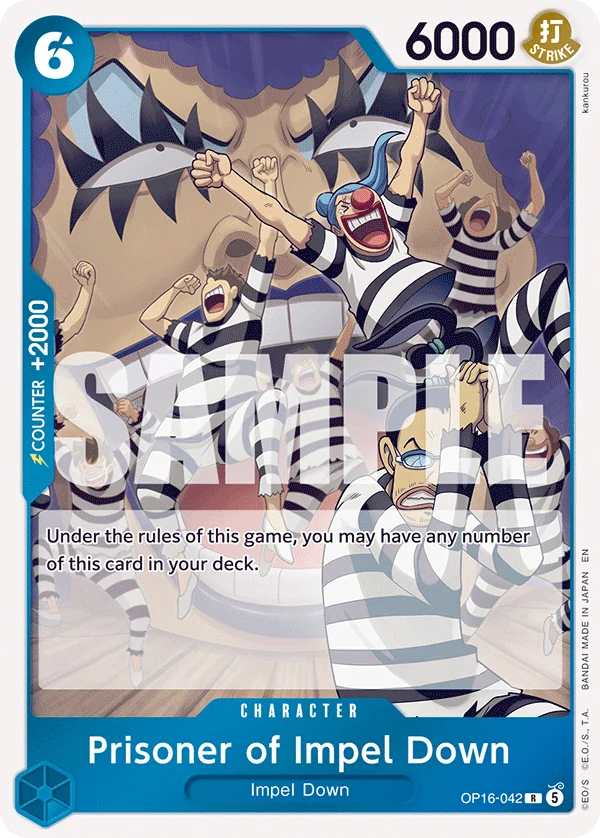 OP16-042OP16-042Shop on TCGplayer from hand when one of your Impel Down Characters leaves the field, supporting a wide board. Play this if you like a numbers-based board plan and are comfortable with a lower-representation OP-16 option. Full breakdown: OP-16 Impel Down Buggy Deck Guide: Blue Swarm Build.
GODEEPER: Want all six leaders compared side by side with cost and difficulty? OP-16 All 6 Leaders Explained
How to Choose Your OP-16 Leader
With six leaders across six colors, the right pick depends on your play style and budget, not on a single "best" answer.
| Leader | Color | Style | Difficulty | Build note |
|---|---|---|---|---|
| Ace | Red | Whitebeard pressure | Medium | SEC Character is optional |
| Sengoku | Purple | Admiral ramp | Hard | High-cost Admiral shell |
| Yamato | Black | Wano trash recursion | Medium | Land of Wano focus |
| Blackbeard | Black/Yellow | Redirect control | Hard | SEC Character is optional |
| Luffy | Green/Blue | Impel Down tempo | Easy | Keep the field Impel Down |
| Buggy | Blue | Impel Down swarm | Easy | Prisoner of Impel Down engine |
If you are new to OPTCG: start with Buggy or Luffy. Their game plans are linear and their key cards are low rarity, so you learn fundamentals cheaply.
If you want control: Sengoku rewards patient, resource-aware play and asks you to plan around a high-cost Admiral turn. Blackbeard is the alternative control option with a higher skill ceiling and attack redirection as a unique tool.
If you want aggression: Ace turns large Whitebeard Pirates Characters into immediate attacks through Rush. Yamato is the recursion alternative that attacks with Land of Wano Characters replayed from the trash.
If budget is the priority: start with Buggy or Luffy and buy the core singles for the list you actually want to play. Neither leader requires an SEC Character to function, while Sengoku's high-cost Admiral shell may require a larger collection of specific pieces.
The honest advice: pick the character you actually like. You will play more games, learn faster, and enjoy the climb if the leader resonates with you.
OP-16 Deckbuilding Fundamentals
Every OP-16 deck follows the same construction frame, regardless of leader.
The structure: 1 Leader card, a 50-card main deck of Characters, Events, and Stages, and a 10-card DON!! deck. Maximum 4 copies of a card number; alternate-art cards sharing that number count toward the same limit. Every card must match your leader's color identity.
Color-locking: Your leader determines which colors you can run. A mono-Red Ace deck runs only Red cards; a two-color leader opens a second color. This is the core constraint that makes leader choice define your whole deck.
The counter package: Across every archetype, Counter Events and Characters are an important defensive package to tune. Prioritize a coherent counter suite before adding expensive finishers.
The curve: Even control decks need early plays. A smooth DON!! curve, with enough low-cost cards to act on turns 1-3, separates consistent decks from clunky ones. Avoid stacking too many high-cost cards.
Faction and Color Guide
OP-16's factions map cleanly onto the Paramount War sides, which helps you sort the card pool fast.
- Navy / Three Admirals (Purple): Sengoku's faction. Sakazuki (Akainu, OP16-065), Garp
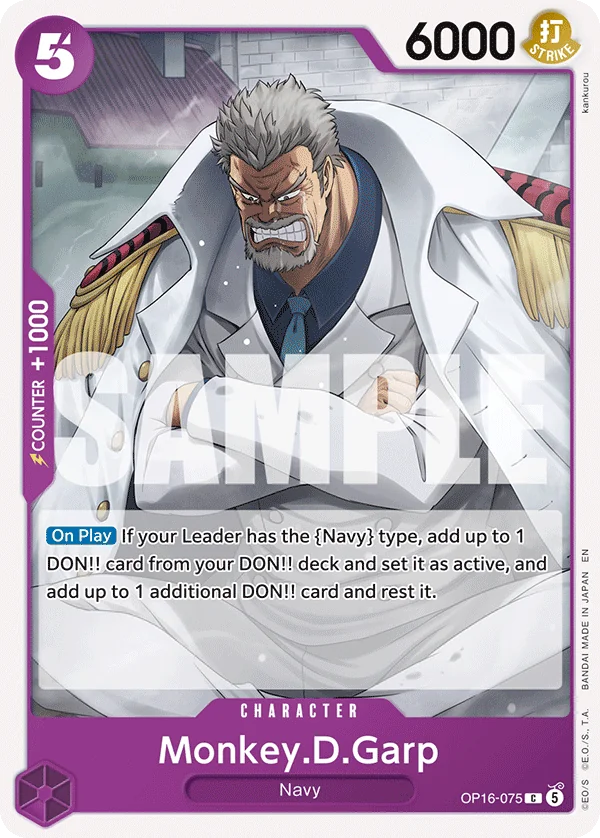 OP16-075OP16-075Shop on TCGplayer, Smoker
 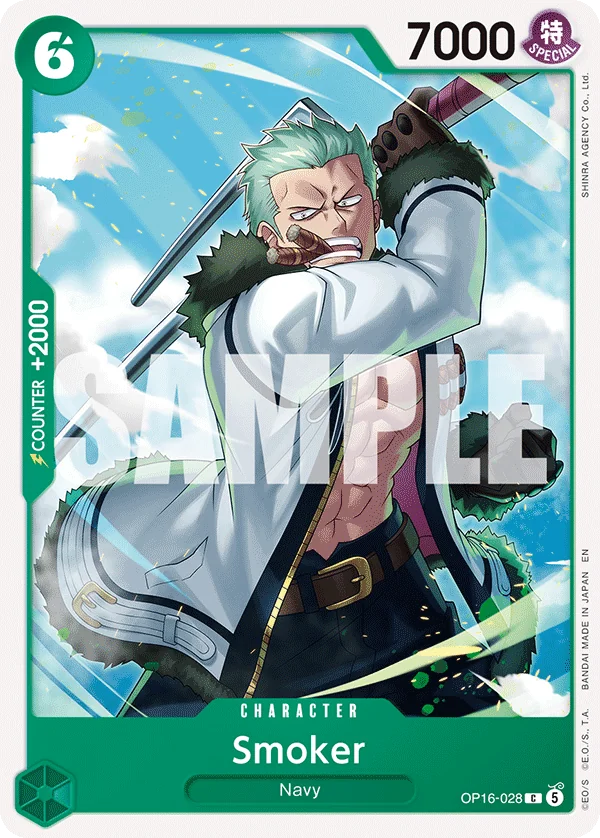 OP16-028OP16-028Shop on TCGplayer, and the other Admirals support the control plan.
 - Whitebeard Pirates (Red): Ace's faction. Family-bond burn triggers and aggressive tempo.
- Wano Country (Black): Yamato's faction. Trash recursion value.
- The Seven Warlords of the Sea / Blackbeard Pirates (Black/Yellow): Blackbeard's faction. Redirect control and disruption.
- Impel Down / Straw Hat Crew (Luffy) and Impel Down / Buggy Pirates (Buggy): the breakout crews. Green Buggy
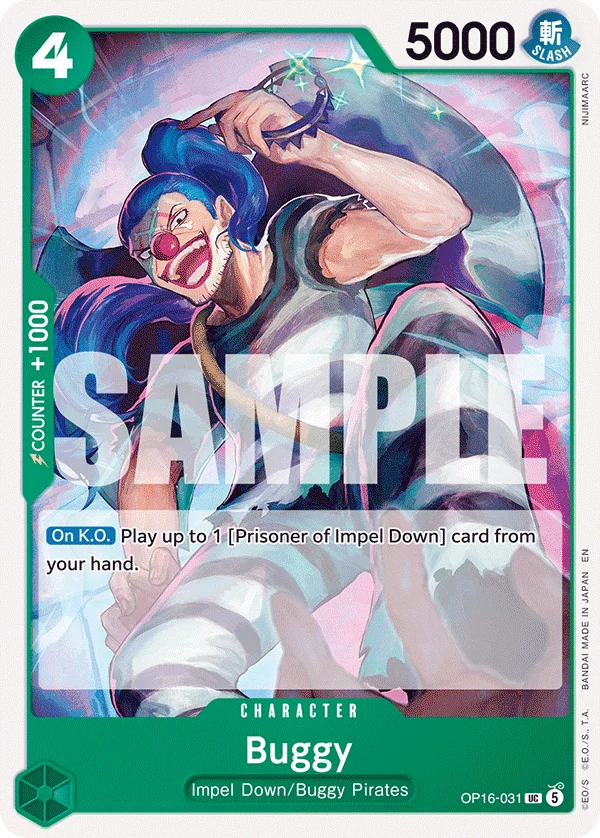 OP16-031OP16-031Shop on TCGplayer supports the Green/Blue Luffy shell, while Blue Buggy
 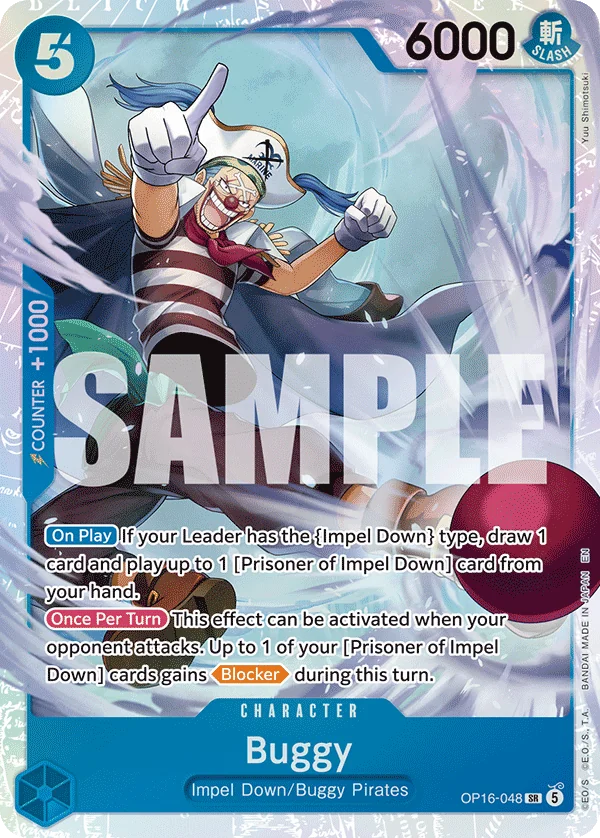 OP16-048OP16-048Shop on TCGplayer and Crocodile
 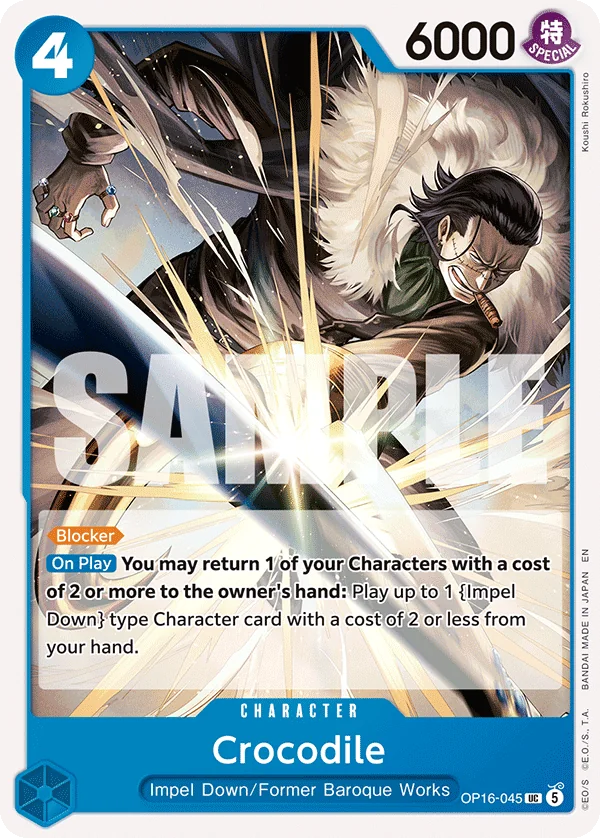 OP16-045OP16-045Shop on TCGplayer support the Blue Leader's wide board plan.
Identifying a card's faction first tells you which leader it pairs with, turning a large card pool into a quick sorting tool.
Key Cards to Chase in OP-16
SEC Character Cards (the top chase)
Ace and Blackbeard's SEC Character cards (OP16-118, OP16-119) are separate from their standard leader cards (OP16-001, OP16-080). The old launch-week price projections are no longer useful after release. Compare the current language and variant before buying, then use the OP-16 most expensive cards guide for a dated market snapshot.
Manga Rare and Super Alt-Art
The Paramount War theme produced Manga Rare treatments of the Three Admirals: Sakazuki (Akainu), Kuzan (Aokiji), and Borsalino (Kizaru). Bandai's product page separately highlights a Three Admirals Super Alt-Art feature. A September 10, 2026 market snapshot listed the Manga versions at roughly $1,127 for Sakazuki, $1,109 for Kuzan, and $1,043 for Borsalino. Those are dated market figures, not guaranteed sale prices. See the OP-16 Admiral Manga Rare guide for context.
Key competitive Characters
Sakazuki, also known as Akainu (OP16-065), is a high-cost removal Character for Sengoku Navy decks. Green Buggy (OP16-031) supports Green/Blue Luffy, while Blue Buggy (OP16-048) and Crocodile (OP16-045) support the Blue Buggy engine. These are competitive considerations, not just collector chases.
GODEEPER: Full value ranking and pull priority for every chase card. OP-16 Best Cards to Pull
Best Cards to Pull for Competitive Play
Priority depends on your leader, but the cross-deck staples are clear:
- Sakazuki, also known as Akainu (OP16-065): a high-cost removal Character; central to Sengoku and relevant to other Navy builds
- Buggy Character (OP16-031): Green Impel Down support for Luffy; do not confuse it with Blue Buggy Character OP16-048
- Crocodile (OP16-045): board-control Impel Down Character for cross-faction decks
- Counter Events: the cheap defensive backbone every deck wants
- Faction support: Whitebeard Pirates for Ace, Navy for Sengoku, Warlords for Blackbeard
For a budget entry, start by pricing the Buggy or Luffy core as singles and build toward a complete list rather than chasing a fixed budget target. See OP-16 Budget Deck Guide.
SHOP: Building from OP-16? Compare current One Piece Card Game listings for the leaders and singles covered in this set guide. Shop TCGplayer →
OP-16 in Competitive Play: The Settled Meta
Current snapshot (2026-09-16): Limitless's OP-16 deck tracker reports share by points, not a win rate or a formal tier list. The leading entries are Blue/Yellow Nami at 23.52%, Green/Blue Luffy at 22.91%, Purple Enel at 22.71%, Purple/Yellow Rosinante at 9.88%, and Black/Yellow Blackbeard at 8.86%. Among OP-16 leaders, Black Yamato is at 1.37%, Red Ace at 0.87%, Purple Sengoku at 0.36%, and Blue Buggy at 0.31%.
That snapshot makes Luffy the most visible OP-16 leader in the tracker, while Blackbeard has a larger share than the other OP-16 leaders listed above. Treat the table as a dated metagame signal rather than a prediction of your local event's results. The OP-16 One Month Meta Report and OP-16 Format July update provide earlier snapshots for comparison.
GODEEPER: How OP-16 compares to the previous set's power level. OP-16 vs OP-15 Power Level
Common OP-16 Beginner Mistakes
A few avoidable errors trip up players entering with OP-16.
Buying SEC cards at launch. SEC prices can move sharply after release, and language, condition, and parallel treatment all matter. If you do not need a copy for a specific deck or collection goal, compare several current listings before buying.
Chasing a specific card through booster boxes. Booster packs contain random cards, so they are an inefficient way to assemble four copies of a specific Character. If you need four copies of Sakazuki for Sengoku, compare the current singles market before opening sealed product.
Confusing Characters with leaders. Akainu, Marco, and Garp appear in older articles and product art prominently, but they are Character cards. Build your deck around an actual leader (Ace, Sengoku, Yamato, Blackbeard, Luffy, or Buggy) and slot those Characters in where colors allow.
Skipping the counter package. New players over-invest in flashy finishers and under-invest in counter Events. The counters win more games than one extra bomb, and they cost a fraction as much.
Assuming a card is legal because of its set. Check the current event rules and Banned/Restricted notice before registering. The official list can ban a card, restrict a pairing, or change as the environment develops.
Collector's Guide: Rarity and Value
OP-16's collector value concentrates in the two SEC Character cards (Ace, Blackbeard) and the Manga Rare and Super Alt-Art chase cards.
Value snapshot (September 10, 2026): a dated market tracker placed the Manga versions of Sakazuki, Kuzan, and Borsalino at approximately $1,127, $1,109, and $1,043 respectively. Prices differ by language, condition, and variant, so use the OP-16 Admiral Manga Rare guide and live listings when making a purchase.
Box value: the official product page lists MSRP and contents but does not publish pull odds or promise a return. Open sealed product for the experience, and buy singles when you need specific cards.
For the full rarity tier breakdown, grading timing, and what to hold long-term, see OP-16 Collectors Guide and One Piece TCG Card Grading Guide.
OP-16 Release Schedule & Timeline
| Date or status | Milestone | What to Do |
|---|---|---|
| June 12, 2026 | Official OP-16 release date | Bandai lists $4.99 per pack MSRP; compare current sealed listings rather than assuming MSRP. |
| Local prerelease | Event-specific early play | Bandai's product page says cards can be legal from the prerelease date at your LGS; confirm the event details. |
| After release | Tournament legality varies by event level | Check the current Bandai tournament manual before registering. |
| September 16, 2026 | Current audit snapshot | Use current Limitless standings and dated price trackers instead of launch forecasts. |
For a launch-day plan and buying priority, see OP-16 Launch Day Guide and OP-16 Pre-Launch Buying Guide.
Format and Legality
OP-16's official release date was June 12, 2026. Bandai's product page says the cards are legal from the prerelease date at your LGS and otherwise start seven days after the release date in your region. The current Bandai Tournament Rules Manual distinguishes event levels: level 1 events use set cards on release, including prerelease, while level 2 and 3 events use them seven days after release. Check the event announcement if those rules conflict with local scheduling.
The current Banned/Restricted notice also says decks may contain up to four copies of the same card number, while specific cards and pairs can be restricted or banned. Bandai's Block Number System began on April 1, 2026 and keeps an approximately three-year Standard pool. Bandai's April 2026 through March 2027 example allows Blocks 2 through 5, so OP-18 does not by itself trigger a set-based rotation. Check the live rules and restriction list before assuming an older card is legal. See One Piece TCG Standard Format Guide 2026.
All OP-16 Guides
- OP-16 Full Card List & Spoilers: What's in the Set: the 126+1 type breakdown, six leaders, official rarity structure, and dated chase context.
- OP-16 Singles Buy Hold Sell: September 2026 Snapshot: a dated OP-16 market and tournament framework for buying, holding, or selling singles.
- Black Yamato Matchups and Build: OP-16 Deck Guide: the mono-Black Yamato list by Limitless average counts, with turn-order matchup data (Yamato's Black Leader can't run Yellow cards).
- One Piece TCG Nami Deck Guide: Blue Yellow Draw Engine 2026: OP11-041 Blue/Yellow, the format's highest deck share (~23.5% per Limitless); win rate unconfirmed.
- One Piece TCG Blue Yellow Guide: How the Color Pair Works: how Blue's tempo and Yellow's Trigger effects combine, and why the pairing dominates the EN format.
- One Piece TCG Nami Counter Guide: Beat Blue Yellow 2026: matchup breakdown for all six OP-16 leaders against Nami
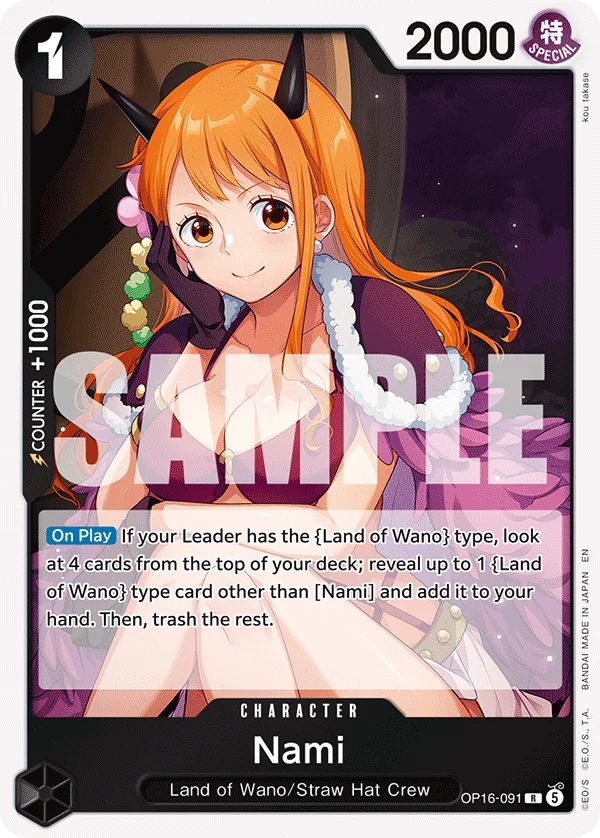 OP16-091OP16-091Shop on TCGplayer, including Zeus tech and when to concede resource advantage.
 - One Piece TCG OP-16 meta report: July 2026 snapshot: historical OP16 points-share context, dated July tournament results, and the transition into OP17.
- One Piece TCG Black Deck Guide: Removal and Trash Mastery: how Black removal and trash recursion work, Yamato vs Blackbeard compared, and which archetype to play.
- One Piece TCG Red Deck Guide: Full Aggro and Burn 2026: Red's identity, OP-16 leaders (Ace SEC, Shanks
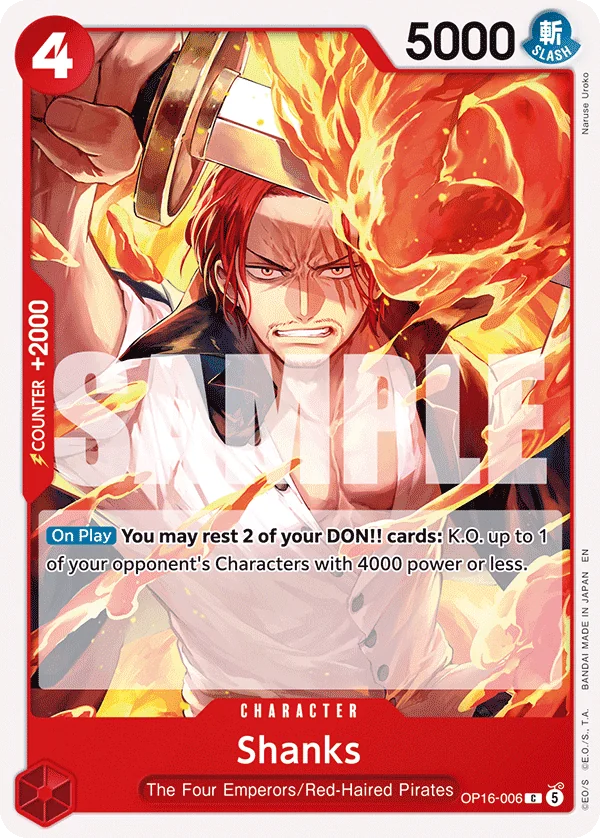 OP16-006OP16-006Shop on TCGplayer), deckbuilding ratios, and matchup guide.
 - One Piece TCG Green Deck Guide: Rest and Tempo Denial 2026: Green's rest-and-tempo identity, OP-16 Luffy (Green/Blue), and when denial beats aggro.
- One Piece TCG Purple Deck Guide: DON Ramp and Control: how Purple's DON!! ramp works, Sengoku and Enel as current leaders, and when to play Purple.
- OP-17 Leaders Preview: 6 Confirmed for World's Strongest: an archived preview of the six confirmed OP-17 leaders (Newgate, Luffy, Shanks, Kaido, Linlin, and Xebec) and the Treasure Rare rarity slot.
- OP-17 Blue Leader Revealed: Rocks D. Xebec Confirmed: the August 3 reveal that filled OP-17's last open color, his Rocks Pirates on-play ability, and how the pick tied the set's Yonko theme together.
- OP-17 Box Price Reality Check: What Boxes Sell For: real sold-listing data on OP-17 box prices versus scalper asking prices, and why the gap exists.
- OP-17 Loki Card Spoiler: Elbaf Prince SEC Chase 2026: an archived early OP-17 chase-card report about the reported Black SEC from Elbaf.
- OP-17 Leader Preview: Deck Potential Before Aug 26: archived community predictions versus confirmed facts and Treasure Rare deck-building implications.
- OP-17 OP-16 Format: How the Meta Changes This Fall: how six OP-17 leaders affect Enel, Yamato, and Blackbeard, plus which OP-16 cards to watch as the card pool expands.
- OP-16 Nami Tech Cards: 7 Verified Picks by Color (2026): the specific removal and negate cards to add to any deck against Blue Yellow, organized by color.
- OP-16 One Month Meta Report: Risers, Fallers and Lessons: the settled EN verdict after five weeks, with S/A/B tier rankings and what changes heading into OP-17.
- One Piece TCG Blue Deck Guide: Tempo and Draw 2026: Blue color identity breakdown covering draw power, bounce, and DON!! recovery, the color powering Nami and Buggy.
- One Piece TCG Yellow Deck Guide: Trigger Power 2026: how Yellow Trigger effects work, why Nami's Yellow engine is so strong, and which Yellow cards define the current format.
- OP-16 Akainu deck guide: Sakazuki in Sengoku Navy 2026: card-by-card Sakazuki role and Sengoku Navy deck plan.
- OP-16 Box Opening Strategy: How Many Boxes to Open: a box-opening framework balancing sealed enjoyment, budget, and singles efficiency.
- OP-16 Garp Deck Guide: Sengoku Navy Build and Meta: a Sengoku Navy build centered on Garp and OP-16 support.
- OP-16 GY Law Deck Guide: Full Supernova Combo 2026: a Supernova combo list and sequencing guide for the OP-16 Law strategy.
- OP-16 Impel Down Luffy Deck Guide: Full 50-Card List: a full Impel Down Luffy list with curve, ratios, and play notes.
- OP-16 is it worth buying? Box, singles, or sealed?: a dated comparison of OP-16 boxes, singles, and sealed value.
- OP-16 Japanese vs English Price Guide: Which to Buy: language, legality, and price tradeoffs between Japanese and English OP-16 cards.
- OP-16 Red Law Decklist: No Leader, Rosinante's Key Piece: how Red Law functions as a support piece in the Rosinante strategy.
- OP-16 Marco Deck Guide: Phoenix in Whitebeard 2026: a Marco-focused Sengoku Navy build with Phoenix support and matchup context.
- OP-16 Meta Tier List Week 1: Early EN Results (2026): early English results preserved as a dated OP-16 metagame snapshot.
- OP-16 Price Guide: What Every Card Is Worth (2026): dated prices and rarity context for the OP-16 card market.
- OP-16 Rosinante Deck Guide: Purple-Yellow Law 2026: a Purple-Yellow Rosinante deck guide with Law support and sequencing.
- OP-16 Sengoku Deck Tech Week 1: Three Admirals Purple: a Three Admirals Purple deck tech with early event context.
- OP-16 Singles Buying Guide: What to Buy Post-Launch: a post-launch checklist for identifying, pricing, and buying exact singles.
- OP-16 3 Admirals Guide: Characters, Not Leaders (2026): character identity and collector context for the OP-16 Admiral trio.
- OP-16 Where to Buy: Post-Launch Buying Guide for 2026: a post-launch guide to sourcing OP-16 sealed product and singles.
Frequently Asked Questions
Q: What is OP-16 The Time of Battle about? A: It continues the Paramount War arc with six new leaders (Ace, Sengoku, Yamato, Blackbeard, Luffy, Buggy) and new mechanics including Yamato's Wano trash recursion and Blackbeard's attack redirection.
Q: When does OP-16 release in English? A: June 12, 2026. Bandai lists MSRP at $4.99 per pack. Current sealed prices vary by region, language, retailer, and demand.
Q: Who are the six OP-16 leaders? A: Ace (Red), Sengoku (Purple), Yamato (Black), Blackbeard (Black/Yellow), Luffy (Green/Blue), and Buggy (Blue). Ace and Blackbeard each also have a separate SEC Character card (OP16-118, OP16-119).
Q: Is Akainu a leader in OP-16? A: No. Sakazuki, also known as Akainu (OP16-065), is a Character card and a key removal piece in Sengoku's Navy deck. Marco and Garp are also Characters, not leaders.
Q: How much does a booster box cost? A: Bandai lists $4.99 per pack. A sealed box's current price depends on the market, and the official product page does not publish pull odds or a guaranteed value. Compare live listings before buying.
Q: Should I buy boxes or singles? A: Singles for competition after you choose a list. Sealed product is reasonable for collectors and casual players who want to open packs, but compare current prices and variants first.
Q: Does OP-16 rotate older sets out? A: Standard now follows Bandai's Block Number System, introduced April 1, 2026, with an approximately three-year pool. Bandai's example for April 2026 through March 2027 allows Blocks 2 through 5; OP-18 does not itself trigger a set-based rotation. Event-level legality and the active Banned/Restricted list still control what you can register, so check the current rules before playing.
Related Reading
- Union Arena InuYasha English Release Guide: Union Arena's biggest EN launch of 2026, for players who cross between anime TCGs.
- OP-16 Format July 2026: Full Meta Update and Outlook: a historical seven-week post-launch snapshot of every OP-16 leader, with the price and buy/sell calls published before OP-17 arrived.
References
- OP-16 The Time of Battle Official Page: official set contents and release info
- Official OP-16 card list: card names, colors, types, rarities, and effects
- Bandai Tournament Rules Manual: deck construction and event-level card legality
- Bandai Banned/Restricted Card Notice: current copy limits, bans, and banned pairs
- Bandai Block Number System: Standard pool timing, Block Number System start date, and the April 2026 through March 2027 example
- Limitless OP-16 deck tracker: dated deck-share snapshot for the OP-16 format
- InkSight The Time of Battle market snapshot: dated TCGplayer market figures for OP-16 cards and sealed product
- TCGplayer OP-16 price guide: card and variant price reference
Cards in this article
About the author
Deck guides and meta
Pen name for the Shonen TCG desk's One Piece TCG deck guides, tier lists and meta reports.
- Lists averaged from public tournament results, sample size stated
- Card text quoted from Bandai's official card list
- Opinions marked as ours, with the reason
Keep reading
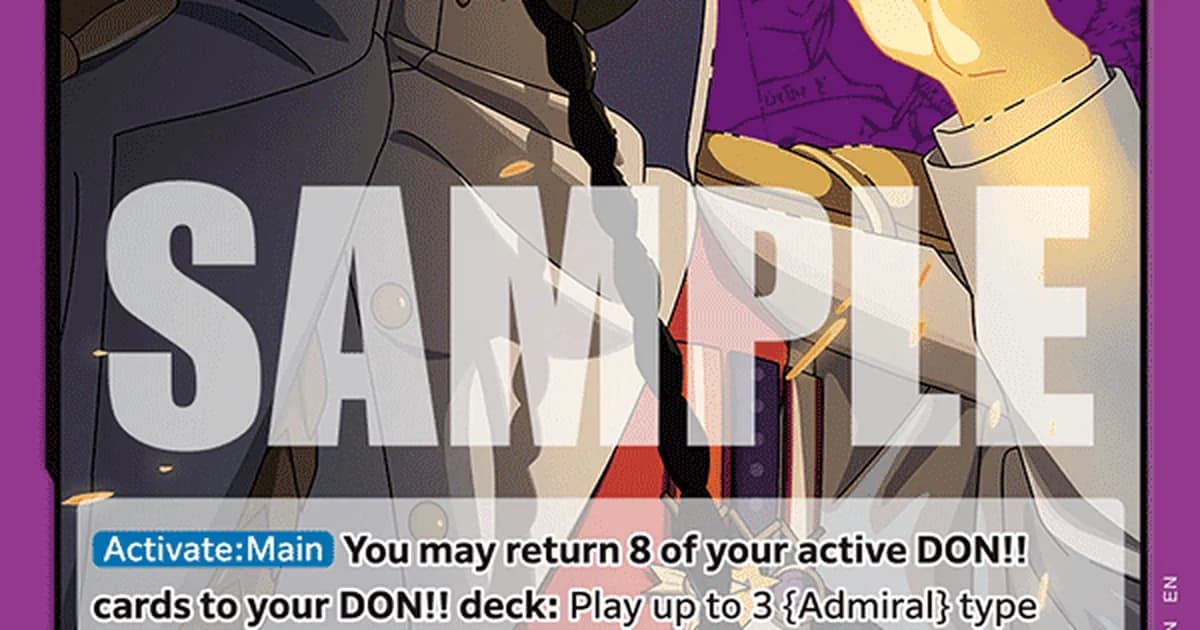
OP-16 All 6 Leaders Explained: Colors & Which to Build
Guides · 12 min
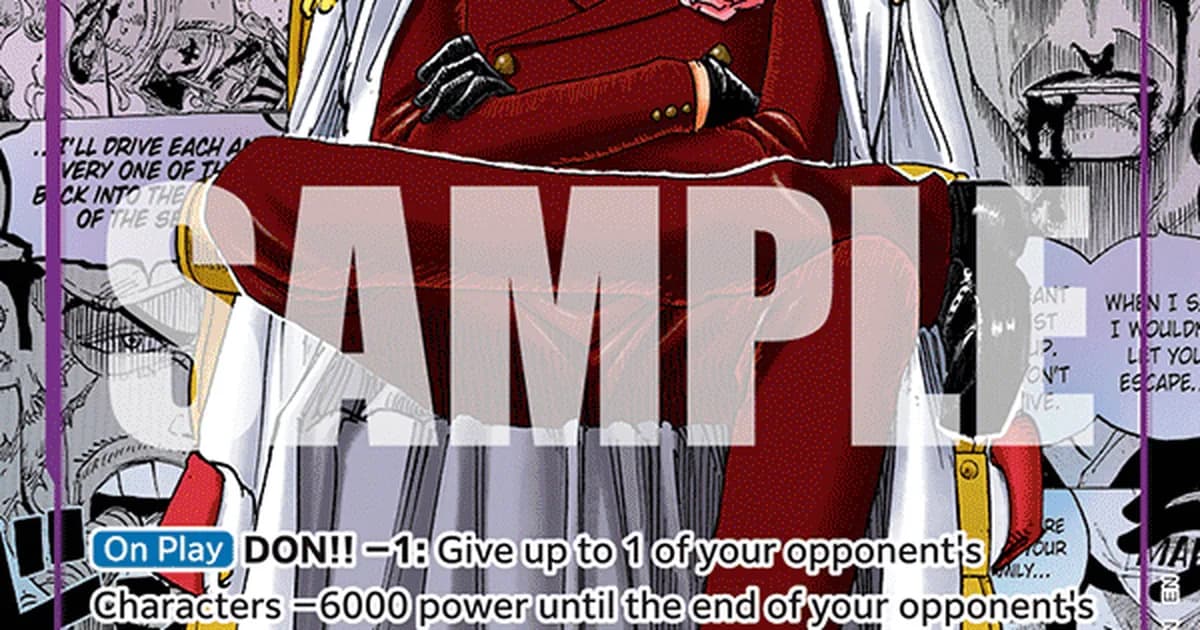
One Piece TCG Manga Rare Cards: Guide & Values (2026)
Guides · 12 min

One Piece TCG How to Play: Rules & Mechanics (2026)
Guides · 16 min
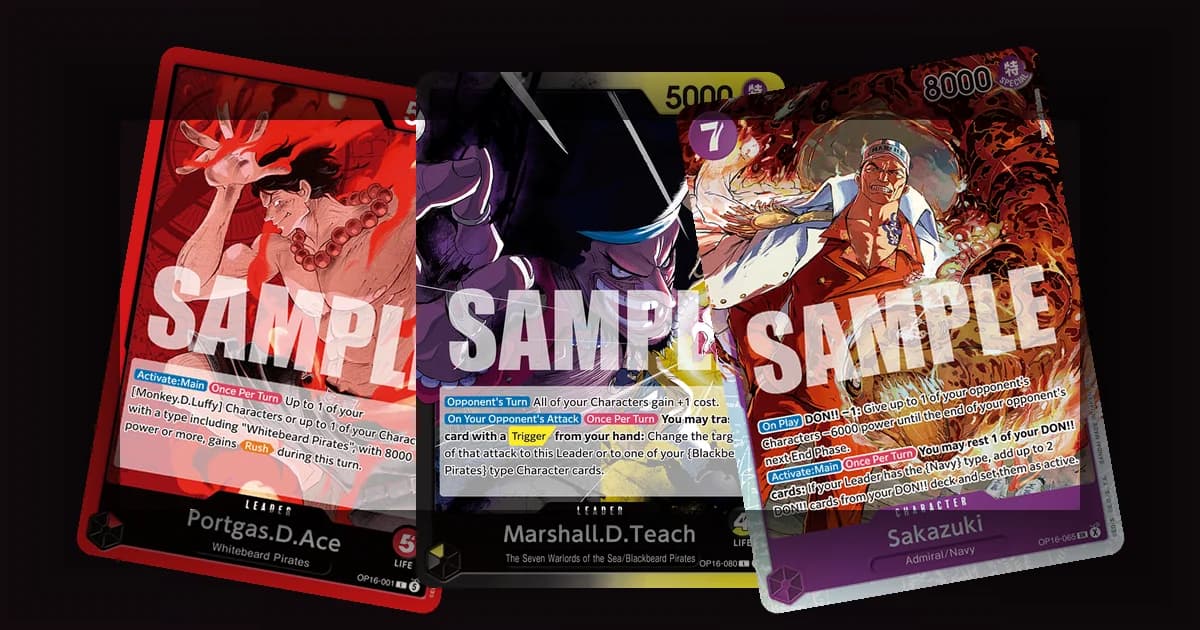
OP-16 Chase Cards: Best to Pull & Value Guide (2026)
Guides · 12 min
OP-16 Paramount War Leaders & Factions Guide (2026)
Guides · 12 min

One Piece TCG Colors: All 6 Colors and Deck Rules (2026)
Guides · 11 min
One Piece TCG Most Expensive Cards 2026: Value Guide
Guides · 9 min
OP-16 Meta Tier List Week 1: Early EN Results (2026)
Guides · 10 min
Disclaimer
This article is published for informational and entertainment purposes. It does not constitute professional financial, legal, or technical advice. Game performance, online services, patch schedules, and store listings change. Verify critical details (pricing, system requirements, regional availability) with publishers and storefronts before you buy. Affiliate links, where present, help support our editorial work and are labelled in our affiliate disclosure.