

Shonen TCG · Guides
Best One Piece TCG Decks for Beginners: 5 Picks (2026)
The best One Piece TCG decks for beginners give you one clear decision to practice at a time. Start with a ready-to-play list or a leader whose ability you can explain before you spend on singles.
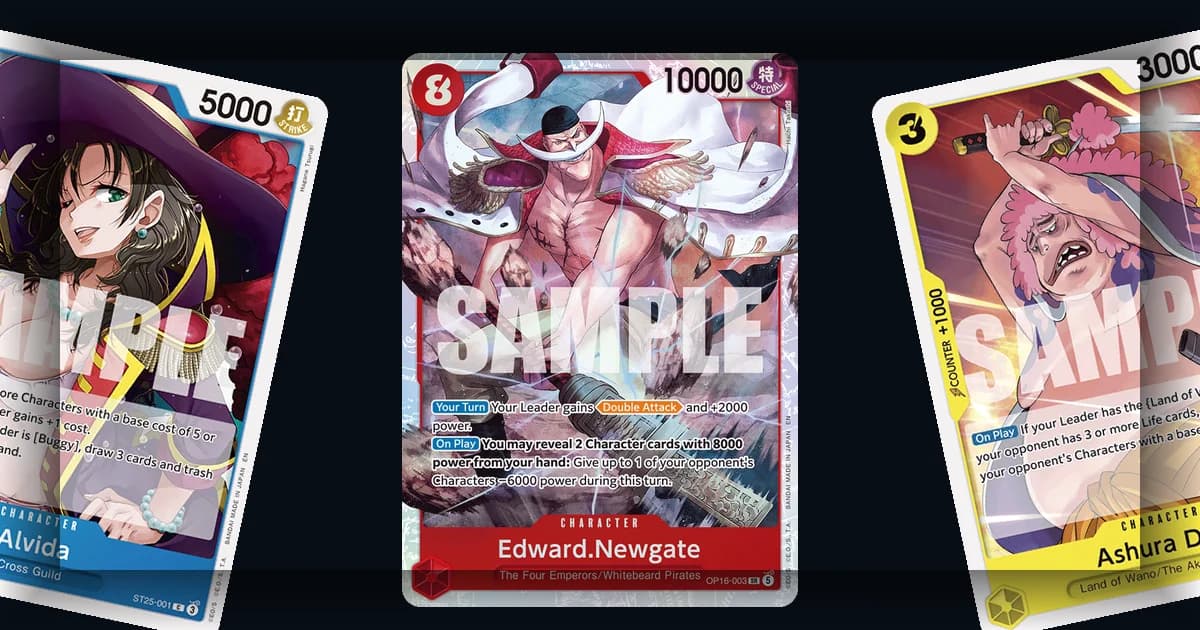
A good first deck does not need to be the strongest deck on a leaderboard. It needs to make your mistakes readable. If you lose because you attacked in the wrong order, spent DON!! too early, or protected the wrong character, you have a useful lesson for the next game.
The five picks below mix official starter products with OP-16 leader shells that are useful for learning. OP-17 is now the live English format, so these are starting points rather than current tier recommendations. The legal card pool and tournament rules can change, so check the event details before you register. For the basic turn sequence, the One Piece TCG how to play guide is a useful first read. If you want a current competitive shortlist instead of a beginner-first ranking, compare the Best One Piece TCG Decks Right Now snapshot.
TL;DR: Choose ST-01 Red Luffy for the most direct first game at home (its leader is not Standard legal; ST-23 Red Shanks is the Standard-legal red starter), ST-24 Green Bonney for defensive rest practice, OP-16 Green/Blue Luffy for an Impel Down learning shell, OP-16 Buggy for blue recursion, or OP-16 Black Yamato if you want to learn trash-based pressure. Prices and legality vary by region and format.
Updated October 8, 2026: Every fact re-checked against Bandai and Limitless. ST-01's leader is Block 1 and not Standard legal, so ST-23 Red Shanks is now named as the Standard-legal red starter; the ST-24 Bonney section now describes the real leader (OP07-019), whose rest effect works on your opponent's attack; OPMetagame figures refreshed.
Best One Piece TCG decks for beginners: quick answer
- Choose ST-01 Red Luffy if you want a ready-to-play lesson in attacks, DON!! attachment, and counter timing at home. For Standard events, pick ST-23 Red Shanks instead.
- Choose ST-24 Green Bonney if you like defensive decisions, such as which attacker to rest during your opponent's turn.
- Choose OP-16 Green/Blue Luffy if you want a current recorded archetype and enjoy sequencing a restricted group of Impel Down characters.
- Choose OP-16 Blue Buggy if you like bounce effects, hand management, and the Prisoner of Impel Down package.
- Choose OP-16 Black Yamato if you are comfortable learning trash management before you worry about faster tournament play.
Before buying, compare the leader's ability with the decisions you want to repeat for the next ten games. A deck that fits your habits will teach you faster than a deck chosen only because it appeared near the top of a result table.
Best One Piece TCG decks for beginners: five starting points
1. ST-01 Red Luffy: the cleanest first lesson
Leader: Monkey.D.Luffy (ST01-001) 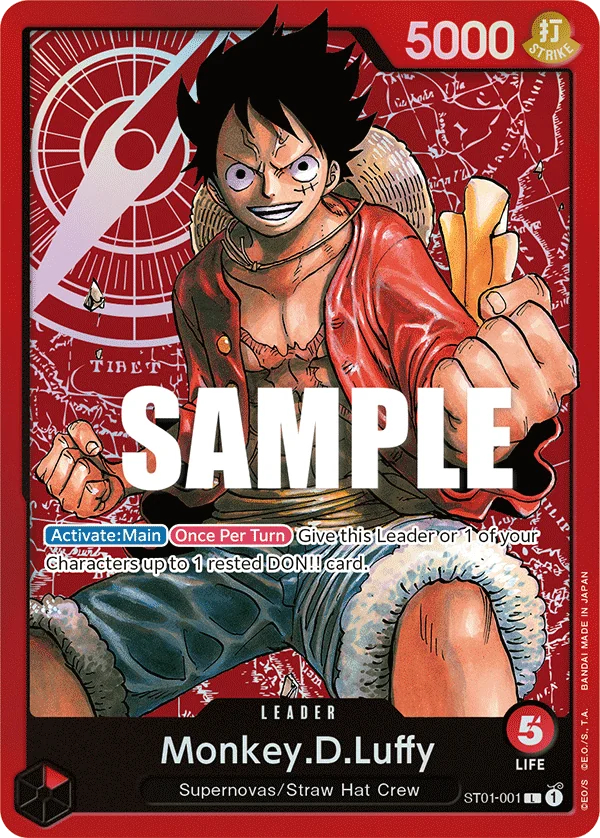 ST01-001ST01-001Shop on TCGplayer
Color: Red
Best for: A first physical deck and players who want direct combat decisions
Main lesson: Attack sequencing, DON!! allocation, and the counter step
ST-01 is a real preconstructed product, so it removes the first barrier for a new player: deciding which fifty cards belong together. Red Luffy lets you focus on the normal rhythm of the game. Develop characters, decide when to attach DON!!, attack in a sensible order, and keep enough counter power for the opponent's turn.
The leader's once-per-turn ability gives a rested DON!! card to the Leader or one of your Characters. That creates a small but useful decision every turn. Do you make the leader attack bigger, or do you improve a character's attack? Learning to answer that question is more valuable than memorizing an upgrade list on day one.
Start here if you have not played a trading card game before. Play several unmodified games, then record the turns where you ran out of counters or left a better attack unused. Those notes tell you what to change.
One catch: Limitless lists ST01-001 as Block 1, "Standard not legal," so ST-01 is for home games and Extra-format events. If you want a red starter you can take to a Standard event, Bandai's ST-23 Red Shanks (released June 6, 2025, MSRP $11.99) uses the Block 3 OP09-001 Shanks leader. Once per turn, when your opponent attacks, it gives one of their Leader or Character cards −1000 power for the turn, which teaches the same counter math from the defending side.
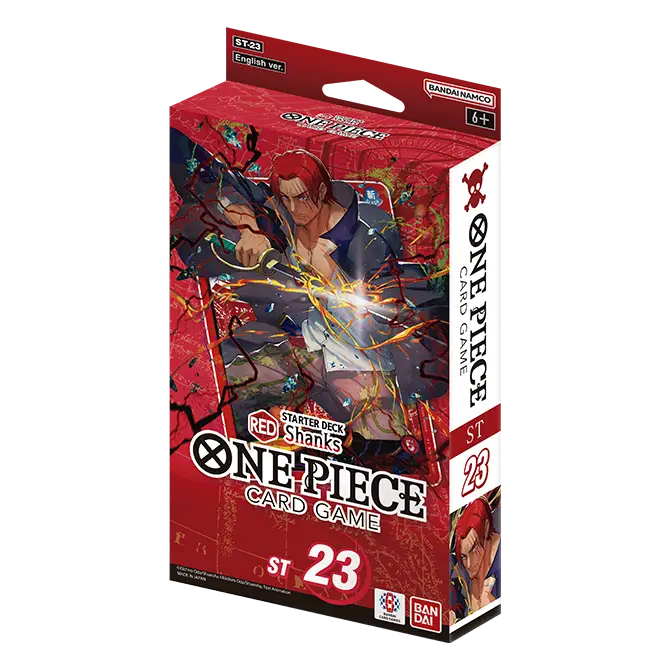 Image: Bandai official ST-23 product page.
2. ST-24 Green Bonney: board control without a large combo
Leader: Jewelry Bonney
Color: Green
Best for: Players who prefer defensive decisions on the opponent's turn
Main lesson: Rest effects, DON!! management, and reading the board
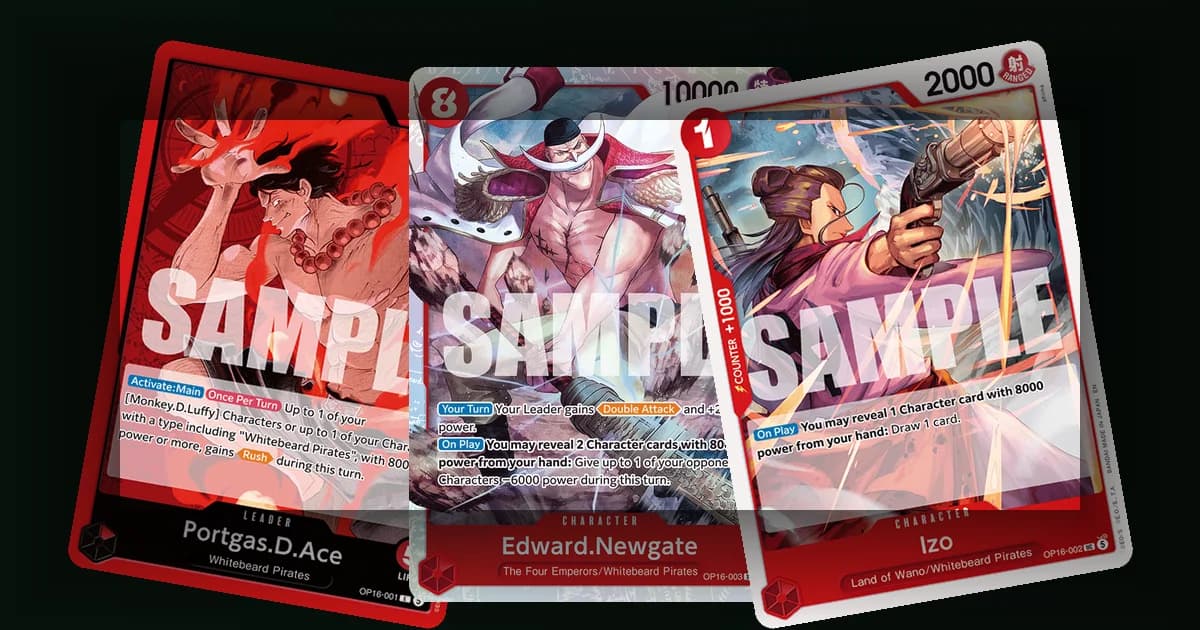
Bandai's ST-24 product page calls it "the ideal deck to start with for supernovas fans" and says "Your Leader Jewelry Bonney can rest your opponent's cards!" It was released on June 6, 2025 at an MSRP of $11.99. The leader in the box is OP07-019, a Block 2 card that Limitless lists as Standard legal.
The timing matters. OP07-019's effect is "[On Your Opponent's Attack] [Once Per Turn] You may rest 1 of your DON!! cards: Rest up to 1 of your opponent's Leader or Character cards." So the decision happens on your opponent's turn: which of their attackers to rest, and whether the DON!! you rest is worth more than the attack you stop. This teaches you to read both players' next turn instead of treating the board as a list of targets.
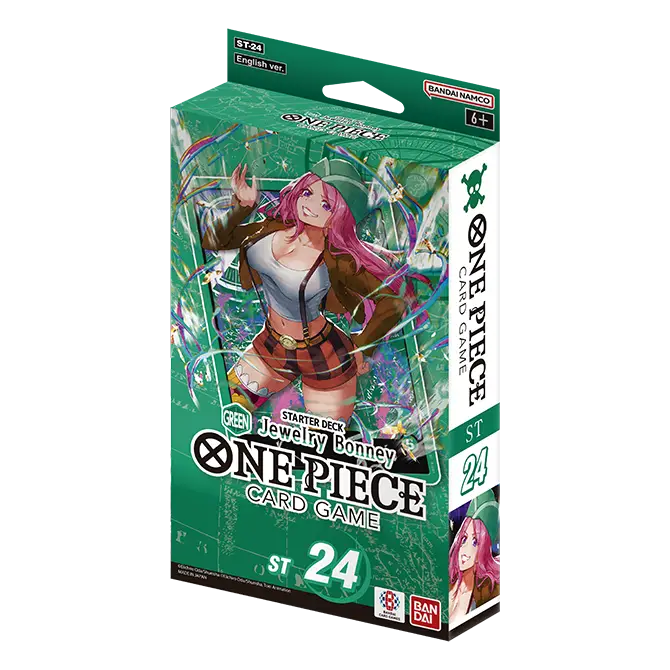 Image: Bandai official ST-24 product page.
Bandai's own channel has a full starter-deck match with ST-24, which shows the rest timing better than a description can.
ST-24 is a genuine starter product, but that does not mean every copy of every card will remain the best upgrade forever. Learn the list first, then use the official card list and a current deck database to decide which singles belong in your next version.
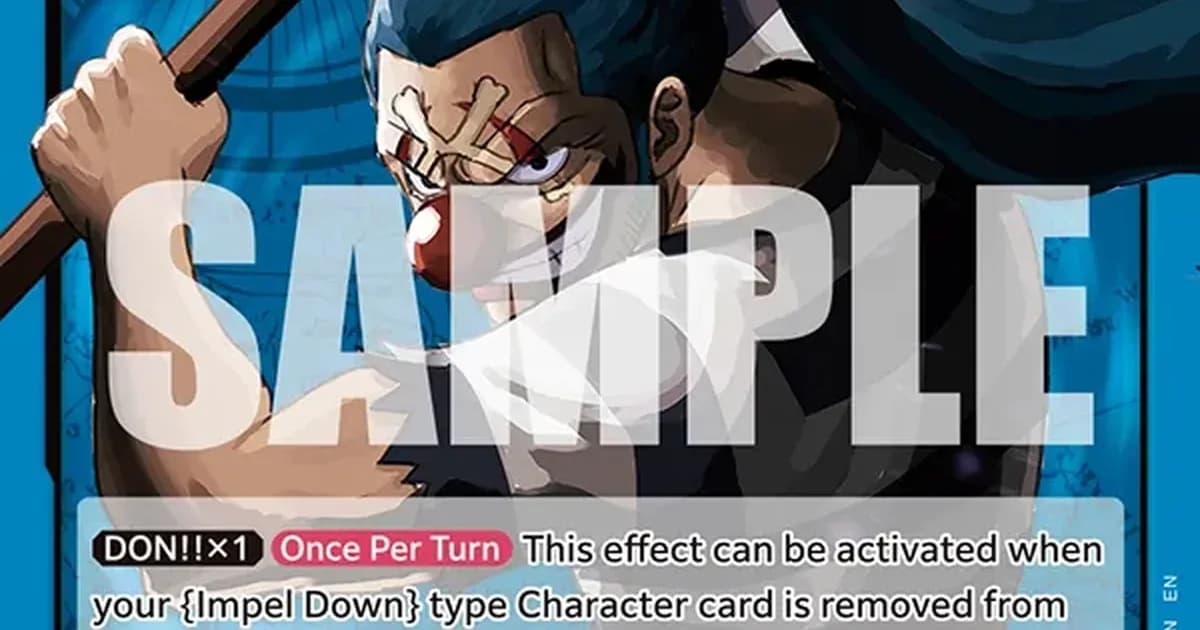
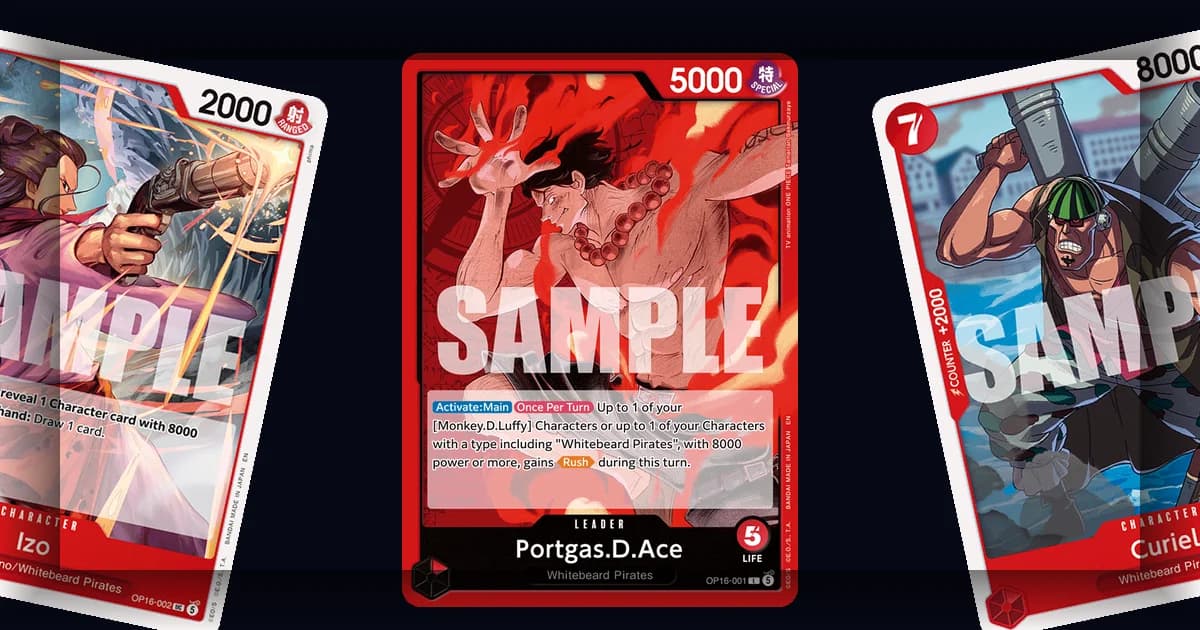
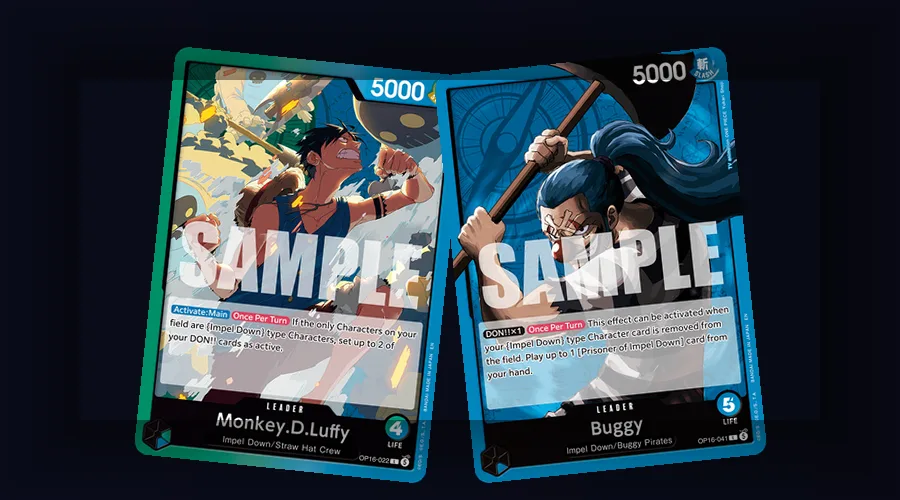 Image: Bandai official OP-16 sample cards (Monkey.D.Luffy and Buggy), used as representative leaders rather than a photograph of starter decks.
3. OP-16 Green/Blue Luffy: an Impel Down learning shell
Leader: Monkey.D.Luffy (OP16-022) 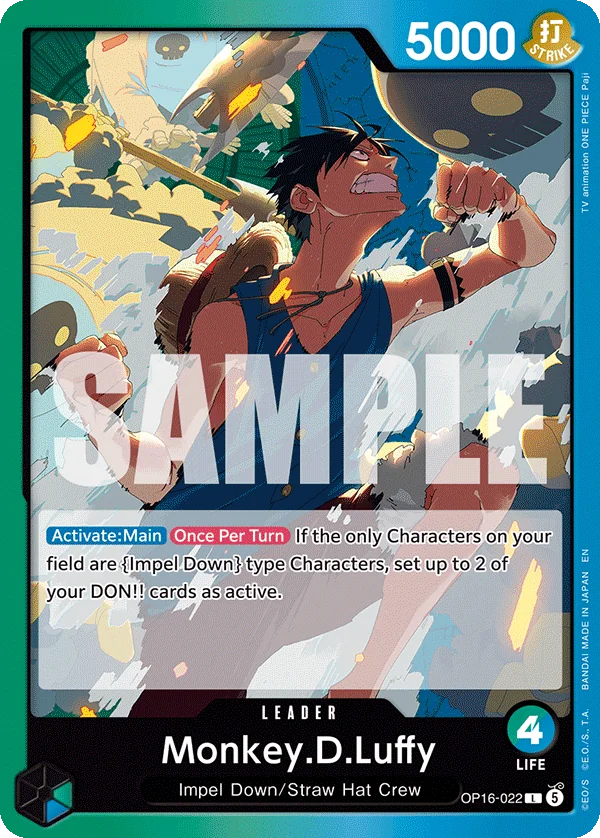 OP16-022OP16-022Shop on TCGplayer
Colors: Green and Blue
Best for: Players who enjoy sequencing restrictions and want a documented archetype
Main lesson: Building a board that keeps the leader ability active
The official OP-16 card list gives this Luffy four Life, 5000 power, and a once-per-turn ability that can set up to two DON!! cards active when the only Characters on your field are Impel Down types. In practice, the deck asks you to balance development with that condition. A card that looks strong in isolation may be the wrong play if it prevents the leader from working.
Limitless's OP-16 table puts Green/Blue Luffy second in that historical format with 22.91% of points. OPMetagame's current OP-17 tier list puts it in S with 23 decklists and a 46.9% average win rate. Treat those as format signals, not a guarantee. The deck has a higher learning curve than ST-01 because you must track the type restriction, your DON!! plan, and the order in which you play your engine cards.
This is a good second deck after you know the basic phases. It is an OP-16 shell, not a claim about the current OP-17 tier list. If you start here, goldfish the first few turns and say the leader condition out loud before you play a non-Impel Down character.
4. OP-16 Blue Buggy: bounce and Prisoner of Impel Down
Leader: Buggy (OP16-041) 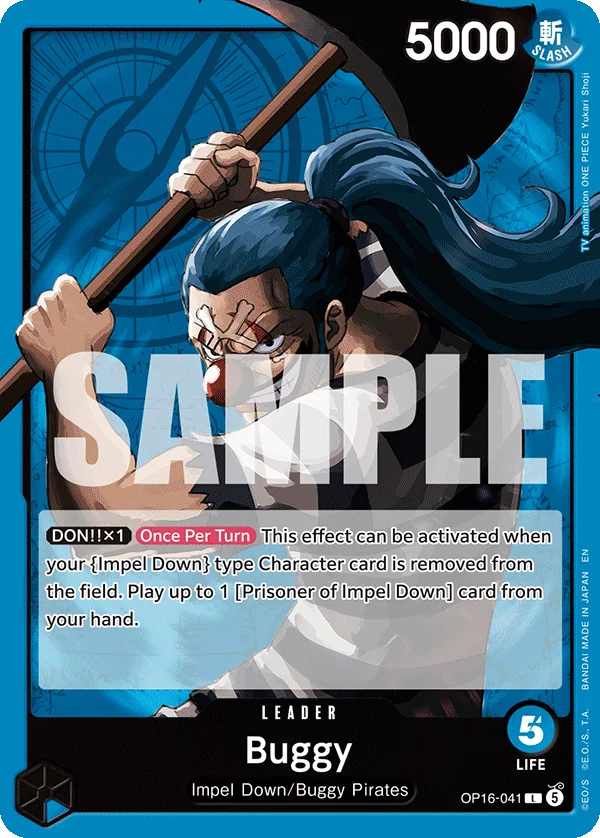 OP16-041OP16-041Shop on TCGplayer
Color: Blue
Best for: Players who like planning around their own Characters leaving the field
Main lesson: Timing and hand management
OP16-041 Buggy has a [DON!! x1], once-per-turn effect that can trigger when your Impel Down Character is removed from the field, then play a Prisoner of Impel Down card from your hand. The leader therefore rewards you for planning what happens after a Character leaves.
That creates useful practice for a blue player. Do you let an Impel Down Character go now, or hold off until a Prisoner of Impel Down card is in your hand? Can you afford to spend a card on defense while keeping the Prisoner package available? Those are clear decisions, but they are less forgiving than the linear ST-01 plan.
Buggy is a good budget-minded starting point only after you have checked the current card pool and local prices. Do not assume that an old decklist remains legal or that every common card is still the cheapest option. The OP-16 budget deck guide and One Piece TCG deck-building guide can help you compare a list before buying.
5. OP-16 Black Yamato: trash-based pressure
Leader: Yamato (OP16-079) 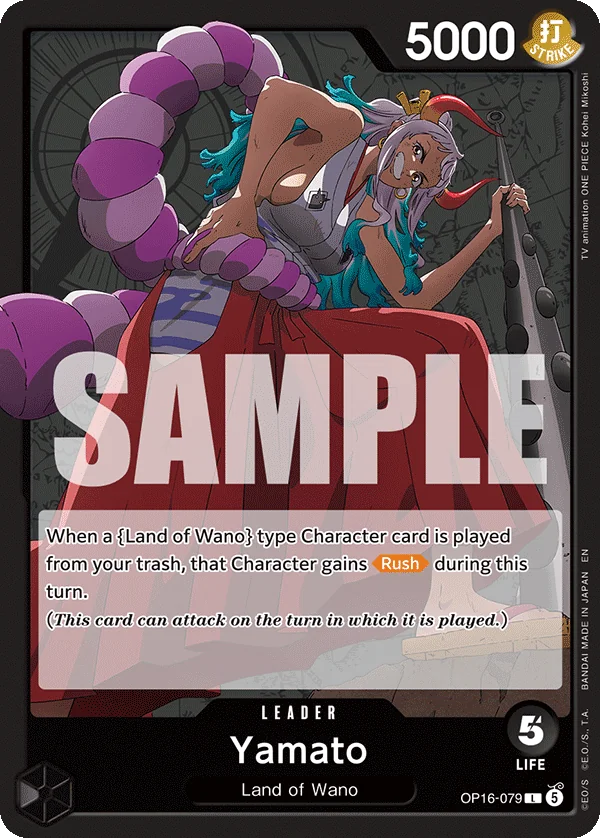 OP16-079OP16-079Shop on TCGplayer
Color: Black
Best for: Players who want to learn recursion and Land of Wano cards
Main lesson: Planning the trash as a resource
OP16-079 Yamato gives a Land of Wano Character played from your trash Rush for the turn. That means the trash is part of the deck's plan rather than a place where finished cards disappear. You need to decide which cards are safe to lose, which effects put the right pieces in the trash, and when a Rush attack is worth exposing your board.
This is not the simplest first deck. It is a strong choice for a player who already understands the attack and counter steps and wants a more involved resource loop. The official card list confirms the leader's color, trait, and Rush-granting effect. Build around the current card pool rather than copying an old list that may have been made for another format.
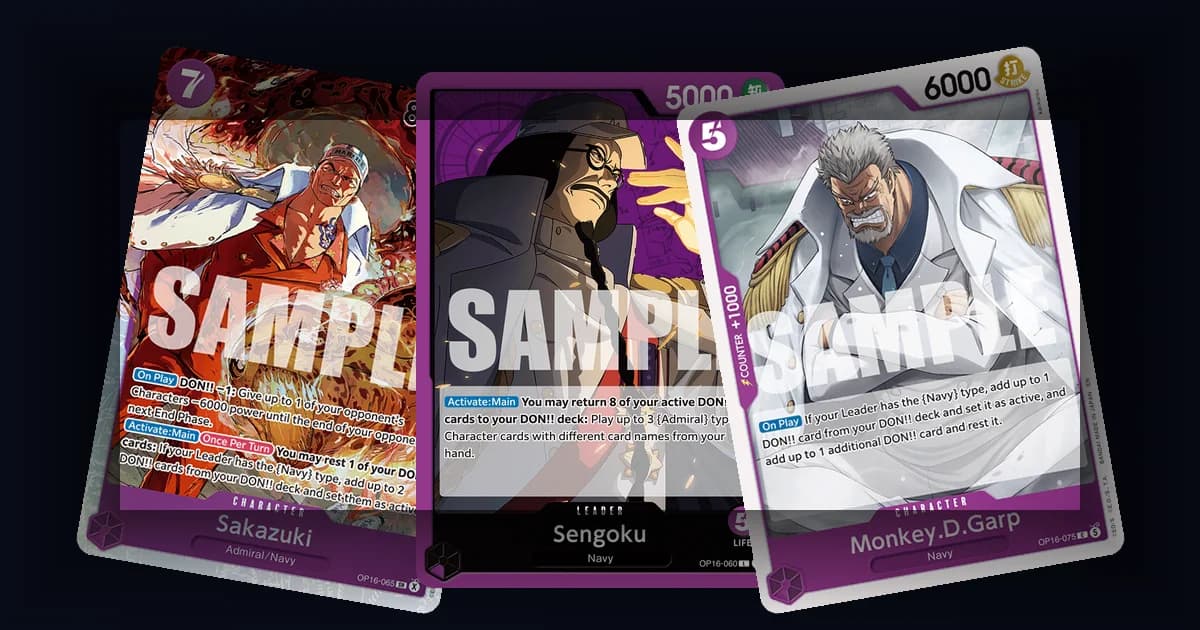
If you prefer a purple resource plan, OP16-060 Sengoku is another option from the same set, but its eight-DON!! ability and Admiral requirement make it a later learning project rather than my default first recommendation.
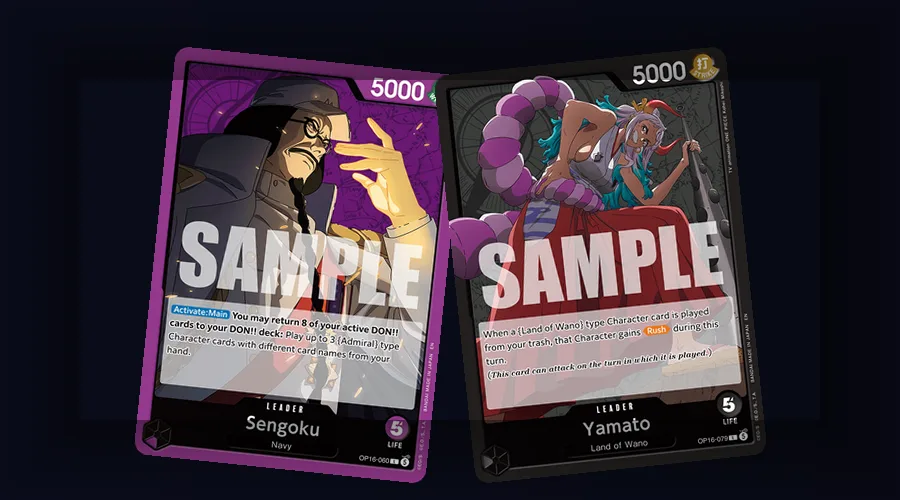 Image: Bandai official OP-16 sample cards (Sengoku and Yamato), representative step-up leaders rather than a starter-deck lineup.
SHOP: Choosing a first One Piece deck? Compare current singles for the starter or leader shell that fits your learning plan. Shop TCGplayer →
Step-by-Step: how to choose and learn your first deck
1. Decide whether you need a ready-to-play product. If you want to shuffle up immediately, start with ST-01 or ST-24. If you already own cards or enjoy deck construction, an OP-16 leader shell can be a better fit.
2. Pick one lesson. Red Luffy teaches combat rhythm. Bonney teaches defensive timing. Green/Blue Luffy teaches a leader condition. Buggy teaches removal timing. Yamato teaches the trash as a resource.
3. Check legality before purchasing singles. Read the event listing, then check the official rules, card list, and restriction notices. Do not rely on a guide's old statement that a set is still legal.
4. Play ten games before making a large upgrade. Write down the first turn where you felt stuck. If the problem was missing counters, change the defensive slots. If the problem was an unclear game plan, test the leader ability and engine cards before buying expensive finishers.
5. Keep the first upgrade narrow. Change a few slots at a time so you know what improved. For a deeper explanation of colors and roles, see One Piece TCG colors explained. For a complete onboarding path, use the One Piece TCG beginner guide.
What to check before a local event
A local event may use a different format from the results page you read. Confirm the date, format, eligible card pool, banned or restricted cards, and language requirements with the organizer. If you are moving from a starter product to a custom list, also check that every card matches the Leader's color identity and that no card number exceeds the deck limit.
Historical OP-16 data is useful for understanding which shells other players submitted, but it is not a ranking of beginner difficulty. Blue/Yellow Nami (23.52%), Green/Blue Luffy (22.91%) and Purple Enel (22.71%) hold the largest shares on the Limitless OP-16 page. In the current OP-17 field, OPMetagame lists Green/Blue Luffy in S with 23 decklists and a 46.9% average win rate, so use it as a learning project rather than a beginner buying signal. For the current field, see the OP-17 meta tier list.
What new players hear on Reddit
The advice on r/OnePieceTCG lines up with the approach here. In an August 2026 thread asking for the best starter deck, one reply asked: "Do you want to build a deck to win or a deck to play? Any starter deck will do great for teaching you the game, but some decks are much stronger than others." In a September thread on starter decks and upgrades, another player put it plainly: "They all work out of the box. No where on the box does it say viable in the meta."
Our take
This take is based only on the product pages, card text and tracker data cited here. A starter deck is the right first purchase, but check the leader's block before you buy one for events: ST-01 is fine for learning at home, while ST-23 and ST-24 are the starters here that you can also take to a Standard event. Move to an OP-16 leader shell only once you know which decisions you enjoy.
Related Reading
- One Piece TCG Best Starter Decks 2026: Compare ready-to-play products before buying.
- One Piece TCG Standard Format Guide 2026: Check format details before taking an old list to an event.
- OP-16 All 6 Leaders Explained: Review the other leaders in the set.
- One Piece TCG tournament guide 2026: Prepare for registration and your first tournament.
Frequently Asked Questions
How many games should I play before upgrading?
Ten games is a useful first checkpoint, not a rule. Upgrade earlier if a card is missing from the product, but make one small change at a time so you can identify the result.
Do I need a complete tournament list to learn?
No. A coherent starter list is enough to learn the phases, attacks, counters, and DON!! timing. A tournament list becomes more useful after you know which decisions you enjoy making.
Can I use an old leader because an older article recommended it?
Check the event format and current legality first. The official rules and restriction pages are the source of truth for an event, not the publication date of a deck guide.
How much should a first deck cost?
There is no stable number. Official MSRP, local stock, singles demand, reprints, and region all affect the total. Set a budget, compare complete lists, and avoid treating a past price estimate as current.
References
- Official ONE PIECE CARD GAME comprehensive rules
- Official OP-16 card list
- Official ST-24 Green Jewelry Bonney product page
- Official ST-23 Red Shanks product page
- ST01-001 Monkey.D.Luffy, Limitless: Block 1, not Standard legal
- OP07-019 Jewelry Bonney, Limitless: ST-24 leader, Block 2, Standard legal
- Official banned and restricted card notices
- OP Meta Game OP-17 tier list and decks table: Green/Blue Luffy S, 23 decklists, 46.9% average win rate, checked October 8, 2026
- Limitless OP-16 deck data
Was this guide helpful?
Cards in this article
About the author
Beginner guides and anime crossover
Pen name for the Shonen TCG desk's beginner guides, starter decks and anime-to-card-game explainers.
- Rules checked against the official rulebook and card text
- Every claim traced to a cited source
- Opinions marked as ours, with the reason
Keep reading
OP-16 is it worth buying? Box, singles, or sealed?
Guides · 9 min
OP-16 Meta Tier List Week 1: Early EN Results (2026)
Guides · 10 min
One Piece TCG Tournament Guide: How to Compete (2026)
Guides · 11 min
One Piece TCG Most Expensive Cards 2026: Value Guide
Guides · 9 min

All One Piece TCG Sets OP-01 to OP-17: Complete List (2026)
Guides · 13 min
OP-16 Akainu deck guide: Sakazuki in Sengoku Navy 2026
Guides · 10 min
OP-16 Chase Cards: Best to Pull & Value Guide (2026)
Guides · 12 min
Best Anime TCG to Play in 2026: 5 Games Ranked and Compared
Guides · 12 min
Disclaimer
This article is published for informational and entertainment purposes. It does not constitute professional financial, legal, or technical advice. Game performance, online services, patch schedules, and store listings change. Verify critical details (pricing, system requirements, regional availability) with publishers and storefronts before you buy. Affiliate links, where present, help support our editorial work and are labelled in our affiliate disclosure.