

Shonen TCG · Guides
OP-16 Black Yamato Deck Guide: Mono-Black Wano Recursion
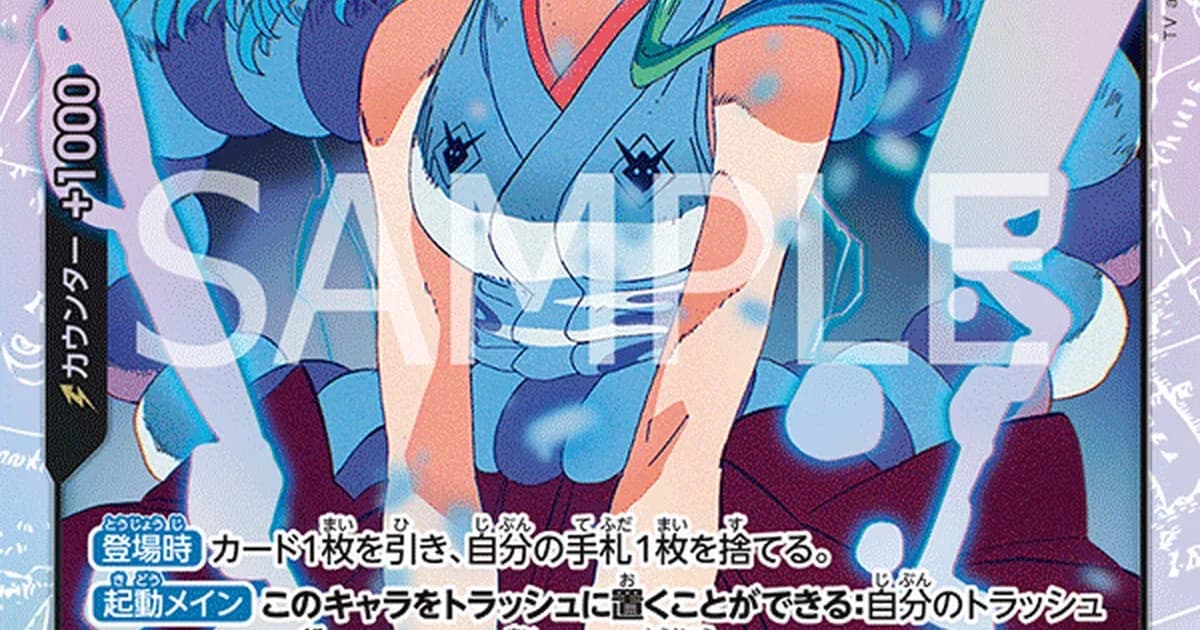
TL;DR: Black Yamato deck guide for OP-16: Yamato (OP16-079) is a mono-Black Land of Wano Leader with 5 Life and 5000 power. Her ability gives Rush to Land of Wano Characters played from your trash, so a recursion play can attack immediately. Limitless's OP16 tracker lists Black Yamato at 1.37% point share with 8 placings and 81 points, a dated participation snapshot rather than a win rate or tier rating. The separate SR Yamato (OP16-098) is a draw, discard, and setup card, not a transformation card. EN launched June 12.
Updated October 12, 2026: Card text re-checked against Bandai's card list. One rules error fixed: earlier versions said Yamato herself can attack the turn she is played and "has Rush as a leader." The bracketed line on the Leader card is Rush reminder text for the Land of Wano Character played from the trash; the Leader does not gain Rush. "Strike type" is corrected to Strike attribute. Added a card image of the three Yamato Characters and player comments from Reddit. This remains an OP-16 build guide: OP-17 released in Japan on August 22 and in English on August 28, so treat OP-17 matchup claims as a separate, newer-format question.
OP-16 Yamato deck guide: quick answer
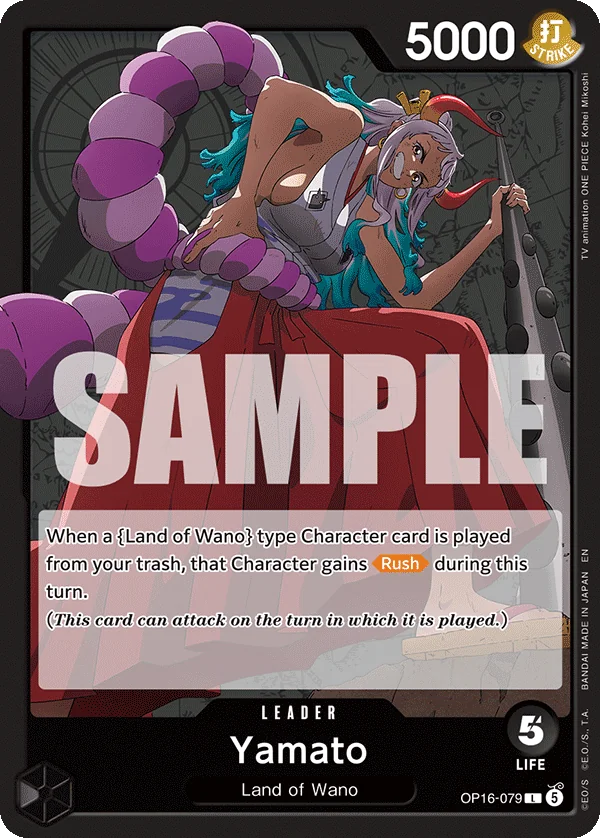 OP16-079OP16-079Shop on TCGplayer Yamato is the mono-Black Leader in OP-16: Life 5, 5000 power, Strike attribute, Land of Wano type. Her leader ability: when a Land of Wano Character card is played from your trash, it gains Rush during this turn (it can attack the moment it arrives). That bracketed "can attack on the turn in which it is played" line describes the replayed Character, not the Leader.
So this is not a slow value deck. It is a Black recursion-aggro build: send Land of Wano Characters to the trash, then replay them with Rush for attacks the opponent does not see coming, all backed by Black's removal.
GODEEPER: Want to see how Yamato compares to the other five OP-16 leaders? The full breakdown covers colour, ability, and difficulty. OP-16 All 6 Leaders Explained
How the Trash-Recursion Mechanic Works
The trash (discard pile) is normally where cards go to be forgotten. Yamato turns it into a resource. Land of Wano Characters that end up in your trash, whether sent there by costs, trades, or effects, can be replayed, and when they come back they have Rush for that turn.
Rush is the key. A character that can attack immediately on entry means recursion isn't just card advantage; it is tempo and surprise damage. The opponent commits blockers expecting your board as it stands, then you replay a Wano character from the trash and swing with it the same turn.
Why Black fits: Black is OPTCG's removal-and-trash color. It naturally fills your trash (through trades and cost effects) and removes the opponent's blockers, clearing the way for your recurred Rush attackers. The deck loops: trade or remove, refill the trash, replay with Rush, attack.
Card-text correction: The separate SR Yamato (OP16-098) is not a transformation or cost-reduction card. Its official text draws 1 card and trashes 1 card from hand, then lets you trash it to play a black Yamato with cost 8 from your trash. The leader (OP16-079) is defined by Black Land of Wano trash recursion. Build around that recursion plan.
Rush changes the math on recursion. Most trash-recursion decks in the game rebuild a board but do not immediately generate attacks from it: you get the body back, then attack on your following turn. Because Yamato's ability grants Rush the instant a Land of Wano Character is played from the trash, every recursion play is also an attack this turn. Chain two Land of Wano Characters out of the trash in the same turn and the opponent needs two blockers available right now, not next turn, to stop both. Combined with Yamato's own attack pressure, the deck plays closer to an aggressive tempo deck than a slow value engine despite the recursion shell.
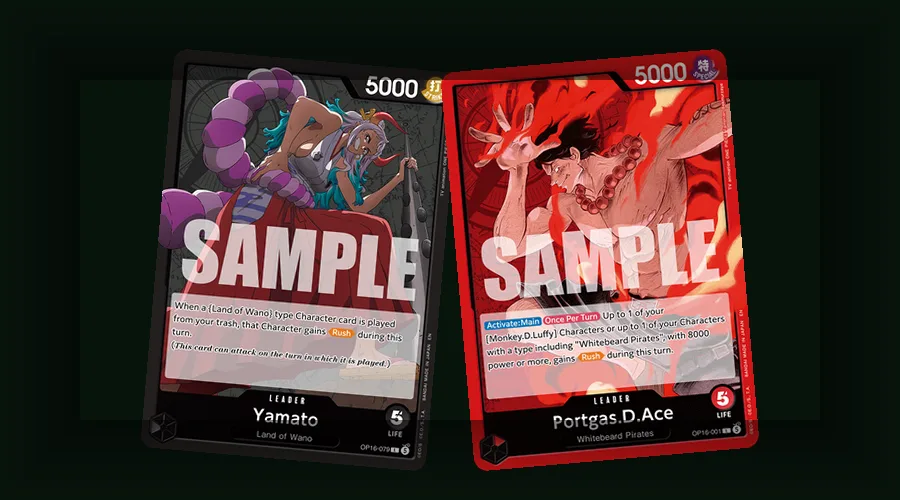 Image: Bandai official card images (OP16-079 Yamato Leader, OP16-001 Portgas.D.Ace Leader). Yamato's printed ability turns a Land of Wano Character played from the trash into immediate pressure.
Building the Black Wano Recursion Shell
Three roles make the engine run:
- Land of Wano Characters worth recurring: the payoff bodies that you want to replay from the trash with Rush. Run the ones whose attacks matter most.
- Trash-fillers: cards and effects that put Land of Wano Characters into the trash so the recursion has fuel early.
- Black removal: trades and removal that clear blockers (so your Rush attacks land) and naturally feed the trash.
Three cards anchor the post-launch loop. 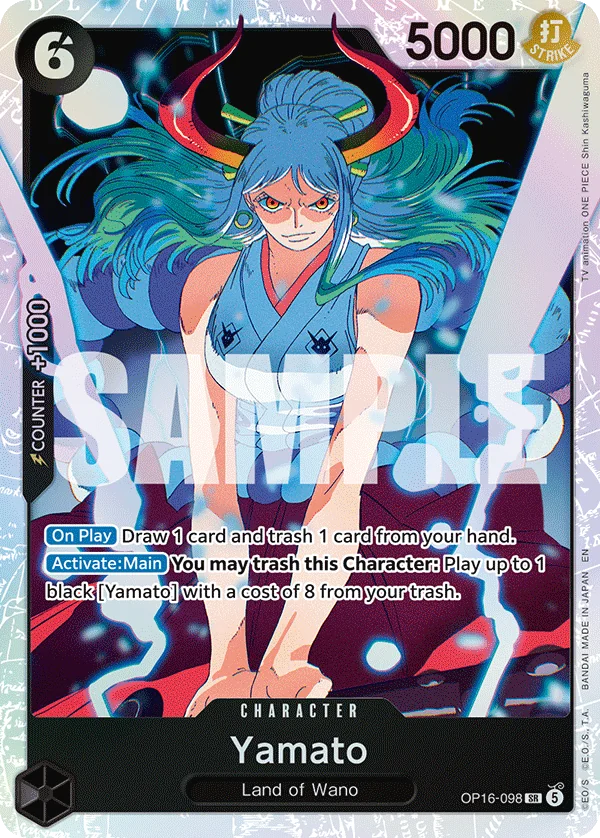 OP16-098OP16-098Shop on TCGplayer Yamato draws 1 card and trashes 1 card from hand when played, then can trash itself to play a black Yamato with cost 8 from the trash. That makes OP16-096 and OP16-097 the two 8-cost payoff options, and either one can gain Rush from the leader when played from the trash.
 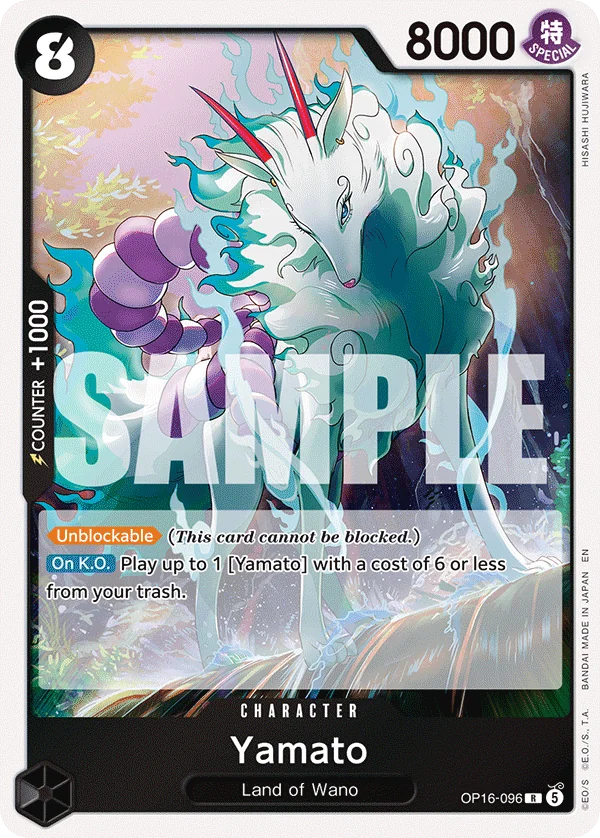 OP16-096OP16-096Shop on TCGplayer Yamato is the unblockable payoff: its On K.O. ability plays a Yamato with cost 6 or less from the trash, so a K.O. does not necessarily end the chain.
 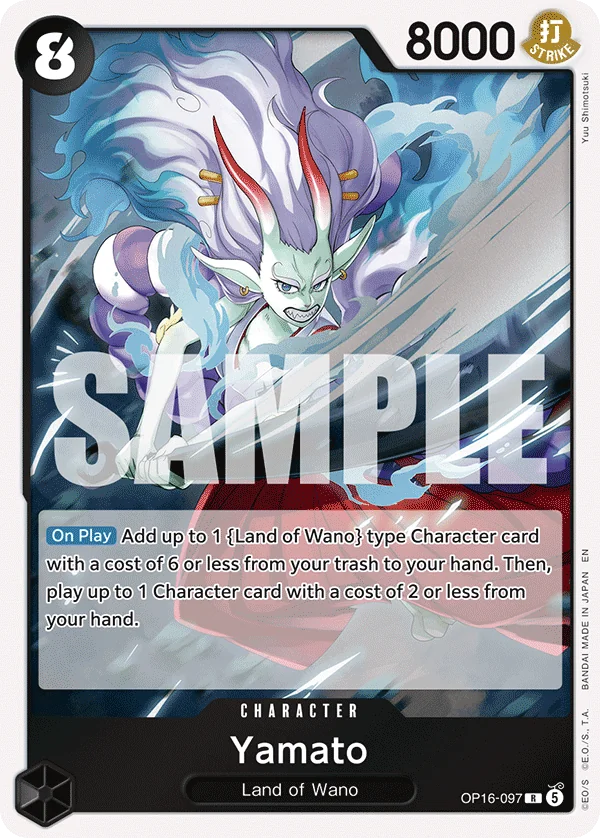 OP16-097OP16-097Shop on TCGplayer Yamato returns a Land of Wano Character costing 6 or less to hand, then plays a Character costing 2 or less from hand. The event "I've Come Here... To Cut Those Chains!!!" (OP16-099) costs 1 and can rest 6 DON!! to trash the top five cards of your deck, then play a Land of Wano Character costing 6 or less from the trash. It is a large DON!! commitment, but it can fill the trash and put a Rush-enabled body into play in the same turn.
Limitless's current OP16 averages point to a core of Nami, Nico Robin, 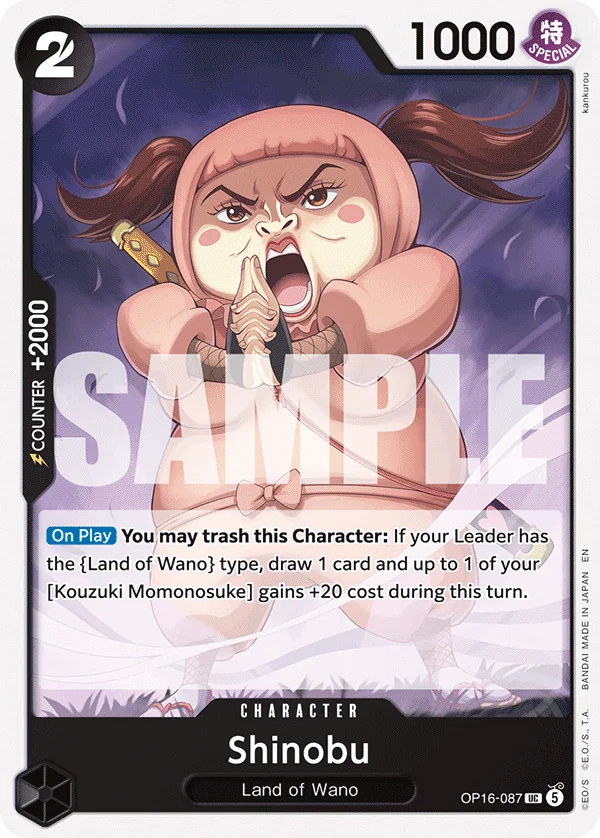 OP16-087OP16-087Shop on TCGplayer Shinobu, Kin'emon, Kouzuki Momonosuke, the three Yamato Characters, and roughly three to four copies of OP16-099. Use those averages as a starting point, not a fixed 50-card list: the construction principle is a stocked trash with a character you are happy to replay and swing with.
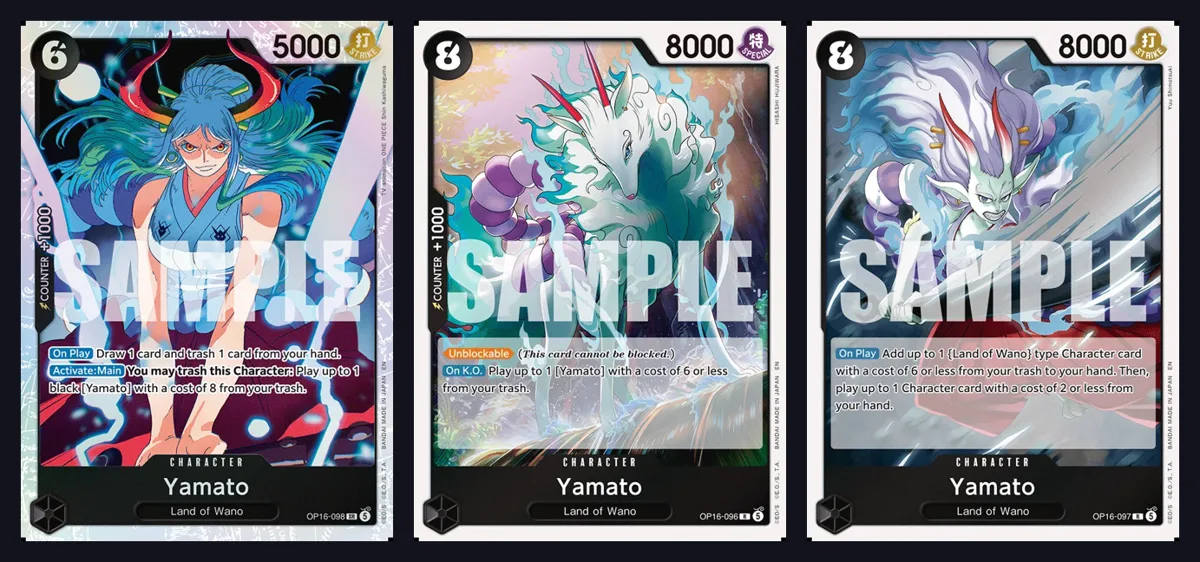 Image: Bandai official card list (OP16-098, OP16-096, OP16-097). The 6-cost SR Yamato trashes itself to play one of the two 8-cost black Yamato Characters from the trash, which then gains Rush from the Leader.
Step-by-Step: playing the recursion loop turn by turn
1. Develop early Land of Wano Characters and start seeding the trash in turns 1 and 2. Black removal keeps the board even here; you're not racing yet, you're stocking the trash with bodies worth bringing back.
2. Start the recursion in turn 3. Replay a Wano character from the trash with Rush for an unexpected attack while removing a blocker first if you can, since an unblocked Rush attack is the whole point of the plan.
3. Accelerate the loop across turns 4 and 5. Each turn you trade, refill, and recur, stacking more attacks than the opponent can profitably block. This is where the deck's identity as tempo-aggro rather than slow value becomes obvious.
4. Close from turn 5 through 7. Repeated Rush attacks from the trash, plus your Leader's attack each turn, push Life faster than the opponent expects from a deck that looks grindy on the surface.
5. Treat the trash as your comeback engine whenever you fall behind. Even after the board is cleared, you can rebuild and immediately attack with recurred Rush characters, which is what makes Yamato resilient against a single sweeping answer that would end a normal aggro deck's turn.
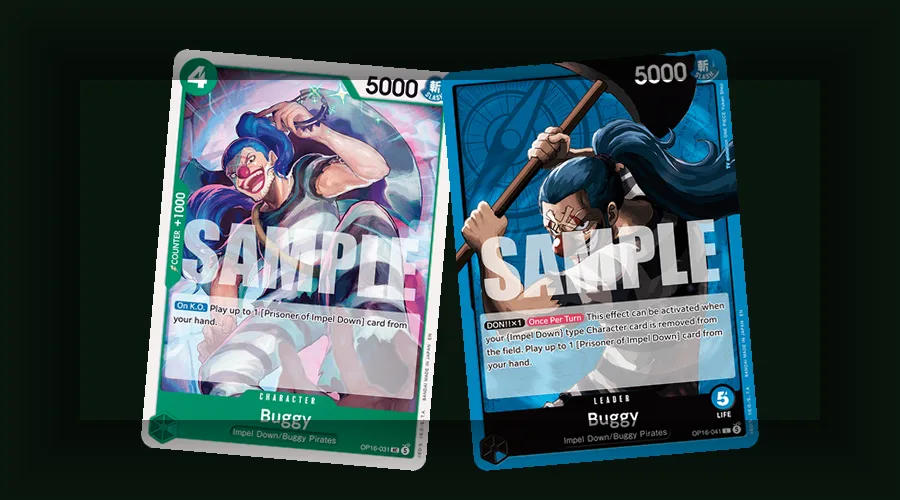 Image: Bandai official card images (OP16-031 Buggy Character, OP16-041 Buggy Leader) from OP-16's Impel Down pool; a separate comparison image, not a Yamato removal board.
Matchup Direction in the OP-16 Snapshot
Limitless's OP16 tracker lists Black Yamato at 1.37% of tracked points, with 8 placings and 81 points. That is a dated point-share snapshot, not a win rate or a formal tier list. The matchup notes below are strategic game-plan leans based on the leaders' card text, not verified matchup percentages. For ranked win rates going first and second against each leader, see our Black Yamato matchups breakdown.
- vs Ace (Red aggro): protect the trash engine while stabilizing through the early pressure. Once the opponent's first wave is answered, recurring a Land of Wano Character with Rush gives you another attack without relying only on the visible board.
- vs Sengoku (Purple Marine ramp): apply pressure before the Admiral turn. Black removal can clear a blocker, while the trash gives you a way to keep attacking after a removal exchange.
- vs Luffy (Green/Blue tempo): expect a wider board and more blockers than the single-leader view suggests. Save removal for the blocker that prevents your best Rush attack, rather than spending it on the first available target.
- vs Buggy (Blue swarm): use Black removal to reduce the swarm's board count, then recur a threat after the exchange. Do not spend the entire trash on one large attack if the opponent can rebuild.
- vs Blackbeard (Black/Yellow control): treat it as a resource contest. Blackbeard's redirect effect is once per turn, so sequencing multiple attacks from the trash can force the opponent to choose which one to redirect. See the OP-16 Blackbeard deck guide for the other side of that interaction.
- vs Rosinante (Purple/Yellow Law control): spread pressure across multiple attacks instead of trading one Character at a time into the opponent's protection effects. The OP-16 Purple/Yellow Rosinante deck guide covers that leader's game plan.
Is Black Yamato Worth Building?
Yamato is a good pick for players who like resilient, slightly tricky aggro. The recursion-with-Rush plan rewards good trash management and punishes opponents who block based on the visible board. She's more forgiving than a glass-cannon aggro deck because the trash lets her rebuild, but she asks you to think a turn ahead about what you send down and when you bring it back. The trash-recursion engine also gives her staying power that pure aggro lacks: Rush replays create combat blowouts that reward reading the opponent. If you want a Black deck that grinds and bursts in equal measure, this is a clear OP-16 option.
OP-17 "The World's Strongest Warriors" released in Japan on August 22 and in English on August 28. Yamato's core pieces, the leader ability and the OP16-096/097/098 Land of Wano recursion suite, remain usable in the broader card pool, but OP17 tournament conclusions need their own current results. The OP-17 OP-16 crossover format guide covers the set transition.
Trash Management Tips
The trash is Yamato's resource, so treat it like one. Early game, you are not just trading, you are deciding which Land of Wano Characters you want waiting in the trash to replay later with Rush. Send your best recursion targets down where you can, and avoid exhausting the trash of everything worth bringing back. Track which Characters are available to recur each turn the way a ramp player tracks DON!!, your replay options are part of your hand even though they sit in the trash. Black removal does double duty here: it clears the blocker in front of your Rush attacker and, through trades, refills the trash for next turn. The loop only stalls if you let the trash empty of good targets, so balance how aggressively you spend it.
Common Yamato Mistakes
The most frequent error is treating Yamato like a normal aggro deck and emptying your hand onto the board, ignoring the trash engine that makes her resilient. A second is forgetting the surprise factor: the Rush replay is strongest when the opponent has committed blockers based on your visible board, so hold a recursion as a combat trick rather than telegraphing it. A third is under-valuing removal, without clearing blockers your Rush attacks bounce off, so keep enough interaction to open lanes. A fourth, smaller but common, is forgetting to attack with the Leader herself. The Leader does not have Rush (that reminder text belongs to the replayed Character), but once she can attack, an unanswered Leader attack is free pressure, and skipping it is a missed point, not a safe pass. Played patiently, the recursion grinds opponents out; played hastily, it looks like a weaker aggro deck.
The trash-recursion loop clicks faster on video than it does described in text. Mr. Pow published this walkthrough on May 29, 2026, before the English release, so treat its list as an early frame.
What Black Yamato players said on Reddit
When r/OnePieceTCG shared OP16 Black Yamato win rates, one reply read the data as "Nami looks like the only terrible matchup...and ST-30 but that's not as prevalent." Another player was more cautious: "Yamato is probably fine to play at locals but having bad matchups into 3 of the top 5 meta decks will make it hard to consistently top big events." The Limitless numbers above, 1.37% of tracked points from 8 placings, fit the second view better than the first.
Sample Black Yamato Decklist
EN launched June 12; Limitless's current OP16 averages show a consistent core across 8 decklists, but the ratios below are a starting frame rather than a tournament-legal 50-card list:
- Leader: OP16-079OP16-079Shop on TCGplayer Yamato (mono-Black, Wano)
- Engine piece: Yamato (OP16-098), a draw-and-discard setup card that can trash itself to play a black Yamato costing 8 from the trash
- Recursion payoff: Yamato (OP16-096), whose On K.O. effect plays a Yamato costing 6 or less from the trash, plus Yamato (OP16-097), which returns a Land of Wano Character and plays a low-cost Character from hand
- Burst trash-fill: "I've Come Here... To Cut Those Chains!!!" (OP16-099), a 1-cost event that can rest 6 DON!! to trash the top five cards and play a Land of Wano Character costing 6 or less from the trash
- Recursion core: the rest of the Land of Wano Character suite you can replay from the trash with Rush for surprise attacks
- Counters: Black counter Events plus removal to trade and refuel
- Curve: low-to-mid, built to keep replaying threats rather than commit one big body
Treat this as a starting frame. Yamato's strength is repeatable pressure from the trash, so the list is built to feed and reuse that loop.
SHOP: Building this Black Yamato recursion shell? Check current OP-16 singles prices on TCGPlayer. Shop TCGplayer →
Our take
Based on the card list and tracker data cited above, Black Yamato is a real but narrow OP-16 deck. The engine is sound: the SR Yamato feeds the two 8-cost Yamato Characters, and both get Rush from the Leader when they come back from the trash. The results were thin, though: 8 placings and 1.37% of tracked points, with a best listed finish of 13th at the July 25 Peoria Treasure Cup. Play it at locals because you like the recursion, not because the data says it beats the field.
How we checked this: 22 facts checked on October 12, 2026 against Bandai's official card list and product pages (English and Japanese), Limitless TCG's OP16 deck data and Peoria results, and the video and Reddit thread cited above; the full source table is kept with our editorial notes. Last reviewed: October 12, 2026.
Key Takeaways
- Yamato (OP16-079) is mono-Black (not Green, an earlier pre-release error)
- Leader ability: Land of Wano Characters played from the trash gain Rush this turn
- It is a Black recursion-aggro deck, looping trade, refill, replay, attack
- The separate SR Yamato (OP16-098) is a draw, discard, and 8-cost Yamato setup card, not a transformation card
- Resilient against sweeps because the trash rebuilds the board
- Limitless OP16 snapshot: 1.37% of tracked points, 8 placings, and 81 points. This is not a win rate or a formal tier placement; the latest listed result is 13th at the July 25 Peoria Treasure Cup.
- EN launched June 12; the official OP16 card list and Limitless database are live
GODEEPER: Comparing the OP-16 aggro options? Ace's Red deck races a different way. OP-16 Ace Deck Guide
Related Reading
-
OP-16 Luffy Deck Guide: Impel Down Blue Green 2026: Luffy's Blue/Green Impel Down and Straw Hat dual-pool build.
-
OP-16 Buggy Deck Guide: Blue Impel Down Swarm Build: OP-16 Buggy deck guide.
-
One Piece TCG Attack and Battle Rules Explained 2026: Blocking, countering, and power comparison step by step.
-
OP-16 Three Admirals Guide: Characters, Not Leaders: Clears up the Akainu, Kizaru, and Aokiji Character cards that get confused with the OP-16 leaders.
-
OP-16 Akainu deck guide: Sakazuki in Sengoku Navy 2026: The Purple Navy build that leans on Akainu as a removal anchor, a useful contrast to Yamato's Black recursion plan.
-
OP-16 Best Cards to Pull: Chase cards including the Admiral Manga Rares.
-
OP-16 Law Deck Guide: No Leader, Rosinante's Key Piece: Trafalgar Law isn't a leader in OP-16; see the real cards and where he actually shows up.
-
OP-16 GY Law Deck Guide: GY Law pairs the Marine package with a grind game plan, a useful comparison for players weighing Black control options against Yamato.
-
One Piece TCG Card Rarities Explained: How to identify every rarity tier and what each is worth.
-
One Piece TCG Colors Explained: Black's removal-and-trash identity.
-
One Piece TCG OP-16 Complete Guide: Full set overview.
-
One Piece TCG OP-16 Meta Report July 2026: EN Settled: the settled EN verdict on how the tier picture shook out as the format matured, useful context alongside the corrected tier note above.
-
One Piece TCG Black Deck Guide: Removal and Trash Mastery: how Black removal and trash recursion work across both Yamato and Blackbeard archetypes.
-
OP-17 Release Date Confirmed: Aug 22 JP, Aug 28 EN: OP-17 World's Strongest Warriors releases in Japan August 22, pre-release August 21, and EN wide release August 28, 2026, with all 6 leaders now confirmed.
-
All One Piece TCG Sets OP-01 to OP-16: all 16 sets with release dates, Standard legality, and the chase cards that defined each format.
-
OP-17 Spoilers Complete Tracker: Every confirmed OP-17 leader, card, and release detail as spoilers drop.
Frequently Asked Questions
Q: What color is Yamato? A: Black (mono-Black). Life 5, 5000 power, Strike attribute, Land of Wano type. OP-16 released in Japan on May 30, 2026 and in English on June 12.
Q: What is Yamato's ability? A: Land of Wano Characters played from your trash gain Rush during this turn. The "can attack on the turn in which it is played" line is Rush reminder text for that Character, not a Leader ability.
Q: Is Yamato a transforming deck? A: No. The leader is Land of Wano trash-recursion. The separate SR Yamato (OP16-098) draws and trashes a card, then can trash itself to play a black Yamato costing 8 from the trash.
Q: How does Yamato win? A: By recurring Land of Wano Characters from the trash with Rush for surprise attacks, backed by Black removal. Resilient aggro-midrange.
Q: Good for beginners? A: Moderate. Trash management takes practice, but Rush attacks reward even partial setups. Good for intermediate players.
Q: What supports Yamato? A: Land of Wano Characters worth replaying, trash-fillers, and Black removal. Limitless's current OP16 averages are a useful starting point for ratios.
References
- OP-16 The Time of Battle Official Product Page: leader lineup and card numbers
- Official OP-16 Card List: official card text and colors
- Limitless TCG OP16-079 Yamato: leader card text reference
- Limitless Black Yamato deck averages: current OP16 decklist averages and card counts
- Limitless Black Yamato results: listed OP16 placings and recent results
- Limitless Treasure Cup Peoria results: July 25, 2026 tournament result and Yamato's 13th-place finish
- OP-17 The World's Strongest Warriors Official Page: English release date
- One Piece Card Game Official Rules: Rush and game mechanics reference
- Bandai Japan booster product list: Japanese release dates for OP-16 (May 30, 2026) and OP-17 (August 22, 2026)
- Mr. Pow: How to Play Black Yamato (OP16): May 29, 2026 video
- TCGPlayer One Piece TCG: card pricing reference
Was this guide helpful?
Cards in this article
About the author
Deck guides and meta
Pen name for the Shonen TCG desk's One Piece TCG deck guides, tier lists and meta reports.
- Lists averaged from public tournament results, sample size stated
- Card text quoted from Bandai's official card list
- Opinions marked as ours, with the reason
Keep reading
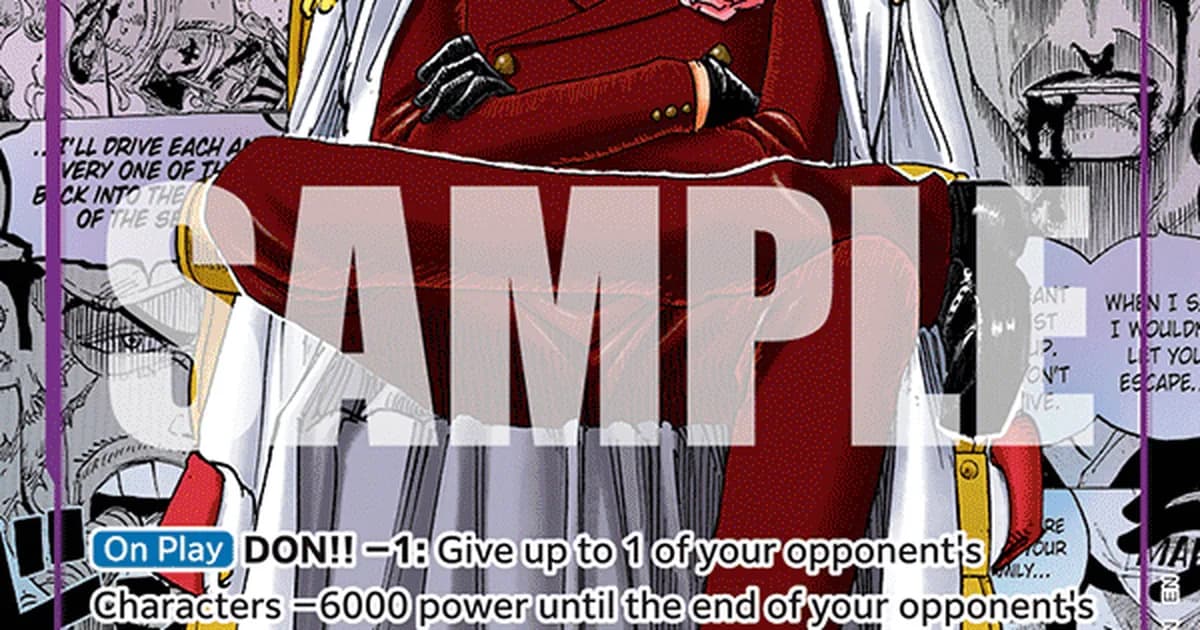
OP-16 Manga Rare Guide: Admiral Prices and Pull Odds
Guides · 13 min
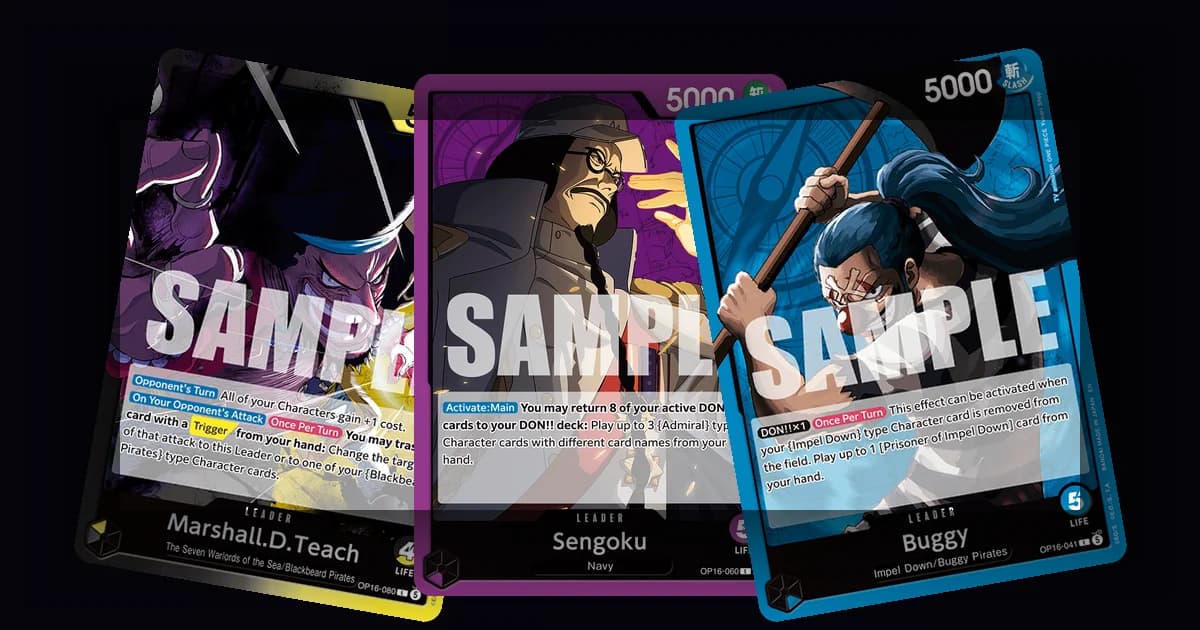
OP-16 Black Yellow Teach Decklist: Blackbeard Deck Guide
Guides · 10 min
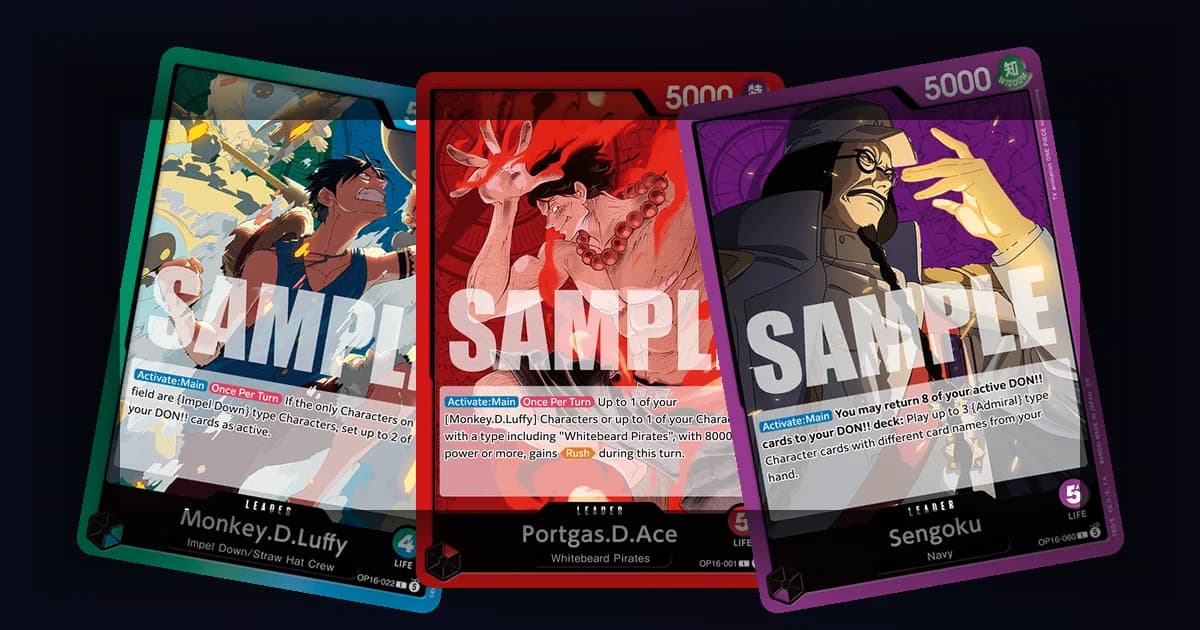
One Piece TCG Best Leaders All Time: Top 10 Ranked
Guides · 13 min
OP-16 EN Launch Guide: What Happened After Release
Guides · 12 min
OP-16 Sengoku Deck Guide: Purple Marine Admirals Build
Guides · 13 min

OP-16 vs OP-15 power level comparison: what changed?
Guides · 11 min
OP-16 Box Opening Strategy: How Many Boxes to Open
Guides · 10 min
OP-16 Collectors Guide: SEC, Manga Rare, Alt-Art Cards
Guides · 11 min
Disclaimer
This article is published for informational and entertainment purposes. It does not constitute professional financial, legal, or technical advice. Game performance, online services, patch schedules, and store listings change. Verify critical details (pricing, system requirements, regional availability) with publishers and storefronts before you buy. Affiliate links, where present, help support our editorial work and are labelled in our affiliate disclosure.