Loading…


Shonen TCG · Guides
One Piece TCG Blue Yellow Guide: Pairing and Nami Strategy
Reviewing
One Piece TCG
One Piece TCG Blue Yellow guide: this pairing combines Blue's hand control with Yellow's Life pressure. The two colors ask you to manage different resources at once, so the deck rewards players who plan several turns ahead instead of treating every attack as a race.
This guide explains what each color contributes, how Nami (OP11-041) and Zeus (OP11-106) interact, how Trigger timing actually works, and how to build a first list without treating an old metagame number as a current promise.
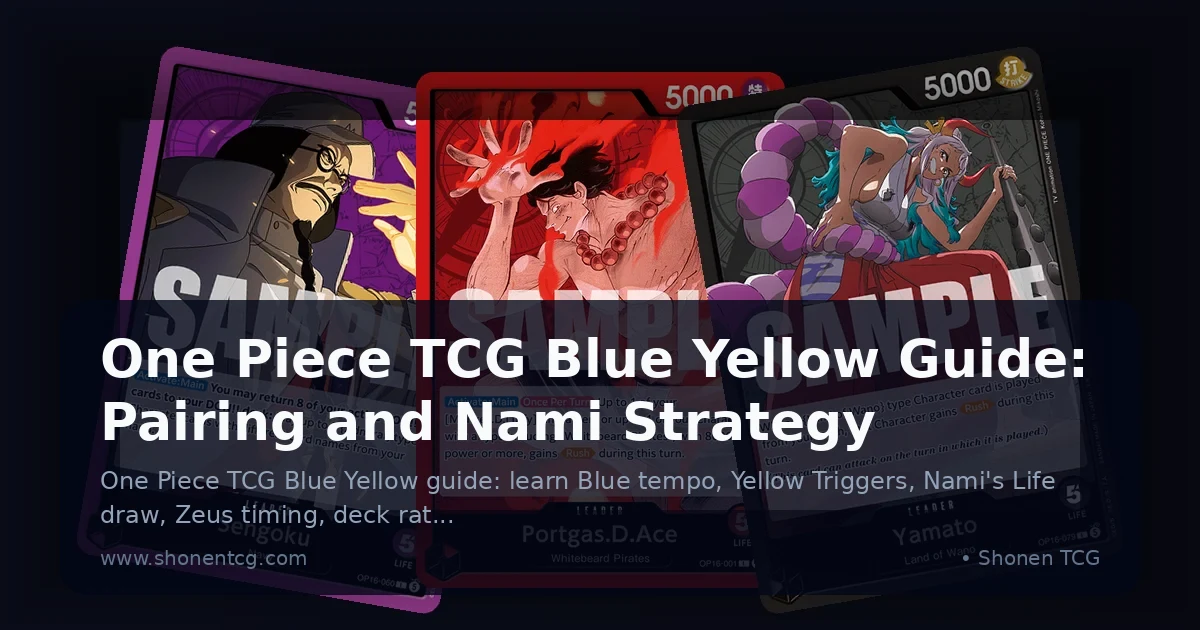
Featured image note: This real sample-card collage shows Sengoku, Portgas.D.Ace, and Yamato. It is representative One Piece Card Game artwork, not a complete Blue/Yellow deck preview.
TL;DR: Blue supplies tempo, bounce, draw, and hand management. Yellow supplies Life manipulation and high-impact Trigger effects. Nami connects the two by drawing when a Life card is removed during your turn, provided your hand has seven or fewer cards. Zeus can create one such Life removal when it is played, but it is a single-use setup card rather than a repeatable draw engine. Current OP-17 data is a dated reference point, not a reason to call Nami the format's best deck.
One Piece TCG Blue Yellow guide? (quick answer)
Blue and Yellow cover different parts of the game. Blue tries to keep more useful cards in hand than the opponent and buys time with tempo plays. Yellow makes the Life area an active part of the deck, so an attack can expose a Trigger instead of simply reducing your survival clock.
The pairing is strongest when those jobs stay separate. Blue does not need every card to manipulate Life, and Yellow does not need every card to be a Trigger. Build enough of each package that one color can cover a weak turn from the other.
What Blue contributes
Blue commonly contributes three things:
- Tempo: Cost reduction, bounce, and other effects can make an opposing board less efficient to develop.
- Hand quality: Draw and filtering effects help find counters, Characters, and the answer needed for the current board.
- Flexible defense: A larger hand gives you more choices in the Counter step, although those cards still need enough Counter value to matter.
Bounce is not the same as a permanent answer. Returning a Character to hand may force the opponent to spend Don again, but it can also give them another chance to use an On Play effect. Use it when the tempo gained is worth the card and resource exchange.
Blue's most common weakness is that it can spend several turns creating options without presenting a fast clock. Yellow adds a way to make the opponent's attack step carry risk, which helps the control plan convert time into advantage.
What Yellow contributes
Yellow is the color most associated with Life manipulation and Trigger effects. A card does not need to be Yellow to have a Trigger, but Yellow's card pool makes that interaction a central part of many builds.
Life is not just a number to protect. It is also a pile of possible effects. A Trigger card can remove a Character, add power, draw, or create another advantage depending on the exact text. The opponent chooses whether to attack, but your deck construction determines how valuable that reveal can be.
Life movement is the other half of the color's identity. Some cards add to, remove, or reorder Life. These effects can preserve a late-game buffer, set up a future reveal, or create the event that a Leader ability is waiting for. They also carry a cost: spending Life without understanding the next attack can leave you with no defensive margin.
Yellow's weakness is that its best effects are often conditional. If you do not have a useful card in Life, or if the opponent can pressure your board without attacking Life, the package is less impressive. Blue's hand and tempo tools help cover those turns.
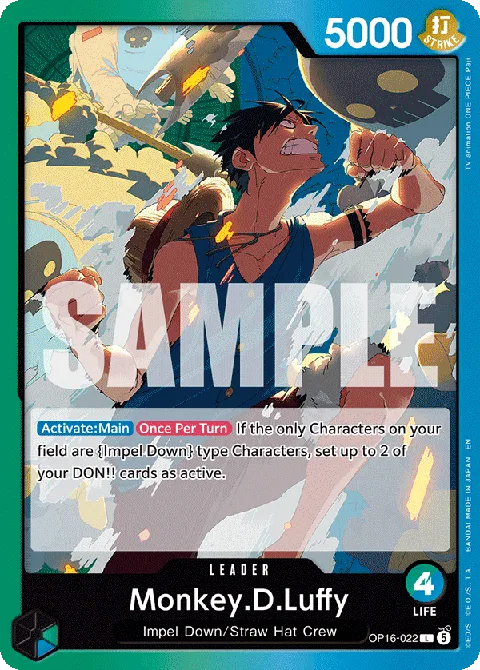 Luffy (OP16-022
 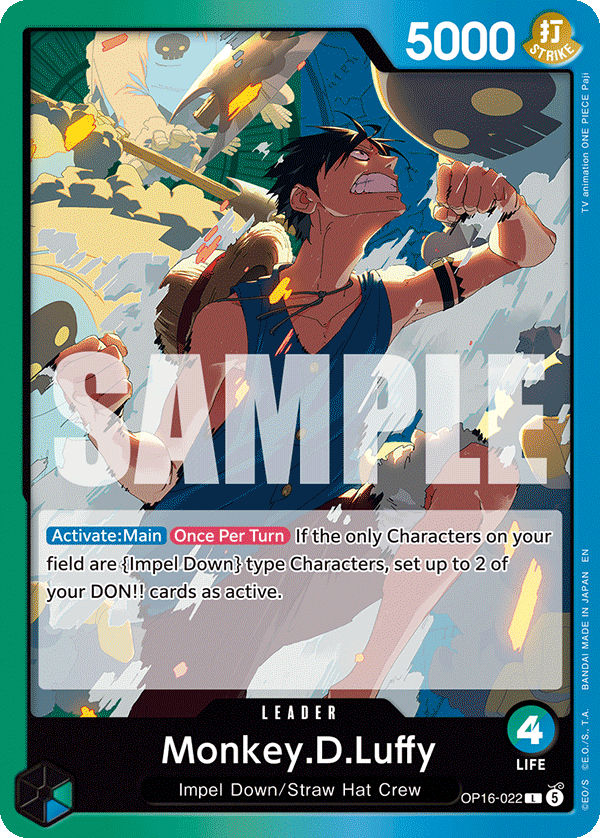 OP16-022OP16-022Shop on TCGplayer) is a real Green/Blue Leader sample from OP-16. It is shown here as a dual-color comparison, not as a Blue/Yellow card.
One Piece TCG Blue Yellow guide: building a test list
Start with the Leader's text, then decide which jobs the 50-card deck must perform. The color pair alone does not tell you whether the finished list should be a slow Nami engine, a more aggressive dual-color shell, or a defensive build that uses Life as a cushion.
The Nami starting point
Nami (OP11-041) is the cleanest teaching example for this pairing. Her [Your Turn] [Once Per Turn] effect can activate when a card is removed from your Life or your opponent's Life. If you have seven or fewer cards in hand, you draw one card.
That wording has two important limits. First, the draw effect is a once-per-turn effect tied to your turn. Second, a qualifying Life removal does not guarantee a draw if your hand is already at eight or more cards when the effect resolves. The deck therefore wants useful cards in hand, but not so many that the Leader condition stops working.
The second Nami ability is defensive rather than a draw engine. With one attached DON!! on the opponent's attack, you may trash one card from hand to give Nami +2000 power for the turn. Keep that cost in mind when deciding whether a card should become a Counter or be discarded for the defensive boost.
Zeus is setup, not an infinite loop
The old version of this article identified Zeus with the wrong card number and described an effect it does not have. The relevant card is Zeus (OP11-106), a 2-cost Yellow Character with 2000 power and a +2000 Counter.
Its On Play effect may add the top or bottom card of your Life cards to your hand, then K.O. up to one opposing Character with a cost of 5 or less. When you play it during your turn, removing that Life card can satisfy Nami's condition and produce one draw if your hand is at seven or fewer cards. The effect happens on that play. Zeus does not repeatedly remove itself from the field and does not create a draw every turn by remaining in play.
That makes Zeus valuable for three different reasons: it is a flexible removal card, it has a meaningful Counter value, and it can create one Nami draw at the moment you need to convert Life into hand quality. It is not mandatory in every Blue/Yellow list, so test the count against your local field and the rest of your Trigger package.
Practical ratios for the first draft
Use these as starting questions rather than fixed competitive rules:
- Trigger-bearing cards: Try roughly 10 to 14 in an initial list if the Leader and Life package reward revealing them. Raise or lower the count after testing how often the effects are useful rather than merely available.
- Counters: Make sure the list has enough Counter value to survive turns where Life does not provide an answer. A narrow Trigger with no Counter can be excellent in the right shell and a liability in the wrong one.
- Draw and filtering: Count Nami's Leader effect as conditional card flow. Add enough Blue draw or filtering that the list can still find key cards when Life removal is not available.
- Curve: Keep the early turns playable. High-cost finishers are only useful if the deck can reach them with a hand that still contains defense.
When testing, record which cards were stranded in hand, which Triggers were poor reveals, and whether your Counter cards were available before you increase the number of flashy finishers. Those notes are more useful than copying a ratio from an unrelated Leader.
For the fundamentals behind the defensive part of the list, see our One Piece TCG counter mechanic guide. For the broader color and deck-building framework, use the One Piece TCG complete guide.
How Trigger timing works
When a Leader takes damage, the top Life card is checked. If the card has a [Trigger] effect, the defending player may reveal it and activate that effect instead of adding it to hand. The official comprehensive rules describe this as a temporary pause in damage processing. If an effect deals more than one damage, the Life check is repeated for each point of damage.
That timing is different from saying that a Trigger resolves before an attack is declared or before the battle exists. The attack has already dealt damage to the Leader. The Life card is then processed, and a Trigger can resolve before the remaining damage processing continues.
The choice is optional. Add the card to hand when you need its Counter, when the Trigger is weak in the current board state, or when exposing the effect would give the opponent useful information. Activate it when the immediate board swing is worth losing the card from hand.
Life removal caused by your own card is a separate case. A card such as Zeus can remove a Life card and satisfy Nami's Leader condition, but that does not mean the removed card was revealed because of an attack. Its printed Trigger does not automatically activate merely because the card moved from Life to hand through Zeus's effect.
Best Blue/Yellow leaders and the current context
Nami (OP11-041) is the best place to start learning the pairing because her text makes the relationship between hand size and Life removal easy to see. Reiju from OP-06 is an older Blue/Yellow example that helped establish the color combination, but a historical leader does not automatically define the current Standard field.
The current context needs a date. At the September 18, 2026 check, the third-party OP Meta Game OP-17 tracker listed Blue/Yellow Nami in its C tier snapshot at 45.5% with three decklists. Limitless' dedicated Blue/Yellow Nami page instead records 175 placings, including 10 wins, and lists late July OP-16 results such as a first-place Treasure Cup finish in Puebla. Those sources measure different samples and formats, so neither should be presented as a universal win rate or permanent tier.
The practical conclusion is simple: choose Nami because you understand the engine, not because an old article called her the best deck. Check the current event field before registering, and label any percentage with its date, format, and source.
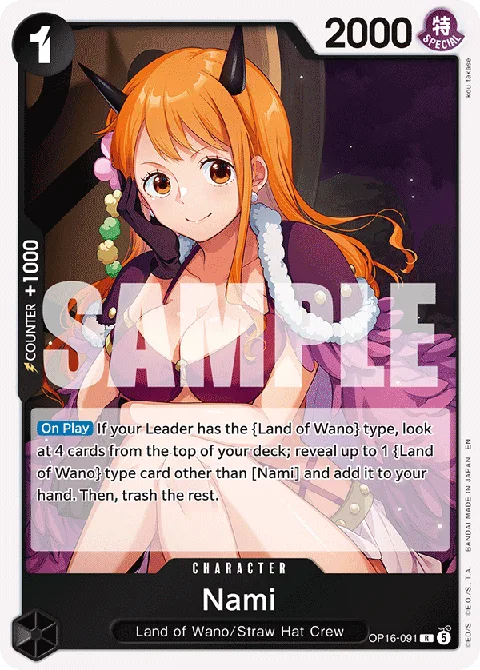
Nami (OP16-091) is a real Black OP-16 Character with Land of Wano and Straw Hat Crew traits. It is a cross-set card example, not the OP11-041 Leader and not proof that it belongs in every Blue/Yellow list.
Step-by-Step: piloting Blue/Yellow
1. Read every Trigger before the game starts. Know which Life reveals remove a Character, add power, draw, or do nothing useful in the current matchup.
2. Establish your hand plan early. Decide which cards are future Counters, which cards are playable bodies, and which cards can be spent for Nami's defensive effect. Do not let a large hand stop Nami's draw condition without a reason.
3. Protect Life with a purpose. Counter an attack when preserving the Life card matters more than the card spent from hand. Take the hit when the reveal can stabilize the board or when saving the Counter protects a later turn.
4. Use Zeus for the board in front of you. Its Life removal can create a Nami draw, but the removal target and the +2000 Counter are also part of its value. Do not treat it as a mandatory early play if the five-cost-or-less K.O. effect has no good target.
5. Track the once-per-turn effects. Mark whether Nami's draw and defensive boost have already been used. A qualifying Life removal after the draw is spent is still useful for other cards, but it will not create a second Nami draw that turn.
6. Reassess after each Life card leaves. Your remaining Life stack, hand size, and available Counters change together. The right decision on the next attack depends on what has already been revealed, not just on your starting Trigger count.
Key takeaways
- Blue supplies hand quality and tempo; Yellow turns Life into a source of optional interaction.
- A Trigger is optional, and its timing is part of damage processing after the Leader has been hit.
- Nami's draw is a once-per-turn effect on your turn, with a hand-size condition.
- Zeus is OP11-106, not OP01-017. It creates one useful Life-removal event when played and does not repeat the draw engine by itself.
- Trigger counts and Counter counts are testing decisions, not universal deck-building laws.
- Current OP-17 rankings change quickly. Date every meta claim and separate historical OP-16 results from the live field.
Related reading
- One Piece TCG Nami Deck Guide: Blue Yellow Draw Engine 2026: a card-by-card look at OP11-041 and the current Nami shell.
- One Piece TCG Blue Color Guide 2026: Blue's tempo, draw, and bounce identity.
- One Piece TCG Yellow Color Guide 2026: Yellow's Life and Trigger fundamentals.
Frequently asked questions
What does Blue do in One Piece TCG? Blue is associated with tempo and hand control. Its card pool commonly returns Characters to hand or deck, draws or filters cards, and creates openings through cost reduction or leader-specific effects. Check the exact card text for each shell.
What does Yellow do in One Piece TCG? Yellow is associated with Life manipulation and Trigger effects. When a Leader takes damage, a card with a Trigger can be revealed from Life and have that effect activated instead of adding the card to hand. Many Yellow cards also move or restore Life.
Why do Blue and Yellow work well together? Blue helps maintain a hand of Counters and options while Yellow makes Life an active resource. Nami (OP11-041) connects both ideas because a qualifying Life removal during your turn can draw a card when your hand has seven or fewer cards.
Who is the best Blue Yellow leader? There is no permanent best Leader. Nami (OP11-041) is the clearest starting point for learning the pairing, while current OP-17 trackers should be treated as dated third-party snapshots rather than final rankings.
What is Zeus in One Piece TCG? Zeus (OP11-106) is a 2-cost Yellow Character with 2000 power and a +2000 Counter. On Play, it may add the top or bottom Life card to hand and K.O. an opposing Character with a cost of 5 or less. That removal can create one Nami draw during your turn.
How many Trigger cards should I run? Start testing around 10 to 14 Trigger-bearing cards, then change the number based on your Leader, Life manipulation, Counter density, and local matchups. The range is a starting heuristic, not a rule.
References
Was this guide helpful?
Cards in this article
About the author

TCG Deck Analyst
Former card game tournament organiser turned analyst. Covers One Piece TCG meta, deck efficiency, and card valuation. Builds spreadsheets for decks most people just play.
- Regional TCG tournament organiser
- One Piece TCG meta specialist
- Competitive deck analysis
Disclaimer
This article is published for informational and entertainment purposes. It does not constitute professional financial, legal, or technical advice. Game performance, online services, patch schedules, and store listings change. Verify critical details (pricing, system requirements, regional availability) with publishers and storefronts before you buy. Affiliate links, where present, help support our editorial work and are labelled in our affiliate disclosure.