Loading…


Shonen TCG · Guides
OP-16 Marco Deck Guide: Phoenix in Whitebeard 2026
Reviewing
One Piece TCG
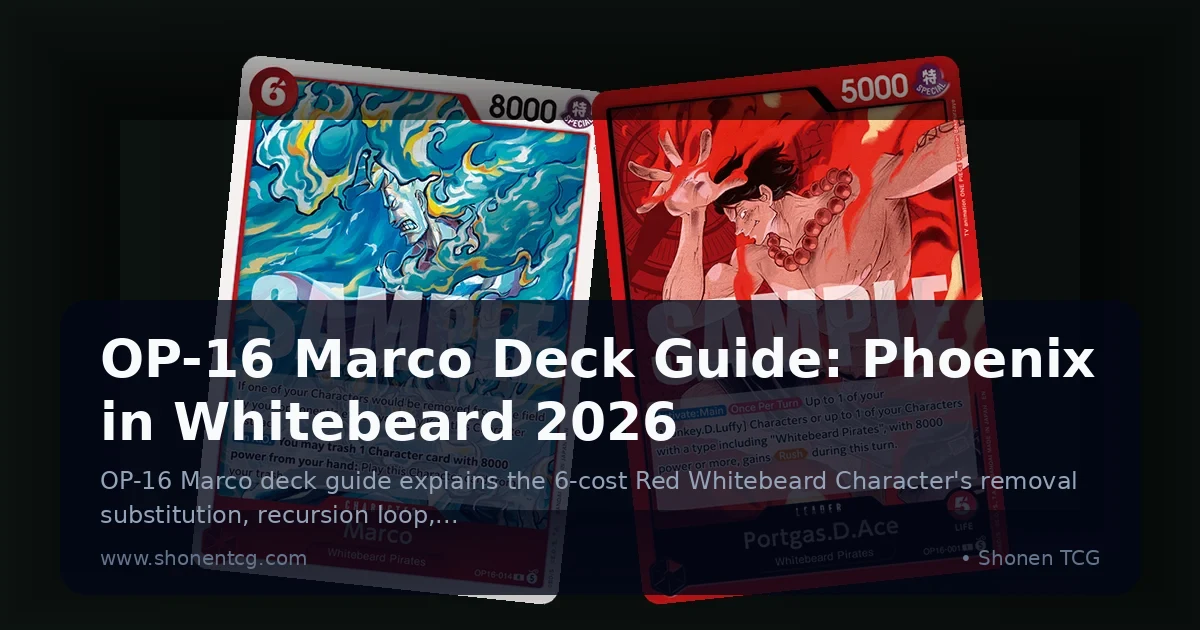
This OP-16 Marco deck guide explains what OP16-014 actually does and where it fits in the Red Whitebeard Pirates shell. Marco is not a Blocker and does not create burn damage. He is a 6-cost, 8000-power Character that can replace another Character's effect removal with his own K.O., then return from the trash if you discard an 8000-power Character.
Portgas.D.Ace (OP16-001) gives one 8000-power Monkey.D.Luffy or Whitebeard Pirates Character [Rush] once per turn. That makes Marco a large body that can attack immediately on your turn after Ace's ability resolves, but it does not turn the deck into a burn strategy. The official OP-16 card list is the source of truth for the card text below.
Last checked: September 18, 2026. This is an OP-16 format guide. Limitless currently labels OP17 as its latest update, so check the event's legal card pool before using an OP-16 list.
TL;DR: Marco OP16-014 is a Red Rare, 6-cost, 8000-power Whitebeard Pirates Character with effect-removal substitution and optional recursion. It has no Blocker keyword, so do not plan around turns 2-3 or repeated attacks being stopped. The current Limitless OP16 Red Ace summary covers four decklists and averages four copies of Marco. Play him when you have an 8000-power Character in hand and a removal target worth protecting.
OP-16 Marco deck guide? (quick answer)
Marco belongs in the Red Portgas.D.Ace Whitebeard Pirates shell. Its best turns are not defined by an early defensive wall. They are defined by a six-DON play, a stocked hand, and a clear decision about whether saving another Character is worth K.O.'ing Marco.
The Limitless Red Ace card summary currently groups four OP16 decklists. It shows an average of 4.00 Marco, 4.00 Edward.Newgate OP16-003, 4.00 Monkey.D.Luffy OP16-015, 4.00 LittleOars Jr. OP16-017, 4.00 Curiel OP16-004, and 4.00 Vista OP16-011. Those are useful observed list patterns, not a universal deckbuilding rule.
OP-16 Marco deck guide: read the card correctly
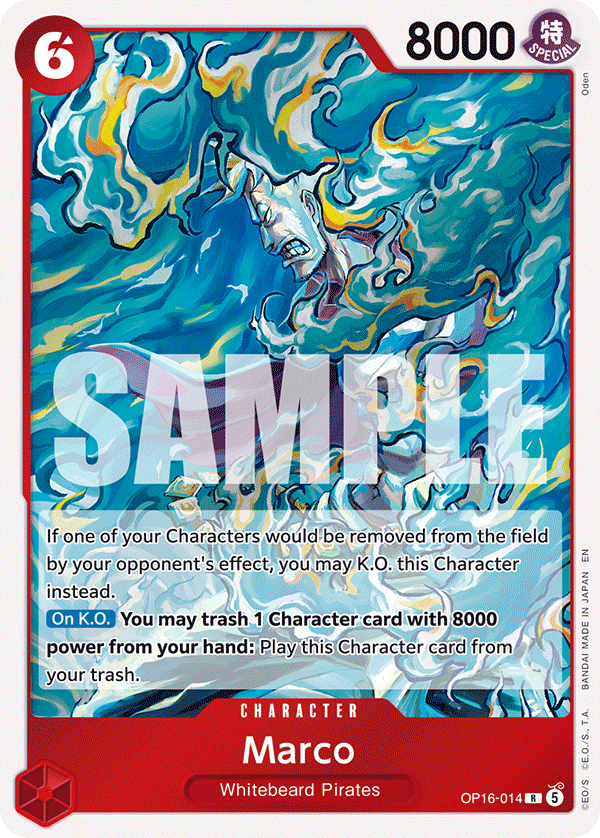 OP16-014OP16-014Shop on TCGplayer Marco is a Red Rare Character, not a Leader, not a Manga Rare, and not a Blocker. The official text has two parts:
- If one of your Characters would be removed from the field by your opponent's effect, you may K.O. Marco instead.
- When Marco is K.O.'d, you may trash one Character card with 8000 power from your hand to play Marco from your trash.
That is removal insurance, not attack prevention. Marco cannot rest to redirect an attack, and his text does not save a Character from being K.O.'d in combat. It also does not automatically return him to the field. The recursion costs a specific 8000-power Character card from your hand, so a hand with no legal fodder leaves Marco in the trash.
The replacement effect is most valuable when the Character being saved is harder to replace than Marco or is carrying the turn's plan. It is less attractive when Marco is your only developed body, when you need the 8000-power card in hand for another effect, or when the opponent's effect is removing an expendable Character.
Ace's Rush interaction, not a burn plan
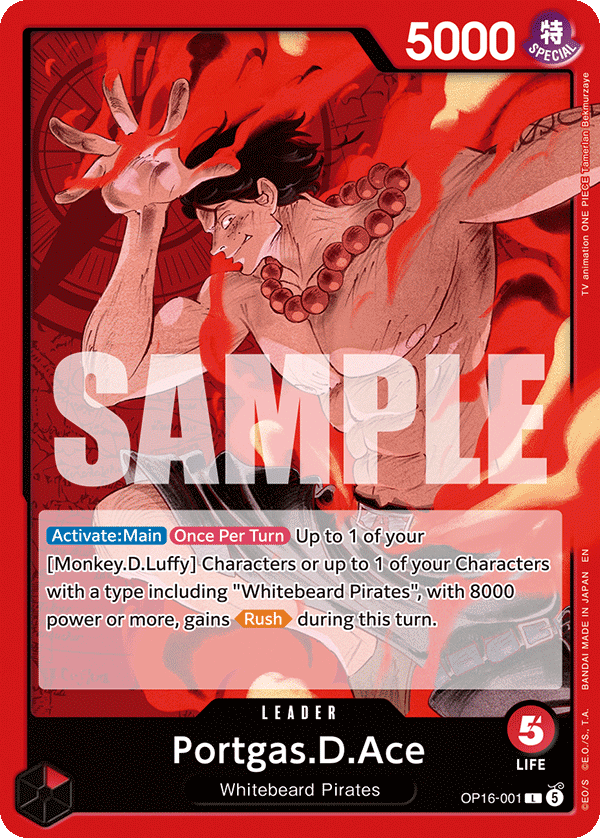 OP16-001OP16-001Shop on TCGplayer Portgas.D.Ace is a Red Leader with 5 Life and 5000 power. Once per turn, his Activate: Main ability gives [Rush] to one of your Monkey.D.Luffy Characters or one of your Characters with a type including Whitebeard Pirates if it has 8000 power or more.
Marco meets that power and type condition. If you play him during your turn and still have Ace's ability available, Marco can attack that turn. The same effect can target another eligible Character, so Marco is one option in a wider Whitebeard pressure plan, not the whole plan.
The distinction matters because the old version of this article described Ace as a burn Leader and Marco as a blocker. Neither description matches the official text. Ace creates immediate attack pressure through Rush, while Marco asks you to manage effect removal and the 8000-power cards in hand.
When to spend six DON!! on Marco
Marco costs 6, so a normal plan should treat him as a midgame play. A turn 2 or turn 3 Marco is not a default line in the OP-16 card text. Only use an earlier timing if the exact list contains a verified cost-reduction or play effect that makes it possible.
Before playing Marco: check three resources. You need enough DON!! to pay the cost, at least one 8000-power Character card you are willing to discard if Marco is K.O.'d, and a board state where effect-removal substitution protects something meaningful.
When Marco is already in play: do not sacrifice him just because the opponent used an effect. Ask whether the other Character is more important, whether you can pay the recursion cost, and whether the opponent may remove Marco again before the recursion creates value.
When combat is the threat: remember that Marco is not a Blocker. Keep actual Blockers, counter cards, or a better attack-trade line available. The card's defensive value is conditional on effect removal, not on the number of attacks aimed at you.
When your turn is about to close: Ace's Rush ability can make Marco an attacker, but using it is a choice between immediate pressure and another eligible 8000-power Whitebeard or Monkey.D.Luffy Character. Do not spend it automatically if a different attack changes the board more.
Step-by-Step: sequencing the Whitebeard shell around Marco
This sequence keeps Marco's two abilities connected to the rest of the deck without inventing a Blocker role for him.
1. Establish the Whitebeard board before planning the Marco turn. Use the early turns to develop Characters, draw, and preserve enough hand quality to support the 8000-power discard requirement. Do not pass early turns while waiting for a six-cost card.
2. Track your 8000-power fodder. Before paying for Marco, identify the Character card in hand that can pay his On K.O. cost. If discarding that card would strand your next turn or break another effect, Marco may be better held.
3. Play Marco when effect removal is likely to matter. A six-cost 8000-power body is a real board investment. It is strongest when the opponent has a credible effect-removal line and you have another Character worth protecting, not when you simply need a body to absorb attacks.
4. Use Ace's Rush ability after choosing the best 8000-power attacker. If Marco is the right target, give him Rush and convert the midgame play into immediate pressure. If Newgate, another Whitebeard body, or an eligible Luffy creates a better attack, use the Leader effect there instead.
5. Replace the important Character only when the trade is favorable. If the opponent's effect would remove a key Character, you may K.O. Marco instead. Do not treat the replacement as mandatory. Sometimes keeping Marco and losing a less important Character preserves more of your hand and board.
6. Resolve the On K.O. choice deliberately. If you have an 8000-power Character card to trash and replaying Marco is worth the card, use the recursion. If not, let Marco go to the trash and keep the hand resource. The right choice changes with the next turn's DON!! and board requirements.
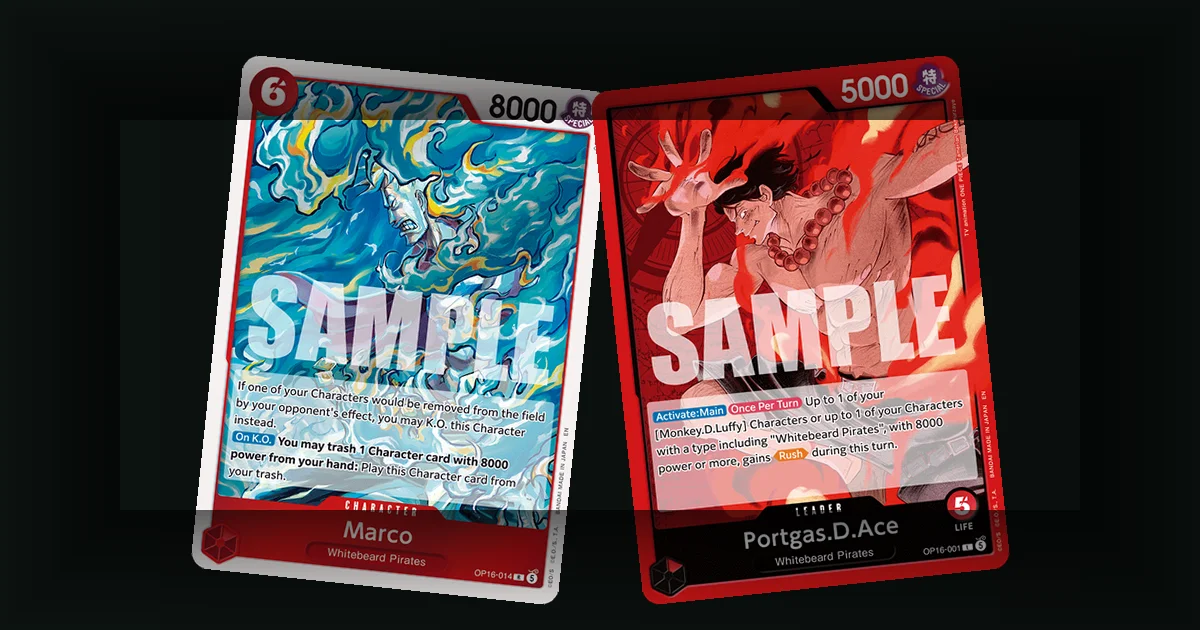 This real OP-16 image shows Marco OP16-014 beside the Portgas.D.Ace OP16-001 Leader. It illustrates their card identities and Rush interaction, not a complete Red Ace decklist.
Marco versus Garp: different colors and jobs
A comparison with 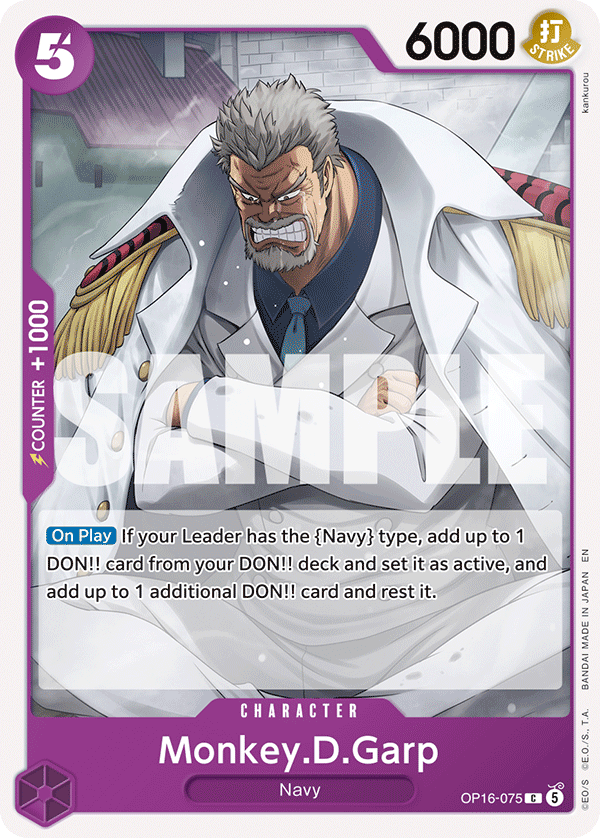 OP16-075OP16-075Shop on TCGplayer Garp is useful only if the roles stay separate. Marco is Red and has the Whitebeard Pirates type. Garp is Purple, has the Navy type, and his On Play effect adds up to two DON!! cards for a Navy Leader, with one set active and one rested.
That makes Garp a ramp Character for a Purple Navy shell, while Marco is a Red Character that trades his own body for effect-removal protection and may recur from the trash. They are not substitutes in the same legal build. The OP-16 Garp deck guide covers the Navy side of that comparison.
Four copies or fewer?
The current Limitless OP16 Red Ace page is a better starting point than the old three-copy claim. It covers four decklists and averages four Marco. The OP16 format table lists Red Ace at 51 points and 0.87% of the tracked OP16 metagame view, so this is a small observed sample rather than proof of a universal best list.
Start at four copies if Marco is central to your plan and you want to see him consistently. Move lower if your build needs more space for other 8000-power bodies, counters, or a different curve. The important deckbuilding question is not simply how many Marcos you own. It is whether the list contains enough 8000-power Character cards to make the On K.O. text live without sacrificing the hand's other jobs.
This also explains why the four-copy average should not be read as a tier claim. Limitless currently marks OP17 as the latest update, and the OP16 page is a format-specific historical sample. Check the event rules and current decklists before treating these counts as current tournament advice.
Building the Red Whitebeard package
Leader: Portgas.D.Ace OP16-001, Red, Whitebeard Pirates. Its once-per-turn Rush ability rewards 8000-power Whitebeard and Monkey.D.Luffy Characters.
Marco package: OP16-014, usually four in the current four-list OP16 sample. The card is a six-cost 8000-power body, so it belongs in the midgame curve rather than the opening-turn plan.
8000-power hand package: include enough legal fodder for Marco's On K.O. text and for the other OP-16 effects that ask you to reveal or trash 8000-power Characters. Curiel, Thatch, LittleOars Jr., and other verified cards should be evaluated by the exact list and role, not by a generic "burn enabler" label.
Large Whitebeard bodies: 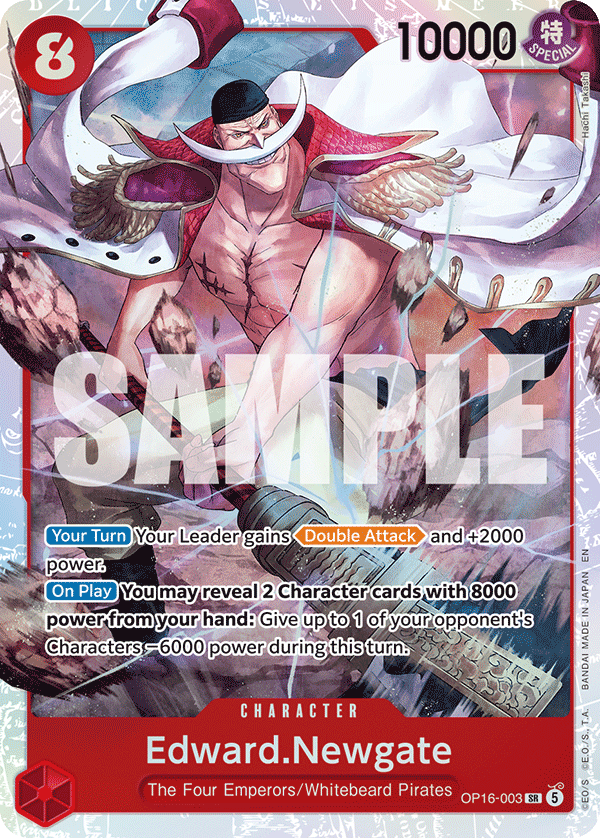 OP16-003OP16-003Shop on TCGplayer Edward.Newgate is a 10,000-power Character with its own Double Attack and power effect, plus an On Play power reduction that asks for two 8000-power Character cards in hand. It is a separate payoff from Marco, and its 10,000 power does not satisfy Marco's 8000-power discard requirement.
Combat protection: use actual Blockers and counter cards when the opponent is attacking. Marco can still be valuable in the same list, but counter Events do not turn him into a Blocker and do not make his effect-removal replacement apply to combat.
For the complete Red Ace list and card-by-card alternatives, see the OP-16 Ace deck guide. For rules context on counter cards, see the One Piece TCG counter mechanic guide.
Matchup principles that follow from the text
These are card-interaction principles, not a current tier ranking.
Against effect-removal control: Marco's replacement can protect a more important Character, then potentially return if you have the 8000-power discard. The opponent can still pressure your hand, remove Marco through another line, or force you to protect a less valuable board. Treat it as a trade tool, not immunity.
Against combat-heavy pressure: Marco does not stop attacks. Prioritize Blockers and counters, and use Marco's 8000 power to contest the board or receive Ace's Rush when that attack is better than holding the Leader ability.
Against hand disruption: Marco becomes worse when the opponent removes the 8000-power fodder from your hand. Keep track of which cards are safe to discard and do not assume the recursion is available just because Marco was K.O.'d.
Against a wide board: do not promise that one Marco protects the whole field. The wording offers a replacement for a Character being removed, while the board still needs separate answers to the opponent's other Characters and attacks.
Marco in sealed and limited play
Marco is playable in a Red pool when you can reach six DON!! and have enough 8000-power Characters to support him. He is not an automatic bomb: he has no Blocker, needs a specific hand card to recur, and depends on the opponent using an effect that actually removes one of your Characters.
If the pool contains several 8000-power Characters and a strong Whitebeard shell, Marco can turn one removal spell into a favorable exchange. If the pool is short on 8000-power fodder or has no reliable Red curve, prioritize cards that affect combat immediately. That is a safer limited evaluation than treating the Phoenix name as a rules ability.
Common mistakes in the Phoenix build
Calling Marco a Blocker. He has no Blocker keyword. Use him to contest combat as an 8000-power Character, not to redirect an attack.
Planning a turn 2 or 3 Marco. His printed cost is 6. Build the curve around the turn where you can pay six DON!! unless a verified card effect changes that timing.
Playing him without 8000-power fodder. The On K.O. recursion is optional and has a real hand cost. Track the card you will discard before you commit Marco.
Sacrificing him to every removal effect. The replacement protects another Character, but Marco is still a card and the discard cost still matters. Make the exchange only when the saved Character and the following turn justify it.
Calling Ace a burn Leader. Ace grants Rush to one eligible 8000-power Character. Use the official text to plan attacks instead of looking for a damage trigger that is not printed on the card.
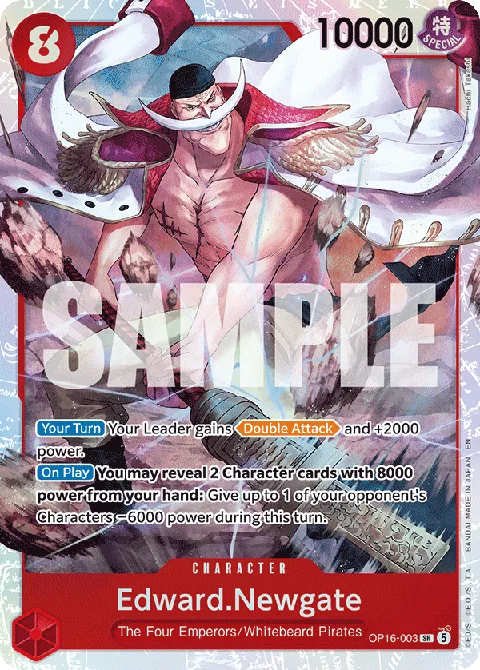 This real OP-16 image shows Edward.Newgate OP16-003, a 10,000-power Whitebeard Pirates Character. Its own effects support a different large-body line and its 10,000 power is not Marco's 8000-power recursion cost.
Key Takeaways
- Marco OP16-014 is a Red Rare, 6-cost, 8000-power Whitebeard Pirates Character.
- It can replace an opponent's effect removal by K.O.'ing itself, then recur by trashing an 8000-power Character card from hand.
- Marco is not a Blocker and does not stop combat attacks.
- Ace grants Rush to one eligible 8000-power Character, so the key synergy is attack timing, not burn damage.
- The current four-list Limitless OP16 Red Ace sample averages four Marcos, but that is not a universal deckbuilding rule or a current OP17 tier claim.
- Keep actual Blockers, counters, and enough 8000-power hand fodder in the list.
Related Reading
- OP-16 All 6 Leaders Explained: why Marco is a Character and how the six Leaders map to play styles.
- OP-16 Ace Deck Guide: the broader Red Whitebeard list and card-by-card choices.
- OP-16 Garp Deck Guide: Garp's Purple Navy ramp role, which is separate from Marco's Red shell.
- One Piece TCG OP-16 Complete Guide: the full set hub for leaders, deck guides, and collector content.
- OP-16 Meta Tier List Week 1: a dated OP-16 metagame snapshot, not a current OP17 ranking.
Frequently Asked Questions
Q: Is Marco the Phoenix a Manga Rare in OP-16? A: No. Marco OP16-014 is a Red Rare Character. Bandai's product page highlights the Three Admirals Super Alt-Art feature, while Marco's value here comes from his effect-removal substitution and recursion text.
Q: What deck does Marco the Phoenix go in? A: His natural OP-16 home is the Red Portgas.D.Ace Whitebeard Pirates shell. Marco is Red and has the Whitebeard Pirates type, while Sengoku's Navy cards are Purple.
Q: When is the best time to play Marco? A: Plan around six DON!!, keep an 8000-power Character card in hand for the recursion cost, and play him when effect-removal substitution protects a meaningful Character. He is not a default turn 2 or turn 3 play.
Q: How many copies of Marco should I run? A: The current Limitless OP16 Red Ace summary covers four decklists and averages four copies. Use that as an observed starting point, then adjust for your curve, fodder count, and event format.
Q: Is Marco better than Garp in Ace's deck? A: They are not substitutes. Marco is a Red Whitebeard Pirates Character; Garp OP16-075 is a Purple Navy Character whose On Play text ramps DON!! for a Navy Leader.
Q: Does Marco work in decks other than Ace? A: Other Red Leaders may legally use him if their color rules allow it, but Ace is the specific OP-16 synergy because his Leader ability gives Rush to an eligible 8000-power Whitebeard Pirates Character.
Q: How does Marco compare to the Three Admirals? A: Marco is a Red Rare Character for the Whitebeard shell. The Three Admirals are Purple Navy cards with the premium Super Alt-Art feature highlighted by Bandai, so they fill a different deck and collector role.
References
- Bandai Namco, OP-16 official product page: English release date, pack MSRP, rarity categories, and the Three Admirals Super Alt-Art feature.
- Bandai Namco, OP-16 official card list: Marco, Ace, Newgate, Garp, and the exact card text, colors, types, costs, and powers.
- Limitless One Piece, Red Ace card summary: four OP16 decklists and observed average card counts.
- Limitless One Piece, OP16 deck metagame table: dated format-specific points and share for Red Ace and other OP16 decks.
- Limitless One Piece, Marco OP16-014 card page: card identity, legality, price reference, and recorded Red Ace placements.
- Limitless One Piece, Ace OP16-001 card page: Leader text, legality, and recorded deck placements.
- Limitless One Piece, Newgate OP16-003 card page: card identity and current card reference.
Was this guide helpful?
Cards in this article
About the author
KT
Competitive TCG Analyst
Competitive One Piece TCG player and deck builder with 3 years of tournament experience. Covers meta analysis, tier lists, and leader builds.
- 3 years competitive OPTCG tournament experience
- Regional top 8 finisher
- Deck builder and meta analyst
- Covers every set since OP-01
Disclaimer
This article is published for informational and entertainment purposes. It does not constitute professional financial, legal, or technical advice. Game performance, online services, patch schedules, and store listings change. Verify critical details (pricing, system requirements, regional availability) with publishers and storefronts before you buy. Affiliate links, where present, help support our editorial work and are labelled in our affiliate disclosure.