Loading…
Shonen TCG · General
OP-16 Buggy Deck Guide: Impel Down Swarm Build 2026
Reviewing
One Piece TCG
The OP-16 Buggy deck guide you need is right here. 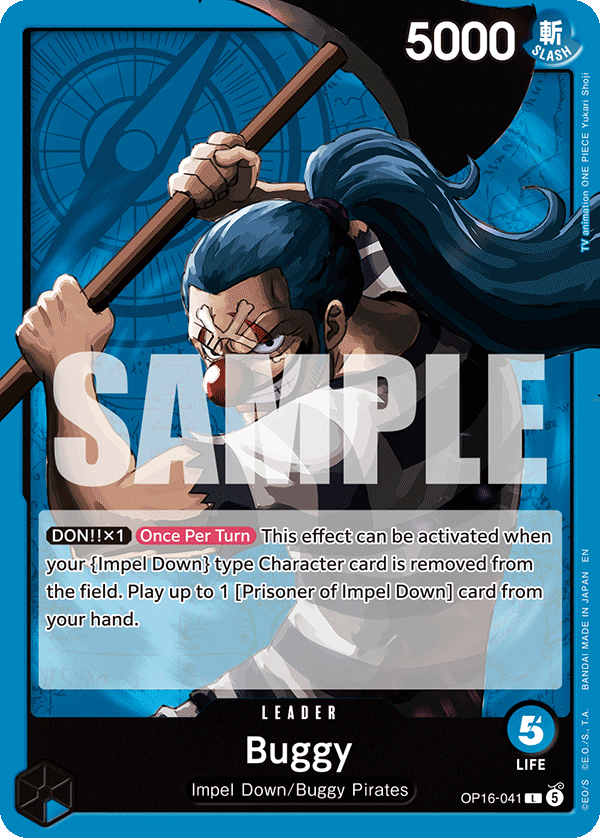 OP16-041OP16-041Shop on TCGplayer Buggy is the Blue Impel Down swarm leader in One Piece TCG OP-16, and he is also the cheapest, most beginner-friendly build in the set. If you want to get into OP-16 competitive play without breaking the bank, this is your starting point.
TL;DR: Buggy (OP16-041) is Blue, not Purple. His Impel Down swarm plan floods the board with cheap characters and wins by attacking with more bodies than the opponent can block. No SEC or Manga Rare cards required. Beginner-friendly, budget-first, and a genuine entry into OP-16 competitive play.
OP-16 Buggy deck guide: is he worth playing? (quick answer)
OP16-041OP16-041Shop on TCGplayer Buggy is the Blue swarm leader in OP-16, built around the Impel Down breakout arc. He is worth playing if you want the most affordable way into OP-16 and a linear, aggressive game plan that teaches real fundamentals.
Competitively, JP week 1 placed Buggy at entry tier while the top of the meta went to Blackbeard, Luffy, and Yamato. EN results from the first three weeks have confirmed similar placement. He is not the format's strongest leader, but he is far from irrelevant: a correctly played swarm board creates real pressure that many decks cannot cleanly answer. For players new to the game or the format, he is the recommended first OP-16 leader.
EN launched June 12, 2026. Matchup guidance below reflects JP week 1 data and the EN format as it has developed.
GODEEPER: Not sure which OP-16 leader to pick? The full breakdown covers all six leaders, verified colors, and a decision tree. OP-16 All 6 Leaders Explained
How the Impel Down swarm mechanic works
Swarm, or go-wide, decks win through quantity rather than individual card power. Instead of building toward one large finisher, you play many smaller characters every turn. The opponent can remove or block a card or two each turn, but a wide board generates more total attacks than they have answers for, and the surplus damage closes the game.
Buggy's Impel Down theme is a natural fit. The breakout arc from the manga is literally about a flood of prisoners escaping at once, and the deck mirrors this: cheap bodies hitting the board in waves. Blue's draw tools let you replace characters after trades so the board stays wide even after your opponent answers one row of attackers.
The core loop:
- Deploy one or more cheap Impel Down characters every turn from the earliest turns
- Attack with the growing board each turn to chip Life damage and force blocks
- Refuel via Blue card-flow so you always have a follow-up character in hand
- Close the game before the opponent assembles a stabilizing answer
Why this is budget-friendly: go-wide shells do not need a single expensive bomb card. Power comes from synergy and numbers, which means low-rarity commons and uncommons played in multiples. That is what makes Buggy the cheapest competitive OP-16 leader: there is no SEC or Manga Rare card that makes the deck function.
The weakness to manage: if the board is swept by mass removal and you have no follow-up, momentum collapses. Pace the swarm carefully. Never empty your hand onto the board in a single turn; keep at least one or two characters in reserve so a sweep does not end your game plan.
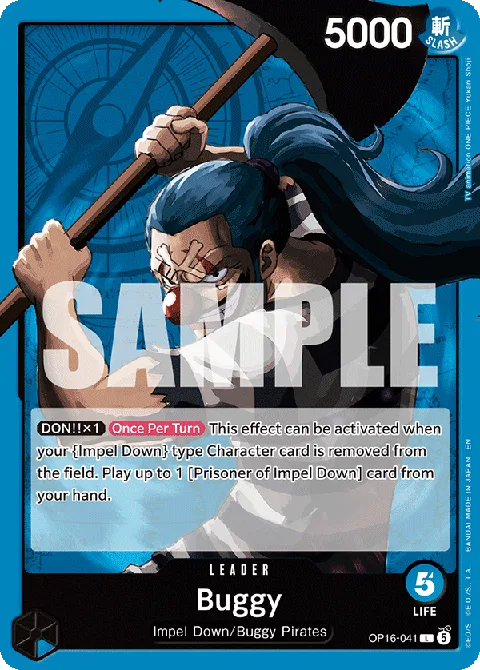 Buggy (OP16-041) leads the Impel Down swarm shell, triggering Blue card-flow tools to keep the wide board refueled each turn.
Building the Blue swarm shell
The Buggy Blue build has three job categories: swarm bodies, draw/refuel, and defensive counters.
Swarm bodies (the deck's core):
The Impel Down prisoner characters form the low-cost backbone. Buggy also shares part of this pool with the other Impel Down leader in OP-16, Luffy. The key is playing these in multiples across the first several turns to build width consistently. 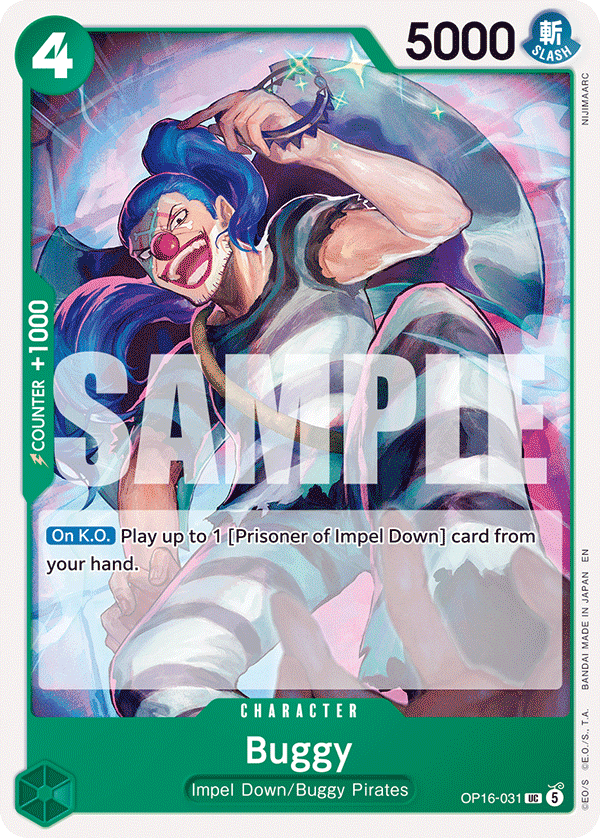 OP16-031OP16-031Shop on TCGplayer and
 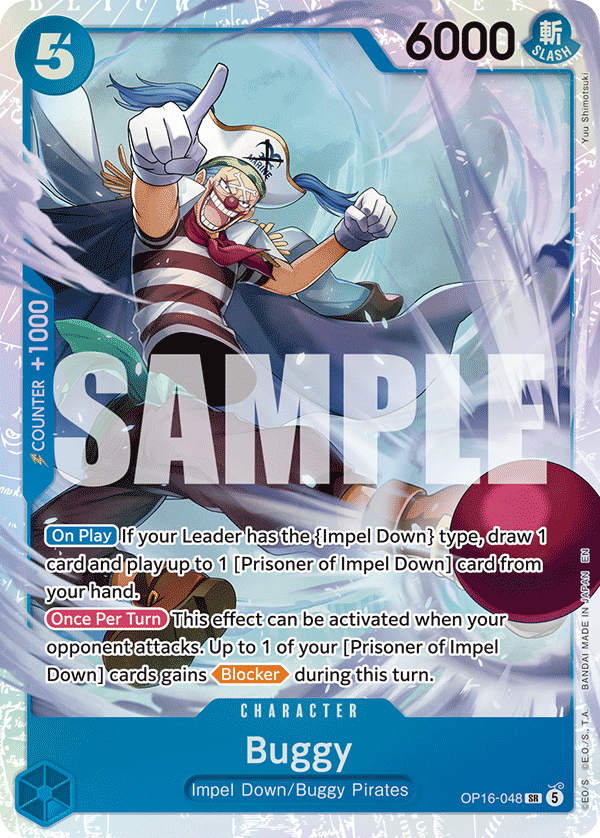 OP16-048OP16-048Shop on TCGplayer are the confirmed Buggy character cards that reinforce the shell's identity and synergy.
Blue draw and tempo tools: Blue color in One Piece TCG provides card-flow cards that replace the bodies you lose to trades and removal. These keep the hand deep enough to deploy at least one character every turn. Without this engine the swarm stalls after the first two or three turns.
Counter Events: Every OPTCG deck wants cheap Counter Events to survive dangerous attacks while setting up the board. These do not add to your threat count but they keep your Life and your leader alive during the early turns when the board is still building.
Deckbuilding principle: prioritize a smooth, low curve over any individual expensive card. The cheapest competitive curve in OP-16 is part of what makes Buggy accessible. Check Limitless TCG for settled EN tournament builds as the meta develops after the June 12 launch.
GODEEPER: Running Buggy on a tight budget? The OP-16 budget guide breaks down costs across all six leaders and lists the highest-value low-rarity pieces. OP-16 Budget Deck Guide
Turn-by-turn play pattern
The play pattern for Buggy Blue is more structured than it looks. Each phase has a clear priority.
Turns 1-2: Deploy your cheapest Impel Down characters. The whole plan depends on building width from the first turn. Do not skip early deployment to save resources; every turn without a character is a turn behind on board width.
Turn 3: Add more bodies and begin attacking. By turn 3 the board should have two or three characters. Start generating Life pressure now. Use Blue draw to keep the hand stocked rather than flooding the board with everything you hold.
Turns 4-5: This is your peak window. A board of three to five characters generates more attacks than most opponents can fully block. Push Life damage through every gap, but hold one or two characters in hand as follow-up against removal.
Turns 5-7: Close the game. Buggy is an early-to-mid deck. If the opponent stabilizes with a big blocker or a clearing effect, you are now racing their late game with early-game tools. The goal is to end the game before this situation arises.
When ahead: resist the urge to play everything. Keep a follow-up body in hand, keep attacking, and do not let the opponent untap without taking damage. Width plus a refuel is what wins; pure width without a follow-up collapses to one removal card.
When behind: re-evaluate whether to double down on the board or pivot to single attacks targeting Life. Sometimes one wide attack that forces multiple blocks is more valuable than building more bodies.
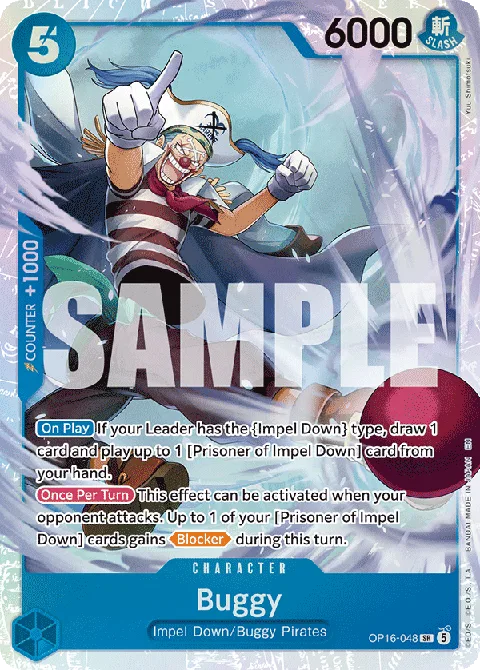 Buggy (OP16-048) is the key character-form support piece reinforcing the Impel Down prisoner identity and synergy package in the Blue swarm build.
Matchup breakdown
vs Ace (Red aggro): roughly even A race between two fast decks. Ace generates Life pressure through burn effects and fast Whitebeard Pirates, Buggy through board width and multiple attackers. The player who applies consistent pressure while protecting their own Life tends to win. Do not over-block early; convert your board into damage. For more on the Red aggro plan, see the OP-16 Ace Deck Guide.
vs Enel (Purple, carries from prior formats): unfavorable Enel from previous formats is one of the hardest matchups for any swarm deck because Purple has efficient mass removal. If you are playing against an Enel build from an earlier set, the key is not over-extending into a single turn sweep. Spread your deployment so removing one turn's worth of characters does not destroy the whole board. The Purple Enel Deck Guide (OP-16 Format) covers how the Enel player approaches the matchup from their side.
vs Blackbeard (Black/Yellow redirect control): unfavorable Blackbeard's ability redirects attacks to his leader or a Blackbeard Pirates character. A wide Buggy board generates many attacks, but Blackbeard can absorb targeted ones and protect his key pieces. The matchup is winnable if you push multiple simultaneous attacks (he can only redirect once per turn) and avoid letting him pick and choose which attacks to absorb. See the OP-16 Blackbeard Deck Guide for the full picture.
vs Sengoku (Purple Marine ramp): slightly unfavorable Sengoku ramps DON!! early to deploy the Three Admirals ahead of schedule. Buggy wants to build enough board width to overwhelm before that ramp produces a stabilizing Admiral setup. The faster you close, the better. If Sengoku hits turn 5-6 with an Admiral Character, the board swing becomes very hard to overcome.
vs Luffy (Blue/Green Impel Down tempo): close to even Two board-centric decks sharing part of the same character pool. The player with the wider, better-refueled board typically wins. Buggy is more committed to the swarm line while Luffy has more flexibility through two character pools; this makes Luffy slightly more consistent in the mid-game grind, but Buggy can end the game faster if the early turns go well.
vs Yamato (Black Wano recursion): unfavorable if the game goes long Yamato replays Wano characters from the trash with Rush via her leader ability, which means she generates threats without spending fresh hand resources. Buggy must close before that recursion engine gets going, because a swarm board that stalls out gives Yamato time to rebuild faster than Buggy can restock. Race her early; if the game reaches turn 6-7 still contested, the recursion usually wins the grind. See the OP-16 Yamato Deck Guide: Black Yamato Wano Recursion for how the Rush loop works from the Yamato side.
Why Buggy is the best budget entry point
For players entering OP-16 without a large budget, Buggy is the correct choice. The reasons stack together:
- No high-rarity requirements: the deck runs on commons and uncommons in multiples. You do not need an SEC leader (Ace or Blackbeard have SEC versions) or a Manga Rare card to build a competitive Buggy list.
- Teaches fundamentals: swarm decks build core skills that transfer to every other archetype. You learn to curve correctly, read what the opponent can block, sequence attacks, and manage a hand under pressure. These skills matter when you step up to Luffy or Sengoku later.
- Consistent early game: low-cost characters mean you are never stuck with an unplayable hand. You will deploy something useful on turns 1 and 2 in nearly every game.
- Genuine competitive presence: entry-tier in JP week 1 does not mean uncompetitive. Buggy creates real pressure that opponents cannot always answer cleanly. A correctly piloted swarm board beats decks that are theoretically stronger on paper.
For broader context on the OP-16 competitive landscape and how all six leaders fit together, the One Piece TCG OP-16 Complete Guide is the place to start.
Common mistakes new Buggy pilots make
Over-extending into removal: the most frequent error. Deploying every character in hand in a single turn leaves you with nothing if the opponent has a sweeping effect. Keep one or two follow-up bodies in hand at all times.
Forgetting to attack: a wide board only matters if you convert it to Life damage. Some players build the board and wait for "the perfect moment" to attack. Push attacks every turn the opponent cannot fully block. Waiting gives the opponent time to stabilize.
Mis-curving: the entire plan depends on having characters on the board from turn 1. Resist including higher-cost cards that leave early turns empty. Every addition to the curve above 3-4 cost needs to justify its presence with a significant effect.
Not protecting the leader: Buggy's leader is not especially tanky. A fast opponent can close your Life faster than your swarm closes theirs if you ignore defensive Counter Events in favor of more bodies.
Key Takeaways
- OP16-041OP16-041Shop on TCGplayer Buggy is the Blue Impel Down swarm leader in OP-16, confirmed at JP release May 30, 2026
- Game plan: flood the board with cheap Impel Down characters, attack with numbers, refuel via Blue draw
- Cheapest OP-16 competitive build: no SEC or Manga Rare required
- Beginner-friendly: linear, proactive, teaches board presence and attack sequencing fundamentals
- Entry-tier in JP week 1 meta; hardest matchups are mass-removal decks (Enel) and redirect control (Blackbeard)
- Shares part of the Impel Down character pool with Luffy; the two leaders diverge in game plan
Related Reading
- OP-16 All 6 Leaders Explained: Verified colors and play styles for every OP-16 leader, with a decision tree for picking your first.
- One Piece TCG OP-16 Complete Guide: The full set overview covering every card worth knowing about before you buy or build.
- OP-16 Ace Deck Guide: The other beginner-friendly OP-16 leader, if you prefer Red burn over Blue swarm.
- OP-16 Budget Deck Guide: Cross-leader budget comparison for entering OP-16 without overspending.
- Purple Enel Deck Guide (OP-16 Format): The hardest matchup for Buggy, explained from the Enel side.
- One Piece TCG Blue Deck Guide: Tempo and Draw 2026: Full breakdown of the Blue color identity that Buggy runs, including draw mechanics, bounce, and Don!! recovery that show up in this deck.
- OP-16 Meta Tier List Week 1: Where Blue Buggy ranks against every other OP-16 leader and returning deck.
- OP-17 Spoilers Complete Tracker: Every confirmed OP-17 leader, card, and release detail as spoilers drop.
Frequently Asked Questions
What color is Buggy in OP-16? Blue. Buggy (OP16-041) is a Blue Impel Down swarm leader. Pre-release speculation said Purple, but the JP release on May 30 confirmed Blue. The Blue color gives him card-flow tools that keep the swarm board refueled.
Is the Buggy OP-16 deck good for beginners? Yes. Buggy and Ace are the two most beginner-friendly OP-16 leaders. The go-wide swarm plan is linear and proactive: deploy cheap bodies, attack with numbers, refuel with Blue draw. You make real decisions every turn without needing complex multi-card sequencing.
How much does the Buggy OP-16 deck cost to build? Buggy is the cheapest competitive OP-16 build. Key pieces are low-rarity characters played in multiples, with no SEC or Manga Rare cards required. It is the recommended starting deck for budget-conscious players entering OP-16.
What is Buggy's game plan in OP-16? Go wide. Deploy a stream of low-cost Impel Down characters every turn, build a board the opponent cannot answer one card at a time, and push Life damage through sheer number of attackers. Blue draw tools keep the hand stocked so the board never runs dry.
What are Buggy's hardest matchups? Mass-removal decks hit swarm hardest. Enel (from prior formats, carried into OP-16 play) can sweep boards efficiently. Blackbeard's redirect control absorbs attacks and protects key pieces, making the wide board less effective. Sengoku with the Three Admirals is also challenging if the game goes long.
Does Buggy share cards with Luffy in OP-16? Yes. Buggy (Blue, mono-Impel Down) and Luffy (Blue/Green, Impel Down plus Straw Hat) share part of the Impel Down prisoner character pool. Both use some of the same low-cost bodies, though Luffy blends two pools and plays a more flexible tempo game while Buggy commits fully to swarm.
When did OP-16 release in English? OP-16 The Time of Battle launched in English on June 12, 2026. The Japanese release was May 30, 2026. EN tournament data continues to develop; the matchup context above reflects JP week 1 and structural analysis of confirmed card text.
References
- OP-16 The Time of Battle Card List: official EN card text and confirmed colors
- One Piece Card Game Official Site: product page with leader lineup and release details
- Limitless TCG One Piece: card database and tournament data for EN format
- r/OnePieceTCG: community discussion on OP-16 builds and meta developments
Was this guide helpful?
Cards in this article
About the author

TCG Deck Analyst
Former card game tournament organiser turned analyst. Covers One Piece TCG meta, deck efficiency, and card valuation. Builds spreadsheets for decks most people just play.
- Regional TCG tournament organiser
- One Piece TCG meta specialist
- Competitive deck analysis
Disclaimer
This article is published for informational and entertainment purposes. It does not constitute professional financial, legal, or technical advice. Game performance, online services, patch schedules, and store listings change. Verify critical details (pricing, system requirements, regional availability) with publishers and storefronts before you buy. Affiliate links, where present, help support our editorial work and are labelled in our affiliate disclosure.