

Shonen TCG · Guides
One Piece TCG Budget Competitive Guide 2026 Under $100
TL;DR: This One Piece TCG budget competitive guide treats $100 as a planning target, not a guaranteed deck price. Standard now uses Bandai's Block Number system, so old cards are not automatically legal. Build around a current Leader, price the exact 50-card list, buy necessary consistency pieces first, and add expensive finishers only after the deck works. Recheck legality, listings, fees, and tournament results before spending.
Note: The rules and rotation details were checked against Bandai's English One Piece Card Game pages on September 18, 2026. Marketplace prices change by region, language, condition, reprint, shipping, and fees. This guide uses buying principles and budget targets rather than pretending that one price applies to every player.
One Piece TCG budget competitive guide: quick answer
A sub-$100 One Piece TCG list can be a useful starting target, especially when you buy singles and avoid premium treatments. It is not a permanent promise that a particular Leader will remain tournament viable at that price. A strong result can increase demand overnight, a reprint can change the cost, and a Block change can remove an older card from Standard.
The reliable process is more important than a fixed number:
- Choose a current Leader and a format before shopping
- Copy a complete recent list instead of buying random “staples”
- Verify every card's Block number and restriction status
- Price the playable versions first, then optional alternate art or rarity upgrades
- Calculate shipping, marketplace fees, taxes, and the cost of buying four copies
- Keep a reserve for cards that become necessary after testing
The goal is a deck that performs its plan consistently at a realistic event level. A cheaper list can win games, but the price alone does not make it a regional deck.
GODEEPER: For format legality and rotation context, read One Piece TCG Standard Format Guide 2026.
Why a budget list can work
One Piece Card Game requires one Leader, a 50-card main deck, and a separate 10-card DON!! deck. The Leader's color identity limits the cards you can use, and most constructed decks can include up to four copies of a card with the same card number. That fixed structure makes it possible to compare a complete list instead of buying an open-ended pile of cards.
The official product pages also make starter decks a practical entry point. A starter is designed as a ready-to-play product, so it can provide a legal base and several copies of cards before you buy upgrades. That does not mean every starter is the best competitive foundation or that its cards are always cheapest on the secondary market. Check the exact list and current availability.
Budget building works best when the deck's game plan is concentrated in cards that are affordable in their standard printing. A list that needs several scarce Secret Rare, Manga Rare, or special parallel copies is unlikely to fit a low target without sacrificing a lot of consistency. A list that can use regular-print Characters, Events, and reprints gives you more room to choose.
That is a structural observation, not a ranking of the current meta. Use recent tournament lists from Limitless One Piece tournaments and its deck database to see which Leaders are actually appearing before you label a build competitive.
One Piece TCG budget competitive guide: choosing the target
Start by deciding what “competitive” means for this purchase. The answer changes the budget more than any generic archetype label.
Local-ready target
For weekly events, prioritize a complete legal list, a coherent curve, enough counters, and practice into common local matchups. A $100 target may be plausible for some lists, but current market evidence must confirm it. A cheaper deck you can play immediately is more useful than a half-built deck with one expensive chase card missing.
Event-ready target
For a larger event, budget for the exact cards that make the deck consistent, not simply the lowest sticker price. A substitute that changes the deck's curve, color count, or searchable traits can save money while removing the reason the list performed well. Test the substitute before registering it.
Collector and player target
Decide whether you need the effect or the treatment. Standard copies, reprints, alternate art, and Super Parallel Rare versions can represent different markets. If the card is for play, buy the legal version with the lowest sensible net cost. If the card is for collection, keep that premium in a separate budget so an expensive finish does not make the whole deck appear necessary.
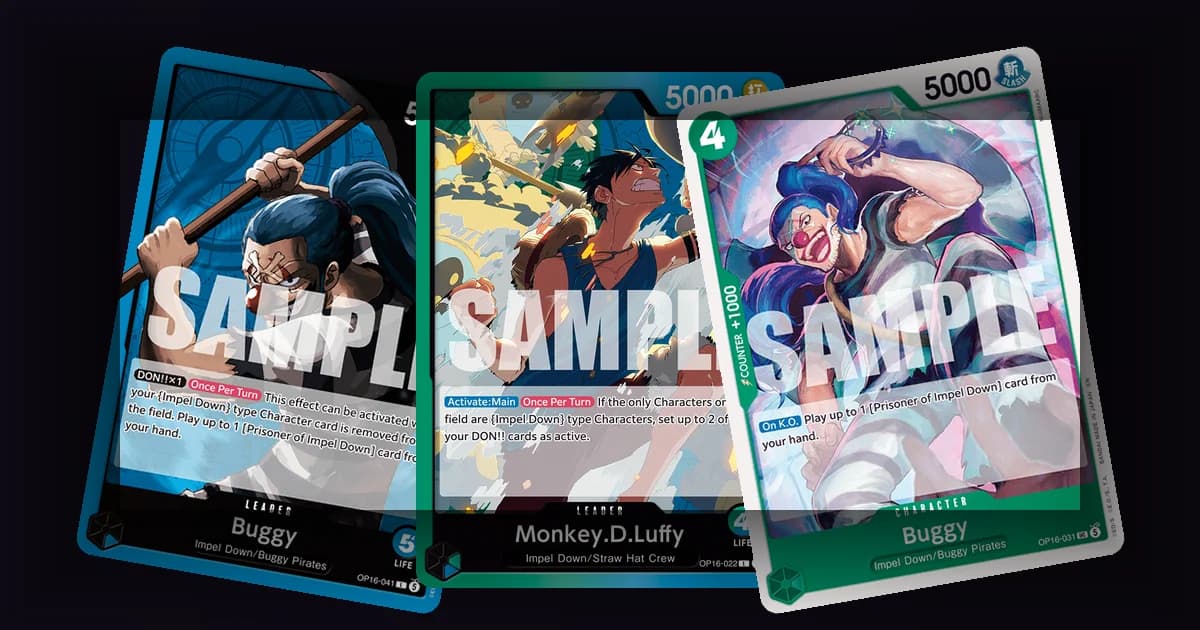
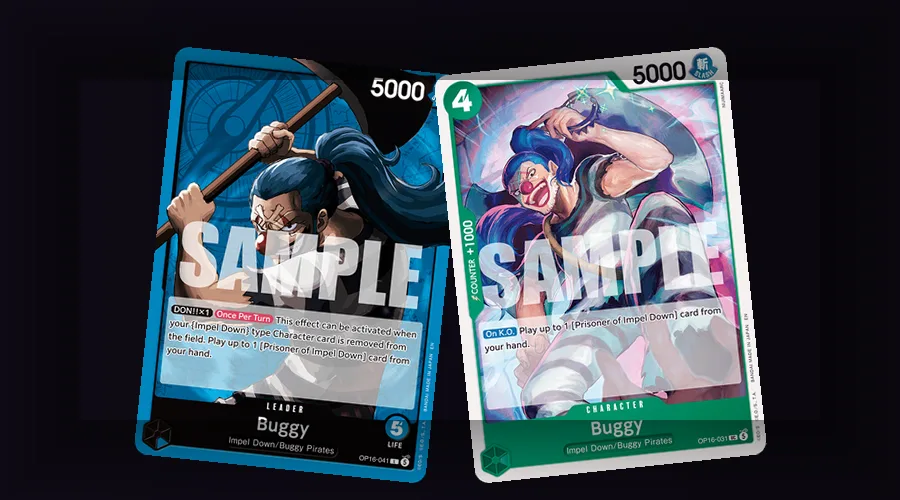 These real OP-16 sample cards show Buggy Leader and a green Buggy Character. They are representative artwork, not a current price quote or a complete budget list.
What to buy first
The correct order is the order that makes the deck function. Do not assume that one card category always has the highest value across every Leader.
1. The Leader and legal shell. Confirm the Leader's color, Block status, and current tournament legality. Then price the cards that define the deck's plan. If the shell is not complete, counter upgrades will not fix it.
2. Consistency pieces. Buy the cards that find, draw, or enable the deck's central plan. A cheap list that misses its required curve is more expensive in practice because you learn from an inaccurate version of the deck.
3. Counter and defensive slots. Count the counter values and defensive effects in the actual list. Do not replace every card with a cheaper card just because both display a Counter number. The effect, cost, color, trait, and timing can be part of the deck's plan.
4. Core Characters and Events. Complete the copies that appear in the recent list. If a card is expensive, test a substitute in casual games and record what the deck loses before deciding the savings are worthwhile.
5. Finishers and premium treatments. Buy the last. A Secret Rare, alternate art, Manga Rare, or Super Parallel Rare can be a collector choice, but it is not automatically necessary for the deck's game plan. Verify the standard-print alternative first.
This order also makes an upgrade path easier. You can play the deck, identify its real problems, and spend the next dollar on a measured improvement instead of guessing from a rarity symbol.
Starter decks, reprints, and the real price check
Starter decks can lower the entry cost because they package a playable list and fixed contents. Official product pages are the right place to confirm what a starter contains. The secondary market is still the right place to compare the price of one specific card, because the starter's sealed cost and the single's price may move in opposite directions.
For each card, compare at least these versions:
- The cheapest legal regular printing
- A starter deck or later reprint with the same card number and effect
- A playset listing versus four separate singles
- A listing in your language and region with shipping included
- The total cost after marketplace fees, taxes, and condition differences
Do not call a card a reprint simply because the art looks similar. Record the card number and confirm the text and legality. Parallel and alternate-art copies can carry a collector premium that has no place in a play-only budget.
The price check should happen on the day you build the list and again before you buy. The TCGplayer One Piece Card Game listings can provide marketplace context, but listing prices are not the same as completed sales. Compare multiple sellers and use a local store quote when it is available.
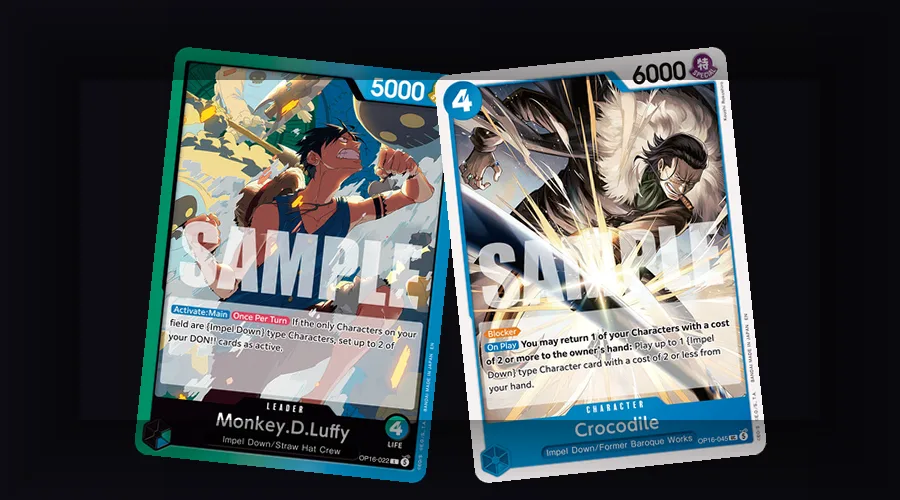 These real OP-16 sample cards show Monkey.D.Luffy Leader and Crocodile Character. They illustrate card artwork only and do not establish current prices or tournament performance.
How rotation changes a budget deck
The “old cards stay legal forever” assumption is now wrong for Standard. Bandai's Block Number system began April 1, 2026. The official schedule describes Standard as an approximately three-year pool, with Blocks 2 through 5 used from April 2026 to March 2027 and Blocks 3 through 6 used from April 2027 to March 2028. Extra Regulation is the broader format, but an event's detailed rules still control.
This matters to budget players because a cheap card can be cheap precisely because its Standard demand is ending. Before buying a large stack of an older staple, record its printed Block number and check the official Block Number update page. Bandai also says that some card numbers receive updates and that past Super Parallel Rare cards and matching numbers generally receive special Standard treatment.
Rotation is not the only legality risk. The official restriction notice uses banned cards, banned pairs, and restricted cards, and says the list may change with the environment. Read the live official restriction page before copying a list from an older event. A card that was affordable and useful six months ago may be banned, paired out, or simply replaced.
Where budget decks can succeed
Use precise language about outcomes.
They can be good learning tools. A complete lower-cost list lets you practice DON!! timing, attacks, counter decisions, and matchup plans without waiting until you own every premium card.
They can win individual games. A budget list can open well, exploit a matchup, or be piloted better than an expensive opponent. That is a real result, but it is not evidence that the list is universally favored.
They may perform at a local event. A local field varies by store and week. Check the actual Leaders people play and test into them. Do not use one local finish as a guarantee for a Regional or Championship event.
They can struggle when consistency is the difference. If the budget version removes the cards that search, draw, answer a board, or close a game, the cost saving can show up over multiple rounds. That is where an “under $100” target can stop being the same deck in practice.
For tournament evidence, compare repeated results and complete decklists rather than a single social post. Limitless is useful for this check, but its data is a tracking resource, not an official ranking.
Step-by-Step: Building and upgrading on a budget
1. Pick the format and date. Decide whether you need Standard or Extra Regulation, then check the current official rules, Block Number, and restriction pages.
2. Choose a recent legal list. Start from a complete decklist that has appeared in the format you plan to play. Record the event date and set context so an old list does not quietly become your baseline.
3. Build a net-cost spreadsheet. List card number, quantity, printing, language, condition, seller, shipping, fees, and total. Mark optional premium treatments separately.
4. Buy the engine before the ceiling. Complete the Leader, early curve, search, draw, counters, and core effects before buying the rare finisher that looks best in a photo.
5. Test every substitution. Play enough games to identify what the cheaper card fails to do. If it changes the deck's curve or matchup plan, count the lost performance as part of the cost.
6. Upgrade from evidence. After testing, replace the card that causes the most recurring losses. Do not buy a premium card merely because a content creator called it a staple.
7. Recheck before the event. Confirm the latest Block update, restriction notice, and event format. Price the missing cards again because a new result or reprint can change the best purchase.
Key takeaways
- Treat $100 as a target that must be checked against current listings, not a permanent promise
- Standard uses the Block Number system from April 1, 2026, so older cards are not automatically legal
- Choose a complete current list before buying generic staples
- Buy the engine and consistency pieces before finishers, alternate art, or premium rarity
- Starter decks and reprints can help, but verify card number, legality, language, and current net cost
- Budget decks can win games and local events, but price does not guarantee regional performance
- Use official rules, Limitless results, and marketplace context together
Related Reading
- OP-16 Full Card List and Spoilers: set context before you price singles.
- OP-16 Buggy Blue Deck Guide: a sample archetype path to evaluate with current lists and prices.
- One Piece TCG Meta Rotation Guide: rotation, legality, and card-demand risk.
- One Piece TCG Trade Guide: trading duplicates toward missing staples.
- One Piece TCG Best Starter Decks 2026: starter-product comparison.
- One Piece TCG Ban List and Restrictions Explained: restriction context before registering a list.
- One Piece TCG Budget Decks: Current Lists Under $100: dated public lists with card-by-card price snapshots and legality flags.
Frequently Asked Questions
Q: Can you play One Piece TCG competitively on a budget? A: A sub-$100 target is possible for some lists and regions, but it is not a guaranteed tournament price. Build a legal list, compare current cards, and test the result before calling it event-ready.
Q: What is the cheapest competitive deck? A: There is no permanent answer. Tournament results, reprints, rotation, language, condition, and local supply can change which list is cheapest from week to week.
Q: Do old cards stay legal? A: Not all old cards stay in Standard. The Block Number system began April 1, 2026, and Standard follows an approximately three-year pool. Older cards may fit Extra Regulation or other formats instead.
Q: What should I buy first? A: Buy the Leader, legal engine, consistency pieces, counters, and core cards that make the list function. Add premium finishers only after testing the playable version.
Q: Can a budget deck beat a meta deck? A: It can win individual games and may do well at a local event. A low price does not predict a long tournament result, so compare the full list and practice the matchups.
Q: How much does a Regional deck cost? A: There is no stable price floor. Use current listings or completed-sales context for the exact Leader, language, treatment, and region instead of relying on a fixed $150 to $300 estimate.
Q: Should I use starter deck cards? A: Yes, if they are legal and fit the list. Compare the sealed starter cost and the current single price, because the starter copy is not automatically the cheapest option.
References
- One Piece Card Game official rules: current rule manuals and official updates.
- Introduction of the Block Number System: Standard, Extra Regulation, and schedule examples.
- Overview of Cards Subject to Block Number Updates: Block updates and Super Parallel Rare treatment.
- Official Banned/Restricted Card Notice: current restriction categories and revision policy.
- One Piece Card Game official products: starter and booster product information.
- Limitless One Piece tournaments: results and event context.
- Limitless One Piece decks: decklists for current comparison.
- TCGplayer One Piece Card Game listings: marketplace context for a live price check.
Was this guide helpful?
About the author
Beginner guides and anime crossover
Pen name for the Shonen TCG desk's beginner guides, starter decks and anime-to-card-game explainers.
- Rules checked against the official rulebook and card text
- Every claim traced to a cited source
- Opinions marked as ours, with the reason
Keep reading

One Piece TCG Deck Building Guide: Build From Scratch
Guides · 12 min
One Piece TCG Meta Rotation Guide: When to Sell Cards
Guides · 15 min
One Piece TCG Trade Guide: How to Trade Cards Fairly
Guides · 13 min
One Piece TCG Standard Format Guide 2026: Legal Sets
Guides · 12 min
OP-16 Ace Deck Guide: Whitebeard Pirates Rush Build
Guides · 12 min
OP-16 Collectors Guide: SEC, Manga Rare, Alt-Art Cards
Guides · 11 min
OP-16 Box Opening Strategy: How Many Boxes to Open
Guides · 10 min

OP-16 vs OP-15 power level comparison: what changed?
Guides · 11 min
Disclaimer
This article is published for informational and entertainment purposes. It does not constitute professional financial, legal, or technical advice. Game performance, online services, patch schedules, and store listings change. Verify critical details (pricing, system requirements, regional availability) with publishers and storefronts before you buy. Affiliate links, where present, help support our editorial work and are labelled in our affiliate disclosure.