Loading…


Shonen TCG · Guides
OP-16 Singles Buy Hold Sell: September 2026 Snapshot
OP-16 singles buy hold sell snapshot for September 2026: dated prices, tournament evidence, and a risk-aware decision for your deck or collection.

This OP-16 singles buy hold sell snapshot replaces the old week-one calendar with dated market and tournament context. The Time of Battle released in English on June 12, 2026, so the launch-week windows in the original version are no longer actionable. Bandai's product page confirms the release date, a $4.99 per-pack MSRP, and seven-day tournament legality in each region, with a local prerelease exception.
Updated September 18, 2026: The advice below is a decision framework for players and collectors, not a promise of profit. Market figures are snapshots from September 12, and the OP-16 competitive view is a separate format filter from the newer OP-17 environment.
TL;DR: The three Admiral Manga Rare variants remain the set's expensive chase cards, but the old week-based buy and sell calls are no longer useful. Buy regular cards for a defined deck need, buy premium variants only for a collection goal, and treat future appreciation as speculation.
OP-16 singles buy hold sell? (quick answer)
The short answer is to separate three questions before spending money:
- Do you need a card to finish a deck for a specific event?
- Do you want a particular printing for a collection?
- Are you hoping a purchase will rise in price later?
The first two can produce a sensible purchase when the price fits your budget. The third is speculation. Nothing in the current market data turns a buy, hold, or sell label into a guaranteed outcome.
InkSight's September 12 TCGplayer Market Price snapshot puts the three OP-16 Admiral Manga Rare variants at $1,127 for Sakazuki, $1,109 for Kuzan, and $1,043 for Borsalino. It also reports a $0.12 median among priced OP-16 cards, with a $31.13 SEC median, $5.82 Leader median, $5.67 Super Rare median, $0.19 Rare median, $0.09 Uncommon median, and $0.07 Common median. These figures describe very different parts of the set. They are not a reason to assume that every rare card has upside.
The same source says the top five cards account for 81.2% of tracked set value. That concentration explains why the three Manga Rares can remain expensive while much of the regular set sits near bulk pricing. It does not establish how any one card will perform next month.
A dated price snapshot
| Card or group | September 12 market reference | What it tells you |
|---|---|---|
| Sakazuki Manga Rare, OP16-065 | $1,127 | The highest OP-16 card in this snapshot, with a thin and volatile premium market |
| Kuzan Manga Rare, OP16-063 | $1,109 | Close to Sakazuki in the same snapshot, so the gap is not a reliable timing signal |
| Borsalino Manga Rare, OP16-073 | $1,043 | Still a four-figure chase card, but not proof that the other two will follow its movement |
| Zehahahahaha! alternate art, OP16-116 | $59.35 | A lower-priced collector variant that has a different supply and demand profile |
| Portgas.D.Ace Leader alternate art, OP16-001 | $49.43 | A premium Leader printing, not the same product as the regular Leader |
| Yamato Leader alternate art, OP16-079 | $48.34 | A collector version of the black Yamato Leader, not evidence of deck performance |
The prices above come from a single dated snapshot. Listings, condition, language, seller reputation, shipping, and taxes can all change the delivered cost. Check the exact listing on TCGplayer's OP-16 set page before you transact.
What the old week-one thesis got wrong
The original article offered week-based calls: buy Black Yamato pieces before Regionals, expect Admiral Super Rares to dip in weeks two through four, and treat weeks three through five as the broad buying window. Those calls are now historical claims, not current instructions.
The first problem was treating a calendar as a market mechanism. InkSight's 50-day report, using a September 5 snapshot, compared June 18 with August 6 and found the three Manga Rares largely held their level or gained slightly over that window: Borsalino moved from $1,011.30 to $1,059.52, Sakazuki from $1,205.32 to $1,224.82, and Kuzan from $1,188.00 to $1,161.82. The report also found larger declines among several mid-tier alternate-art and SEC printings. This is useful evidence that different rarity groups behaved differently. It is not proof that the same pattern will repeat.
The second problem was treating a Japan result as confirmation for the English format. The official OP-16 page presents Black Yamato as a recommended Black deck, but a recommendation is not a tournament tier. In Limitless's current OP16 dashboard, the displayed leader ranking is led by Blue/Yellow Nami at 23.52%, Green/Blue Luffy at 22.91%, Purple Enel at 22.71%, Purple/Yellow Rosinante at 9.88%, and Black/Yellow Blackbeard at 8.86%, followed by Red/Blue Lucy at 2.44%. The dashboard is a useful format-filtered reference, but it should not be confused with a universal current Standard ranking.
Pankurecords' OP16 archive gives a broader sense of the evidence. Its September 7 update lists 212 decklists from 43 official events and shows several leaders reaching high placements, including Green/Blue Luffy, Black/Yellow Teach, Purple/Yellow Rosinante, Purple Enel, and other decks. A mixed result set is a reason to use careful wording, not to call one card a safe buy.
OP-16 singles buy hold sell: decide by card type
Buy when the need is specific
Buying makes the most sense when a card completes a deck, replaces a damaged copy, or meets a defined collection goal. Start with the exact card number. The official card list identifies OP16-065 as Sakazuki, OP16-063 as Kuzan, and OP16-073 as Borsalino, all purple Admiral/Navy Characters. The premium Manga Rare treatment and the regular card are separate market objects even when they share a card number.
For a player, compare the regular printing first. If a scheduled event needs a playset, a current clean listing may be more useful than waiting for a generic week-based dip that may never arrive. Check the event notice because Bandai's general product page says cards become legal seven days after release in a region, while local prerelease events are an exception.
For a collector, buy the exact art and finish you actually want. A $49.43 Leader alternate art and a regular Leader are not interchangeable collection targets. A Manga Rare at more than $1,000 needs an even stricter check of language, condition, grading, seller history, and return policy.
Hold only when the reason is clear
Holding a card can mean keeping it for play, keeping it because you like the character, or waiting to complete a collection. Those are personal reasons. They are easier to defend than a claim that a card will appreciate.
The three Admiral Manga Rares have strong collector visibility in the September snapshot, and the official product page specifically highlights the Three Admirals Super Alt-Art feature. That supports collector interest, but it does not create a price floor. If you already own one, decide whether the card gives you more value in your collection than its current sale proceeds would give you. Revisit that decision when a real event, reprint, banlist change, or major supply shift occurs, not simply because a week number changed.
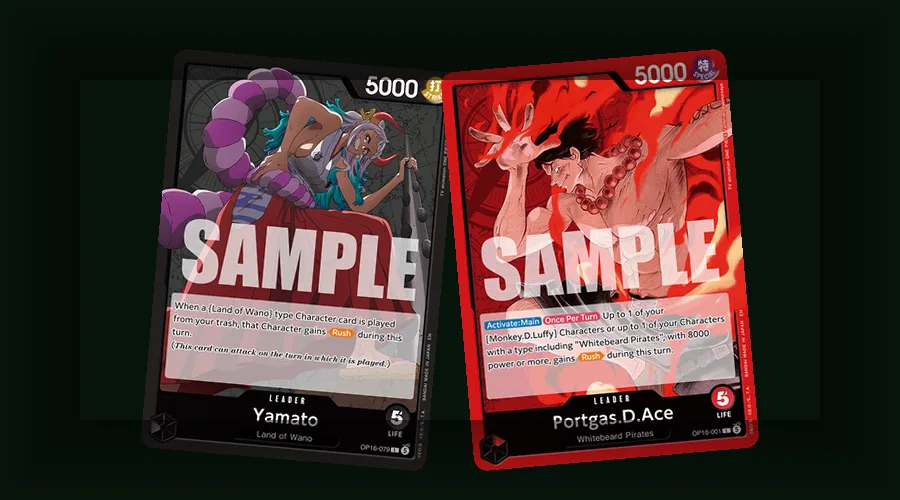 This real OP-16 image shows the Yamato and Portgas.D.Ace Leader cards. It illustrates card identity, not current pricing or the contents of a Yamato support package.
Sell or skip when the thesis is only hype
Selling can be reasonable when you have a duplicate, no longer need the card, or would rather use the money elsewhere. It is not automatically correct because a new set released or because a listing headline looks high.
Before listing a card, compare several current offers for the same card number, language, finish, and condition. Asking prices are not completed sales. For premium variants, a small number of transactions can make a market look more stable than it is. Use a conservative net figure after fees, shipping, taxes, and the chance that the card sits unsold.
The old article's advice to sell all standard Admiral copies or non-competitive Secret Rares during a fixed launch window should not remain as a rule. A card's play value can change, and a collector may value a card even when it is not in a top deck. Sell because the card no longer serves your plan, not because an old forecast says the window is closing.
A five-step checkout and resale check
- Write down the exact identity. Record the set, card number, card name, rarity, printing, language, and condition. Use the official OP-16 card list if a marketplace title is incomplete.
- Separate play from collecting. If you need a legal deck, compare regular copies first. If you want a premium treatment, make that a collection decision rather than a disguised deck expense.
- Record the date and market. Save the source, currency, listing condition, and delivered total. The September 12 InkSight figures above are not today's guaranteed checkout prices.
- Set a hard budget. Include shipping, taxes, platform fees, grading, and sleeves or storage where relevant. Do not increase the ceiling because a listing uses urgent language.
- Check the competitive context separately. Use the Limitless OP16 dashboard for format-filtered results and the OP16 event archive for dated event lists. Meta evidence can explain play demand, but it cannot predict a card's resale price.
For a broader purchasing workflow, the OP-16 singles buying guide has useful identity and budget checks. The OP-16 price guide adds dated market context, while the OP-16 most expensive cards article covers collector concentration. Those references are more useful than trying to turn launch-week timing into a universal formula.
Key takeaways
- The September 12 snapshot places the Sakazuki, Kuzan, and Borsalino Manga Rare variants at about $1,127, $1,109, and $1,043.
- InkSight reports that the top five OP-16 cards hold 81.2% of tracked set value, so the chase market should not be used to represent every card.
- The current OP16 Limitless view displays Nami, Green/Blue Luffy, Purple Enel, Purple/Yellow Rosinante, Black/Yellow Blackbeard, and Red/Blue Lucy as its top six displayed groups.
- The old weeks-three-to-five buying window is a historical hypothesis, not a dependable schedule.
- Buy for a known deck or collection goal, hold for a reason you can state clearly, and sell only after checking the exact printing and net proceeds.
- Standard copies are usually the practical player option. A premium variant is not required just because it is expensive.
Related reading
- One Piece TCG OP-16 Complete Guide: the set hub for leaders, mechanics, and deck context.
- OP-16 Singles Buying Guide: a card-identity and checkout workflow.
- OP-16 Price Guide: dated market context for the broader set.
- OP-16 Most Expensive Cards: collector concentration and premium variants.
- OP-16 Meta Report: older tournament context that should be read with its date visible.
Frequently Asked Questions
What are the most expensive OP-16 singles right now?
InkSight's September 12 snapshot lists Sakazuki, Kuzan, and Borsalino Manga Rare variants at about $1,127, $1,109, and $1,043. Verify the exact version and a current listing before transacting.
Should I buy an OP-16 Manga Rare?
Only if it meets a collection goal and the delivered price fits your budget. The market snapshot shows demand, not a guaranteed return. Treat a purchase made for future appreciation as speculation.
Are regular OP-16 cards enough for competitive play?
Yes. Confirm the exact card number, version, language, and event legality, then buy the regular printing when it does the job. A premium finish is a collector choice, not a gameplay requirement.
Is Black Yamato still an OP-16 top-tier buy?
The official site recommends a Black Yamato deck, but that is not the same as a current tier placement. Limitless's displayed OP16 ranking currently emphasizes other leaders, so use dated results instead of repeating the old week-one claim.
Is there a reliable week to buy OP-16 singles?
No. The old week-three-to-five forecast has already passed, and the 50-day market report shows different behavior across premium and mid-tier printings. Compare the specific card instead of following a calendar.
Did OP-17 automatically make OP-16 cards a sell?
No. A new release may shift attention, but a single snapshot cannot prove that it caused a price move. Check current offers and your own need before deciding.
References
- Bandai official OP-16 product page: release date, MSRP, legality note, featured Leaders, and Three Admirals treatment.
- Bandai official OP-16 card list: card numbers, names, types, and effects.
- InkSight OP-16 market snapshot: TCGplayer Market Price data dated September 12, 2026.
- InkSight OP-16 50-day market report: dated comparison of premium and mid-tier printings.
- Limitless One Piece OP16 dashboard: format-filtered deck ranking and tournament context.
- Pankurecords OP16 official event archive: dated official-event decklists.
- TCGplayer The Time of Battle set page: current listings to recheck before purchase.
About the author
MS
TCG Collector & Value Analyst
TCG collector and value analyst covering anime card games since 2021. Specializes in pull rates, card values, and market trends across One Piece TCG and Union Arena.
- TCG collector since 2021
- Tracks card values across TCGPlayer and CardMarket
- Pull rate analysis across 100+ boxes opened
- Covers One Piece TCG and Union Arena collector market
Keep reading
OP-16 Impel Down Buggy Deck Guide: Blue Swarm Build
Guides · 15 min
OP-16 Price Guide: What Every Card Is Worth (2026)
Guides · 11 min
OP-17 Spoilers: All Confirmed Cards and Leaders 2026
Guides · 12 min
OP-16 Marco Deck Guide: Phoenix in Whitebeard 2026
Guides · 15 min
Purple Enel Deck Guide for One Piece TCG OP-16 2026
Guides · 11 min
Blue Yellow Nami OP17 Deck Guide: One Piece TCG Draw Engine
Guides · 18 min
One Piece TCG Global Launch: What EN Players Gain in 2026
Guides · 9 min
One Piece TCG Nami Counter Guide: Beat Blue Yellow 2026
Guides · 10 min
Disclaimer
This article is published for informational and entertainment purposes. It does not constitute professional financial, legal, or technical advice. Game performance, online services, patch schedules, and store listings change. Verify critical details (pricing, system requirements, regional availability) with publishers and storefronts before you buy. Affiliate links, where present, help support our editorial work and are labelled in our affiliate disclosure.