

Shonen TCG · Guides
One Piece TCG Purple Deck Guide: DON Ramp and Control
Reviewing
One Piece TCG
One Piece TCG Purple deck guide, short version: Purple is the color that adds DON!! from your DON!! deck faster than the normal turn does, then spends DON!! as a cost through "DON!! −X" effects. That push and pull is the whole color. This guide explains the real DON!! rules first, because the color only makes sense once you know them, then covers the three Purple leaders worth knowing in late 2026: Enel, Kaido and Sengoku.
TL;DR: Under the comprehensive rules each player has a 10-card DON!! deck and places 2 DON!! per turn (1 on the first player's first turn). Purple cards break that pace by adding extra DON!! from the DON!! deck, and many of them pay "DON!! −X" costs, which return DON!! to the DON!! deck. On OPMetagame's current OP-17 tier list, Purple Enel is S (87 decklists, 50.5% win rate) and Purple Kaido is A (101 decklists, 50.2%). Sengoku (OP16-060) returns 8 active DON!! to play up to 3 Admirals from hand.
Updated October 8, 2026: Rewritten after a full check against Bandai's card lists and comprehensive rules. The old version said each player "untaps exactly 1 DON!! per turn" (the rules add 2 per turn) and described Sengoku's ability as an on-attack search; both were wrong. Enel is now listed as mono-Purple, as Bandai's card list shows, and the tracker figures are refreshed.
One Piece TCG Purple deck guide: quick answer
Purple's identity is DON!! manipulation. Its cards add DON!! from the DON!! deck beyond the normal 2 per turn, and they also spend DON!! with "DON!! −X" costs that send DON!! back to the DON!! deck. A Purple deck therefore runs ahead on DON!! early, then converts that lead into removal, extra Characters or a big leader activation.
Key Takeaways
- Each player has a 10-card DON!! deck and places 2 DON!! per turn in the DON!! phase; the player going first places only 1 on their first turn
- In the Refresh Phase all your rested cards, including DON!!, become active again, so DON!! is never stuck tapped
- "DON!! −X" means returning X DON!! cards from your field to your DON!! deck; Purple uses it as a cost on many cards
- Enel (OP15-058) is mono-Purple and plays with a 6-card DON!! deck; OPMetagame lists Purple Enel at S with 87 decklists and 50.5%
- Kaido (OP17-058) pays DON!! −1 for −2000 power once per turn; OPMetagame lists Purple Kaido at A with 101 decklists and 50.2%
- Sengoku (OP16-060) returns 8 active DON!! to play up to 3 differently named Admirals from hand
How DON!! works, and what Purple changes
Most guides skip the rules, so start there. Rule 5-1-2 gives each player "a 10-card DON!! deck." In the DON!! phase (rule 6-4-1) you place 2 DON!! cards from the DON!! deck into your cost area, except that the player going first places only 1 on their first turn. In the Refresh Phase (rule 6-2-4) every rested card in your Leader, Character, Stage and cost areas becomes active again. Without help, the first player has 1 DON!! on turn 1, 3 on turn 2, 5 on turn 3, and so on until all 10 are out.
Purple changes the pace in two directions:
- Adding DON!!. Purple Characters often "add up to 1 DON!! card from your DON!! deck" or more on play. Kuzan adds 2 rested, Borsalino adds 1 active and 1 rested, and Sakazuki can add 2 active once per turn with a Navy leader.
- Spending DON!!. Rule 10-2-10-1 defines "DON!! −X" as selecting X DON!! cards from your Leader area, Character area and cost area "and return them to your DON!! deck." Kaido's leader ability, Sakazuki's On Play and Kuzan's blocker lock all use it.
The two halves feed each other. DON!! you return with a −X cost goes back to the DON!! deck, so the next "add DON!!" effect has something to pull. That is why Purple decks can pay large DON!! costs and still keep up on the board. The One Piece TCG DON!! system guide covers the base rules in more depth.
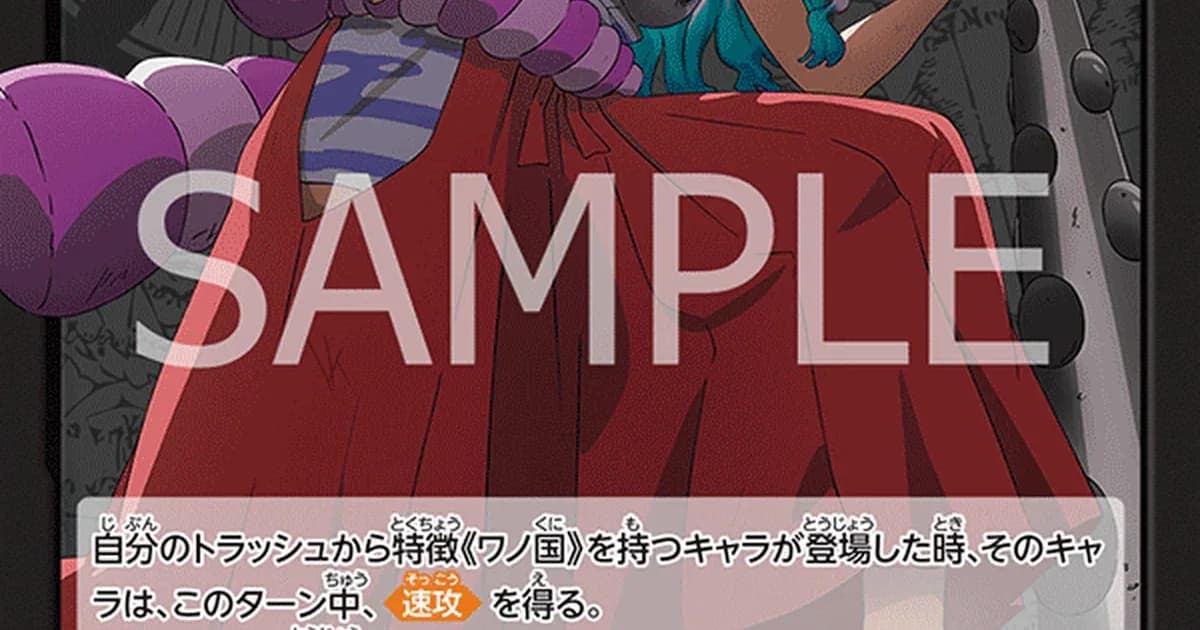
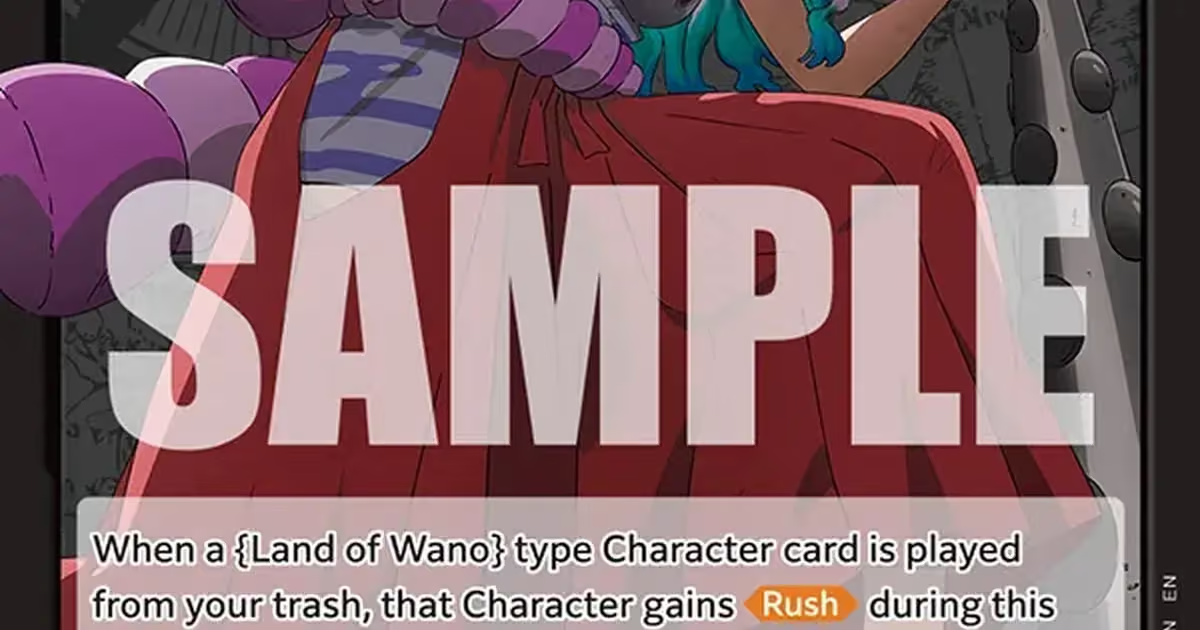
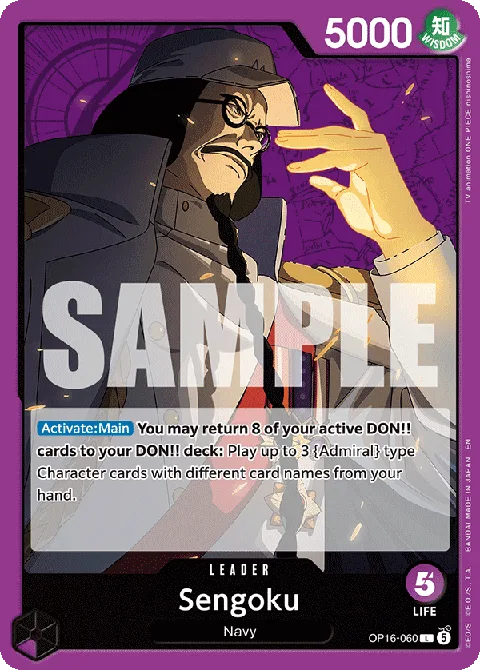 Image: Bandai official card list (OP16-060).
GODEEPER: New to the game's colors and turn structure? The beginner guide walks through all six colors and a full turn. One Piece TCG Beginner Guide 2026 →
Purple leaders to know in 2026
Enel (OP15-058)
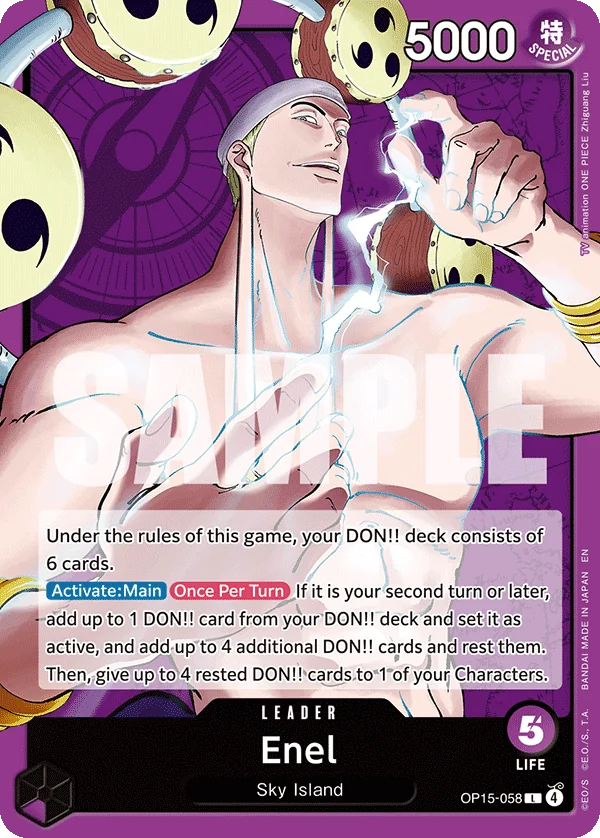 OP15-058OP15-058Shop on TCGplayer Enel is a mono-Purple leader with 5 Life and 5000 power. His first line rewrites the DON!! rules for you: "Under the rules of this game, your DON!! deck consists of 6 cards." Once per turn, from your second turn on, he adds 1 DON!! as active and up to 4 more rested, then gives up to 4 rested DON!! to one of your Characters. The deck reaches its whole DON!! deck far earlier than a normal 10-card deck can.
OPMetagame's tier list names Purple Enel among its headline S-tier decks, with 87 decklists, and its decks table shows a 50.5% average win rate at 6.3% popularity. The Purple Enel deck guide covers the OP-16 version of the list.
Kaido (OP17-058)
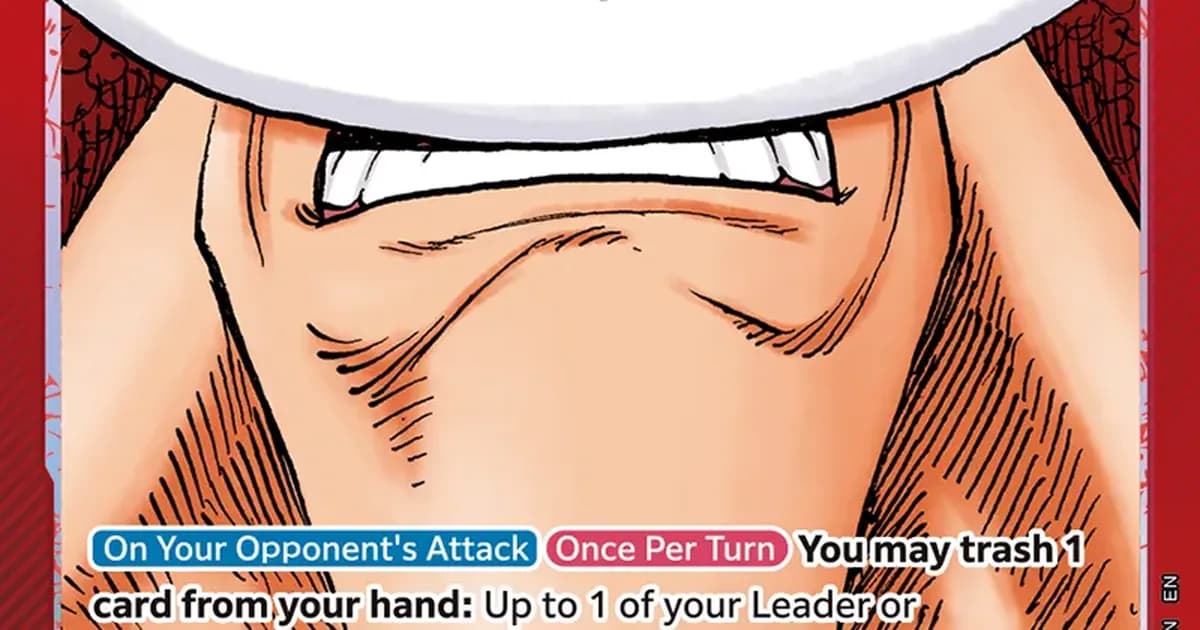
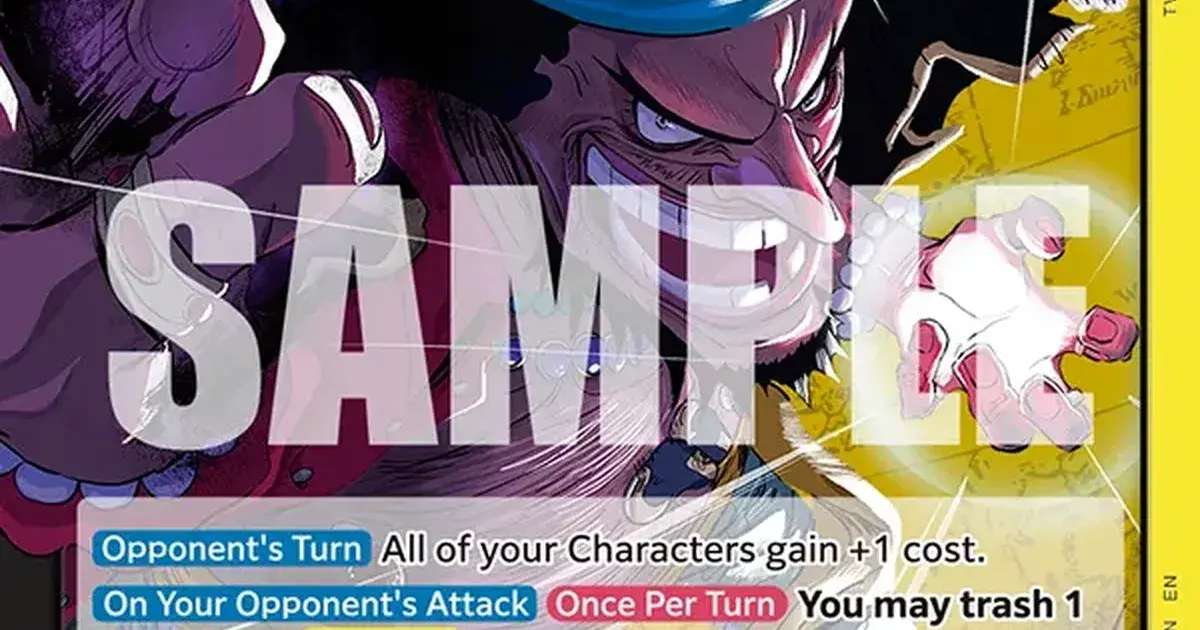
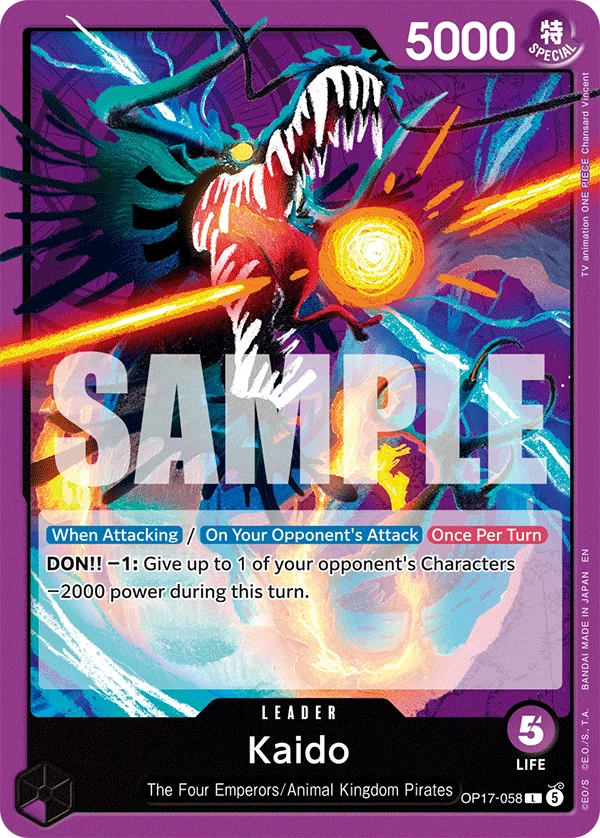 OP17-058OP17-058Shop on TCGplayer Kaido is OP-17's Purple leader, 5 Life and 5000 power, with the types The Four Emperors and Animal Kingdom Pirates. His ability: "[When Attacking]/[On Your Opponent's Attack] [Once Per Turn] DON!! −1: Give up to 1 of your opponent's Characters −2000 power during this turn." It works on both turns, and its only cost is one DON!! returned to the DON!! deck.
OPMetagame places Purple Kaido in A with 101 decklists, a 50.2% average win rate and 5.9% popularity. The OP-17 Kaido deck guide has a full list.
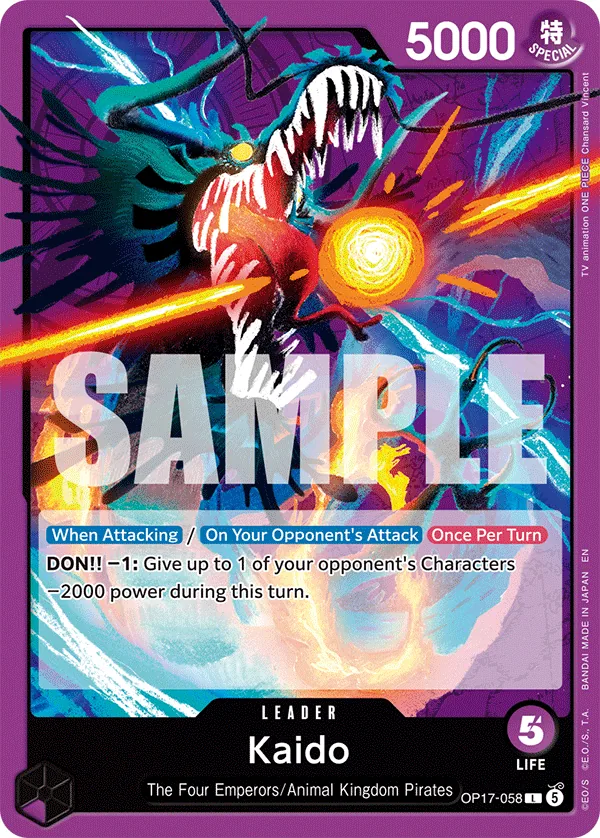 Image: Bandai official card list (OP17-058).
Sengoku (OP16-060)
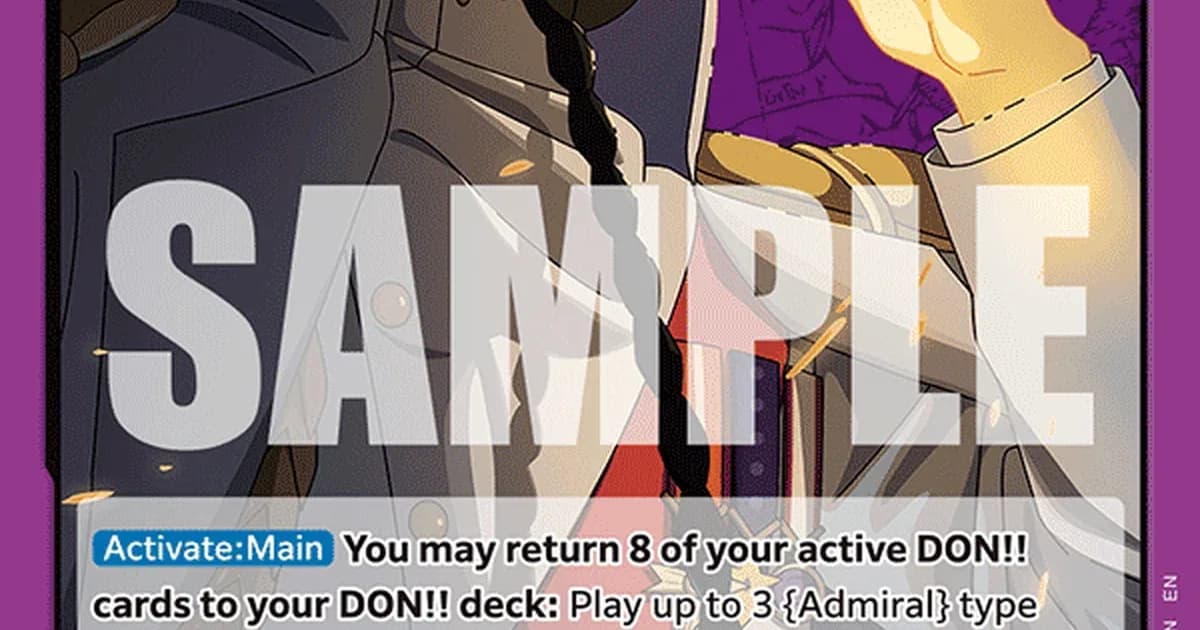
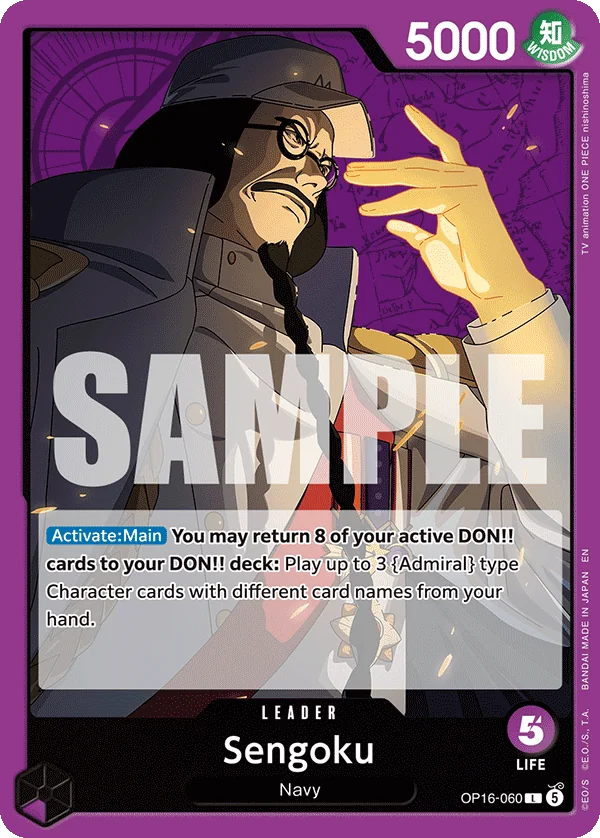 OP16-060OP16-060Shop on TCGplayer Sengoku is OP-16's mono-Purple Navy leader, 5 Life and 5000 power. His only ability: "[Activate: Main] You may return 8 of your active DON!! cards to your DON!! deck: Play up to 3 {Admiral} type Character cards with different card names from your hand." There is no once-per-turn tag, but 8 active DON!! is most of a 10-card DON!! deck, so in practice it is one big turn. The OP-16 Sengoku deck guide has card counts.
Building a Sengoku Admiral deck
The three OP-16 Admirals are all 7-cost, 8000-power Purple Characters with the Admiral and Navy types, and each one adds or uses DON!! on its own:
- Kuzan:
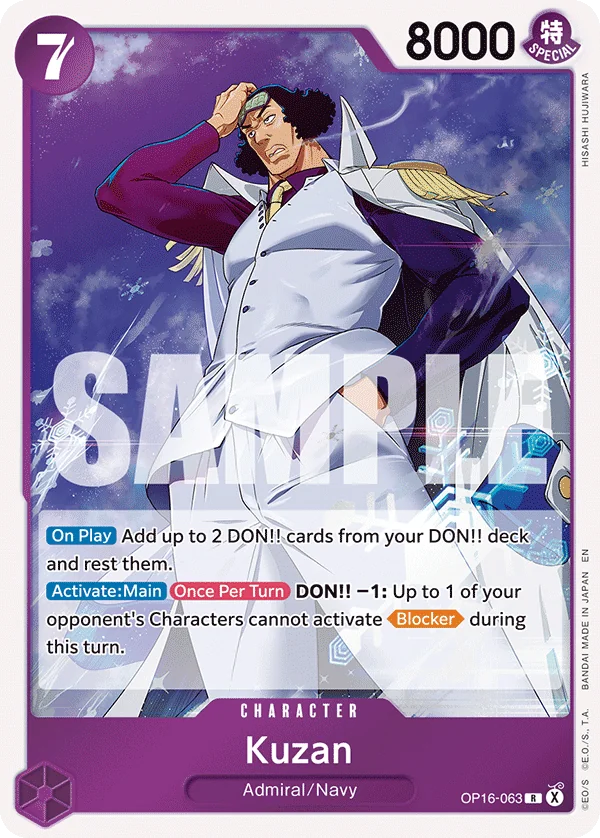 OP16-063OP16-063Shop on TCGplayer On Play adds up to 2 DON!! from your DON!! deck, rested. Once per turn, DON!! −1 stops one opposing Character from using [Blocker] that turn.
 - Sakazuki:
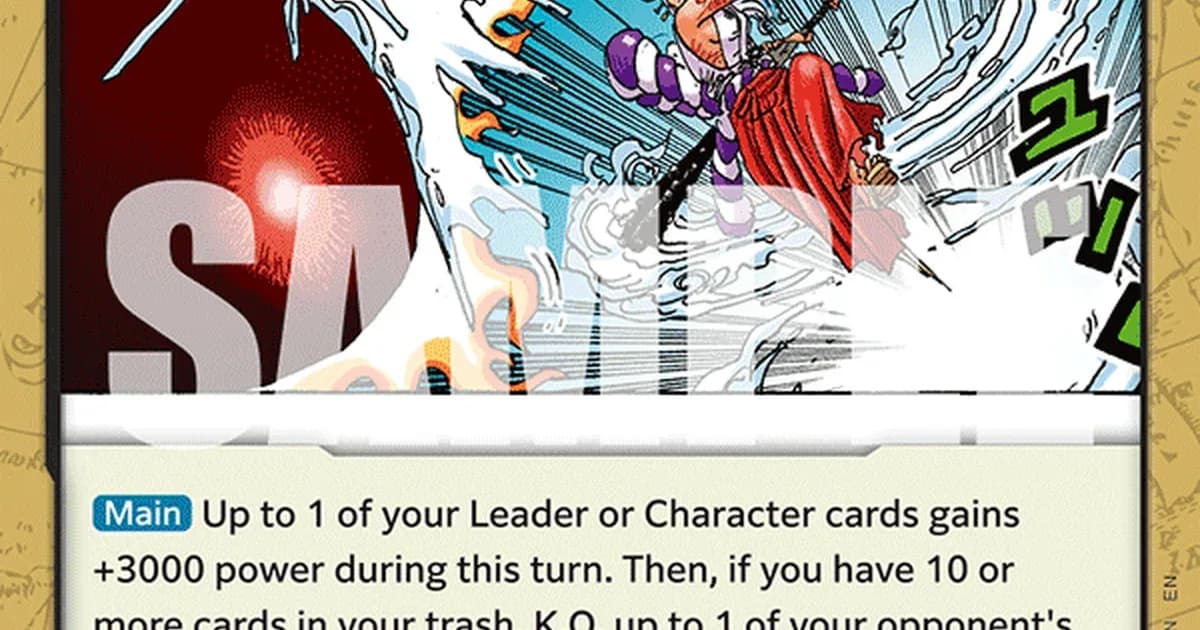
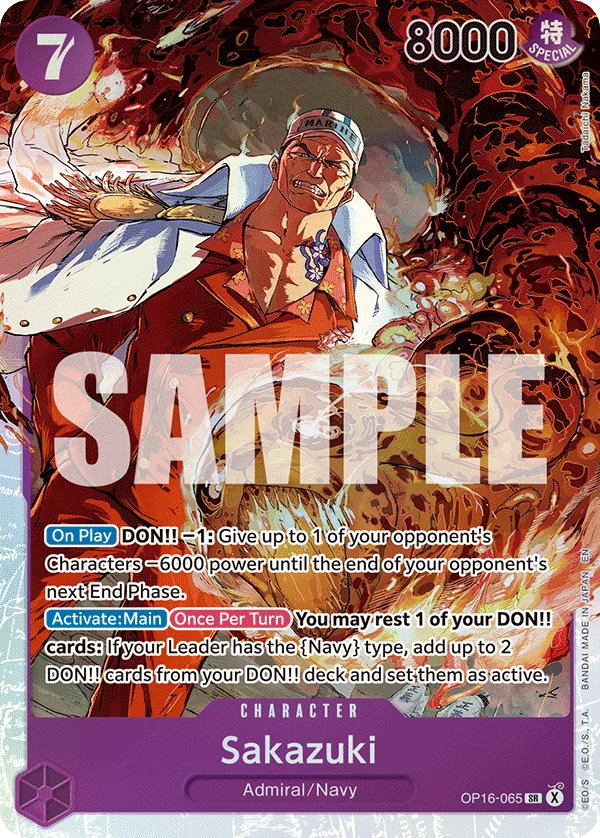 OP16-065OP16-065Shop on TCGplayer On Play, DON!! −1 gives one opposing Character −6000 power until the end of your opponent's next End Phase. Once per turn, resting 1 DON!! with a Navy leader adds up to 2 DON!! from your DON!! deck as active.
 - Borsalino:
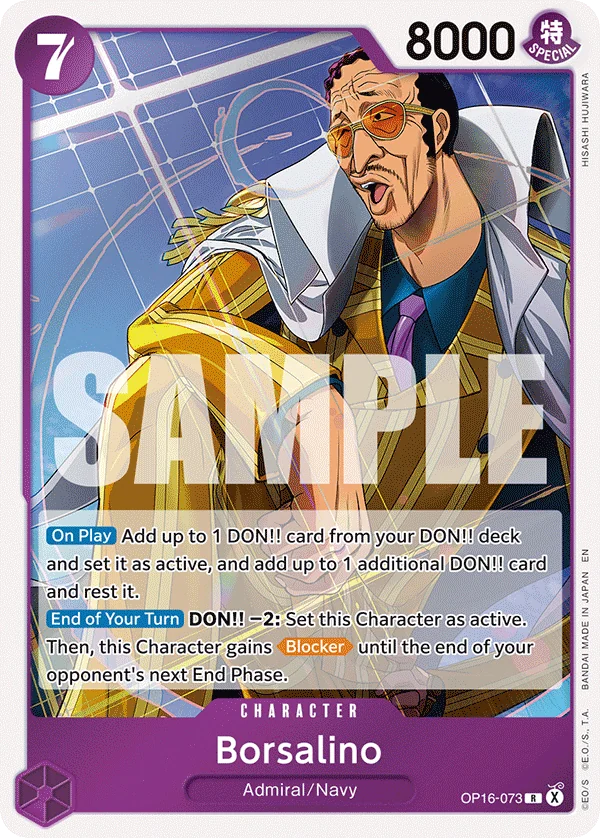 OP16-073OP16-073Shop on TCGplayer On Play adds 1 DON!! as active and 1 more rested. At the end of your turn, DON!! −2 sets him active and gives him [Blocker] until the end of your opponent's next End Phase.
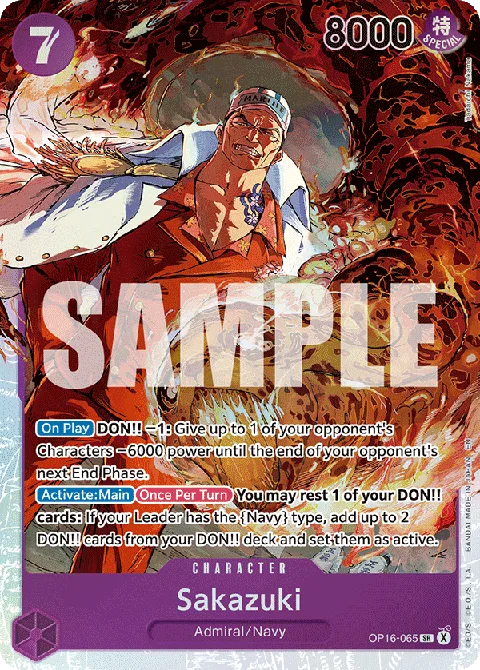 Image: Bandai official card list (OP16-065).
Two cheap Navy searchers find them. Koby 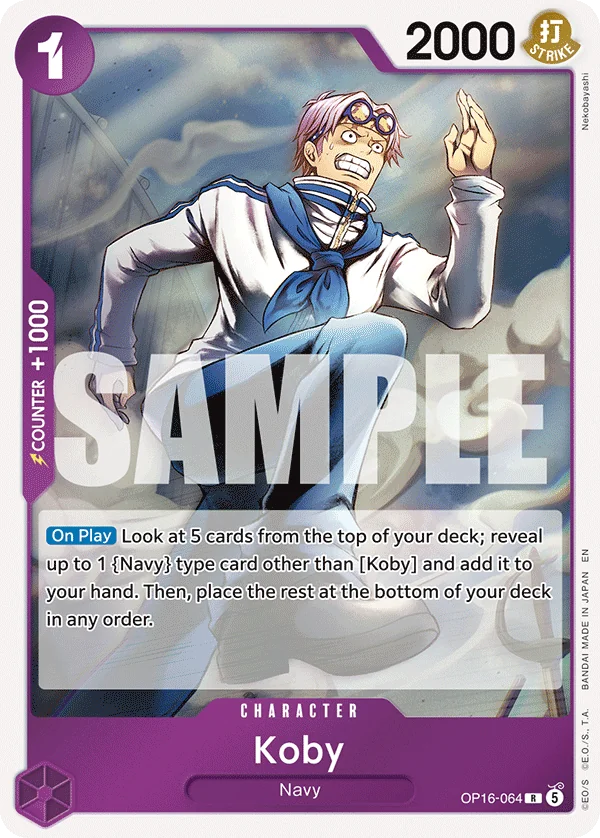 OP16-064OP16-064Shop on TCGplayer (OP16-064) is a 1-cost Character that looks at 5 cards and adds a Navy card other than Koby. Tsuru
 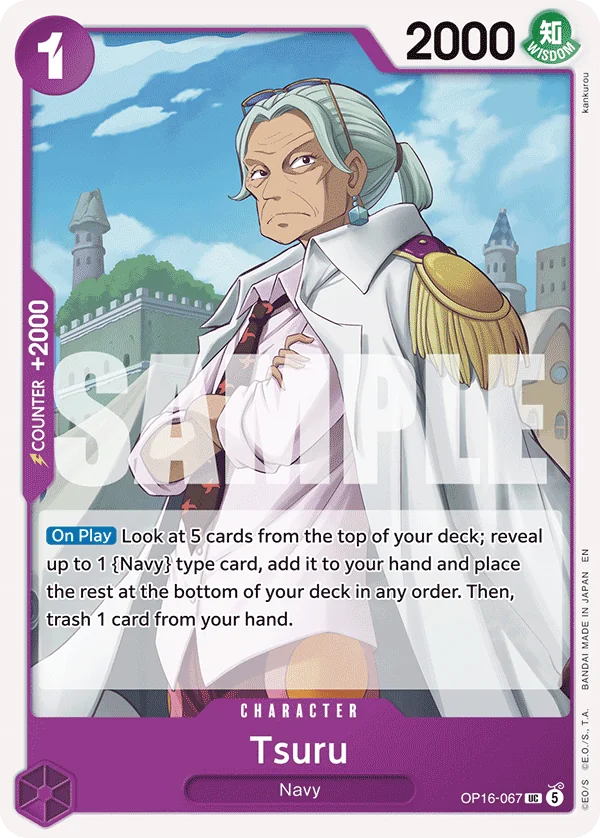 OP16-067OP16-067Shop on TCGplayer (OP16-067) is a 1-cost Character with a 2000 counter that looks at 5 cards for a Navy card, then trashes 1 card from your hand.
SHOP: Building a Purple One Piece deck? Compare current One Piece Card Game singles for the DON!! package. Shop TCGplayer →
GODEEPER: For where the Purple leaders sat in the OP-16 field, the July report has the tournament snapshot. OP-16 Meta Report July 2026 →
Step-by-Step: Piloting a Purple DON!! deck
1. Count your DON!! deck, not just your cost area. Every "add DON!!" effect needs DON!! left in the DON!! deck. With a normal 10-card DON!! deck, the natural 2 per turn empties it fast; Enel's 6-card DON!! deck empties even sooner.
2. Use DON!! −X costs to refill. A DON!! −1 on Kaido or Sakazuki sends DON!! back to the DON!! deck, which gives your next add effect a target. Plan the −X before the add, not after.
3. With Sengoku, build toward 8 active DON!! on the turn you need it. Kuzan, Borsalino and Sakazuki each add DON!!, so landing one Admiral by hand first can make the 8-DON!! return reachable a turn earlier. The leader needs at least two different Admirals in hand to make the return worth it.
4. With Kaido, spend the −1 where 2000 power changes a fight. The ability works on your attack and on your opponent's attack, once per turn. Use it to win a battle or to make an attacker miss, not just because DON!! is available.
5. Search early with Koby and Tsuru. Both cost 1 and look at 5 cards for a Navy card, which is how a Sengoku deck finds its Admirals in time.
Tips
Returned DON!! is not lost. A DON!! −X cost puts DON!! back in your DON!! deck, where your own add effects can bring it back.
Rested DON!! still comes back. Kuzan adds his 2 DON!! rested, but the Refresh Phase sets all rested cards in your cost area active at the start of your next turn.
Read the leader lock. Sakazuki's DON!! add only works "If your Leader has the {Navy} type," so it is a Sengoku card first.
Enel plays with a smaller DON!! deck. His 6-card DON!! deck means more of your DON!! is on the field early, but there is less in the DON!! deck for add effects to draw on.
What Purple players say
A late-September r/OnePieceTCG thread asking for thoughts on Purple Kaido split along the usual line for DON!! decks. The top reply praised the leader: "He has a genetically good ability. Doesn’t rely on animal kingdom pirates. He can essentially slot in any good purple card as long as it isn’t leader locked." Another player was less sure: "Too inconsistent, too bricky, but when the curve is good it feels good to play."
Our take
This take is based only on the card text, the comprehensive rules and the tracker data cited here. Purple is not "ramp" in the sense of untapping more than other colors; it is the color that adds DON!! from the DON!! deck and pays DON!! back as a cost. Right now Enel (S, 50.5%) and Kaido (A, 50.2%) both sit just above even on OPMetagame, so pick between them on style: Enel for a fast DON!! engine, Kaido for a flexible leader that works on both turns. Sengoku is the most dramatic of the three but needs the right Admirals in hand.
Related Reading
- One Piece TCG Black Color Guide 2026: Black's removal identity and how it plays against Purple on the board.
- One Piece TCG Red Deck Guide 2026: The aggro color Purple has to survive against.
- One Piece TCG Green Deck Guide 2026: Another color to compare against Purple's approach.
- One Piece TCG Standard Format Guide 2026: Which sets are legal right now, useful context for any Purple build.
- One Piece TCG Deck Building Guide: How to build a 50-card deck from scratch before committing to a Purple archetype.
Frequently Asked Questions
What is Purple's main mechanic in One Piece TCG? Purple manipulates DON!!. Its cards add DON!! from your DON!! deck beyond the normal 2 per turn, and many of them pay "DON!! −X" costs that return DON!! to the DON!! deck. Kuzan, Borsalino and Sakazuki add DON!!; Kaido and Sakazuki spend it.
How many DON!! do you get each turn? Two. Under rule 6-4-1 you place 2 DON!! from your 10-card DON!! deck each DON!! phase, except the player going first places only 1 on their first turn. The Refresh Phase then sets all your rested DON!! active again at the start of each turn.
Who are the best Purple leaders right now? On OPMetagame's current OP-17 tier list, Purple Enel (OP15-058) is S with 87 decklists and a 50.5% average win rate, and Purple Kaido (OP17-058) is A with 101 decklists and 50.2%. Sengoku (OP16-060) is the OP-16 Admiral leader.
What does Sengoku's leader ability do? Sengoku (OP16-060) reads: "[Activate: Main] You may return 8 of your active DON!! cards to your DON!! deck: Play up to 3 {Admiral} type Character cards with different card names from your hand." It has no once-per-turn tag, but 8 active DON!! is most of your DON!! deck.
Is Enel Purple/Yellow? No. Bandai's card list shows OP15-058 Enel as a Purple leader with the Sky Island type. His deck plays with a 6-card DON!! deck instead of 10, which is printed on the card itself.
What does DON!! −X mean? Rule 10-2-10-1 defines it as choosing X DON!! cards from your Leader area, Character area and cost area and returning them to your DON!! deck. It is a cost, so you pay it before the effect resolves.
References
- One Piece Card Game comprehensive rules (Bandai): rules 5-1-2, 6-2-4, 6-4-1 and 10-2-10
- Official OP-16 card list: Sengoku, Kuzan, Sakazuki, Borsalino, Koby and Tsuru
- Official OP-15 card list: Enel OP15-058
- Official OP-17 card list: Kaido OP17-058
- OPMetagame OP-17 tier list and decks table: Purple Enel S (87 decklists, 50.5%) and Purple Kaido A (101 decklists, 50.2%), checked October 8, 2026
- r/OnePieceTCG Purple Kaido thread: community quotes above
Was this guide helpful?
Cards in this article
About the author

TCG Deck Analyst
Former card game tournament organiser turned analyst. Covers One Piece TCG meta, deck efficiency, and card valuation. Builds spreadsheets for decks most people just play.
- Regional TCG tournament organiser
- One Piece TCG meta specialist
- Competitive deck analysis
Keep reading
One Piece TCG Black Deck Guide: Removal and Trash Mastery
Guides · 9 min
OP-17 Leaders Preview: All 6 Confirmed, Xebec Is Blue
News · 6 min
One Piece TCG Green Deck Guide: Rest and Tempo Denial 2026
Guides · 17 min
OP-16 Nami Tech Cards: 7 Verified Picks by Color (2026)
Guides · 16 min
One Piece TCG Red Deck Guide: Full Aggro Strategy 2026
Guides · 14 min
OP-16 One Month Meta Report: Complete 5-Week Breakdown
Guides · 10 min
One Piece TCG Blue Yellow Guide: Pairing and Nami Strategy
Guides · 14 min
One Piece TCG OP-16 meta report: July 2026 snapshot
Guides · 9 min
Disclaimer
This article is published for informational and entertainment purposes. It does not constitute professional financial, legal, or technical advice. Game performance, online services, patch schedules, and store listings change. Verify critical details (pricing, system requirements, regional availability) with publishers and storefronts before you buy. Affiliate links, where present, help support our editorial work and are labelled in our affiliate disclosure.