

Shonen TCG · Guides
OP-17 Big Mom Deck Guide: Yellow's Hand Disruption Plan
Decklist · 50 cards
LeaderCharlotte LinlinOP17-099
- 4Charlotte Pudding
- 4Charlotte Linlin
- 4Charlotte Cracker
- 4Charlotte Katakuri
- 4Charlotte Daifuku
- 4Sweet 3 Generals
- 4Charlotte Oven
- 4Streusen
- 3Zeus
- 3Charlotte Perospero
- 2Charlotte Smoothie
- 2Marshall.D.Teach
- 2Maser Saber (Event)
- 1Don't you know that even in the cruel world of pirates there's still a code of honor?!! (Event)
- 1Gecko Moria
- 1Borsalino
- 1Roronoa Zoro
- 1Charlotte Brulee
- 1Charlotte Mont-d'or
OP-17 Big Mom deck builders should know up front that this isn't one of the older mono-Yellow Charlotte Linlin leaders (ST07-001 or OP03-099) some players remember from prior sets. Charlotte Linlin  OP17-099
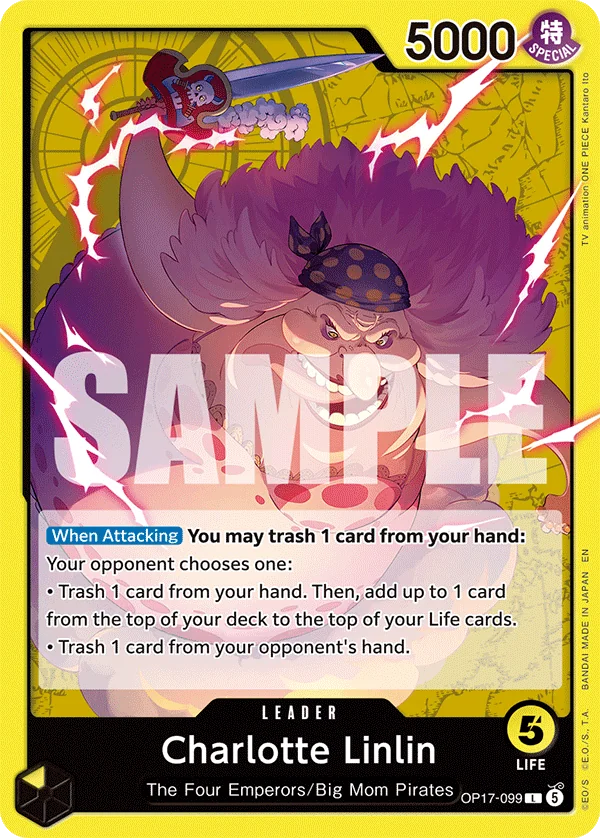 OP17-099Shop on TCGplayer (OP17-099) is a new Yellow leader with a When Attacking ability built around hand disruption, not simple Life addition. Her text: trash 1 card from your hand to trigger it, and your opponent picks between two outcomes, neither of which is good for them. This OP-17 Big Mom deck guide breaks down exactly what that ability does, why the opponent's choice always benefits you, and what building around it actually takes.
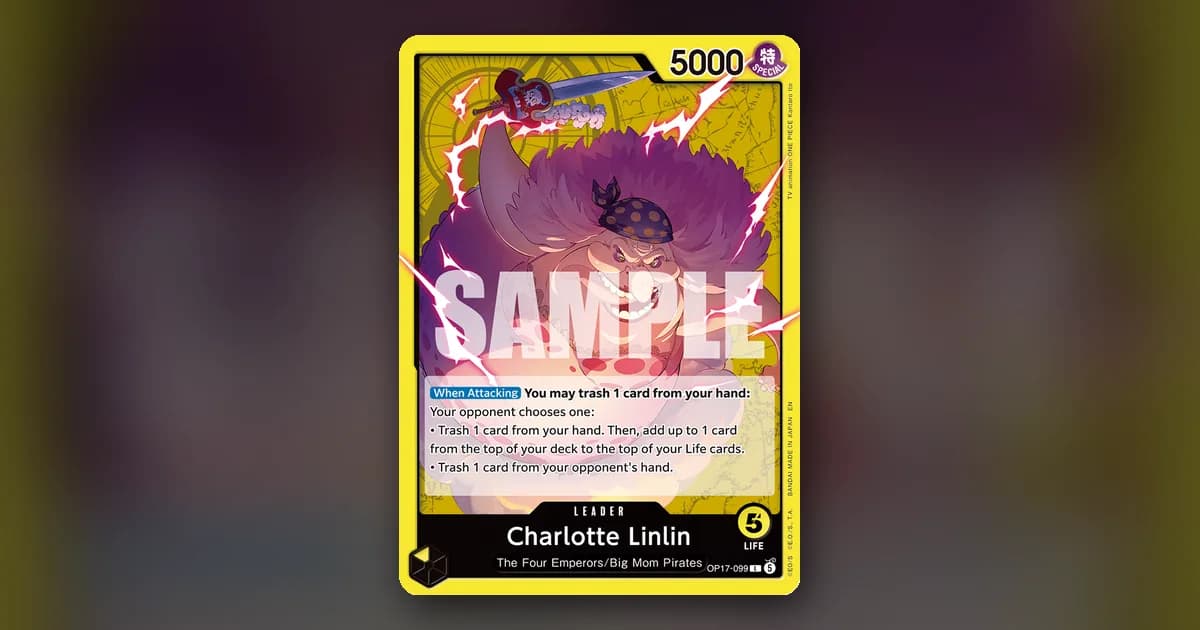
TL;DR: OP-17 Charlotte Linlin (OP17-099) is a mono-Yellow leader, 5 Life, 5000 power, Special attribute. Her When Attacking ability lets you trash 1 hand card to make your opponent choose: either you trash a second hand card and move a card from the top of your deck to the top of your Life pile, or they trash a card from their own hand. The opponent chooses which resource they would rather give up, so the effect always produces a meaningful trade for you. The average of 32 Limitless Play lists, with a reason for every card, is the first section below.
Updated October 13, 2026: Added a 50-card average decklist from 32 Limitless Play lists (August 17 to October 12), a one-line reason for every card, the two Regional top-16 variants and a matchup table. OPMetagame still lists Yellow Big Mom in S with 18 decklists.
OP-17 Big Mom deck: how does it work? (quick answer)
Every time Big Mom attacks, you may pay 1 card from hand to force a choice on your opponent: they either let you trash another hand card in exchange for adding a card from your deck to your Life pile, or they sacrifice a card from their own hand instead. Whichever they pick, you come out ahead in some resource. That's the entire engine, and it repeats on every attack you're willing to pay for.
OP-17 Big Mom deck list: the average of 32 tournament lists
This is the average of every Standard-format Charlotte Linlin decklist on Limitless Play between August 17 and October 12, 2026: 32 lists from 16 events, all but one of them played online. Together those lists went 69-75-2, a 47.26% match win rate. Each count is the card's average number of copies rounded to the nearest whole number, which gives 49 cards; the 50th slot goes to Streusen, whose 3.44 average had the largest remainder.
| Count | Card | Cost | Played in | Why it's here |
|---|---|---|---|---|
| 1 | Charlotte Linlin OP17-099 (Leader) | - | 32 of 32 | Every attack can tax the opponent's hand or refill your Life. |
| 4 | Charlotte Pudding OP17-109 | 3 | 32 of 32 | Trash a [Trigger] card from hand to draw 3, which refills the cards the leader's cost eats. |
| 4 | Charlotte Linlin OP17-112 | 10 | 32 of 32 | On your turn, every [Trigger] Character with 4000 base power becomes 8000. The whole list is built for this line. |
| 4 | Charlotte Cracker OP17-104 | 3 | 32 of 32 | Rest 2 DON!! to add a Life card, an On Play that needs a Big Mom Pirates leader. |
| 4 | Charlotte Katakuri OP17-103 | 6 | 31 of 32 | Adds a Life card and gives an opposing Character −3000 power. |
| 4 | Charlotte Daifuku OP17-107 | 3 | 31 of 32 | No effect text: a +2000 Counter, a [Trigger] that plays it, and 4000 base power for OP17-112. |
| 4 | Sweet 3 Generals OP17-114 | 6 | 31 of 32 | Rest 2 DON!! to draw 1, add a Life card and give up to 2 opposing Characters −3000. |
| 4 | Charlotte Oven OP17-102 | 4 | 30 of 32 | When K.O.'d, plays a Character with 4000 power or less from your trash, such as Pudding. |
| 4 | Streusen OP17-113 | 1 | 28 of 32 | Looks at 3 cards for a Big Mom Pirates card, then sits in hand as a +2000 Counter. |
| 3 | Zeus OP11-106 | 2 | 29 of 32 | Moves a Life card to hand to K.O. a cost 5 or less Character; another +2000 Counter. |
| 3 | Charlotte Perospero OP17-110 | 7 | 27 of 32 | Plays a cost 6 or less Big Mom Pirates Character from hand and gains Rush. |
| 2 | Charlotte Smoothie OP17-106 | 5 | 24 of 32 | Rest 2 DON!! to add a Life card, then the opponent trashes a card: the leader's tax again. |
| 2 | Marshall.D.Teach OP16-119 | 8 | 21 of 32 | Puts the best of your top 3 cards on top of Life; as a Trigger it K.O.s a cost 5 or less Character. |
| 2 | Maser Saber OP17-117 (Event) | 1 | 18 of 32 | +3000 Counter for Big Mom; as a Trigger the opponent trashes 3 cards or loses a cost 6 or less Character. |
| 1 | Don't you know that even in the cruel world of pirates there's still a code of honor?!! OP17-115 (Event) | 1 | 16 of 32 | Makes the Linlin leader Unblockable for a turn, or works as a +4000 Counter. |
| 1 | Gecko Moria OP14-104 | 8 | 8 of 32 | Flex. As a Trigger, plays a cost 4 or less Character from your trash. |
| 1 | Borsalino EB04-058 | 5 | 8 of 32 | Flex. A Blocker that adds a Life card when you have 2 or less. |
| 1 | Roronoa Zoro OP15-113 | 4 | 9 of 32 | Flex. A 6000-power body; trash a hand card to add a Life card. |
| 1 | Charlotte Brulee OP17-108 | 3 | 8 of 32 | Flex. A Blocker whose Trigger rests an opposing cost 6 or less Character. |
| 1 | Charlotte Mont-d'or OP17-111 | 3 | 6 of 32 | Flex. Reveal 2 [Trigger] cards from hand to K.O. up to 2 cost 1 or less Characters. |
SHOP: Want to build this exact list? Buy this list on TCGplayer → It loads the cards into TCGplayer Mass Entry at the lowest-priced matching printing, so check set, art and condition before you pay.
The first 14 cards after the leader are the core: each one is in at least half of the 32 lists. The last five are flex slots, and rounding gives each of them one copy, but lists that play one tend to play several. Gecko Moria averages 3.75 copies in the 8 lists that run it, Borsalino 3.12, Mont-d'or 2.67, Zoro 2.56 and Brulee 2.50. In practice a builder picks one or two of them and plays them in multiples.
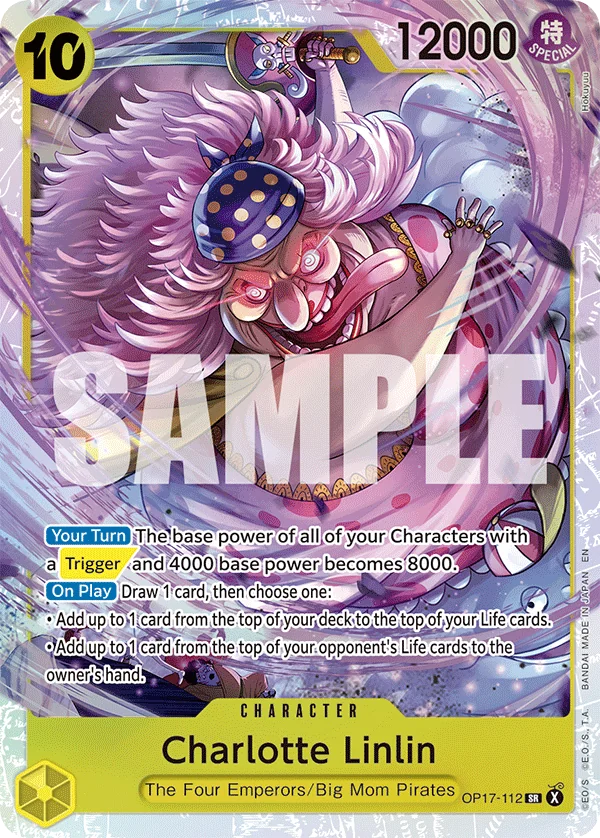 Image: Bandai official card image (OP17-112). This 10-cost Character, not the leader, is the reason the list is full of 4000-power bodies.
Count the [Trigger] Characters with 4000 base power in the average list and you get 26 of the 50: four each of Cracker, Katakuri, Daifuku, Sweet 3 Generals and Oven, three Perospero, two Smoothie and one Brulee. On your turn, OP17-112 turns every one of them into an 8000-power attacker. Pudding is also 4000 power but has no [Trigger], so she stays at 4000. Players call this pile of cards the Big Mom package, or less kindly "Big Mom slop", and Yellow leaders other than Linlin borrow it. Asked why every Yellow leader plays it, the top reply on r/OnePieceTCG was short: "It’s generic, good, and consistent" (u/DenverLikeTheCity).
What two Regional top-16 lists changed
Most of the 32 lists come from online events. OPDeckGuide has published two paper Regional lists: MerryTCG's top 16 at the London Regional (October 4) and LordOfTime's top 16 at the Prague Regional (September 27). Both keep the same 32-card core, four each of Streusen, Cracker, Daifuku, Pudding, Oven, Katakuri, Sweet 3 Generals and OP17-112, and spend the other 18 slots differently:
| Card | Online average (32 lists) | London, Oct 4 | Prague, Sep 27 |
|---|---|---|---|
| Gecko Moria OP14-104 | 0.94 | 4 | 4 |
| Roronoa Zoro OP15-113 | 0.72 | 3 | 3 |
| Borsalino EB04-058 | 0.78 | 3 | 3 |
| Zeus OP11-106 | 3.31 | 2 | 2 |
| Marshall.D.Teach OP16-119 | 2.19 | 3 | 2 |
| Charlotte Smoothie OP17-106 | 2.38 | 0 | 2 |
| Charlotte Perospero OP17-110 | 2.78 | 0 | 0 |
| Maser Saber OP17-117 | 1.94 | 0 | 0 |
| Don't you know... OP17-115 | 0.91 | 0 | 0 |
| Gum-Gum Dawn Stamp OP13-117 | 0.38 | 1 | 2 |
| Black Rope Dragon Twister EB04-059 | 0.41 | 2 | 0 |
Both Regional lists cut Perospero and both Linlin-only Events. They play four Gecko Moria, whose Trigger brings back a cost 4 or less Character such as Pudding or Oven, plus three Zoro and three Borsalino as extra ways to add Life, and they take removal from Gum-Gum Dawn Stamp, which K.O.s a base cost 6 or less Character. Two lists are a small sample, but they are the only Regional results among the lists we checked. If you are building for a paper event, start from them; for online play, the 32-list average has more games behind it.
Key Takeaways
- Charlotte Linlin (OP17-099) is a mono-Yellow leader: 5 Life, 5000 power, Special attribute, no second color
- Her When Attacking ability costs 1 hand card to activate, then hands the opponent a choice between two outcomes
- Option A: trash a second card from your own hand, then add up to 1 card from the top of your deck to the top of your Life cards
- Option B: your opponent trashes 1 card from their own hand
- Because the opponent picks whichever hurts them less, the ability effectively never whiffs, unlike a fixed single-mode effect
- This is a different card from the older mono-Yellow Charlotte Linlin leaders (ST07-001 and OP03-099), whose abilities work on Life cards, not the opponent's hand
- The 32-list Limitless Play average (August 17 to October 12, 2026) runs four each of Pudding, OP17-112 Linlin, Cracker, Katakuri, Daifuku, Sweet 3 Generals, Oven and Streusen
- Those 32 lists went 69-75-2 (47.26%); Rocks D. Xebec was the worst common matchup at 2-10
- OPMetagame's October 2026 tier list places Yellow Big Mom in S with 18 decklists; it does not publish a win rate for this entry
Overview: OP-17 Big Mom's Hand Disruption Leader
Charlotte Linlin (OP17-099) fills the Yellow slot among OP-17's six confirmed leaders: Whitebeard (Red), Luffy (Black), Shanks (Green), Kaido (Purple), Big Mom (Yellow), and Rocks D. Xebec (Blue). Full stats: 5 Life, 5000 power, Special attribute, illustrated by Kantaro Ito. Her Type line reads "The Four Emperors/Big Mom Pirates." For how all six leaders were revealed and what each color's identity looks like, the OP-17 leaders deck potential preview covers the full lineup.
The ability's exact wording matters, so here it is in full: "[When Attacking] You may trash 1 card from your hand: Your opponent chooses one: Trash 1 card from your hand. Then, add up to 1 card from the top of your deck to the top of your Life cards. OR Trash 1 card from your opponent's hand." Read carefully, "your hand" and "your deck" and "your Life cards" all refer back to Big Mom's own controller, since that's the card's own perspective as printed. Only the second branch, trashing a card from your opponent's hand, targets the other player directly.
Break the sequence into its actual steps. Step one: you declare an attack with Big Mom. Step two: you may choose to trash 1 card from your own hand as a cost, this part is optional and entirely your call. Step three, only if you paid that cost: your opponent now has to pick between two branches. Branch one costs you a second hand card but nets you a card moved from the top of your deck to the top of your Life pile. Branch two costs your opponent a card straight out of their hand, with no cost to you at all beyond the initial one you already paid.
The framing that matters for deck building: your opponent is never choosing between "something happens" and "nothing happens." Both branches cost them something, just in different currencies. If they're sitting on a full grip they don't want to thin, they'll likely let you burn a second hand card for the Life pile addition. If they're already low on cards and can't afford to lose one, they'll take that branch anyway rather than let you refill your Life total. Either way, you extracted value from a single hand card investment on your part.
Why This Fits Yellow's Established Identity
Yellow's whole color identity, as covered in the One Piece TCG Yellow deck guide, runs on Trigger density and Life manipulation. Adding cards to your own Life pile isn't a side effect in Yellow, it's close to the point of the color. Big Mom's first branch slots directly into that established pattern: moving a card from the top of your deck to the top of your Life cards is Life manipulation in the purest sense the mechanic allows.
Here's why that specific placement matters more than it looks like on the surface. Adding a card to the top of your Life pile means it's the next card that gets revealed the next time an opponent's attack connects. If that card happens to carry a Trigger, you've effectively queued up a future Trigger activation on your own schedule rather than leaving it to chance deep in your deck. The One Piece TCG Life cards guide covers exactly how Life card reveals and Trigger timing interact if you need the full mechanical picture.
That's the real reason this ability reads as stronger than a simple "trash a card, get a card" trade. You're not just adding raw Life total, you're putting a known card on top of it. Whether your deck can consistently stack genuine Trigger cards near the top of your deck for this to matter is a deck-building question the current card pool will answer as more OP-17 support gets played.
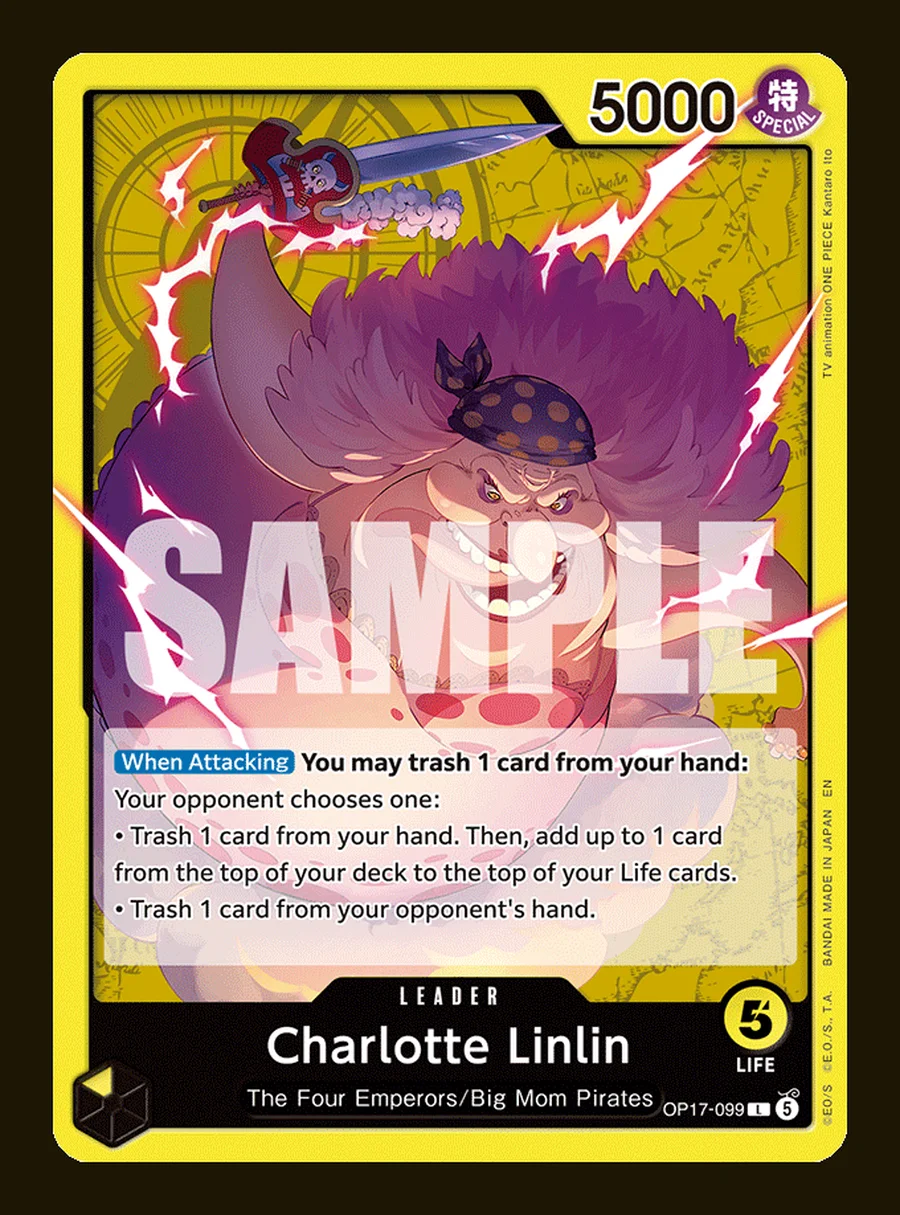 Image: Bandai official card list (OP17-099). The ability text splits cleanly into the two branches your opponent has to pick between.
GODEEPER: Big Mom's Super Parallel print is the OP17-112 Character card, not this leader. See the full premium-rarity breakdown. OP-17 Super Parallel Cards: New Manga Rare Tier Explained →
Building Around the Hand-Disruption Plan
OnePieceDecklists averages a larger pool of 47 public lists and lands on the same core: "Pudding, the on-color Linlin, and Cracker are in every averaged list." The same three cards are in all 32 Limitless lists above. Here is how the list answers the questions the leader's text raises.
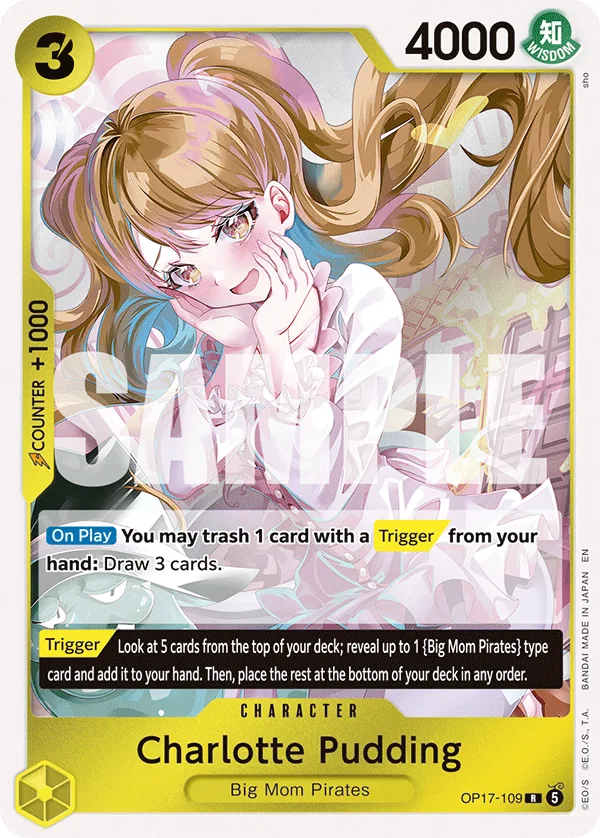 Image: Bandai official card list (OP17-109). Charlotte Pudding draws 3 cards On Play when you trash a card with a [Trigger], which is the hand refill this leader's cost needs.
Hand size comes first. The leader spends a hand card on every paid attack, and one branch spends a second. Four Pudding are the answer: each one turns a single [Trigger] card into three new cards. When an Oven is K.O.'d it can play a Pudding back from your trash, and her On Play fires again.
The fuel is cheap on purpose. Daifuku has no effect at all, and Streusen and Zeus are low-cost bodies with +2000 Counters. Those are the cards you trash to the leader's cost, not OP17-112 or Sweet 3 Generals.
Life is the second resource. Cracker, Katakuri, Sweet 3 Generals, Smoothie and Teach all add a card to the top of your Life, the same thing the leader's first branch does. With 26 [Trigger] Characters in the list, whatever lands there is often a card that plays itself when revealed.
The finish is OP17-112. Once she is down, the 4000-power board attacks for 8000 on your turn, and Perospero can drop a 6-cost from hand with Rush the same turn.
Step-by-Step
1. Open on Streusen and Pudding. Streusen costs 1 and looks at 3 cards for a Big Mom Pirates card; Pudding costs 3 and trades a [Trigger] card for 3 draws. Build the hand the leader's cost will spend later.
2. Add Life with Cracker and Smoothie. Each rests 2 DON!! to put the top card of your deck on top of your Life, and Smoothie also makes your opponent trash a card from hand.
3. Pay the leader's cost only when your hand can spare it. Each paid attack costs one card and one branch costs a second. If your hand is thin, attack without paying.
4. Swing the board with the 6-cost cards. Katakuri gives one opposing Character −3000 power and Sweet 3 Generals gives up to two −3000, each while adding a Life card.
5. Land OP17-112 at 10 DON!!. On your turn every 4000-power [Trigger] Character becomes 8000, and her On Play draws a card and either adds a Life card or sends the top of your opponent's Life to their hand.
Tips
Don't treat the ability as mandatory every attack. The cost is optional for a reason. A hand that's already down to 2 or 3 cards usually shouldn't keep feeding this engine, since running yourself out of resources defeats the purpose of a value-generating ability.
Save your worst cards for the cost, not your best. Build your hand-management habits around always having a low-value card ready to trash. A deck that's forced to trash genuinely useful cards to activate this ability is fighting itself.
Watch your opponent's hand size before attacking. If they're already near empty, they're far more likely to take the branch that costs you a second hand card instead of losing their own last few cards, so factor that into whether the attack is worth the cost this turn.
Pair this with real Trigger density, not just generic Yellow support. The deck-to-Life branch only overperforms if what lands there is actually useful when it gets revealed later. A low-Trigger build gets a much smaller return from this leader than a properly built one.
Remember this is a new card, not the old Big Mom. If you're pulling deck ideas from older community discussion of Charlotte Linlin, double check whether it's describing OP17-099's hand-disruption ability or the earlier mono-Yellow leaders' Life-card kits. They play very differently.
OP-17 Big Mom deck matchups
Limitless Play's matchup table for the same 32 lists shows Big Mom ahead against Black Luffy and Ace, behind against Rocks D. Xebec, Kaido and Robin, and close to even against Sabo, the leader it met most. Each sample is 10 to 26 games, so read these as leanings, not settled odds.
| Opponent leader | Games | Big Mom's record | Win % | Read |
|---|---|---|---|---|
| Sabo (OP13) | 26 | 12-14 | 46.15% | Close |
| Monkey.D.Luffy (OP17, Black) | 13 | 8-5 | 61.54% | Leans Big Mom |
| Rocks D. Xebec (OP17) | 12 | 2-10 | 16.67% | Bad |
| Kaido (OP17) | 11 | 4-7 | 36.36% | Leans opponent |
| Portgas.D.Ace (OP16) | 10 | 6-4 | 60.00% | Leans Big Mom |
| Nico Robin (OP09) | 10 | 3-6-1 | 30.00% | Leans opponent |
Big Mom also went 8-3 against Mihawk (OP14), but OP14-020 is banned from October 12, 2026, so that row no longer matters at sanctioned events; the One Piece TCG banlist guide has the full list. The Xebec row is the one to worry about: OPMetagame counts 178 Blue Rocks decklists in S tier, almost ten times Big Mom's 18.
Sabo players see the leader's choice on every attack. When a player posted that they won an event with Linlin on r/OnePieceTCG, one Sabo player asked: "Wondering if I should be letting you heal or taking the gamble on the discard." That is the whole leader in one question: the opponent picks the branch, and both cost them something.
Asked what beats the package, one reply was blunt: "Play a removal deck, power based removal even better." (u/lhwang001) The card text backs that up: OP17-112's 8000 applies only on Big Mom's turn, so on the opponent's turn her board is back to 4000-power bodies.
Brock Lee's video guide walks through the same decisions with a full list:
Where OP-17 Big Mom Fits the Current Format
Big Mom is a real deck with a modest record. OPMetagame's October 2026 tier list places Yellow Big Mom in S with 18 decklists but publishes no win rate for it, while the 32 Limitless lists above sit just under even at 47.26%. Purple/Yellow Nico Robin, another leader with Yellow in the same tier, has 160 decklists on the same page.
The deck is legal in Standard as built. Bandai's April 2026 to March 2027 Standard allows Block 2 onward, which means boosters from OP-05 through OP-17, and none of the cards in the average list is on Bandai's banned list: the banned Pudding and Gecko Moria are the older OP06-047 and OP06-086 prints, not OP17-109 and OP14-104. Check Bandai's current rules and restriction policy before an event anyway, since the list changed as recently as October 12.
GODEEPER: For the full current-format picture, including where Yellow-adjacent leaders like Rosinante and Nami currently sit, see the format breakdown. OP-17 OP-16 Format: How the Meta Changes This Fall →
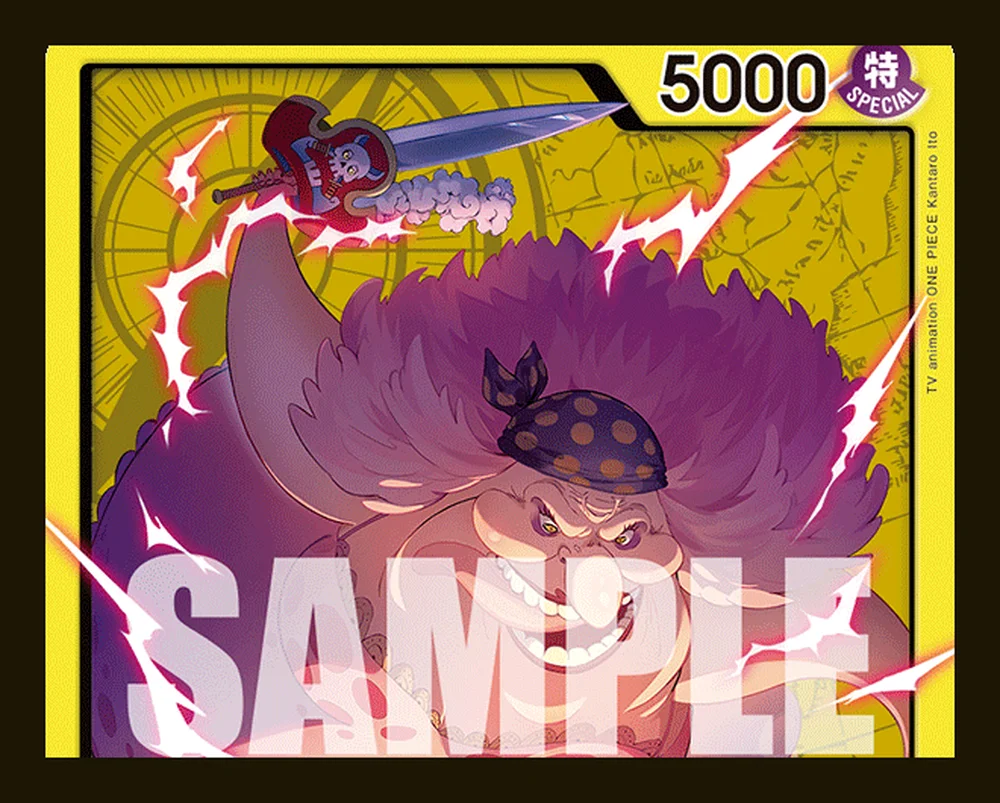 Image: Bandai official card list (OP17-099, art crop). Big Mom is one of the four Emperors Bandai's OP-17 page groups under "The Four Emperors, Assemble" for this 4th Anniversary set.
Our take
This take is based only on the lists, card text and matchup data cited here. OP17-099's ability gives value on every paid activation, because both branches cost the opponent something, and the list solves the fuel problem with four Pudding and cheap +2000 Counter bodies. The record is the catch: 69-75-2 across 32 online-heavy lists, and 2-10 against Xebec, the fourth most-played Standard leader on Limitless Play. If you play online, copy the 32-list average. If you are registering for a paper Regional, start from the London and Prague lists with four Gecko Moria. Either way, treat hand size as the resource you manage every turn.
Frequently Asked Questions
What does OP-17 Big Mom's leader ability do? Charlotte Linlin (OP17-099) has a When Attacking ability: you may trash 1 card from hand to trigger it, then your opponent picks one of two outcomes. Either you trash a second hand card and add a card from your deck to the top of your Life pile, or your opponent trashes a card from their own hand.
Why does the opponent get to choose the effect? Both branches give Big Mom's controller value in a different way, so the opponent is choosing which resource they would rather concede. One branch trades another card from your hand for a Life card, while the other removes a card from their own hand. The choice changes the shape of the payoff, but it does not erase it.
Is OP-17 Big Mom the same leader as the older Charlotte Linlin card? No. Prior sets have older mono-Yellow Charlotte Linlin leaders, ST07-001 and OP03-099, whose abilities work on your Life cards. OP17-099 is a new print with an entirely different When Attacking hand-disruption ability, though both share the Big Mom name and the general Yellow Life-manipulation identity.
What is the best OP-17 Big Mom deck list? Our average of 32 Limitless Play lists from August 17 to October 12, 2026 runs four each of Pudding, OP17-112 Linlin, Cracker, Katakuri, Daifuku, Sweet 3 Generals, Oven and Streusen, then Zeus, Perospero, Smoothie, Teach and Maser Saber. Two Regional top-16 lists swap Perospero and the Events for Gecko Moria, Zoro and Borsalino.
Is OP-17 Big Mom good competitively? OPMetagame's October 2026 tier list labels Yellow Big Mom S with 18 decklists. On Limitless Play, 32 Standard lists from August 17 to October 12 went 69-75-2, a 47.26% win rate, and Rocks D. Xebec was the worst common matchup at 2-10. Treat it as a playable deck, not a dominant one.
What color is OP-17 Big Mom and does she pair with another color? Yellow, and mono-color: her leader card carries no second color. That puts her deck entirely inside Yellow's own card pool plus generic support, without a splash color's toolkit to lean on the way several other OP-17 leaders can.
How much does the ability cost to activate? One card from your own hand, trashed, as the initial cost before your opponent even makes their choice. If they then pick the option that also trashes a card from your hand, the full activation can cost you two hand cards for one Life pile addition or one opposing hand card, depending on their pick.
Does OP-17 Big Mom fit Yellow's established Trigger strategy? Yes, directly. Adding a card from the top of your deck to the top of your Life pile is a Life-manipulation effect in the same family as Yellow's core identity. If that added card happens to carry a Trigger, it becomes a future Trigger source the next time that Life card gets revealed.
Related Reading
- OP-17 release date guide: the regional release timeline for the set this leader belongs to.
- OP-16 Rosinante Deck Guide: Purple-Yellow Law 2026: A current Yellow-adjacent leader for comparison, showing how the color performs as a splash rather than a mono-color build.
- One Piece TCG Nami Deck Guide: Blue Yellow Draw Engine 2026: A Blue/Yellow leader built around draw, useful context for how Yellow's Trigger cards fit a two-color deck.
References
- Charlotte Linlin OP17-099 card page, Limitless TCG: official card text, stats, and current decklist tracker for this leader
- One Piece Card Game official card list: official Bandai card database for OP-17 and all prior sets
- Limitless Play: Charlotte Linlin (OP17-099) Standard decklists: the 32 lists averaged above, 69-75-2, checked October 13, 2026
- Limitless Play: Charlotte Linlin matchups: matchup table, checked October 13, 2026
- OPDeckGuide: Charlotte Linlin, London Regional top 16 (October 4): MerryTCG's paper Regional list
- OPDeckGuide: Charlotte Linlin, Prague Regional top 16 (September 27): LordOfTime's paper Regional list
- One Piece Decklists Charlotte Linlin OP17 hub: consensus list averaged from 47 public lists, checked October 13, 2026
- OP Meta Game OP-17 tier list: S tier and 18-decklist count checked October 13, 2026; the page publishes no win rate for this entry
- Bandai OP-17 product page: set theme and release details
- Brock Lee: The Ultimate OP17 Charlotte Linlin Guide (YouTube): video guide embedded above
- r/OnePieceTCG: Won EGB with linlin: community thread quoted above
- r/OnePieceTCG: Why does every yellow leader play big mom slop: community thread quoted above
- r/OnePieceTCG: what cards counter big mom package?: community thread quoted above
- CardsRealm Charlotte Linlin OP17 deck tech: post-launch build discussion
Was this guide helpful?
Cards in this article
About the author
Pen name for the Shonen TCG desk's tournament coverage, format analysis and cross-game comparisons.
- Results taken from event pages and standings
- Other games checked against their own official rules
- Opinions marked as ours, with the reason
Keep reading
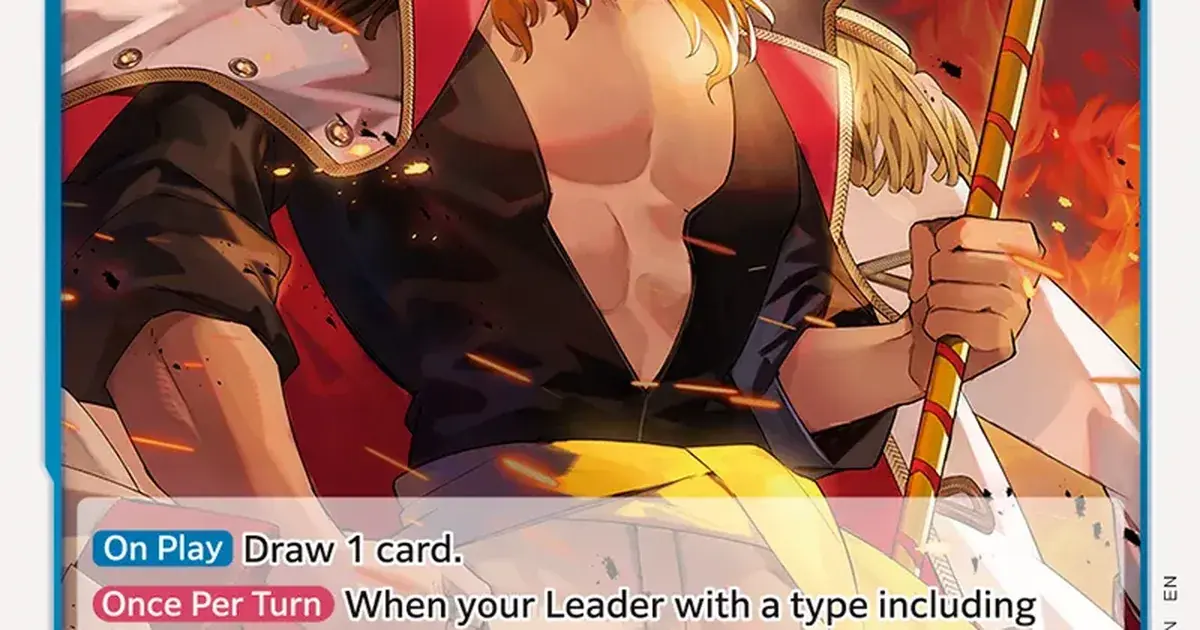
OP-17 Complete Card List: 135 Cards, 169 Prints + Prices
Guides · 14 min
OP-17 Kaido Deck Guide: Purple Removal, Not Ramp 2026
Guides · 13 min
OP-17 Luffy Deck Guide: Black's New Cost-12 Blocker Plan
Guides · 14 min
OP-17 Meta Tier List (October 2026): After the Mihawk Ban
Guides · 8 min
One Piece Heroines Special Set: $70 Box Ships September
News · 4 min
OP-17 Xebec Deck Guide: Blue Rocks Pirates Build 2026
Guides · 13 min
OP-17 Newgate Deck Guide: Trash-for-Power Red Leader
Guides · 10 min
OP-18 Release Date: What One Piece TCG Fans Actually Know
News · 7 min
Disclaimer
This article is published for informational and entertainment purposes. It does not constitute professional financial, legal, or technical advice. Game performance, online services, patch schedules, and store listings change. Verify critical details (pricing, system requirements, regional availability) with publishers and storefronts before you buy. Affiliate links, where present, help support our editorial work and are labelled in our affiliate disclosure.