Loading…
Loading…
Shonen TCG · Guides
Find the best One Piece TCG decks right now with a dated OP-17 tier snapshot, reasons, legality notes, and current deck-building paths this month.
Reviewing
One Piece Card Game
The best One Piece TCG decks right now are not one permanent list. They are the leaders that remain competitive in the current Standard field, fit the way you like to play, and still make sense after you check legality and card cost. This article is the evergreen monthly page for that decision. The URL stays the same, while the snapshot, sources, and warnings change.
For the September 29, 2026 snapshot, OPMetagame's live OP-17 page places Green Mihawk, Blue/Purple Luffy, Blue Rocks, Red/Black Sabo, Purple/Yellow Nico Robin, Yellow Big Mom, Red/Green Luffy & Ace, Purple Enel, Red/Green Luffy, and Green/Blue Luffy in S tier. It places Black Luffy, Red Ace, Black Luffy from ST-14, Black/Yellow Moria, Blue/Yellow Boa Hancock, Yellow Enel, Purple Kaido, Red/Purple Luffy, Black Blackbeard, Purple/Yellow Crocodile, and Red Whitebeard in A tier. Black Yamato is the displayed B-tier pick.
That ranking is useful as a starting filter, not as a promise that every S-tier deck beats every A-tier deck. The live page says its labels use tournament data, win rate, and competitive performance. The companion page exposes changing decklist counts and percentages, but the pages do not all use one visible denominator. I therefore use the tier call as the source-backed signal and explain the game plan separately instead of inventing a universal meta share.
TL;DR: Start with Blue Rocks if you want a focused OP-17-native deck, Green Mihawk only for an event through October 11, Red/Black Sabo if you want resilient board combat, or Purple Enel if you prefer ramp and large turns. Blue/Purple Luffy, Nico Robin, Red/Green Luffy & Ace, and Black Luffy are also serious testing choices. Treat every tier as a September 29 snapshot and verify legality before buying. Updated September 30, 2026: Bandai's September 24 notice makes OP14-020 Dracule Mihawk a Banned Card effective October 12, 2026. The One Piece TCG banlist and effective dates controls the cutoff; recheck this same URL for the next monthly refresh.
Green Dracule Mihawk.  OP14-020OP14-020Shop on TCGplayer Mihawk converts a rested card and a 5-cost-or-higher Character on board into a burst of up to three active DON!!, then asks you not to play Characters for the rest of that turn. That creates a clear rhythm: develop first, cash in the leader effect on a later turn, and spend the recovered DON!! on Events, counters, or a decisive attack. It was a high-ceiling engine in the September tracker, which explains its top placement in that dated sample. The catch is crucial for a monthly page: Bandai makes OP14-020 a Banned Card effective October 12, 2026, so this is a through-October-11 option only. Check the internal banlist note above before purchasing a Mihawk shell.
Blue/Purple Luffy. This is the OP11 leader, not every other Luffy deck on the page. Its eight-DON!! setup looks at five cards and finds a Straw Hat Crew card, so the list rewards careful top-deck management and a curve that can exploit the extra selection. It belongs in the top conversation because it combines late-game access with two colors that can play both tempo and large threats. Do not copy a list tagged only “Luffy” until you confirm the card number.
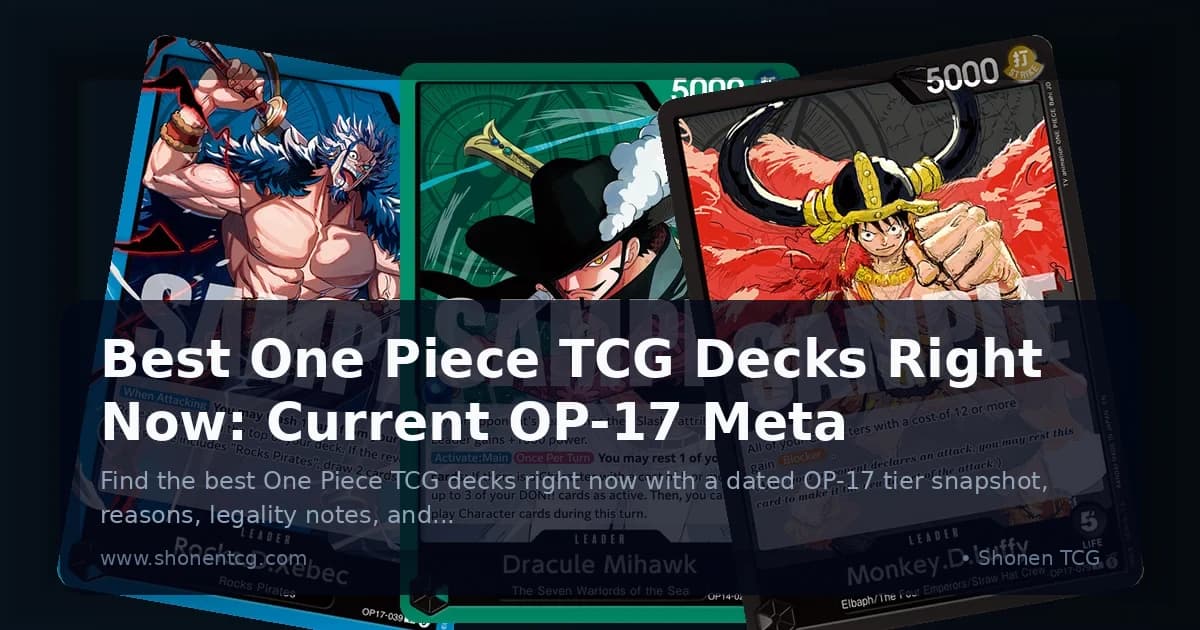
Blue Rocks D. Xebec.  OP17-039OP17-039Shop on TCGplayer Rocks turns a leader attack into selection and draw when the revealed card has the Rocks Pirates type. The current OP-17 shell has enough same-type cards to make that reveal plan meaningful, and the leader's five Life keeps the deck from needing to race every opposing attack. It is the cleanest OP-17-native recommendation for a player who wants a defined engine rather than a pile of generic staples.
Red/Black Sabo. OP13-004 Sabo rewards a board with an 8-cost-or-higher Character by increasing the Leader and Characters, while the red and black card pools give the deck a practical mix of pressure and cost management. That combination makes the deck less dependent on a single attack connecting. The best reason to test it is the way a stable high-cost board converts into better combat math, not a claim that one tracker percentage will hold across every region.
Purple/Yellow Nico Robin. OP09-062 Nico Robin has Banish and can trade a Trigger card from hand for a rested DON!! card. That is an unusual resource exchange: the pilot turns a card that might be awkward in hand into acceleration while threatening Life that cannot safely rely on a Trigger. It asks for disciplined hand management, but the reward is a deck that can pressure Life and build a large turn without playing like a simple rush list.
Yellow Big Mom. The OP-17 Charlotte Linlin leader, 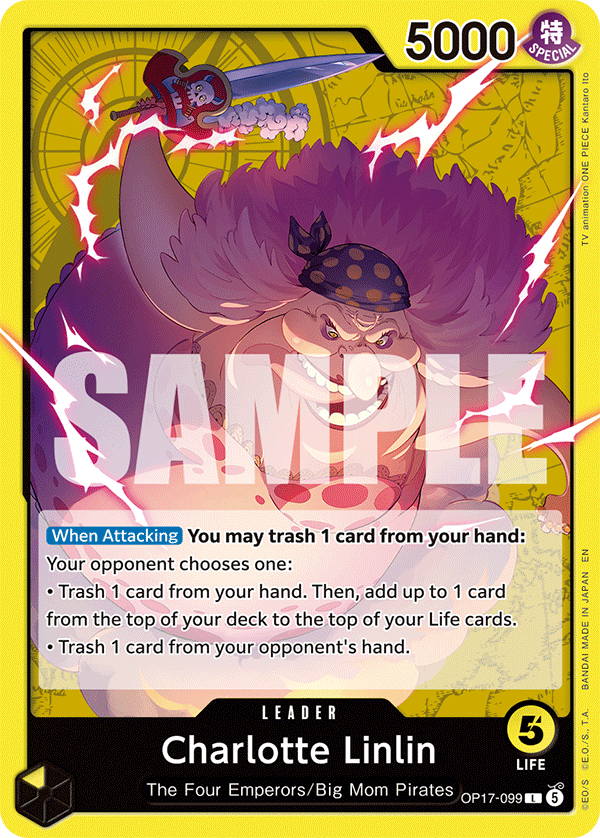 OP17-099OP17-099Shop on TCGplayer, creates pressure in both hands and Life. When she attacks, the opponent chooses whether to lose a hand card and let you rebuild the top of your Life, or trash a card from their own hand. The current page places her in S tier, but the visible sample is smaller than the largest S-tier archetypes. That makes her an excellent test choice and a less certain “buy four premium copies” choice.
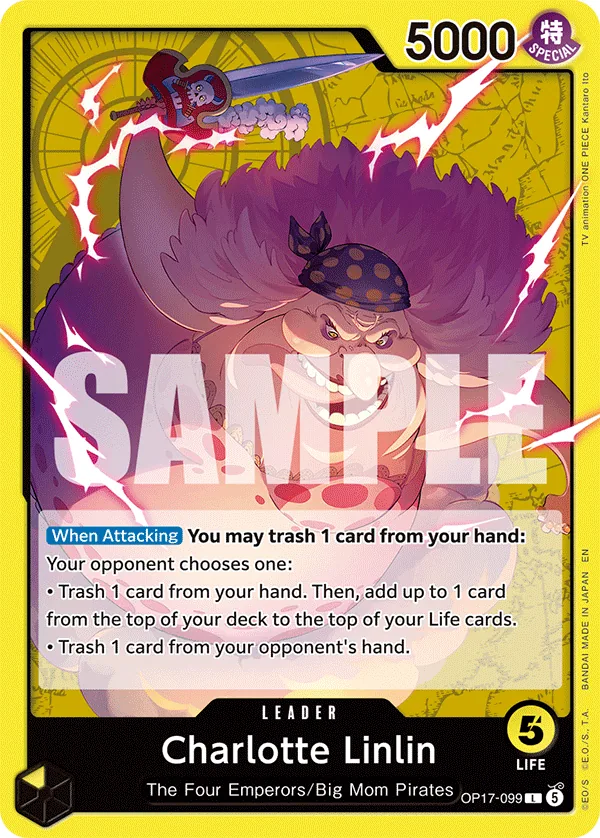 OP17-099 Charlotte Linlin shows the hand and Life pressure behind the Yellow Big Mom entry in the current snapshot.
Red/Green Luffy & Ace. The ST30 leader gives Portgas D. Ace and Monkey D. Luffy cards a large defensive boost on the opponent's turn, with a drawback that lowers the Leader when a 7,000-power Character is present. The deck therefore rewards sequencing and board checks. You want to establish the right Characters before you expose yourself to attacks, not simply attach every DON!! to the Leader.
Purple Enel. OP15-058 Enel uses a six-card DON!! deck and places a large amount of rested DON!! onto a Character after the early turns. That unusual resource rule makes the deck feel explosive, but it also creates a narrower construction problem. The list has to spend the extra resources efficiently and protect the turns where the Leader is setting them up. It remains a strong S-tier test for players who prefer ramp over incremental combat.
Red/Green Luffy. OP13-001 turns rested DON!! into defensive power for the Leader or a Straw Hat Crew Character. It can make an opponent's attack calculation awkward and lets the pilot preserve cards by choosing exactly where the bonus matters. This is a different archetype from Red/Green Luffy & Ace and from Blue/Purple or Black Luffy, despite the shared character name.
Green/Blue Luffy. OP16-022 requires an Impel Down-only Character field to reset up to two DON!! cards. That restriction gives the deck a narrow identity, but it also makes its turns repeatable when the correct type line is assembled. The current S-tier placement is a reason to test the archetype. It is not a reason to mix in unrelated Straw Hat cards that break the Leader condition.
GODEEPER: Blue Rocks needs a tighter card-by-card plan than a generic blue deck. See the OP-17 Xebec Deck Guide: Blue Rocks Pirates Build 2026 →
Black Luffy. 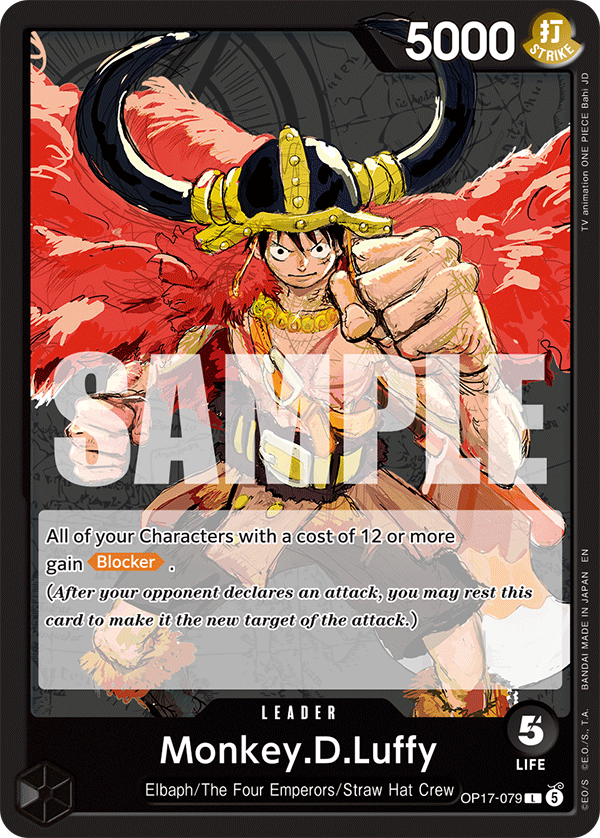 OP17-079OP17-079Shop on TCGplayer gives Characters with cost 12 or more Blocker. That effect changes how a large Character is evaluated: it is not only a finisher, but also a way to make the opponent spend more resources before reaching the Leader. The tradeoff is obvious in testing. If your list cannot reach the high-cost turns on time, the Leader text does less work than the A-tier label suggests.
Red Ace. 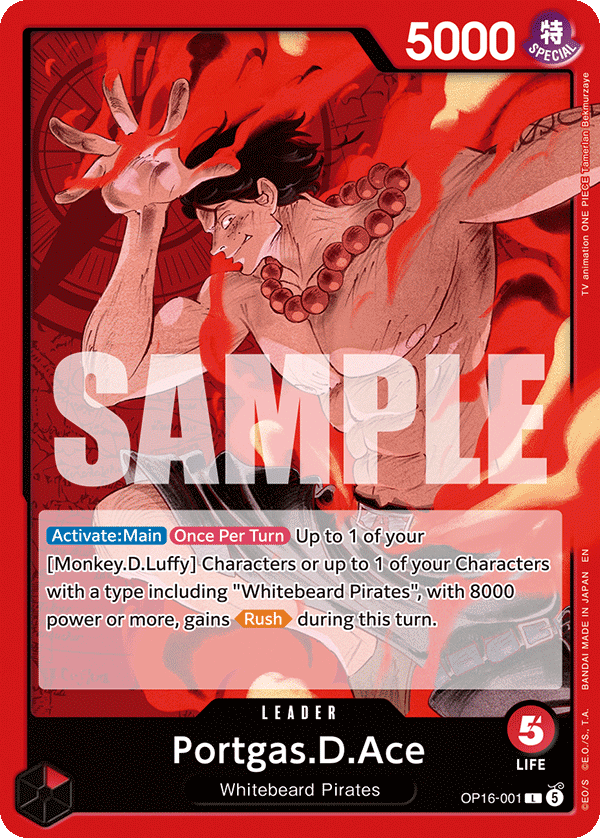 OP16-001OP16-001Shop on TCGplayer gives Rush to a Monkey D. Luffy Character or a Whitebeard Pirates Character with at least 8,000 power. The current public decklists show why the effect is attractive: expensive bodies become immediate pressure instead of waiting a full turn. It is also a useful price warning, because the same finisher cards that make Ace threatening can dominate a deck's budget.
Black Luffy from ST-14. The starter version raises the cost of your Characters and gains Leader power when an 8-cost-or-higher Character is present. It is a different leader from OP17 Black Luffy, so a search result that says “Black Luffy” is not enough to identify the deck. It earns A-tier attention when the list can turn the cost increase into better removal and a strong board, but it has less room for casual substitutions than the name implies.
Black/Yellow Moria. OP14-080 Moria can trade a Thriller Bark Pirates Character for a team-wide power increase, or trade three hand cards for a top-Life card. Those costs create meaningful decisions every turn. The list is strongest when the pilot knows which resource is expendable and does not use the Leader effect simply because it is available.
Blue/Yellow Boa Hancock. OP14-041 rewards a Character being played on the opponent's turn with a draw, and its second effect turns a qualifying Amazon Lily or Kuja Pirates K.O. into a Life-card exchange. That gives the deck a reactive shape. It wants the opponent to commit to a board, then turns that commitment into hand quality and pressure rather than racing from turn one.
Yellow Enel. OP05-098 replaces a zero-Life moment with a card from the top of the deck and a hand discard once per opponent turn. That creates a recovery window, but it does not make every attack safe. Yellow Enel still needs enough removal, counters, and timing discipline to reach the effect without losing the board first.
Purple Kaido.  OP17-058OP17-058Shop on TCGplayer spends one DON!! to reduce an opposing Character by 2,000 power when attacking or defending. The effect is modest enough to use often and flexible enough to change combat math on either player's turn. It sits below the most oppressive engines because the pilot must convert the temporary reduction into a real trade.
Red/Purple Luffy. This archetype uses the purple side's DON!! movement to make larger turns while the red side keeps pressure on the opponent's board and Life. The best lists do not treat ramp as the win condition. They use the extra DON!! to create a turn where a removal spell, a threat, and a counter can all fit together.
Black Blackbeard. Its Leader effect negates your own On Play effects, then can discard a card to turn off the opponent's On Play effects until the end of the opponent's next turn. The deck therefore asks a very specific question each game: which effects are worth losing so the opponent cannot use theirs? That asymmetry can punish decks built around a single explosive development turn, while weaker pilots may shut off their own best cards at the wrong time.
Purple/Yellow Crocodile. This deck is a slower resource exchange choice. Its strengths come from making DON!! and Life decisions matter, while its weakness is that it can spend too many resources before finding a clean close. The A-tier label makes it worth testing, but the lower public sample means I would choose it for an intentional metagame call, not because a tier letter removes the practice requirement.
Red Whitebeard. 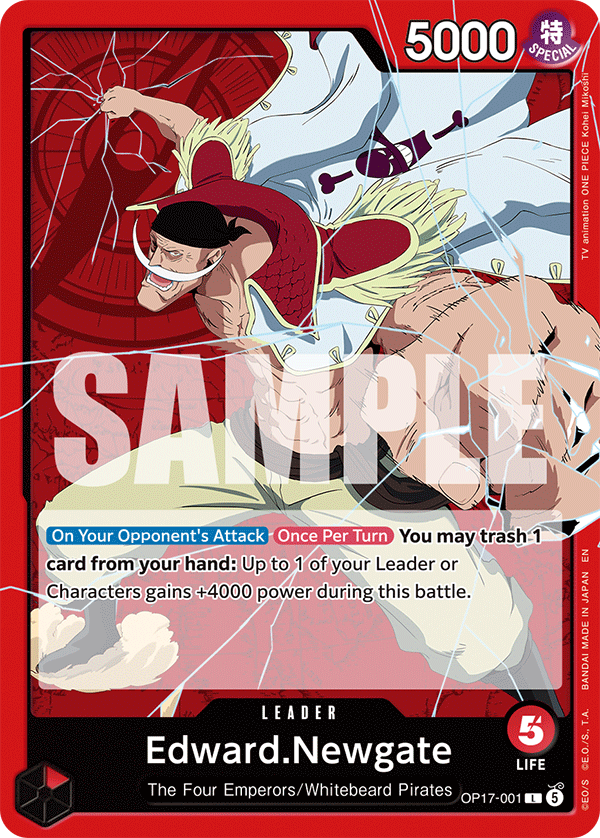 OP17-001OP17-001Shop on TCGplayer can discard a card during the opponent's attack to give the Leader or one Character a large defensive boost. That is a simple effect with real depth. The pilot has to decide which card is a resource now and which card must remain for the next turn's board. It is a good choice for players who value direct combat decisions and do not want a complicated search engine.
About the author
Competitive TCG Analyst
Competitive One Piece TCG player and deck builder with 3 years of tournament experience. Covers meta analysis, tier lists, and leader builds.
Keep reading
OP-17 One-Month Meta Report: Leaders After Release
Guides · 15 min
Sabo deck guide: OP17 Red/Black Elbaph Build Plan 2026
Guides · 12 min
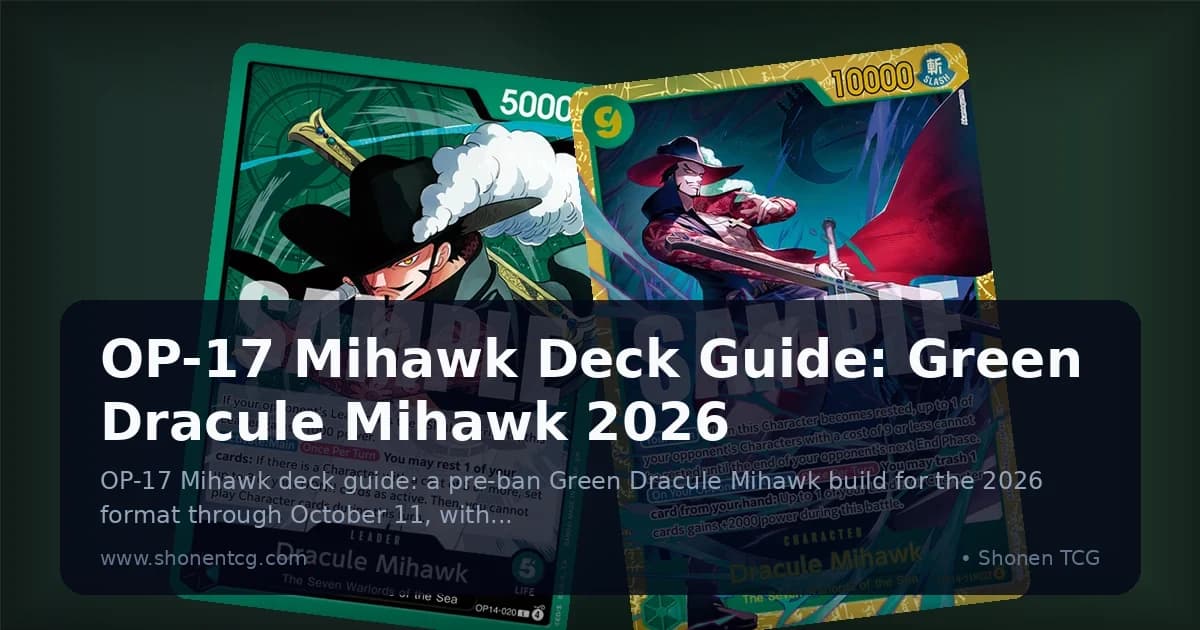
OP-17 Mihawk Deck Guide: Green Dracule Mihawk 2026
Guides · 13 min
OP-17 Mihawk Matchup Guide: All 6 Leaders Explained
Guides · 14 min
One Piece TCG Banlist: 5 Banned Now, 6 From Oct 12 (2026)
Guides · 8 min
OP-17 Enel Tech Cards: 3 Verified Picks by Color (2026)
Guides · 16 min
BCG Fest Dallas: One Piece TCG Season 1 Finals Preview
News · 6 min
OP-17 Shanks Deck Guide: Green Tempo-Lock Leader Build
Guides · 13 min
Disclaimer
This article is published for informational and entertainment purposes. It does not constitute professional financial, legal, or technical advice. Game performance, online services, patch schedules, and store listings change. Verify critical details (pricing, system requirements, regional availability) with publishers and storefronts before you buy. Affiliate links, where present, help support our editorial work and are labelled in our affiliate disclosure.
Start with the action you want to repeat. Choose Blue Rocks or Purple Enel if you like building a resource engine before a large turn. Choose Mihawk only for the pre-ban window through October 11, or choose Red/Green Luffy if you enjoy timing windows where DON!! becomes combat math. Choose Sabo, Black Luffy, or Red Ace if you want a board that makes the opponent answer specific bodies. Choose Nico Robin or Big Mom if hand and Life management are the part of the game you find most interesting.
Then check the list, not only the Leader. A top-tier Leader with four expensive finishers may be a worse first purchase than an A-tier deck whose core costs less and whose cards you can reuse. The One Piece TCG deck-building guide is the better next read if you are still deciding how many searchers, counters, Characters, and Events the shell needs.
The current page also contains several separate leaders with the same character name. “Luffy” can mean OP11 Blue/Purple, OP13 Red/Green, OP16 Green/Blue, OP17 Black, or another printed Leader. The same problem appears with Ace, Sabo, Luffy & Ace, Enel, and Boa Hancock. Record the exact card number before copying a decklist, and verify the card text against Bandai's official card list.
This monthly page uses OPMetagame's September 2026 OP-17 tier labels and its live leader pages as the primary current snapshot. OPMetagame says its tiers use tournament results and win-rate data. OnePiece.gg describes its own tier list as a ranking built from metagame data and the latest tournaments. Limitless remains useful for checking public decklists and older event context, but its public filtered page returned OP16 rows during this check, so I did not blend those rows into the September OP-17 tier calls.
That separation matters. A 65 percent figure on one page and a deck count on another are not automatically compatible measurements. The event mix, date window, region filter, and treatment of online events can all differ. This article reports the current tier labels and explains why each Leader belongs on a testing shortlist. It does not manufacture a combined win rate or meta share.
If a major Regional, Championship Season event, restriction notice, or new set arrives, the next refresh should change the date line and recheck every named Leader. The old OP-17 Meta Tier List remains useful as a dated OP-17-specific comparison, but this page is intentionally broader and is meant to be updated at the same URL each month.
Before you buy a current top deck:
SHOP: Checking the current OP-17 shells? Compare the exact set and Leader searches before buying singles. Shop TCGplayer →
GODEEPER: The tier label tells you where to test, while the crossover report shows how OP-17 changed the older field. Read the OP-17 One-Month Meta Report: Leaders After Release →
What are the best One Piece TCG decks right now? The September 29, 2026 snapshot puts Green Mihawk, Blue/Purple Luffy, Blue Rocks, Red/Black Sabo, Purple/Yellow Nico Robin, Yellow Big Mom, Red/Green Luffy and Ace, Purple Enel, Red/Green Luffy, and Green/Blue Luffy in S tier on OPMetagame. That is a dated tracker signal, not a guarantee for every event.
Is OP-17 Mihawk still legal in Standard? OP14-020 Dracule Mihawk is legal through October 11, 2026, in this article's snapshot, but Bandai makes it a Banned Card effective October 12, 2026. Do not treat Green Mihawk as a post-October 12 Standard recommendation.
Which OP-17 leader is the best starting point? Blue Rocks is the clearest starting point if you want an OP-17-native strategy with a visible S-tier result and a focused Rocks Pirates shell. Black Luffy and Purple Kaido are also current OP-17 leaders with A-tier placement, but they ask for different testing priorities.
Are tier-list percentages directly comparable across sites? No. Limitless, OPMetagame, and OnePiece.gg use different tracked events, time windows, and denominators. Read the date and methodology beside any percentage. A 65% result on one page cannot be combined with a deck count from another and presented as one universal meta share.
How often should this One Piece TCG tier list be updated? Use the same URL for each monthly refresh. Recheck tournament results, tier labels, Standard legality, scheduled restrictions, and the card pool snapshot before changing the date line or recommending a purchase. Record the new check date so readers can distinguish a current signal from an archived one.
Should I buy an S-tier deck immediately? Only after checking legality, local event timing, and the complete list. A strong result can move single prices quickly, while a ban or new set can change the value of an expensive shell. Test the Leader before upgrading premium copies.
Related
Union Arena Re:ZERO and Attack on Titan Vol.2 Tier List
12 min read
Union Arena Mikasa Deck Guide: Red AoT Vol.2 Build 2026
14 min read
Union Arena Re:ZERO Ram Deck Guide: Yellow Build 2026
12 min read
Union Arena Attack on Titan Eren Deck Guide: Red Vol.2
22 min read
Union Arena Re:ZERO Emilia Deck Guide: Purple Build 2026
13 min read