Loading…
Loading…
Shonen TCG · Guides
Reviewing
One Piece TCG
An OP-17 Mihawk matchup guide has to start with the one fact that changes everything about how you answer him: his finisher doesn't work anything like Purple Enel's.  OP14-020OP14-020 Green Dracule Mihawk sits at 10.1% meta share, the format's clear second leader, and his 9-cost payoff Character has real teeth. But unlike Enel's near-unremovable finisher, Mihawk's biggest threat has no protection clause at all. The problem isn't getting past an immunity condition. It's reaching a cost-9 target with the tools most decks actually carry.
TL;DR: Mihawk (OP14-020) ramps DON!! through a leader ability that costs a "cannot play Character cards" drawback every time it fires. The payoff is a 9-cost, 10000-power Character (OP14-119) whose real danger is a repeating lockdown: whenever it becomes rested, it locks one opposing Character (cost 9 or less) out of being rested for roughly two turns. It carries zero removal immunity, so standard K.O. and bounce effects work fine, the catch is that most format removal tops out around cost 5-7. Newgate and Luffy have the clearest structural answers among OP-17's own leaders. Xebec takes a small passive penalty from sharing Mihawk's Slash attribute.
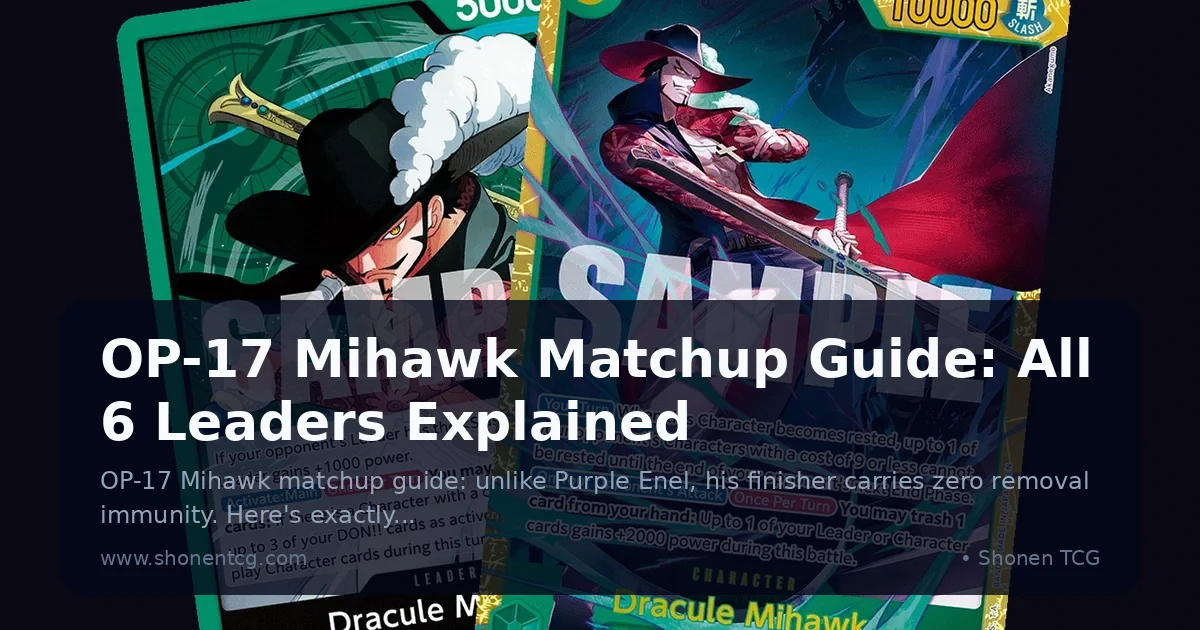
Mihawk's engine runs on two pieces working together, and neither one is dangerous alone. The leader ability ramps DON!!, but only if a Character with a cost of 5 or more is already in play, and it locks you out of playing new Characters the turn you use it.  OP14-119OP14-119 The payoff, a 9-cost 10000-power Character, punishes you every time it rests by locking down one of your Characters for close to two full turns. Neither half has a printed immunity clause. The finisher can be K.O.'d, bounced, or blocked exactly like any other Character. What makes this matchup tricky isn't a rules trick, it's that cost-9 sits above where most removal in the format is actually built to reach.
Purple Enel's finisher has a printed clause that makes it immune to opponent's effects while it holds 6 or fewer DON!! cards, a condition his 6-card DON!! deck makes almost permanent. The OP-17 Enel tech-card guide covers exactly how to get around that. Mihawk's finisher has nothing like it. Read its full text and there's no "cannot be removed," no conditional power bonus tied to a resource count, nothing. It's a big body with a scary trigger, full stop.
That distinction matters for deck-building. Against Enel, generic K.O. removal is often dead on arrival. Against Mihawk, generic K.O. removal works fine, it's just frequently the wrong tool for the job because of the cost gap. The One Piece TCG Black color guide puts it plainly: at 3 DON!! of investment, Black's cost-based removal clears cost 5-7. A 9-cost target sits above that ceiling entirely. You're not fighting an immunity clause here, you're fighting a cost curve.
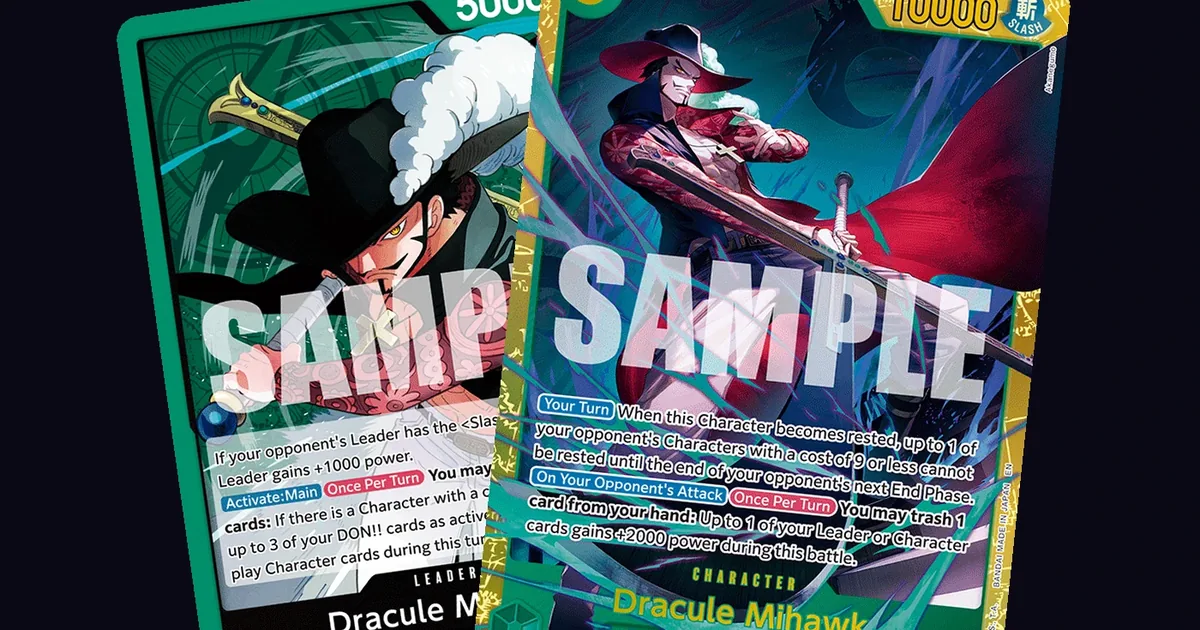 Mihawk's leader (OP14-020, left) and his 9-cost payoff (OP14-119, right). Neither card carries a removal-immunity clause, unlike Enel's finisher.
The ramp needs a 5-cost body to exist first. The leader ability only fires "if there is a Character with a cost of 5 or more" in play. Early turns, before either side has committed a body that big, the ability simply does nothing. Mihawk decks have to bridge that gap with a normal curve before the ramp turns on.
Every activation skips a turn of Character development. "Then, you cannot play Character cards during this turn" is printed directly on the ability. That's not a minor footnote, it's a real tempo cost every single time the ramp fires, and it's a genuine window to develop your own board while Mihawk's hands are tied.
The lockdown has a hard ceiling. It only affects "up to 1 of your opponent's Characters with a cost of 9 or less." Anything you control at cost 10 or above is completely untouchable by this specific effect, full stop.
The finisher is a normal body between attacks. Once it's rested from attacking, and before your opponent's next turn refreshes it, it's sitting there like any other Character. If your removal actually reaches cost 9, that's the moment to use it, since the lockdown has already fired and killing it afterward denies the second and third activations.
GODEEPER: Want the full Mihawk deck breakdown from the pilot's side, including the DON!! math on when the ramp actually turns on? Read the OP-17 Mihawk Deck Guide: Green Dracule Mihawk 2026 → for the current 50-card shell and turn-by-turn plan.
Was this guide helpful?
About the author
Competitive TCG Analyst
Competitive One Piece TCG player and deck builder with 3 years of tournament experience. Covers meta analysis, tier lists, and leader builds.
Disclaimer
This article is published for informational and entertainment purposes. It does not constitute professional financial, legal, or technical advice. Game performance, online services, patch schedules, and store listings change. Verify critical details (pricing, system requirements, regional availability) with publishers and storefronts before you buy. Affiliate links, where present, help support our editorial work and are labelled in our affiliate disclosure.
Win and loss framing here reflects verified leader mechanics, not tournament data, since OP-17-specific matchup results are still thin. Treat this as a mechanical breakdown, not a settled tier ranking.
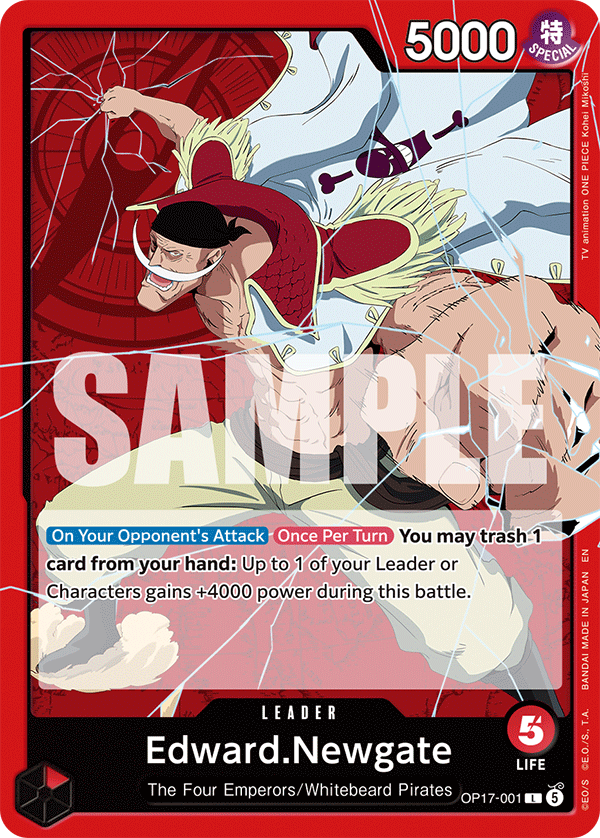 OP17-001OP17-001Shop on TCGplayer Edward Newgate's leader ability is a reactive, once-per-turn trick: "On Your Opponent's Attack," trash 1 card from hand to give his Leader or a Character +4000 power during that battle. That's a tool built exactly for surviving one big attacker. A modest 6000-power blocker suddenly reads as 10000, enough to trade evenly with Mihawk's finisher, or better, if Newgate has any power buffs stacked on top.
The trade-off is that Newgate's ability is purely reactive. It doesn't proactively remove or race Mihawk down, it just makes sure the finisher's attacks stop being free. Against a deck whose whole plan is landing repeated lockdown triggers, a reliable way to survive the hit and trade back is a real structural answer.
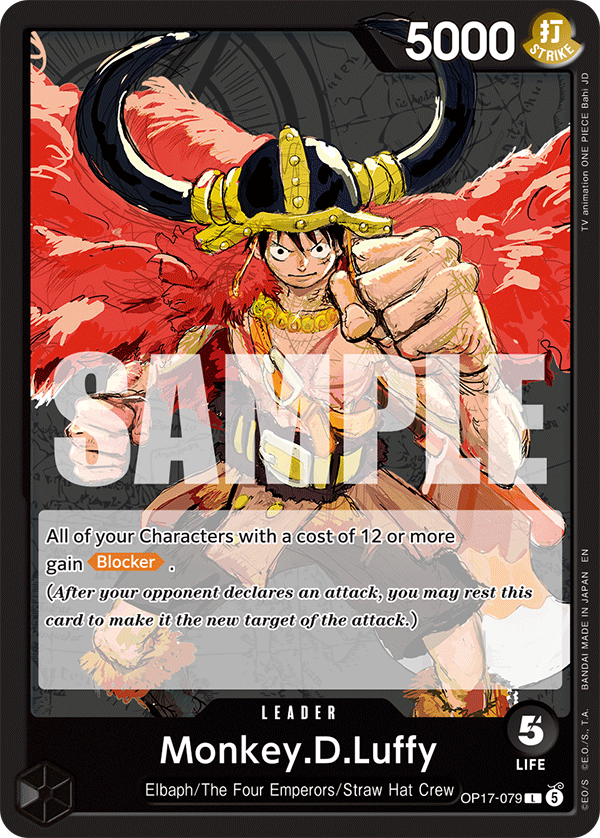 OP17-079OP17-079Shop on TCGplayer Luffy's leader ability is static and unconditional: any Character you control at a cost of 12 or more automatically has Blocker, no activation cost, no Once Per Turn limit. Cost-12-plus bodies in this game routinely sit well above 10000 power. Once Luffy actually has one in play, it can block Mihawk's finisher and simply win the fight on raw power, no special removal needed.
The catch is getting there. Luffy's deck has real DON!! math problems reaching cost 12 consistently, and early turns before that threshold is live, he's just as exposed to the lockdown as anyone else. This matchup rewards patience: survive to your own top end, and Mihawk's biggest threat stops being scary.
 OP17-058OP17-058Shop on TCGplayer Kaido's leader ability fires on either player's attack, Once Per Turn, DON!!-1: give an opposing Character -2000 power during that turn. Used on Mihawk's finisher, that drops it from 10000 to 8000, a real difference for anything trying to trade with it in combat. It doesn't touch the finisher's printed cost, so it won't disrupt Mihawk's ramp condition, but as a pure power tool it makes an otherwise-unfavorable block survivable.
Since Kaido's ability is cheap and repeatable, he can apply it defensively on Mihawk's attacks and offensively on his own, which keeps this matchup close rather than one-sided in either direction.
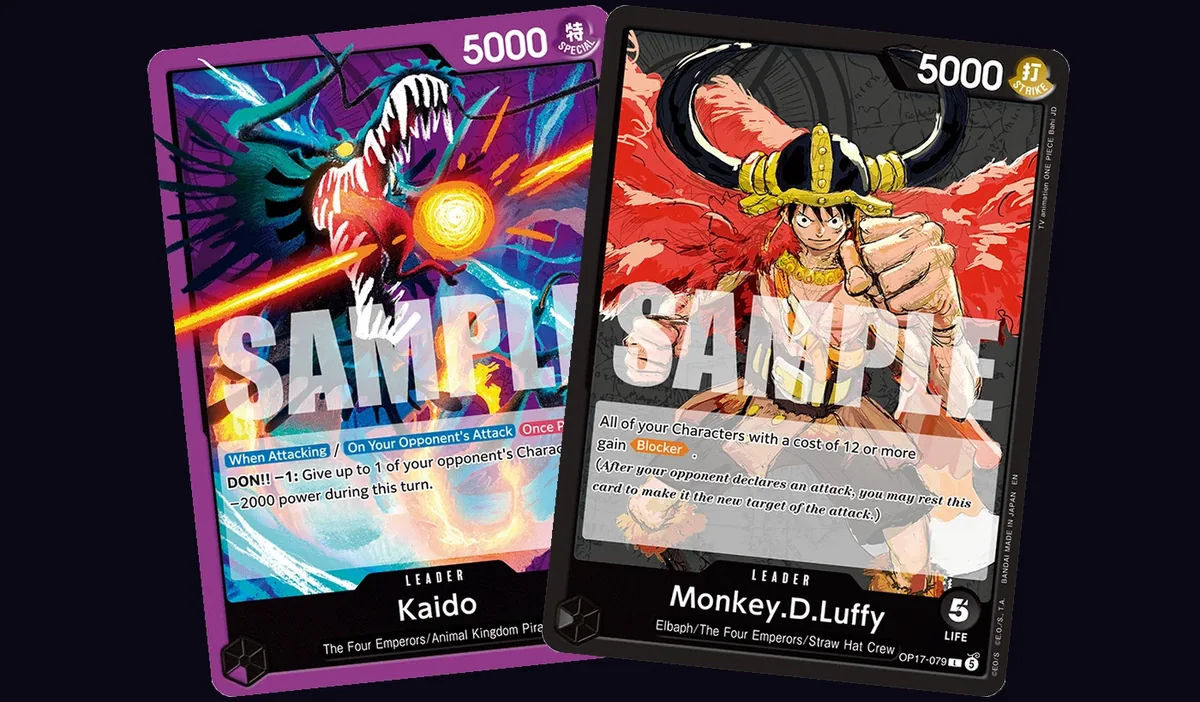 Kaido (left) chips away at the finisher's power turn after turn. Luffy Black (right) skips the problem entirely once his own cost-12-plus bodies come online, since those get automatic Blocker for free.
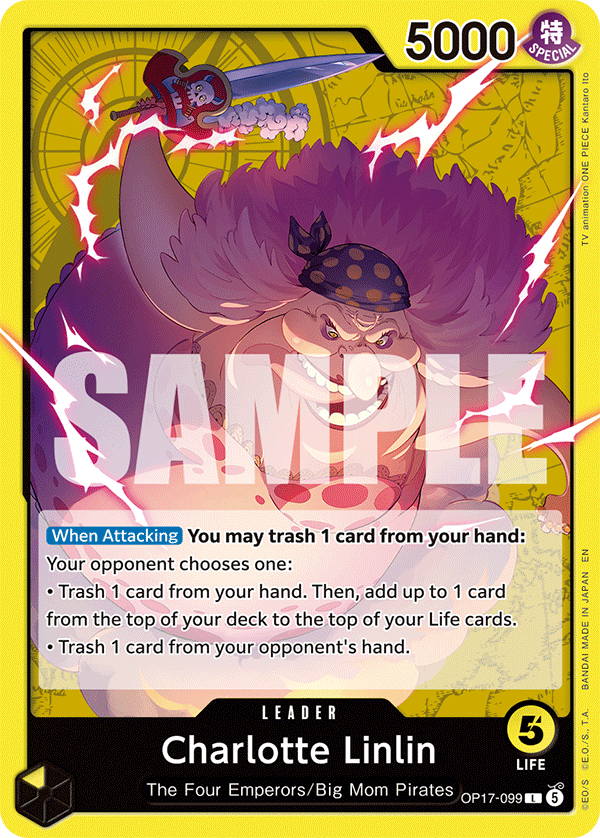 OP17-099OP17-099Shop on TCGplayer Charlotte Linlin's leader ability fires on every attack she's willing to pay for: trash 1 card from hand to force a choice, either you trash a card too in exchange for her banking Life, or you take the Life hit yourself. Repeated over several turns, that drains hand resources fast. Mihawk's own leader ability already costs him a turn of Character development every activation; stacking Big Mom's hand attrition on top makes his resources noticeably tighter, including the card his finisher wants to trash for its own defensive power boost.
Neither side races particularly fast, so this comes down to who runs out of resources to spend first. It's a genuine grind, not a clean favorite either way.
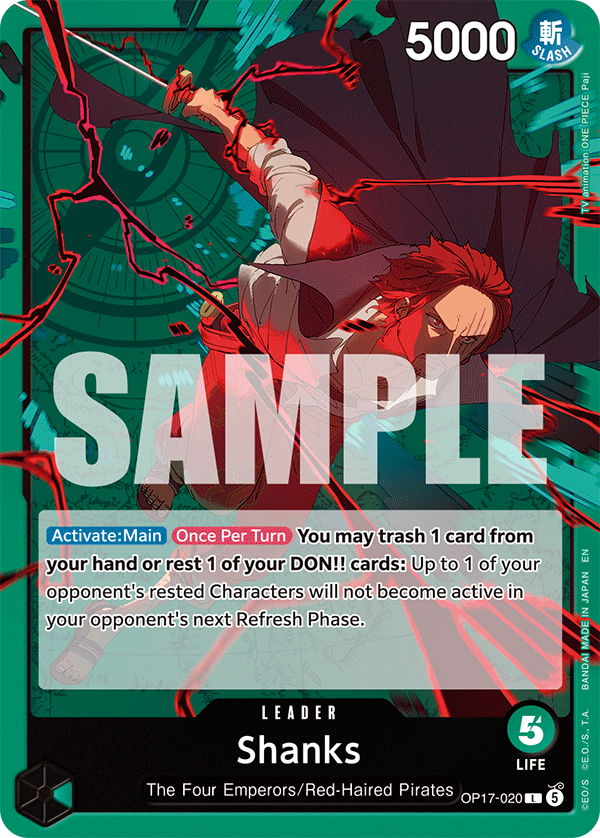 OP17-020OP17-020Shop on TCGplayer Shanks's leader ability denies a rested opponent Character its next Refresh Phase, once per turn, at the cost of a hand card or DON!!. That's the same rest-denial idea Mihawk's finisher already runs, just from the other side. Whoever controls the tempo of who's tapped down and when tends to control this matchup, and both leaders are built to fight over exactly that resource.
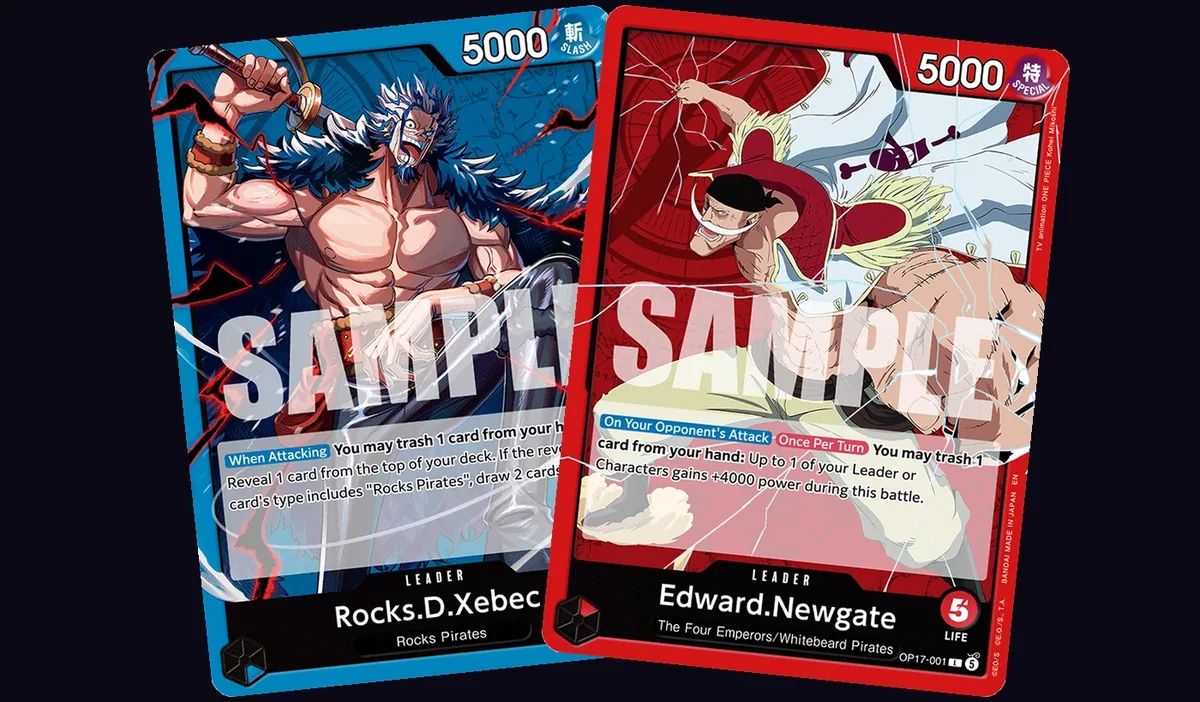 Xebec (left) carries the Slash attribute, which triggers Mihawk's own passive power bonus. Newgate (right) has the clearest reactive answer to a single big attacker in the format.
 OP17-039OP17-039Shop on TCGplayer Rocks D. Xebec carries the Slash attribute, visible on the card itself. Mihawk's leader ability includes a passive: "If your opponent's Leader has the Slash attribute, this Leader gains +1000 power." That's not a general Mihawk strength, it's a matchup-specific bonus that only exists because Xebec happens to share the same attribute. In this pairing specifically, Mihawk's leader sits at 6000 power instead of 5000, a real, if small, structural edge for Mihawk that doesn't apply against any of OP-17's other five leaders.
Beyond that one interaction, Xebec's own deck runs on Blue's usual draw and bounce tools, and bounce is a legitimate way to answer Mihawk's finisher without needing cost-based removal to reach it, since return-to-hand effects don't check the same cost thresholds K.O. effects often do.
Bounce over K.O. when you can't reach cost 9. Cost-threshold K.O. removal is the thing most likely to whiff against a 9-cost target. Return-to-hand effects are the other real removal axis in this game, and they're worth prioritizing specifically because Black's K.O. suite tends to top out below where this finisher lives.
Time your interaction around the rest window, not the attack. The lockdown fires the instant the finisher becomes rested, which happens the moment it attacks, before damage even matters to your removal plan. If you're trying to prevent the lockdown itself, you need an answer that resolves before that attack is declared, not after.
Keep something at cost 10 or higher if you can. It's flatly immune to the lockdown effect. That's a real, verifiable building consideration if you know you're heading into this matchup.
GODEEPER: Curious how Luffy actually gets a cost-12-or-more body onto the field consistently enough to lean on this matchup? OP-17 Luffy Deck Guide: Black's New Cost-12 Blocker Plan → breaks down the DON!! math behind reaching that threshold.
1. Watch for the ramp turn. The leader ability requires an existing cost-5-or-more Character and skips Character development for that whole turn. That's a visible tell and a real tempo window to push your own board while Mihawk can't add to his.
2. Don't let the finisher land its first attack for free. Removal or a trade before it ever attacks denies the lockdown trigger entirely, since the effect only fires when it becomes rested.
3. If it resolves, plan the defensive answer before it swings. A reactive power boost (Newgate-style) or a power debuff (Kaido-style) applied before damage is calculated can turn a losing block into an even one.
4. Punish it right after it rests from attacking. The lockdown has already fired by then, so removing it at that moment denies every future activation without losing anything to the trigger itself.
5. Build toward cost 10 or above when you can. Anything at that threshold is completely immune to the lockdown, regardless of what else is happening in the game.
Don't panic-remove the finisher the instant it's played if your removal is conditional on cost or power. Check the math first: at 9 cost and 10000 power, plenty of format-standard removal simply won't apply, and wasting a card confirming that costs you tempo you didn't need to lose. Save cost-based removal for smaller Mihawk support pieces where it actually functions, and reserve bounce, combat trades, or power debuffs for the finisher itself.
Assuming the finisher is protected like Enel's. It isn't. Nothing in its text blocks opponent's effects. The reason removal often fails against it is a cost mismatch, not a rules trick.
Removing it before it's ever attacked, when a cheaper Character was the real threat. The lockdown only matters once it's live. If your removal is scarce, make sure you're not spending it pre-emptively on a body that hasn't done anything yet.
Forgetting the leader ability's own drawback. Mihawk skips playing Characters on ramp turns. Missing that window to develop your own board is a free tempo turn given away for nothing.
Ignoring the cost-9 ceiling on the lockdown. If you already have a cost-10-plus Character in play, it was never a valid target for that specific lock effect in the first place.
Does Mihawk's finisher have removal immunity like Enel's does? No. Dracule Mihawk (OP14-119), the 9-cost, 10000-power payoff, has no protection clause anywhere in its printed text. Standard K.O. and bounce effects work on it exactly like any other Character; the challenge is reaching its cost, not getting past an immunity condition.
What is Mihawk's leader ability? Once per turn, rest 1 of your cards: if there is a Character with a cost of 5 or more in play, set up to 3 of your DON!! cards as active. Then you cannot play Character cards for the rest of that turn, a real tempo cost every time it fires.
What does Mihawk's 9-cost finisher actually do? Whenever it becomes rested, including from attacking, it locks one opposing Character with a cost of 9 or less out of being rested until the end of your next End Phase. That Character can't attack, block, or use rest-cost abilities for roughly two full turns.
Which OP-17 leader answers Mihawk best? Edward Newgate's reactive On Your Opponent's Attack power boost is built exactly for surviving one big attacker, and Luffy's cost-12-or-more automatic Blocker rule lets his top-end bodies simply out-power the 10000-power finisher in a straight block once he reaches it.
Can you lock down Mihawk's own finisher with the same effect? Not with his own card, since the lockdown only targets your opponent's Characters. But the finisher's cost-9 ceiling cuts both ways: any Character you control at cost 10 or higher is completely immune to it, a real building target if you're expecting this matchup.
Is Rocks D. Xebec at a disadvantage against Mihawk specifically? Yes, a small one. Mihawk's leader ability grants +1000 power whenever the opposing Leader has the Slash attribute, and Xebec (OP17-039) carries that exact attribute, pushing Mihawk's leader to 6000 power in that specific matchup only.
Related
Union Arena Re:ZERO Prerelease: What to Expect (2026)
8 min read
Union Arena Rurouni Kenshin Deck Guide: Red Build 2026
9 min read
Best TCG Dice and Counters 2026: What You Actually Need
12 min read
Union Arena Bleach Ichigo Deck Guide: Purple Build 2026
8 min read
Best Deck Boxes for TCG Storage in 2026: Full Buying Guide
13 min read